A construction contingency budget is a reserve set aside within a project’s total cost to absorb unforeseen conditions, design gaps, and price escalation without derailing the schedule or the owner’s bottom line. For most projects, we recommend planning 5% to 10% for design contingency and a separate, smaller reserve for the contractor. Which bucket applies to you depends on whether you’re the owner negotiating a contract or the contractor managing a guaranteed maximum price.
TL;DR:
- Owners control funds outside contract sums for scope changes; contractor reserves sit inside GMPs, typically 2% to 5%, and cover estimating risk or field surprises.
- Design contingency commonly starts at 5% to 10% and shrinks as drawings mature; complex systems, hidden conditions, and volatile prices warrant more.
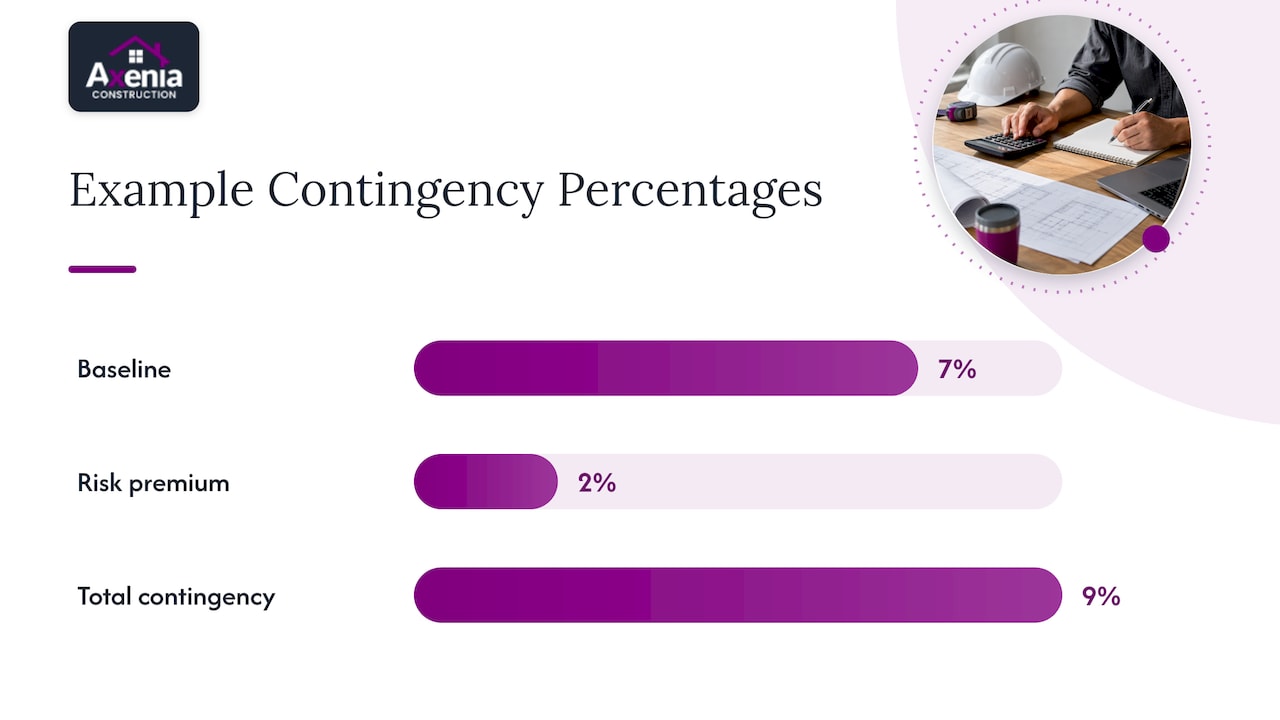
- For a $500,000 renovation, a 7% baseline plus a 2% risk premium produces a $45,000 reserve; review it at each design milestone.
- Contracts should define eligible costs, approval authority, documentation, reporting, and closeout treatment; require written cost backup and signed change orders before any contingency draw.
Table of Contents
- Owner, Contractor, and Design Contingencies: Who Controls What
- How Much Contingency Should You Budget?
- How to Calculate a Realistic Contingency
- Rules for Using and Reporting Contingency Funds
- How We Approve a Contingency Draw
- What Discipline Actually Looks Like on a Job Site
- How We Help You Plan and Protect Your Contingency
- FAQ
- Sources
Owner, Contractor, and Design Contingencies: Who Controls What
Not every contingency dollar belongs to the same party, and confusing the three creates most of the disputes we see on job sites. Owner contingency sits outside the contract sum entirely. It belongs to the owner and funds owner-initiated changes, scope additions, or decisions that shift after the design is locked. Contractor contingency lives inside a guaranteed maximum price (GMP) and covers the contractor’s own estimating risk, buyout savings or losses, and field conditions that don’t rise to the level of a formal change order. In lump-sum contracts, contractor contingency is often invisible to the owner, baked into the price rather than tracked as a line item. Design contingency applies earlier, during schematic design and design development, and shrinks as drawings mature and unknowns get resolved.
- Owner contingency: controlled by the owner, used for scope changes and owner-driven decisions.
- Contractor contingency: controlled by the contractor within a GMP, used for estimating gaps and field surprises.
- Design contingency: managed by the design team, used to cover incomplete design information before construction documents are final.
Knowing which bucket a cost belongs to before it happens saves weeks of back-and-forth once it does.
How Much Contingency Should You Budget?
Percentages are not arbitrary, and the right one depends on how much is still unknown about your project. AIA guidance places design contingency commonly in the 5% to 10% range, while Construction Executive reports contractor contingency on private GMP projects typically running 2% to 5% of the GMP.
A design contingency of 5% to 10% is standard practice at early design stages, according to AIA, and it should shrink as drawings move toward construction documents.
Several factors push a project toward the higher end of these ranges:
- Early-stage design with limited drawing detail.
- Complex structural, mechanical, or electrical systems.
- Unknown or unverified existing site conditions.
- Volatile material pricing or long-lead equipment.
A simple kitchen remodel with a known floor plan and no structural changes can often run near the low end of the range. A complex tenant buildout with existing conditions behind finished walls, or a ground-up commercial project with multiple trades and permitting unknowns, justifies pushing toward the top of the band or layering an additional risk premium on top.
How to Calculate a Realistic Contingency
A contingency figure should come from analysis, not habit. Three methods cover most situations, and you can combine them depending on how far along your design is.
- Build a risk register. List each foreseeable risk (permit delay, hidden water damage, material escalation), assign a probability and a cost impact, then multiply the two to get an expected value for each line.
- Stage contingency by design milestone. AIA suggests allocating the design contingency unevenly across phases, often front-loading around 20% in schematic design, 30% in design development, and letting the remainder carry into construction documents as unknowns resolve.
- Apply a quick formula when time is short. Start with a baseline percentage drawn from the ranges above, then add a risk premium based on site or market volatility. For a $500,000 renovation with a 7% baseline and a 2% risk premium for unverified existing conditions, that’s a 9% contingency, or $45,000.
Contract delivery method changes where this calculation lives. In design-bid-build, bidding variability tends to push contingency higher because the contractor hasn’t been involved in early cost decisions. In CM/GC and design-build arrangements, the contingency can be negotiated and adjusted collaboratively as the GMP takes shape.
Pro Tip: Recalculate your contingency at every design milestone instead of setting it once at kickoff. A number set in schematic design rarely reflects the risk still on the table by construction documents.
Rules for Using and Reporting Contingency Funds
A contingency fund without governance tends to disappear long before the risks it was meant to cover ever materialize. Strong contracts spell out exactly what the fund can pay for, who approves a draw, what documentation is required, and what happens to money left over at closeout.
- Define permitted uses in the contract: unforeseen conditions, design errors, and price escalation are typical, per Procore.
- Require a documented change and cost backup before any draw, not after the fact.
- Set a reporting cadence tied to milestones and subcontractor buyout, so the owner sees the balance shrink or hold steady in real time, a practice outlined in The Build’s budget variance guidance.
- Decide upfront whether unused contingency reverts to the owner or is split under a shared-savings clause, since Construction Executive notes shared-savings models can incentivize a contractor to manage the fund carefully.
Most disputes trace back to vague contract language. NASBP warns that ambiguous clauses let owners dip into contractor contingency for owner-driven changes, eroding the fund before real field risks even show up. A clear clause naming who approves a draw, routed through a formal change order rather than a verbal agreement, prevents that erosion before it starts.
How We Approve a Contingency Draw
Before any draw leaves our contingency line, we require a documented scope change, cost backup from the trade involved, a note on schedule impact, and sign-off from the project manager and the owner’s representative. That sequence, in that order, keeps the fund intact for the risks it was actually built to cover.
- Confirm the cost ties to an unforeseen condition, not a scope upgrade.
- Attach subcontractor pricing or a formal estimate as backup.
- Flag any schedule impact before approval, not after.
- Route every draw through a signed change order.
On a recent conference room buildout, we found electrical capacity behind an existing wall didn’t match the as-built drawings. Because the contingency was already staged and the documentation process was in place, we resolved it with a single approved draw instead of a change order fight that stalled the schedule.
What Discipline Actually Looks Like on a Job Site
The contingency fights we’ve watched unfold rarely come down to the percentage chosen at kickoff. They come down to who gets to say yes to a draw, and whether that answer is written down before the invoice arrives. A reserve is only as good as the paperwork behind it.
If you remember one rule, make it this: never spend contingency on a verbal okay. Get it in writing, tie it to a documented cause, and review the balance at every milestone instead of waiting for it to run dry.
— Arienne
How We Help You Plan and Protect Your Contingency
We build contingency planning into every project from the first budget conversation, not as an afterthought once construction starts. Our general contracting work includes sizing a realistic reserve against your specific risk profile, while our design-build projects let us adjust contingency collaboratively as drawings mature instead of locking in a number too early.
- General Contracting: we size and manage your contingency fund from bid through closeout.
- Design-Build: we adjust contingency together as design decisions firm up.
- Tenant Buildout: we plan for the site unknowns that hide behind existing walls and ceilings.
If you’re planning a project in Maryland, DC, or Northern Virginia and want a contingency built on a real risk assessment rather than a guess, request a consultation through our general contracting page and we’ll walk through the numbers with you.
FAQ
What is a good construction contingency percentage?
A good starting point is 5% to 10% for design contingency during early design phases, shrinking as drawings mature. Contractor contingency inside a GMP typically runs 2% to 5%, depending on project complexity and site conditions.
What is a good contingency budget?
A good contingency budget matches the amount of design and site uncertainty still unresolved at the time you set it, rather than a flat number applied to every project. Projects with incomplete drawings, unverified existing conditions, or volatile material pricing warrant a reserve toward the higher end of the 5% to 10% design contingency range.
How many percent should be the contingency fund?
There’s no single fixed percentage, since the right figure depends on design maturity, contract type, and site risk. AIA recommends treating contingency as a monitored gauge reviewed at each design milestone rather than a number set once at kickoff.
What is 20% contingency?
A 20% contingency is higher than the typical 5% to 10% design contingency range and usually signals a project with significant unresolved risk, such as very early conceptual design, major unknown site conditions, or a highly volatile material market. It’s not a standard figure for most construction projects and should be justified by a documented risk assessment rather than applied as a default.
Sources
- The Best Laid Plans: Contingency in a Construction Contract – Construction Executive
- Managing the contingency allowance – AIA
- The Contractor’s Contingency: What Contractors and Construction Managers Need to Know and Be Wary of – NASBP
- What is Construction Contingency? – Procore