If your bathroom remodel in Rockville moves a fixture, changes the plumbing, touches the electrical or alters a wall, you need a permit. If you are only swapping a toilet, faucet or sink in the same spot, or painting and replacing flooring, you generally do not. Inside the City of Rockville limits, the permit comes from the city’s Inspection Services Division. Elsewhere in Montgomery County, it comes from the county.
Below is how to tell which side of that line your project falls on, what the city charges, how long review takes and what inspectors check. We are a licensed, women-owned general contractor in Rockville, and we handle this paperwork on client projects every week.
TL;DR
- No permit is generally needed for like-for-like swaps (toilet, faucet, sink in the same place), painting, cabinets or floor coverings. Montgomery County’s permit guide lists them.
- A permit is required for moving walls, rearranging plumbing fixtures or doing electrical work. Expect a building permit plus separate plumbing and electrical permits.
- Per the City of Rockville fee schedule, the building permit is $0.35 per square foot of affected area with a $145.00 minimum. Each trade permit has an $80.00 minimum. A 10.25% automation fee is added to all of them.
- Standard review for alterations is about 28 calendar days. Small, simple projects may qualify for a faster track.
- Skipping the permit can cost you far more later, at inspection, at resale or when an insurer asks questions.
Table of Contents
- Which Bathroom Jobs Need a Permit in Rockville
- What a Rockville Bathroom Permit Costs
- How Long Review Takes
- Applying: What You Need and Who Can Apply
- Inspections: Where Bathroom Projects Stall
- What Happens If You Skip the Permit
- Our Perspective: Treat the Permit as Part of the Design
- A Step-by-Step Path for Your Rockville Bathroom
- Planning a Bathroom Remodel in Rockville?
- FAQ
- Sources
Which Bathroom Jobs Need a Permit in Rockville
The dividing line is repair versus alteration. Montgomery County’s residential alterations page says a permit is required before reconstruction or renovation of an existing structure, other than a repair. The same page says no permit is needed for painting, wallpapering, replacing a faucet, installing countertops or laying tile and hardwood floors.
Here is how that plays out in a bathroom.
| Job | Permit usually needed? |
|---|---|
| Painting, wallpaper | No |
| Replacing a faucet, toilet or sink in the same location | No |
| New flooring or tile over the existing floor | No |
| Replacing a vanity or cabinets without moving plumbing | Generally no |
| Moving the toilet, tub, shower or vanity | Yes (building and plumbing) |
| Adding a new fixture or a new bathroom | Yes (building, plumbing, usually electrical) |
| New circuits, fans, lighting or outlets | Yes (electrical) |
| Removing or moving a wall | Yes (building) |
The city’s own building and safety codes page explains that Inspection Services reviews design and construction under Chapter 5 of the Rockville City Code and state-adopted codes. In practice, that means your bathroom is reviewed against the 2021 International Residential Code and the 2021 International Plumbing Code.
One trap catches people who think they are doing a “simple update”. A new vanity is easy. But if the new vanity’s drain lands six inches from the old one, the pipes have moved. Plumbing rearrangement is on the permit-required list, so that update is no longer a swap.
City of Rockville or Montgomery County?
This matters because the two offices have different forms, fees and portals. If your address is inside Rockville city limits, you apply with the city. If you have a Rockville mailing address but live in unincorporated Montgomery County, the county’s Department of Permitting Services handles it. Confirm your jurisdiction before you spend a day on an application. Many addresses with a Rockville ZIP code are not in the city.
What a Rockville Bathroom Permit Costs
The FY27 fee schedule sets the numbers. Fees are revised periodically, so check the current version before you budget.
- Building permit, residential alterations: $0.35 per square foot of the affected area, with a minimum of $145.00.
- Plumbing permit: minimum of $80.00.
- Electrical permit: minimum of $80.00.
- Automation fee: 10.25% on application and permit fees.
A worked example
Take a 60-square-foot hall bath where you are moving the vanity and adding a new circuit. At $0.35 per square foot, the affected area works out to $21.00, which is below the minimum. So the building permit is $145.00.
| Item | Base fee | With 10.25% automation fee |
|---|---|---|
| Building permit (minimum applies) | $145.00 | $159.86 |
| Plumbing permit (minimum) | $80.00 | $88.20 |
| Electrical permit (minimum) | $80.00 | $88.20 |
| Total | $305.00 | $336.26 |
This is our own arithmetic from the published schedule, not a quote from the city. Larger affected areas, additional trade items or other fee lines can raise it. Even so, the permit is a small line in a remodel budget. For the wider picture, see our breakdown of bathroom remodel costs in Maryland, including permits and ventilation.
The fee is also not the real cost of permitting. The real costs are time, drawings and coordination, which is where most homeowners get stuck.
How Long Review Takes
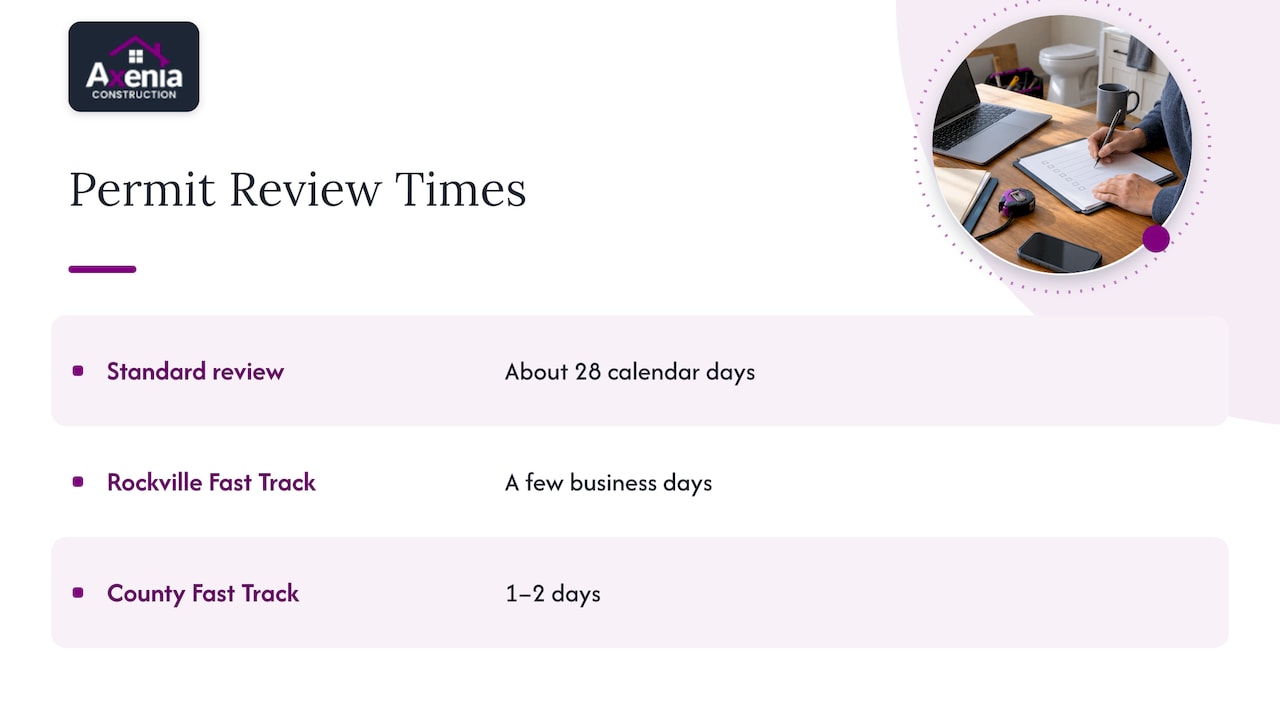
The City of Rockville’s standard review for building permit applications involving alterations or repairs runs about 28 calendar days, according to the city. Plan on that when you set a start date, and do not book a demolition crew for the week after you apply.
Some smaller projects can move faster. The city publishes review timeframes that include same-day express programs for items such as fences, water heaters and HVAC replacements. A simple bathroom alteration with no structural change may qualify for a Residential Fast Track review, which can shorten the wait to a few business days. Eligibility depends on project scope and on a complete submission, so confirm with the Inspection Services Division before counting on it.
In Montgomery County, the Department of Permitting Services revived its Residential Fast Track in 2023 to issue eligible permits in one to two days, with single-level decks and fences as examples. A bathroom with moved plumbing is a different category from those examples, so do not assume it fits.
Applying: What You Need and Who Can Apply
The city’s permit application page is the starting point for both building and trade permits. A solid bathroom package usually includes:
- A scaled floor plan showing existing and proposed layouts, with fixture locations.
- The scope of work in plain terms: what moves, what is replaced, what is new.
- Electrical details for any new circuits, fans or lighting.
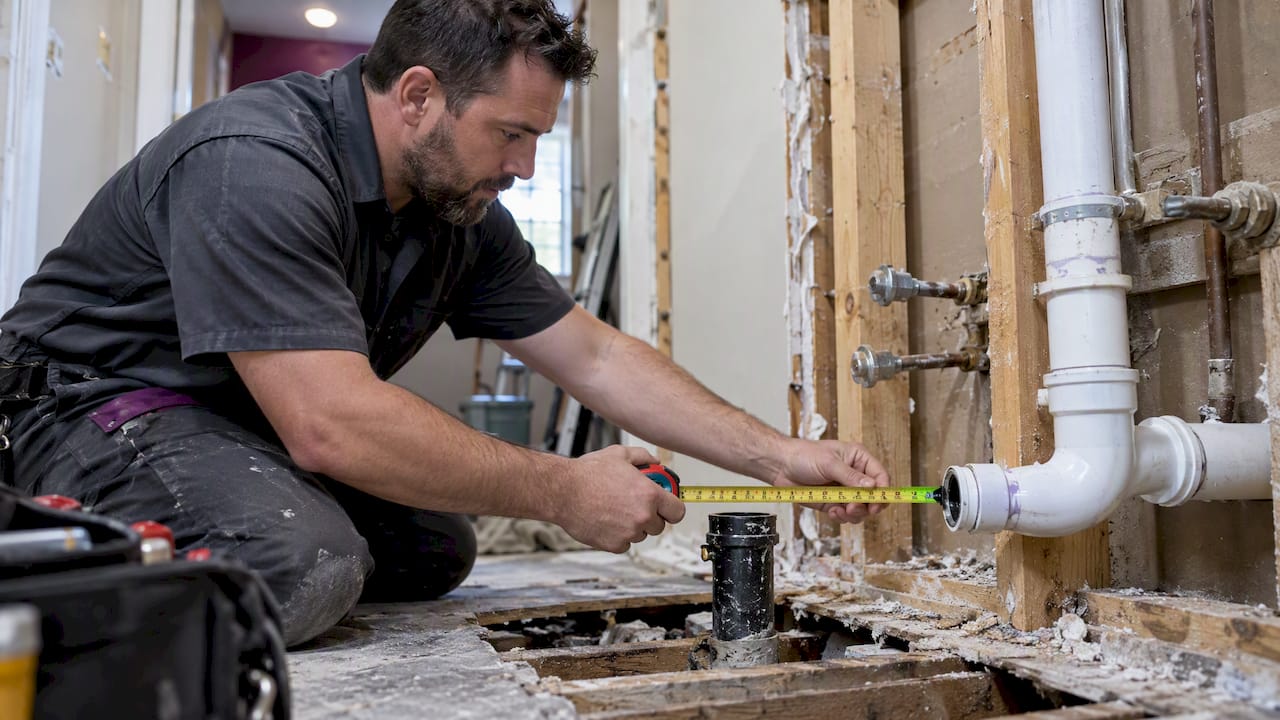
- Plumbing details for any relocated or new fixtures.
- Contractor licensing information, if a contractor is doing the work.
Homeowners can legally pull their own permits in Rockville and Montgomery County. We understand the appeal. But a bathroom touches building, plumbing and electrical permits, and a single mistake in how they are filed or coordinated can mean repeat inspections and weeks of delay. A licensed contractor files these every week and knows what reviewers look for.
If you want to compare who does what before you hire, our home renovation contract review guide for DC, MD and VA shows how to confirm that permits and inspections are written into the contract and who is responsible for them.
Inspections: Where Bathroom Projects Stall
Permits are not the hard part. The inspection sequence is. Montgomery County’s residential alterations inspection sheet lays out the order, and each stage needs approval before the next. Rough plumbing and electrical must be approved before walls are closed in, and framing sign-off depends on those rough-ins.
Three things go wrong most often.
- Drywall goes up too early. If a rough-in has not been inspected, the inspector can ask you to open finished walls. That is a costly, avoidable repair.
- Plans are not on site. Inspectors expect approved drawings at the job. Without them, the inspection can be denied and you are back in the queue.
- Trades are out of sync. If the plumber is not ready when the inspector arrives, everything behind that inspection waits. A bathroom is only as fast as its slowest trade.
This is the part of the job we protect most carefully. We schedule trades around the inspection sequence rather than the other way around, so no one is waiting on a single missed appointment.
The inspections are also on your side. They are an independent check that the work meets code, and that matters in a room full of water, wiring and hidden pipes.
What Happens If You Skip the Permit
We understand why people do. The process looks like paperwork, and the job looks small. Here is what you risk.
- Failed work discovered later. Unpermitted plumbing or electrical that was never inspected may be wrong, and nobody will know until a leak or a fault shows itself.
- Resale friction. Buyers’ agents and inspectors notice unpermitted work. Sellers with open code issues have limited options, as this overview of selling a house with code violations explains. Fixing it before you list is almost always cheaper and calmer.
- Retroactive permits. Homeowners in local forums describe being asked to obtain permits after the fact, sometimes after opening finished work for inspection. That costs more than doing it right the first time.
- Insurance questions. A claim tied to unpermitted work can get complicated. Ask your insurer how it treats unpermitted renovations.
If you live in DC rather than Maryland, the process differs. The DC Department of Buildings runs a Homeowner’s Center that helps with permits for interior renovations and repairs. Virginia localities vary again, so check with your own county or city.
A related note: if your Rockville remodel is part of a bigger project, such as finishing a basement, the rules change by county. Our guide to Maryland basement permit requirements covers it, and we also cover kitchen remodel permits in Maryland if you are updating both rooms.
Our Perspective: Treat the Permit as Part of the Design
Most homeowners picture the permit as a form that gets filed once the design is done. We see it the other way around. The permit is part of the design, and it is where a project’s problems show up cheaply, on paper, rather than expensively, behind a finished wall.
That is why we like design-build for bathrooms. When the same team draws the layout and builds it, code conflicts get caught while a line on a plan can still be moved. A drain that cannot reach the new vanity location, a fan with no path to the exterior, a circuit that needs to be upgraded: these are far easier to fix in a drawing than after tile is set.
We also think plan review is misunderstood. A permit is not simply a fee a contractor pays. Plan reviewers check the proposed layout against code, and a clear, scaled drawing is what they need to say yes. So we put effort into the drawings and into plain communication with clients. You should always know which permits are filed, what has been inspected and what is next.
As a women-owned firm, we have built our name on that kind of transparency. Many clients come to us anxious about the process. Our job is to make the permitting piece quiet and predictable, so you can think about the fun parts, like tile and lighting.
— Arienne
A Step-by-Step Path for Your Rockville Bathroom
- Confirm your jurisdiction. City of Rockville or unincorporated Montgomery County? That decides where you apply.
- Define the scope. List every change. If anything moves, gets added or involves wiring, assume permits.
- Draw it. Get a scaled plan with fixture locations before you apply.
- File building, plumbing and electrical permits together. Coordinating them avoids mismatched approvals.
- Allow for review. Budget for roughly four weeks unless the city confirms a faster track.
- Schedule inspections in order. Rough plumbing and electrical first, then close-in, then final.
- Keep approved plans on site. Every inspection, every time.
- Close out the permit. Keep the final approval records with your home documents. They help at resale.
Planning a Bathroom Remodel in Rockville?
We handle scoping, drawings, permit filing, trade coordination and inspections as one managed process. Learn more about our kitchen and bath remodels, or see how our design-build approach catches code issues early. You can also read about our general contractor services in Rockville and contact us to talk through your project.
FAQ
Do I need a permit to replace a toilet or vanity in Rockville?
Replacing a toilet, faucet or sink in the same location generally does not need a permit, according to Montgomery County’s list. If the new fixture requires moving pipes, or you add electrical work, a permit is required. When in doubt, call the Inspection Services Division before starting.
Do I need a permit to put a bathroom in my basement?
Yes. Adding a new bathroom means new plumbing, and usually electrical work, so expect building, plumbing and electrical permits. Basement rules also vary by county, and a finished basement raises other code questions such as egress and ventilation. Our Maryland basement permit guide is a good place to start.
How much is a bathroom permit in Rockville?
The city’s schedule sets the building permit at $0.35 per square foot of affected area with a $145.00 minimum. Plumbing and electrical permits each have an $80.00 minimum, and a 10.25% automation fee is added to the fees. For a small bath with plumbing and electrical changes, the minimums total about $336.26 with the surcharge. Check the current schedule, because fees are updated.
Can I pull the permit myself?
Homeowners can apply for their own permits in Rockville and Montgomery County. The difficulty is coordinating building, plumbing and electrical permits and the inspection order. A licensed contractor does that regularly, which reduces the chance of repeat inspections and delays.
Do I need a permit to remodel a bathroom in Virginia or DC?
Rules differ by jurisdiction. In DC, the Department of Buildings Homeowner’s Center helps with permits for interior renovations. In Virginia, the answer depends on your county or city building department, so contact it before you start.
Sources
- City of Rockville FY27 Inspection Services fee schedule
- City of Rockville homepage
- City of Rockville: Apply for a Building or Trade Permit
- City of Rockville: Building and Safety Codes
- City of Rockville: Inspection Services Division review timeframes
- Montgomery County DPS: Permits Required, No Permits Required
- Montgomery County DPS: Residential Alterations Permit Process
- Montgomery County DPS: Residential Alterations Building Inspections
- Montgomery County: Residential Fast Track update
- DC Department of Buildings: Homeowner’s Center