Finishing a basement in Maryland can vary widely in cost, with larger, full-featured projects costing substantially more. The cost for our clients is especially affected by egress windows, waterproofing, and whether the plan includes a bathroom. Permit and inspection fees are a required part of the budget here, not an optional line item.
TL;DR:
- Address waterproofing before finishes and budget for egress excavation whenever you add a legal bedroom; both protect the structure, occupants, and later investment.
- Bathroom plumbing drives the jump from basic to middle tier; egress work and custom finishes raise top tier costs, while distant drain lines add expense.
- Labor and permit costs tend to run higher near Washington, D.C., while Frederick and Carroll often fall lower; foundation age can outweigh county averages.
- Get a written, line item estimate before financing, confirm who handles permits and inspections, and keep a contingency for concealed moisture damage or review delays.
Table of Contents
- Maryland cost ranges: per-square-foot bands and sample totals
- Where the money goes: framing, finishes, and the systems behind the walls
- Real budget examples by project scope and size
- Permits, inspections, and egress rules that shape Maryland budgets
- What to expect during the construction timeline
- Where to spend and where to save on your basement budget
- Hiring a Maryland contractor: what to ask before you sign
- Financing a basement finishing project in Maryland
- How climate and common basement conditions affect Maryland costs
- Cost differences across Maryland counties and regions
- What we see on Maryland basement projects
- Getting a real estimate for your basement project
- FAQ
Maryland cost ranges: per-square-foot bands and sample totals
We break basement finishing into basic, mid-range, and high-end bands, and many Maryland homeowners land toward the lower end.
- Basic finish: painted drywall, carpet or basic vinyl plank, recessed lighting, and minimal partition walls, with no plumbing added.
- Mid-range finish: a full bathroom, upgraded flooring like luxury vinyl plank or tile, a wet bar rough-in, and better lighting and trim.
- High-end finish: custom millwork, a legal bedroom with egress, a full wet bar or kitchenette, built-in media or storage features, and premium finishes throughout.
Applying those bands to common basement sizes gives a useful ballpark. A smaller basement finished at the basic level will generally cost less than the same space finished at mid-range. A larger basement in a Montgomery or Howard County colonial will generally cost more for a basic finish than a smaller one, and more again at mid-range. A high-end finish with a bedroom suite and wet bar can substantially increase the total cost. A larger basement in newer construction throughout Frederick and Anne Arundel counties typically costs more to finish, especially for a high-end build-out with multiple rooms and a full bath.
These figures sit above many national averages, largely because Maryland’s labor rates, permit requirements, and older housing stock (think fieldstone foundations in Montgomery County or clay-heavy soil near the Chesapeake) add real cost to prep and waterproofing work. County to county, the spread is noticeable too: homeowners closer to Washington, D.C. and in parts of Montgomery County tend to see higher labor costs than those in more rural stretches of Frederick or Carroll County. We walk every client through where their project sits on these bands before we write a proposal, because a generic average rarely matches what a specific basement actually needs.
Where the money goes: framing, finishes, and the systems behind the walls
Once you know your overall budget band, it helps to understand which line items are driving it. Framing and drywall are usually the most predictable costs, priced largely by square footage and wall configuration, with labor making up the bulk of the expense since materials are relatively inexpensive. Insulation adds a modest per-square-foot cost but is required for comfort and code compliance in most basement walls.
Flooring choices swing the budget more than people expect. Carpet remains the cheapest option, luxury vinyl plank (LVP) sits in the middle and handles moisture better, and tile costs the most but holds up best in bathrooms or mechanical areas prone to dampness.
- Electrical and lighting: running new circuits, adding recessed lights, and bringing a sub-panel up to code if the basement adds significant load.
- HVAC: extending ductwork from the existing system is cheaper than it sounds in a well-planned layout, while a ductless mini-split adds cost but solves comfort problems in basements with no good duct access.
- Plumbing and bathroom additions: running new supply and drain lines, especially when the basement bathroom sits far from the main stack, is one of the costliest single upgrades in the project.
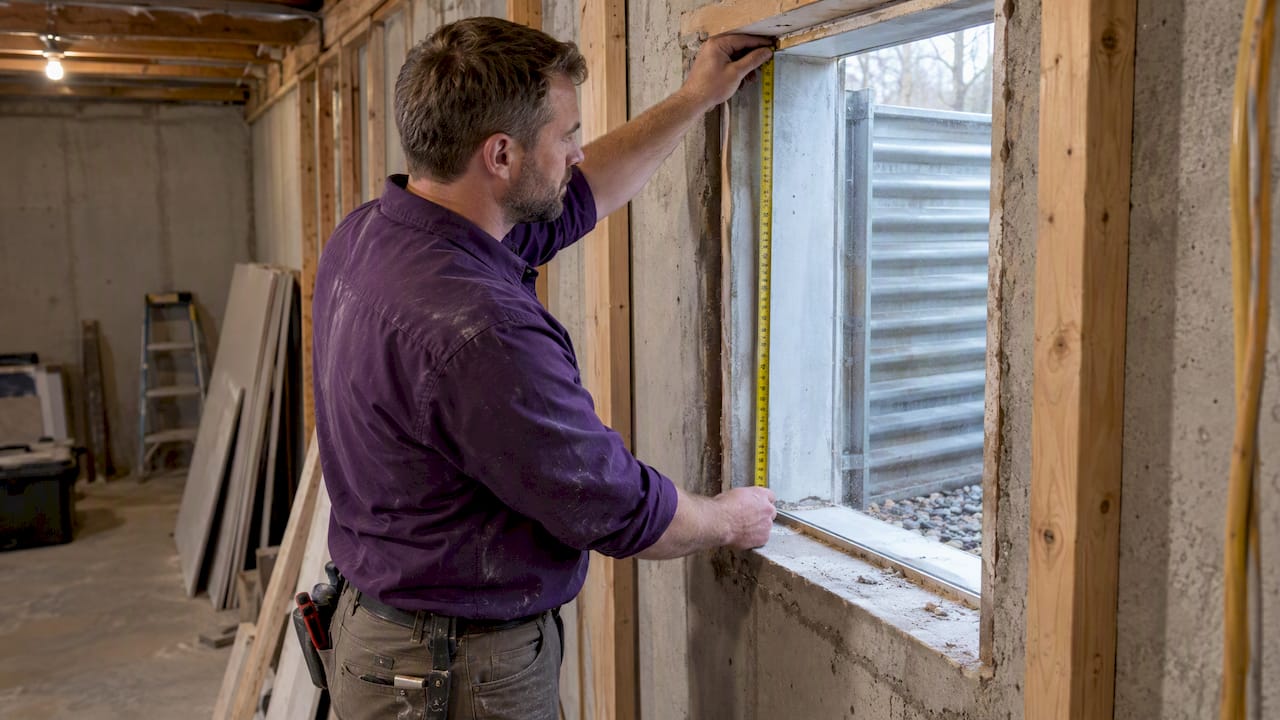
- Egress windows or bulkhead doors: required for any room classified as a bedroom, this item often involves excavation and a window well, making it one of the more expensive individual features, as detailed in our basement egress window cost breakdown.
- Waterproofing and sump pump systems: addressing moisture before finishing anything else protects every other dollar spent on the project.
- Finish carpentry and built-ins: trim, custom shelving, and millwork add polish but are where costs can balloon quickly if left open-ended.
Labor typically outweighs materials on framing, electrical, and plumbing, since those trades are priced by hours and code compliance rather than material cost alone. Materials carry more weight on flooring and finish carpentry, where the choice between a stock product and a custom one changes the number fast.
Pro Tip: Set a finishes allowance for flooring, lighting fixtures, and hardware in your contract, then add a contingency to the total project cost to absorb surprises behind the walls.
Real budget examples by project scope and size
Seeing three scoped examples side by side makes it easier to place your own project.
- Basic open finish: this covers drywall, carpet or basic LVP, recessed lighting, and a small number of partition walls. No plumbing is added, so permit scope and ventilation requirements stay simple.
- Mid-range finish with bathroom: this includes a full bathroom, upgraded flooring, a partitioned media room, and improved lighting. Adding the bathroom brings plumbing permits, ventilation fans, and often a sump pump tie-in into the budget, along with a contingency to account for the added trades.
- High-end build-out with bedroom, bath, and wet bar: this scope adds a legal bedroom with an egress window, a full bathroom, and a wet bar with plumbing and electrical. Because a legal bedroom triggers additional permit review and fire-separation requirements, we recommend a contingency for this scope.
Across all three, the jump from basic to mid-range is driven almost entirely by plumbing, while the jump from mid-range to high-end comes from egress work and custom finishes. Any time a basement project adds a bedroom or bathroom, expect permit review, ventilation, and plumbing costs to rise together, since Maryland code treats those additions as life-safety items rather than cosmetic ones.
Permits, inspections, and egress rules that shape Maryland budgets
Maryland basement projects require formal permits and inspections, and skipping that step creates problems at resale, not just during construction. Local jurisdictions, including Montgomery County, require permit submittals that detail the electrical, plumbing, HVAC, and framing plans before work begins, and those submittals are reviewed against the International Residential Code (IRC).
- Habitable rooms, including any basement bedroom, require a code-compliant egress window or door, which often means excavating a window well and reinforcing the foundation opening.
- Fire-rated materials and proper fire separation are typically required between the basement and the rest of the home, particularly around mechanical rooms.
- Permit and inspection fees vary by county, but they are a required and budgeted part of the project, not an optional add-on, since they protect the work’s legality and insurability.
We cover county-specific permit timelines and submission requirements in more detail in our guide to Maryland basement permit rules, which is worth a read before you finalize a budget. Working with a contractor who already knows a given county’s review process tends to prevent the delays that catch first-time basement owners off guard.
What to expect during the construction timeline
Basement finishing projects in Maryland can take several weeks from permit approval to final inspection, though planning and permitting can add time before work even starts, especially when considering interior door replacement and custom closet organization as part of the finished space.
- Planning and estimate: scope definition, design decisions, and a written proposal.
- Permit submission and review: timing depends heavily on the county and the complexity of plumbing or egress work.
- Demolition and prep: clearing the space and addressing any existing moisture issues.
- Framing, rough electrical, and plumbing: the systems that get hidden behind walls.
- Insulation, drywall, and finishes: the visible transformation phase.
- Final inspections: sign-off from the county before the space is considered legally finished.
Delays most often come from permit backlogs, concealed water damage found during demolition, or long lead times on custom fixtures, all of which are easier to manage with buffer time built into the schedule from the start.
Where to spend and where to save on your basement budget
Spend first on waterproofing and egress, since both protect the structure and the people using the space, and cutting corners there creates costly problems later. Once those are handled, there’s real room to save without lowering quality.
- Phase the project: finish the main living area now and leave a bathroom or wet bar for a later addition.
- Choose standard-size fixtures and stock cabinetry instead of custom orders, which cost more in both materials and lead time.
- Use a contractor allowance for flooring and lighting rather than locking in high-end selections before you’ve seen the full budget.
Pro Tip: Ask for a fixed-price, line-item estimate rather than a lump sum, and hold back a contingency reserve instead of spending it on upgrades. That reserve is what keeps a basement project from stalling when something unexpected turns up behind the drywall.
Hiring a Maryland contractor: what to ask before you sign
A clear written scope protects you more than any verbal promise. Before signing with a contractor, request proof of licensing and insurance, references from recent basement projects, and a written scope that breaks out line items rather than a single lump figure.
- Ask who is responsible for pulling permits and managing inspections, since this should never fall back on the homeowner.
- Ask directly how they plan to handle egress, waterproofing, and any existing moisture issues before finishes go in.
- Ask which portions of the work are subcontracted, and request a payment schedule tied to completed milestones rather than large upfront deposits.
- Watch for vague scopes of work, pressure for a large deposit before permits are pulled, or no clear answer about who handles the permit plan.
A contractor who can answer these questions specifically, rather than generically, is usually the one managing the project the way your county expects.
Financing a basement finishing project in Maryland
Most Maryland homeowners pay for basement finishing through a home equity line of credit (HELOC), a home equity loan, a cash-out refinance, or an unsecured personal loan, and the right choice depends on how much equity is already in the home. A HELOC tends to offer the most flexibility for phased projects, since draws can be taken as work progresses rather than all at once. A home equity loan or cash-out refinance works well for homeowners who want a fixed rate and a lump sum to cover a full build-out in one pass.
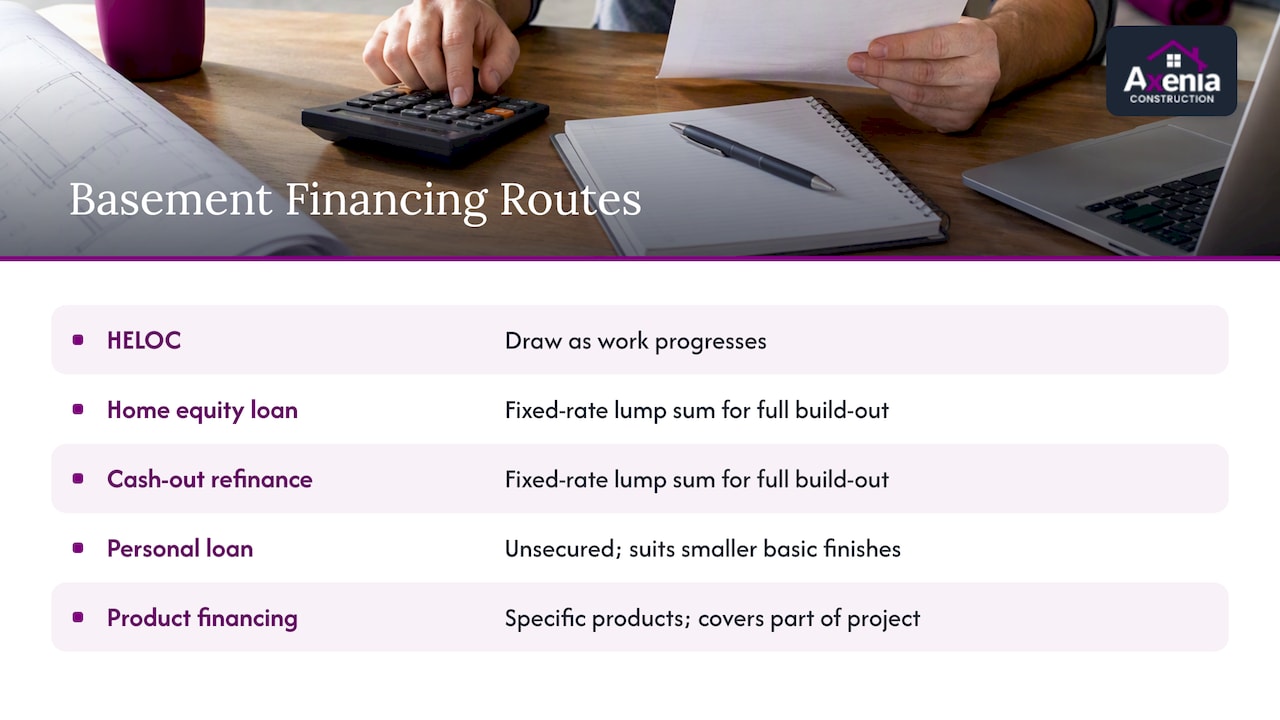
Some homeowners also use manufacturer or retailer financing tied to specific products, such as HVAC equipment, though that typically covers only a portion of the project. A personal loan can make sense for smaller, basic-finish projects, since it avoids placing the home itself as collateral.
Whichever route you choose, get your contractor’s written, line-item estimate first. Lenders generally want a firm project cost before approving a home equity product, and a vague verbal estimate slows that process down. We always provide clients with a detailed proposal early specifically so it can be used for financing conversations with a bank or credit union.
How climate and common basement conditions affect Maryland costs
Maryland’s climate and housing stock both push basement finishing costs higher than in drier, newer-construction regions. Humid summers and a high water table in many parts of the state make waterproofing a near-universal line item rather than an optional upgrade, and that work has to happen before drywall goes up, not after.
Older homes, particularly in established neighborhoods throughout Montgomery and Prince George’s County, often have fieldstone or block foundations that need additional parging, sealing, or interior drainage systems before a basement can be finished safely. Newer homes in Frederick or Anne Arundel County tend to have poured concrete foundations with fewer moisture surprises, which can keep waterproofing costs on the lower end of the range.
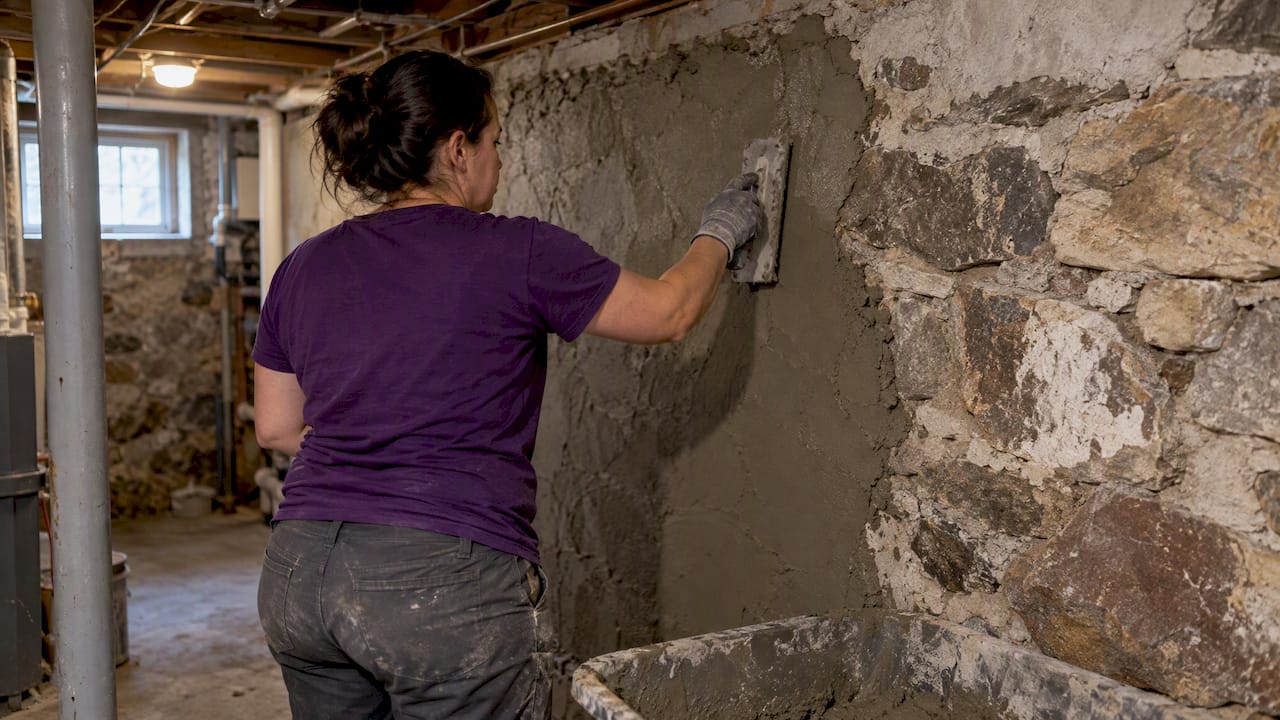
Clay-heavy soil near the Chesapeake Bay watershed also affects egress window installation, since excavation and drainage around a new window well take more effort in clay than in sandy or well-draining soil. Homeowners closer to the water table, including parts of Anne Arundel and Calvert County, should budget toward the higher end of the waterproofing range as a starting assumption rather than a worst-case scenario.
Cost differences across Maryland counties and regions
Basement finishing costs vary across Maryland largely due to labor rates and permitting complexity rather than material costs, which stay fairly consistent statewide. Homeowners in Montgomery County and other areas close to Washington, D.C. generally see higher labor rates, often pushing a mid-range project toward the upper end of the cost range.
Frederick, Carroll, and Washington County tend to sit closer to the middle or lower end of the same bands, reflecting both lower labor costs and, in some cases, less complex permit review processes. Anne Arundel and Howard County generally land in between, with costs influenced more by the age and foundation type of the specific home than by county-wide labor differences alone.
Permit timelines also differ by jurisdiction. Montgomery County’s review process for basement permits is detailed in our guide to Maryland basement permit rules, and similar variation exists in neighboring counties, which is part of why we recommend getting a written timeline estimate as part of any contractor’s proposal rather than assuming a flat statewide average.
What we see on Maryland basement projects
On the basement projects we take on across Montgomery County and the surrounding region, the same three cost drivers show up again and again: egress requirements, moisture conditions in older foundations, and the permit coordination that comes with both. Our team manages that permit process directly with the county so homeowners aren’t left chasing paperwork mid-project.
If you’re preparing for a site visit, walk the space beforehand and note any visible moisture, cracking, or uneven flooring. That single observation often shapes the entire waterproofing conversation before we even open a tape measure. You can see examples of our completed work in our finished basement remodeling project in Rockville, MD.
— Arienne
Getting a real estimate for your basement project
We offer general contracting and home renovation services across Maryland, and we manage permitting and inspections directly so you’re not navigating county requirements alone. The next step is simple: request a site visit, get a written proposal with real line items, and confirm the schedule and payment terms before you sign.
Reach out through our general contracting page to start that conversation with a local estimate built around your specific basement.
FAQ
What is the average cost to finish a 2,000 square foot basement?
A larger basement in Maryland typically costs more to finish, with costs varying according to the finish level and project scope. The final number depends heavily on whether the plan includes a bathroom, egress windows, or custom finish work.
How long does it take to finish a 1,000 square foot basement?
Basement projects can take several weeks from permit approval to final inspection, with planning and permit review adding time beforehand. Complex scopes involving egress windows or bathroom plumbing tend to take longer.
What’s the most expensive part of finishing a basement?
Adding a bathroom and installing an egress window are typically the two most expensive individual line items in a basement finishing project. Both require specialized labor, permit review, and in the case of egress, excavation and structural work around the foundation.
Is finishing a basement worth the money?
Finishing a basement adds usable living space without the cost of a home addition, and it can add real value when the work includes a legal bedroom, proper waterproofing, and permitted plumbing. The return depends on local market conditions and how well the finished space matches what buyers in your area expect.