
A home renovation contract review is the process of systematically examining every clause in a renovation agreement before you sign, to confirm the document protects your investment and reflects exactly what you agreed to verbally. Most homeowners in DC, MD, and VA sign these agreements once every several years, while contractors sign them weekly. That gap creates real risk. This home renovation contract review guide walks you through the critical components, credential checks, red flags, and the moments when a lawyer is worth every dollar.
What are the critical components to check in a home renovation contract?
A standard renovation contract must include six non-negotiable elements: a detailed scope of work, itemized pricing, a staged payment schedule, firm dates, a written change-order policy, and lien waivers. Missing even one of these creates a gap a contractor can exploit later.
Here is what to verify in each area:
- Scope of work. The contract must name specific materials, brands, dimensions, and finishes. “Kitchen remodel” is not a scope. “Remove and replace 42-inch upper cabinets with Shaker-style maple in Antique White, install 3 cm quartz countertop” is a scope. Review your renovation scope details to understand what level of detail is standard in the DC, MD, and VA market.
- Itemized pricing and deposit. Every line item should carry a unit cost. The industry-standard deposit is 10% of the contract value. Some states cap deposits by law. Paying 30–50% upfront before a single nail is driven is a red flag, not a standard practice.
- Payment schedule tied to milestones. Payments should release when verifiable work is complete, not on calendar dates. A schedule that reads “payment due on the 15th of each month” gives you no leverage if the work is behind.
- Start and completion dates. The contract must state both. It should also define what constitutes an acceptable delay, such as weather or permit hold, and what happens if the contractor misses the deadline without cause.
- Change-order policy. Every change to scope, material, or cost must be documented in a signed written change order before the work begins. Verbal agreements do not hold up in dispute.
- Lien waivers. A lien waiver confirms that subcontractors and suppliers have been paid. Without them, a supplier your contractor never paid can place a lien on your home even after you paid the contractor in full.
- Warranties. Workmanship warranties typically cover 1–5 years. Manufacturer warranties on materials should state explicitly whether they transfer to you as the homeowner.
Pro Tip: Ask the contractor to highlight where each of these seven items appears in the contract. If they cannot point to them quickly, the clauses may not exist.
How do you verify contractor credentials and legal compliance in DC, MD, and VA?

Credential verification is not optional. It takes about 60 seconds using state-specific online lookup tools, and it can save you from hiring an unlicensed operator with no legal accountability.
Follow these steps before you sign anything:
- Look up the license. Maryland, Virginia, and DC each maintain public contractor license databases. Use the Maryland Home Improvement Commission (MHIC) portal, the Virginia Department of Professional and Occupational Regulation (DPOR) database, or DC’s Department of Consumer and Regulatory Affairs (DCRA) to confirm the license is active. Axeniaconstruction, for example, holds an active Maryland license as a locally owned general contractor in Rockville. Learn how to verify a Maryland contractor license step by step.
- Check the classification. A license for small repairs does not authorize a full addition. Confirm the classification matches your project scope.
- Confirm legally required disclosures. Maryland and Virginia law requires contractors to provide a written notice of your right to cancel within three business days of signing. A “Notice to Owner” regarding lien rights is also typically required. Missing disclosures signal a contractor who does not follow the rules.
- Verify the signer’s authority. An unauthorized signature risks contract invalidity. Cross-reference the name on the contract with the name on the license and the name on the company vehicle or business registration. If they do not match, ask for written confirmation that the signer has legal authority to bind the company.
- Understand what a licensed contractor means locally. The requirements differ across DC, MD, and VA. Review what licensed contractor means in your specific jurisdiction before signing.
Step-by-step process for reviewing renovation contracts effectively
Effective contract review means comparing the document against a structured checklist, not just reading it once. A thorough review uses a 25-item checklist to catch missing clauses covering change orders, permit responsibilities, and warranties.
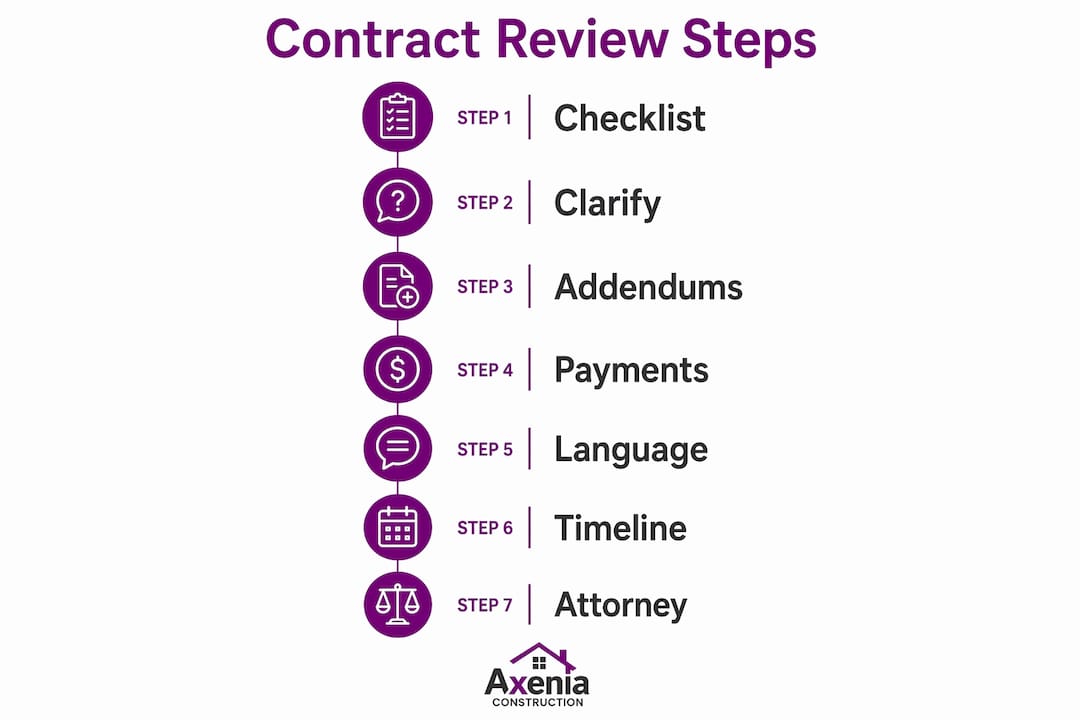
Step 1: Read the full contract before asking any questions. Note every term you do not understand and every clause that feels vague. Write your questions down.
Step 2: Compare against a checklist. Your checklist should include at minimum:
- Detailed scope of work with material specifications
- Itemized cost breakdown
- Deposit amount and payment schedule tied to milestones
- Permit responsibility (contractor or homeowner)
- Start date, substantial completion date, and final completion date
- Written change-order requirement
- Lien waiver process
- Workmanship warranty duration
- Dispute resolution method (mediation, arbitration, or litigation)
- Contractor license number and insurance certificate
Step 3: Request written addendums for anything missing. Do not accept verbal promises. If the contractor says “don’t worry, we always do that,” ask them to add it to the contract. A reputable contractor will not object. Use the home renovation planning guide to cross-check your checklist against standard project requirements.
Step 4: Scrutinize payment terms. Milestone-based payments protect homeowners from paying for incomplete work. A payment tied to “framing complete and inspected” is enforceable. A payment tied to “week three” is not.
Step 5: Flag ambiguous language. Terms like “standard materials,” “as needed,” or “approximately” create disputes. Replace them with specific quantities, product names, and fixed numbers.
Pro Tip: Review the renovation timeline examples for your project type before your meeting with the contractor. Knowing realistic timelines helps you spot dates that are either unrealistically fast or suspiciously open-ended.
For projects over $25,000, attorney review is worth the cost. A construction attorney typically charges $150–$500 for a contract review. That fee is a fraction of what a single disputed change order can cost in litigation.
| Review Step | What to Check |
|---|---|
| Scope of work | Specific materials, dimensions, and finishes named explicitly |
| Payment schedule | Tied to verifiable milestones, not calendar dates |
| Dates | Firm start, substantial completion, and final completion |
| Change orders | Written and signed before any additional work begins |
| Warranties | Duration for workmanship and transferability of manufacturer warranties |
What are the common red flags to avoid in renovation agreements?
Pressure to sign immediately is a significant red flag. Reputable contractors expect you to read the contract carefully and negotiate terms. Any contractor who says “this offer expires today” or “I have another client ready to take this slot” is using a sales tactic, not running a professional operation.
Watch for these warning signs:
- Missing standard clauses. A contract without a change-order policy, lien waiver requirement, or dispute resolution clause is written to favor the contractor. Refusal to include these protections in writing signals future problems.
- Calendar-based payment schedules. Paying on fixed dates regardless of progress means you can be fully paid before the job is half done.
- Vague allowances. An “allowance” for tile at $3 per square foot when the tile you selected costs $12 per square foot is a budget trap. Every allowance must reflect the actual product you chose.
- Signer mismatch. If the person signing the contract is not the licensed contractor or an authorized company officer, the agreement may not be legally enforceable. Avoid common renovation mistakes by confirming authority before you sign.
- No insurance certificate. A contractor without current general liability and workers’ compensation insurance leaves you financially exposed if someone is injured on your property.
“Contractors often draft contracts favoring themselves by omitting protections. Recognizing this and pushing back is not confrontational. It is how successful projects get built.”
When and how should you seek professional help for contract review?
Attorney review is not just for large commercial projects. For any home renovation contract over $25,000, a construction attorney is the right call.
Here is what professional review provides:
- Hidden risk identification. An attorney reads contract language the way a contractor reads blueprints. They spot indemnification clauses, limitation-of-liability provisions, and arbitration requirements that shift risk entirely onto you.
- Workable alternative language. A good construction attorney does not just flag problems. They provide replacement language you can propose to the contractor, making negotiation concrete and specific.
- Written negotiation scripts. Ask your attorney to give you exact language for each requested change. Walking into a negotiation with written proposed edits is far more effective than a verbal list of concerns.
- Peace of mind on large investments. A $300 attorney review on a $75,000 kitchen renovation is 0.4% of the project cost. The protection it provides is disproportionately large.
If you are not ready to hire an attorney, start with a structured checklist and a thorough self-review. Many disputes originate from clauses homeowners never read, not from clauses that were deliberately hidden.
Key Takeaways
A home renovation contract review is the single most effective step a homeowner can take to prevent disputes, protect payments, and hold contractors accountable throughout a project.
| Point | Details |
|---|---|
| Six non-negotiable clauses | Every contract must include scope, itemized pricing, milestone payments, dates, change orders, and lien waivers. |
| Verify credentials first | Use MHIC, DPOR, or DCRA databases to confirm active licenses before signing anything. |
| Milestone payments protect you | Payments tied to verifiable work completion give you leverage if progress stalls. |
| Pressure to sign is a red flag | Reputable contractors expect negotiation and will not rush you to sign. |
| Legal review pays off | Attorney review for projects over $25,000 costs $150–$500 and can prevent far larger losses. |
What I have learned from watching homeowners sign renovation contracts
The most consistent mistake I see is treating a renovation contract as a formality rather than a negotiation document. Contractors sign contracts weekly, while most homeowners sign one every five to ten years. That experience gap is real, and it shows up in how contracts are written.
The contracts that cause the most damage are not the ones with obviously bad terms. They are the ones with missing terms. A contract that says nothing about change orders does not protect either party. In practice, it protects the contractor, because they know how to operate without that clause and you do not.
Every clarification you receive verbally should go into the contract in writing before you sign. I have seen homeowners lose thousands of dollars on disputes that would have been resolved in five minutes if the agreement had included one additional sentence. Verbal assurances are not worth the paper they are not printed on.
The other thing I want you to take away is this: asking for changes is not rude. It is expected. Reputable contractors expect due diligence and do not pressure homeowners to sign immediately. If a contractor reacts badly to your questions, that reaction tells you everything you need to know before the project even starts.
— Arienne
Axeniaconstruction is here to make your renovation clear from day one
At Axeniaconstruction, we believe a well-written contract is the foundation of a successful renovation. As a licensed, women-owned general contractor based in Rockville, MD, we serve homeowners and property managers across DC, MD, and VA with transparent agreements, clear scopes of work, and honest communication at every stage.

We do not hand you a contract and ask you to figure it out. We walk through every clause with you, answer your questions, and make sure you feel confident before anything is signed. Whether you are planning a kitchen update or a full home remodel, our home renovation services are built around your goals. You can also explore our full residential renovation guide to understand what the process looks like from start to finish. Contact Axeniaconstruction today to schedule a consultation.
FAQ
What should every home renovation contract include?
Every home renovation contract must include a detailed scope of work, itemized pricing, a milestone-based payment schedule, firm start and completion dates, a written change-order policy, lien waivers, and warranty terms covering both workmanship and materials.
How do I verify a contractor’s license in Maryland, Virginia, or DC?
Use the MHIC portal for Maryland, the DPOR database for Virginia, and the DCRA system for DC. License verification takes about 60 seconds and confirms whether the license is active and matches the project classification.
When should I hire an attorney to review a renovation contract?
Hire a construction attorney for any project valued over $25,000. Attorney review typically costs $150–$500 and identifies hidden risks, unfavorable indemnification clauses, and missing protections that a standard self-review may miss.
What is a lien waiver and why does it matter?
A lien waiver is a document confirming that subcontractors and suppliers have been paid by your contractor. Without it, unpaid suppliers can place a lien on your property even after you have paid the contractor in full.
Is it normal to negotiate a renovation contract before signing?
Negotiating is not just normal. It is expected. Reputable contractors anticipate that homeowners will request changes, ask questions, and require written addendums before signing. Any contractor who resists negotiation is a contractor worth walking away from.