
A deck permit in Maryland is a mandatory building approval issued by your county authority to confirm that your deck construction meets local safety standards and building codes. Understanding what is a deck permit Maryland homeowners need before breaking ground protects your investment, your family, and your ability to sell the home later. The Maryland Department of Permitting Services and the Maryland Home Improvement Commission (MHIC) both play roles in regulating this process. Skipping the permit is not a shortcut. It is a liability that can cost far more than the permit itself.
What is a deck permit in Maryland, and when do you need one?
Nearly all Maryland jurisdictions require a building permit for any deck supported by footings, regardless of how high it sits above the ground. That rule catches many homeowners off guard. They assume a low deck close to the ground is exempt. It is not, at least not in most Maryland counties.
Montgomery County takes an even stricter position. Montgomery County requires permits for all decks regardless of height above grade, including ground-level platforms. This goes further than many other states that exempt decks under 30 inches. If you live in Montgomery County, assume you need a permit for any deck project.
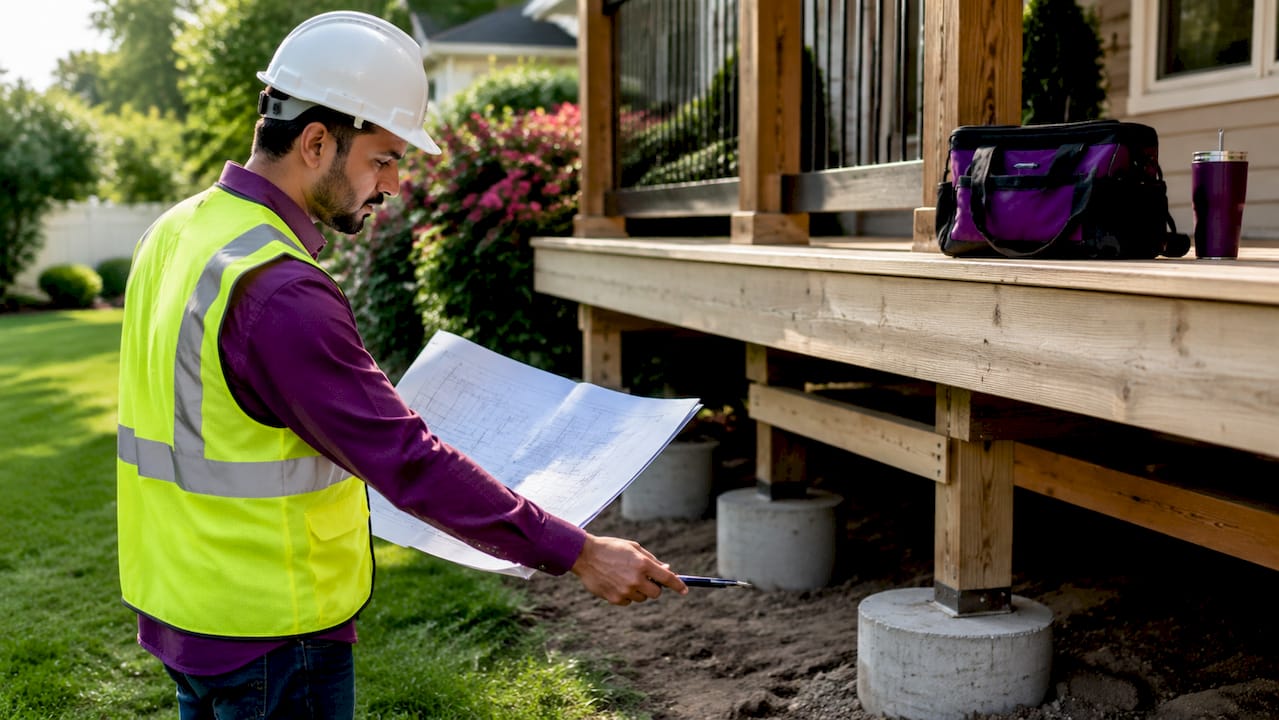
Ordinary repairs do not always trigger a permit requirement. Replacing surface decking boards does not require a permit, but structural work on footings, joists, or any attachment to the house does. The line between cosmetic repair and structural modification is where most homeowners get confused. When in doubt, call your county’s Department of Permitting Services before you start.
What are the key Maryland deck permit requirements and regulations?
Maryland deck building regulations draw from the International Residential Code (IRC) as the baseline standard. Counties then layer on their own rules. The result is a patchwork of requirements that varies significantly by location.
The most critical technical requirement involves footings. Frost depth in Maryland is approximately 30 inches, so deck footings must be set below that level to prevent heaving during freeze-thaw cycles. A footing that sits too shallow will shift, crack, and eventually compromise the entire structure. This is not a guideline. It is a code requirement enforced during inspection.
Key requirements that apply across most Maryland counties include:
- Footing depth: Minimum 30 inches below grade to meet frost depth standards
- Setbacks: Decks must maintain minimum distances from property lines, easements, and structures
- Lot coverage: Your deck counts toward total impervious surface limits on your lot
- Critical Area rules: Properties near the Chesapeake Bay face additional environmental buffer requirements
- Ledger attachment: Any deck attached to the house requires proper flashing and approved fasteners
- Railings and stairs: Height, spacing, and load requirements follow IRC standards
Zoning issues like setbacks and environmental buffers are among the leading causes of permit application delays in Maryland. Properties near the Chesapeake Bay face Critical Area regulations that restrict grading, vegetation removal, and impervious surface expansion. If your property sits within 1,000 feet of tidal water, budget extra time for environmental review.
Pro Tip: Before submitting your application, call your county zoning office and ask specifically about Critical Area status and lot coverage limits. These two issues cause more delays than any other factor.
How to get a deck permit in Maryland: the application process
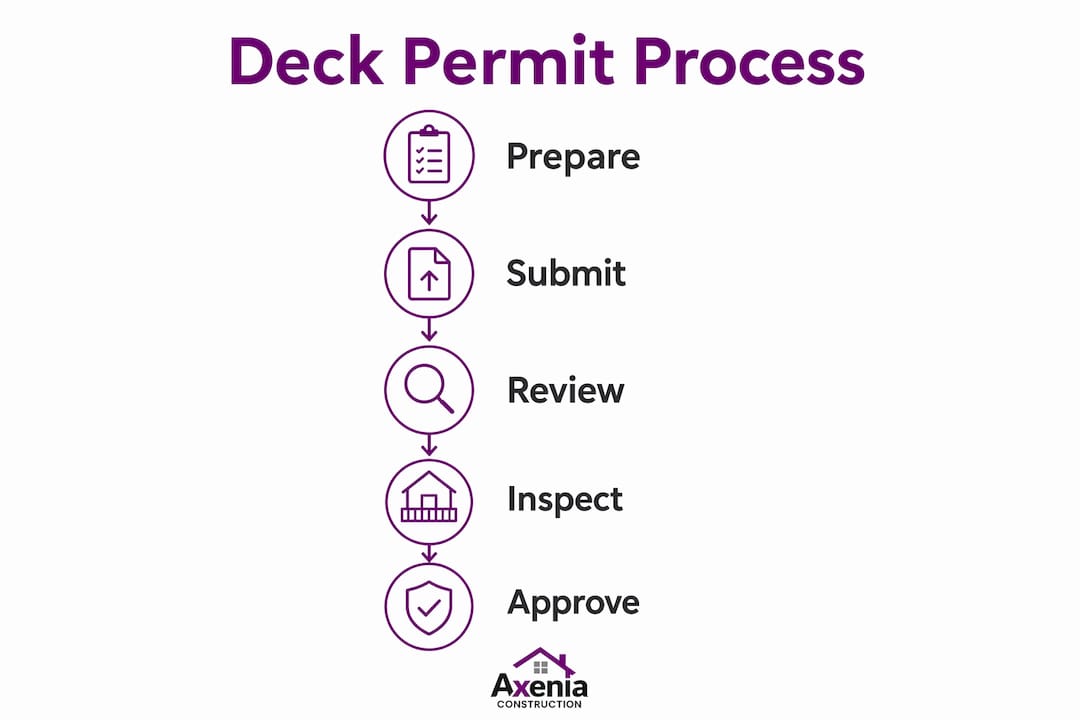
The deck permit application process in Maryland follows a consistent structure across counties, though the specific portal and fee schedule vary by jurisdiction. Most counties now accept applications through online Department of Permitting Services portals, which speeds up submission and tracking.
Here is the standard sequence for applying:
- Confirm zoning compliance. Verify setbacks, lot coverage, and any environmental restrictions before drawing plans.
- Prepare your site plan. Show the property boundaries, existing structures, and the proposed deck location with dimensions.
- Create construction plans. Include framing layout, footing details, railing design, stair configuration, and ledger attachment method.
- Gather contractor documentation. If you hire a professional, include their MHIC license information and contact details.
- Submit the application. File online or in person with your county DPS office and pay the permit fee.
- Respond to plan review comments. Reviewers may request revisions. Address them promptly to avoid delays.
Applications must generally include a completed building permit application, a site plan, construction plans detailing framing and footings, and contractor MHIC license information if applicable. Missing any one of these documents typically results in an incomplete submission and a restart of the review clock.
Permit fees for residential deck projects range from $75 to $300 depending on the county and project size. That is a modest cost relative to the protection it provides. Permit review times typically range from 1 to 3 weeks for residential deck projects, though Montgomery County may require additional plans for sediment and erosion control on larger decks.
If your deck includes lighting, outlets, or a ceiling fan, you will also need a separate electrical permit. Plan for that additional review time in your project schedule.
Pro Tip: Submit your most complete application on the first attempt. Every round of revision comments adds one to two weeks to your timeline. Have a licensed contractor or designer review your plans before submission.
What inspection stages occur after obtaining a deck permit in Maryland?
Inspections are not a formality. They are the quality control mechanism that confirms your deck is safe before you use it. Standard inspections occur at footing, framing, and final stages to ensure compliance with the IRC and prevent structural failure.
The three required inspection stages are:
- Footing inspection: Occurs before concrete is poured. The inspector confirms the hole depth meets the 30-inch frost depth requirement and that the diameter matches the approved plans.
- Framing inspection: Occurs after the structural framing is complete but before any decking boards are installed. The inspector checks joist sizing, beam spans, post connections, and ledger attachment with flashing.
- Final inspection: Occurs when the deck is fully complete. The inspector verifies railings, stair dimensions, hardware, and overall compliance with the approved permit drawings.
The ledger board flashing inspection deserves special attention. Improper flashing at the ledger is one of the most common causes of water intrusion and rot in attached decks. Inspectors focus on this connection because failures here can damage the house structure, not just the deck.
Schedule each inspection before you proceed to the next phase of construction. Building over an uninspected footing or framing stage means the inspector cannot verify compliance without destructive testing. A failed or missed inspection can require you to expose completed work at your own cost.
Common mistakes and legal risks of building without a permit
Building a deck without a permit risks fines, forced removal, resale complications, and safety hazards. These are not theoretical risks. They show up at the worst possible moments, typically when you are trying to sell your home.
Unpermitted decks create a paper trail problem that title companies and buyers cannot ignore. When a structural alteration lacks permit documentation, buyers either walk away or demand price reductions that far exceed what the permit would have cost. The financial damage from skipping a permit compounds over time.
The most common legal and financial risks include:
- Stop-work orders: County inspectors can halt construction and issue fines if unpermitted work is discovered.
- Forced removal: In serious cases, the county can require you to demolish the unpermitted structure entirely.
- Resale complications: Title companies require proof of permits for structural alterations. Missing permits can kill a sale.
- Insurance gaps: Homeowner’s insurance may deny claims for damage related to unpermitted structures.
- Safety liability: If someone is injured on an unpermitted deck, your legal exposure increases significantly.
Zoning violations involving setbacks and easements frequently delay or complicate permit approval even when homeowners try to get permits after the fact. Retroactive permitting, sometimes called “permit after the fact,” is possible in Maryland but expensive and not guaranteed. The county may require you to bring the structure into full compliance, which can mean rebuilding footings or relocating the deck entirely.
Hiring a licensed contractor in Maryland who handles permits professionally is the most reliable way to avoid these outcomes.
Tips for working with contractors on the deck permit process
The permit process goes faster and smoother when a qualified professional manages it. Licensed contractors with MHIC credentials typically handle permitting to reduce liability and ensure proper inspection scheduling. That is the industry standard for good reason.
Practical steps for working effectively with a contractor on permits:
- Verify the MHIC license before signing any contract. Maryland requires all home improvement contractors to carry this license.
- Confirm permit responsibility in writing. Your contract should specify who pulls the permit and who is responsible for scheduling inspections.
- Ask for permit copies. Keep a copy of the approved permit and plans. You will need them for the final inspection and for future resale.
- Set a realistic timeline. Factor in 1–3 weeks for permit review before construction can begin.
- Review the plans before submission. Clear, accurate construction plans reduce revision cycles and speed up approval.
Pro Tip: Ask your contractor to show you the permit card before any work begins. If they cannot produce it, construction has started without authorization. That is a red flag that puts you, as the homeowner, at legal risk.
Axeniaconstruction manages the full permitting process for deck construction in Rockville and surrounding Maryland communities. We handle the documentation, coordinate inspections, and keep you informed at every stage.
Key Takeaways
A Maryland deck permit is a legal requirement that protects your safety, your investment, and your ability to sell your home without complications.
| Point | Details |
|---|---|
| Permits are nearly universal | Almost all Maryland counties require permits for decks on footings, regardless of deck height. |
| Footing depth is non-negotiable | Footings must reach at least 30 inches below grade to meet Maryland frost depth requirements. |
| Three inspections are required | Footing, framing, and final inspections confirm IRC compliance at each construction stage. |
| Unpermitted decks create resale risk | Title companies require permit documentation; missing permits can delay or derail a home sale. |
| Licensed contractors reduce liability | MHIC-licensed contractors handle permitting professionally and assume responsibility for compliance. |
Why I think most homeowners underestimate the permit process
Most homeowners I talk to assume the permit is just paperwork. They see it as a fee and a delay. After years of working on residential projects across Maryland, I see it differently. The permit process is the only independent check between your family and a structural failure.
The inspection stages are where this becomes real. A footing inspection that catches an undersized hole prevents a deck that shifts and separates from the house three winters later. A framing inspection that flags missing ledger flashing prevents rot that can spread into your floor joists. These are not hypothetical scenarios. They are the exact problems that show up in unpermitted decks when homeowners eventually call a contractor to investigate a problem.
The misconception I hear most often is that small decks do not need permits. Montgomery County’s rules alone disprove that. Ground-level decks still require permits there. The size of the deck does not determine the permit requirement. The presence of footings and structural attachment to the home does.
My honest advice: treat the permit process as part of the project, not an obstacle to it. Build it into your timeline, budget the fees, and hire a contractor who handles it without being asked. The documentation you create during permitting becomes a permanent record that adds credibility to your home’s value for every year you own it.
— Arienne
How Axeniaconstruction helps Maryland homeowners build decks right
Planning a deck in Maryland means navigating county-specific codes, zoning rules, and a multi-stage inspection process. Axeniaconstruction takes that complexity off your plate.

We are a licensed, women-owned general contractor based in Rockville, MD, and we specialize in residential deck construction that meets every Maryland code requirement from the first footing to the final inspection. Our team manages the full permit application process, coordinates all required inspections, and keeps you informed throughout. Every project we build is backed by our MHIC credentials and a genuine commitment to quality. If you are ready to build a deck that adds real value to your home, explore our home renovation services and see how we can help.
FAQ
Do I need a permit for a small deck in Maryland?
Yes. Nearly all Maryland jurisdictions require permits for decks supported by footings, regardless of size or height. Montgomery County requires permits even for ground-level decks.
How long does a Maryland deck permit take to get approved?
Permit review typically takes 1 to 3 weeks for residential deck projects. Larger projects in Montgomery County may take longer if sediment and erosion control plans are required.
Can I build a deck myself without hiring a contractor in Maryland?
Homeowners can pull their own permits in Maryland, but licensed contractors with MHIC credentials are recommended to manage permitting and inspections. Contractor-managed permits reduce your personal liability and ensure proper inspection scheduling.
What happens if I build a deck without a permit in Maryland?
Building without a permit can result in fines, a stop-work order, forced removal of the structure, and complications when you sell your home. Title companies require permit documentation for structural alterations.
What documents do I need to apply for a deck permit in Maryland?
You need a completed building permit application, a site plan showing property boundaries and setbacks, construction plans covering framing and footings, and your contractor’s MHIC license information if you are using a professional.
Recommended
- How to Verify Contractor License in Maryland
- Deck Builder in Bowie, MD: Create the Perfect Outdoor Living Space – Axenia Construction
- Deck Builder in Rockville, MD: Transform Your Backyard with Custom Outdoor Living Spaces – Axenia Construction
- Top Home Remodeling Tips in Maryland for 2026: Boost Value & Comfort – Axenia Construction