
Construction subcontractor selection is the systematic process of vetting and hiring qualified trade professionals who meet your project’s technical, safety, financial, and scheduling requirements. For homeowners and commercial property owners in the DC, MD, and VA areas, getting this process right determines whether your project finishes on time, on budget, and to standard. A rushed or informal approach to choosing subcontractors exposes you to cost overruns, safety violations, and legal liability. This guide walks you through the full subcontractor evaluation criteria used by experienced general contractors, so you can apply the same discipline to your own project.
What is a construction subcontractor selection guide and why does it matter?
A construction subcontractor selection guide is a structured framework for identifying, vetting, and awarding work to trade contractors across every phase of a project. The process covers electrical, plumbing, HVAC, framing, roofing, and any other specialty trade your project requires. Without a defined process, owners default to whoever submits the lowest number, which is one of the most expensive mistakes in construction.
The stakes are real. A subcontractor who lacks proper licensing, carries insufficient insurance, or is already overcommitted on other jobs will cost you far more than the savings from a low bid. Axeniaconstruction applies a structured vetting process on every project it manages, from residential renovations in Rockville to commercial builds across the DC metro area. That discipline is what separates a smooth project from a costly dispute.

Subcontractor prequalification, the industry term for this process, is not just a large-project formality. Even a $50,000 bathroom renovation benefits from verifying a tile contractor’s license, insurance, and references before signing anything.
What credentials and licenses should you verify for DC, MD, and VA subcontractors?
Licensing requirements vary by trade and jurisdiction across DC, Maryland, and Virginia. A plumber licensed in Maryland is not automatically authorized to work in Virginia, and the same applies to electrical and HVAC contractors. Verifying jurisdiction-specific compliance is the first step in any subcontractor hiring checklist.
The core documents to collect and verify include:
- Trade-specific license: Confirm the license is active and covers the work scope in the correct jurisdiction. Verify directly with the issuing state board, not just from a copy the subcontractor provides.
- General liability insurance: Minimum coverage levels vary by project size, but $1 million per occurrence is a common baseline for residential work. Commercial projects typically require higher limits.
- Workers’ compensation insurance: Required in DC, MD, and VA for any subcontractor with employees. Confirm it covers all workers on your site.
- Additional insured status: Your name or your general contractor’s name must appear on the policy as an additional insured. This protects you if a subcontractor’s worker is injured on your property.
- Bonding: Required for projects above certain thresholds. A performance bond guarantees the subcontractor completes the work; a payment bond protects against unpaid material suppliers.
Prequalification requirements scale with contract value. Projects under $100,000 require basic licenses and insurance. Projects between $100,000 and $500,000 add a minimum of three years in business, an Experience Modification Rate (EMR) at or below 1.0, and two verifiable references. Projects over $500,000 require bonding equal to the contract value, audited financials, and a dedicated project manager.
Pro Tip: Never accept a Certificate of Insurance at face value. Verify coverage directly with the insurance carrier to confirm the policy is active, the limits are correct, and your additional insured endorsement is in place.
How do you evaluate subcontractor safety records beyond the EMR?
The Experience Modification Rate (EMR) measures a subcontractor’s historical workers’ compensation claims relative to industry averages. A score below 1.0 indicates better-than-average safety performance. The problem is that EMR is a lagging indicator. It reflects past incidents, not current safety culture.
Combining EMR with additional safety metrics gives a far more accurate picture of risk. The metrics that matter most include:
- DART rate: Days Away, Restricted, or Transferred. This measures the frequency of injuries serious enough to affect work capacity.
- OSHA 300 logs: The federal injury and illness recordkeeping form. Request the last three years and look for patterns, not just totals.
- Written safety program: A documented program signals that safety is a managed process, not an afterthought.
- Training frequency: How often do workers receive safety training? Monthly toolbox talks indicate an active program.
- Leadership involvement: Does the company’s owner or superintendent participate in safety reviews? Leadership engagement predicts field behavior.
Safety data should be viewed as trends over time rather than static scores. A subcontractor with a low recent EMR but no formal training program may be a hidden risk. The absence of incidents could reflect luck rather than discipline. Look for the combination of low outcome metrics and strong program metrics before drawing conclusions.
Ask every subcontractor candidate to provide their OSHA 300 logs and their written safety program as part of your standard subcontractor hiring checklist. A subcontractor who hesitates to share these documents is telling you something important.
What steps define a thorough bid evaluation and prequalification process?
Collecting bids is not the same as evaluating them. A thorough process requires both prequalification and bid leveling before any award decision is made.
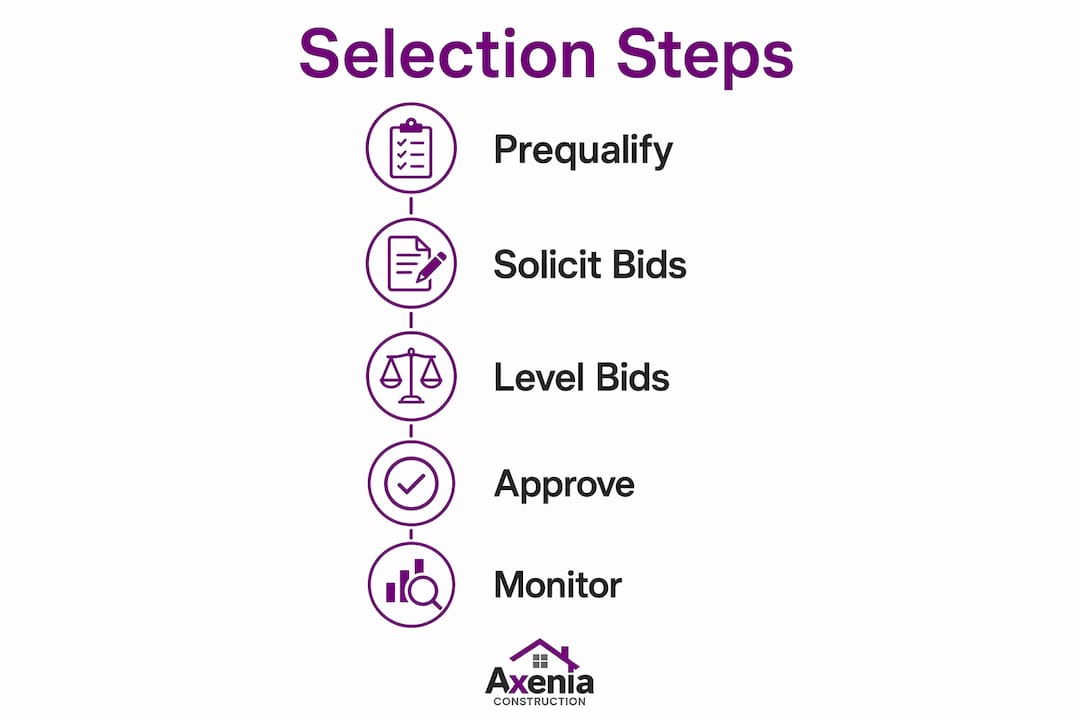
Step 1: Prequalify before you solicit bids
Prequalification filters out unqualified subcontractors before they submit pricing. Collect financials, references, litigation history, and current project capacity from every candidate. A subcontractor operating above 90% capacity risks delays and quality failures on your project. Capacity is a qualification, not a preference.
Step 2: Solicit bids from multiple qualified candidates
Aim for 3–5 qualified bidders per trade. For high-value trades like mechanical, electrical, and plumbing, five or more bidders produces more competitive pricing and reduces the risk of a single-source failure. Fewer than three bids gives you no meaningful comparison.
Step 3: Level the bids
Bid leveling normalizes each submission to the same scope basis. When one subcontractor excludes permits and another includes them, the lower number is not actually lower. Create a bid leveling sheet that adds estimated costs (called “plugs”) for any missing scope items. This produces an apples-to-apples comparison.
| Evaluation factor | What to look for |
|---|---|
| Scope completeness | All required line items included, no unexplained exclusions |
| Bid leveling adjustment | Plugs added for missing scope items |
| References | At least two verifiable projects of similar size and type |
| Current workload | Capacity to staff your project without overextension |
| Litigation history | No unresolved claims or pattern of disputes |
Step 4: Use a multi-person approval process
Multi-person approval reduces individual bias and catches financial or safety red flags that a single reviewer might miss. At minimum, have two people review the prequalification package and bid before any award is made. Document the decision and the reasoning.
Pro Tip: Red flags in a bid include vague scope language, no unit pricing, and bids that are more than 20% below the next lowest number. A bid that is too low is not a deal. It is a signal that scope is missing or the subcontractor is buying the job.
How do you protect your investment through contract terms and ongoing compliance?
Selecting the right subcontractor is only half the work. The subcontract agreement and your ongoing oversight determine whether that selection holds up through the life of the project.
Every subcontract agreement for DC, MD, and VA projects should include:
- Defined scope of work: Specific enough that disputes over inclusions are unlikely. Attach the bid leveling sheet as an exhibit.
- Schedule milestones: Tie payment to completion of defined phases, not just calendar dates.
- Retainage terms: Standard retainage withholds 5–10% of each payment until substantial completion. This gives the subcontractor a financial incentive to finish and fix punch list items.
- Insurance requirements: Restate the required coverage limits and additional insured status in the contract itself.
- Default and termination clauses: Define what constitutes a default, how notice is given, and what cure period applies before termination.
- Dispute resolution: Specify mediation or arbitration before litigation. This saves time and legal costs for both parties.
- Lien waiver requirements: Require conditional lien waivers with each payment and unconditional waivers at final payment. This protects your property from mechanic’s liens filed by unpaid suppliers.
Ongoing compliance monitoring is equally critical. Annual re-submission of qualification documents with enforced deadlines keeps insurance, licensing, and safety records current throughout a long project. Insurance lapses mid-project are more common than most owners expect. A subcontractor whose policy expires in month three of a six-month project leaves you exposed for the back half of the work.
When you identify a performance decline or safety concern, issue a written notice immediately. Document the issue, the required corrective action, and the deadline. Verbal conversations do not create a record you can rely on if the relationship deteriorates.
Understanding commercial construction contract types also helps you structure subcontractor agreements that align with your prime contract obligations.
What are the most common mistakes in subcontractor selection?
Most subcontractor selection failures trace back to shortcuts taken early in the process. Recognizing these patterns helps you avoid them.
- Selecting on price alone: A low bid that excludes key scope items will cost more than a complete bid at a higher number. Always level bids before comparing.
- Ignoring capacity: A subcontractor with a full schedule cannot staff your project adequately. Ask directly: how many active projects do you currently have, and what is your crew size?
- Accepting expired documents: Insurance certificates and licenses have expiration dates. Check them. An expired policy provides no coverage.
- Skipping multi-person review: One person reviewing a prequalification package misses things. Two people catch more. Document the review.
- No requalification after award: Prequalification at the start of a project does not guarantee compliance at month six. Build requalification checkpoints into your project schedule.
- Relying on relationships over process: A subcontractor you have worked with before still needs to meet current standards. Familiarity is not a substitute for documentation.
Pro Tip: Build a simple subcontractor evaluation criteria scorecard before you solicit bids. Score each candidate on license status, insurance, EMR, references, and capacity. A numeric score makes the award decision defensible and reduces the influence of personal preference.
Knowing how to choose the right contractor from the start saves you from the most expensive mistakes in construction.
Key Takeaways
Selecting the right subcontractor requires a structured process that combines credential verification, safety assessment, bid leveling, and ongoing compliance monitoring throughout the project.
| Point | Details |
|---|---|
| Verify credentials directly | Confirm licenses and insurance with issuing authorities, not just subcontractor-provided copies. |
| Scale vetting to contract size | Projects over $500K require bonding, audited financials, and a dedicated project manager. |
| Level all bids before comparing | Add plugs for missing scope items so every bid reflects the same work. |
| Use multi-person approval | Two reviewers catch financial and safety red flags that one person misses. |
| Monitor compliance continuously | Require annual requalification documents and check insurance at every payment cycle. |
What I have learned from watching owners skip the process
By Arienne
After years of working on construction projects across DC, Maryland, and Virginia, the pattern I see most often is this: owners who skip structured vetting do so because they feel time pressure. They need the project started. They trust the referral. They assume the general contractor is handling it. Sometimes that works. More often, it creates a problem that surfaces at the worst possible moment, usually mid-project when replacing a subcontractor costs twice what proper vetting would have.
The piece of advice I give most often is to treat prequalification as a fixed cost of doing business, not an optional step. The time you spend verifying a license and calling two references is nothing compared to the time you spend managing a dispute with an uninsured subcontractor who walked off the job.
Local licensing rules in DC, MD, and VA add a layer of complexity that out-of-area owners consistently underestimate. A contractor licensed in one jurisdiction is not automatically compliant in another. That detail alone has derailed projects I have seen firsthand.
The multi-person approval process is the single change that makes the biggest difference in practice. It is not bureaucracy. It is a second set of eyes that catches the expired certificate, the missing reference, and the bid that is suspiciously low. Build it into your process before you need it.
— Arienne
How Axeniaconstruction supports your subcontractor selection in DC, MD, and VA
Axeniaconstruction manages the full subcontractor vetting process on every project it takes on, from initial prequalification through final lien waiver collection. As a licensed, locally owned general contractor based in Rockville, MD, Axeniaconstruction brings direct knowledge of DC, Maryland, and Virginia licensing requirements, insurance standards, and local trade markets.

Whether you are planning a residential renovation or a commercial build-out, Axeniaconstruction handles subcontractor selection with the same structured, documented process described in this guide. You get the benefit of established trade relationships, verified credentials, and continuous compliance monitoring without managing it yourself. Reach out to Axeniaconstruction to discuss your project and learn how we put this process to work for you.
FAQ
What is subcontractor prequalification?
Subcontractor prequalification is the process of evaluating a trade contractor’s licenses, insurance, financial health, safety record, and capacity before inviting them to bid on a project. It filters out unqualified candidates before pricing is collected.
How many bids should I collect per trade?
Aim for 3–5 qualified bidders per trade. For high-value trades like mechanical, electrical, and plumbing, five or more bids produces more competitive pricing and reduces single-source risk.
What is bid leveling and why does it matter?
Bid leveling adjusts each submission to reflect the same scope by adding estimated costs for any items a subcontractor excluded. It prevents a low bid that is missing key work from being selected over a complete bid at a higher price.
What is retainage in a subcontract agreement?
Retainage is a percentage of each payment, typically 5–10%, withheld until substantial completion. It gives the subcontractor a financial incentive to finish the work and address punch list items before final payment is released.
How often should I requalify a subcontractor during a project?
Require requalification documents at least annually on long projects, and verify insurance certificates at every major payment milestone. Insurance lapses and safety metric changes can occur mid-project without any notification to the owner.