
A general contractor is the licensed professional responsible for executing the physical construction of your project, while a construction manager (CM) serves as a coordinator and advisor focused on planning, scheduling, and budget oversight. Understanding what is general contractor vs CM is the single most important decision you will make before breaking ground. Confusing these two roles is a leading cause of budget overruns and project delays, according to industry experts. For homeowners and commercial property owners across DC, Maryland, and Virginia, getting this distinction right protects your investment from day one.
What is general contractor vs CM: the core definitions
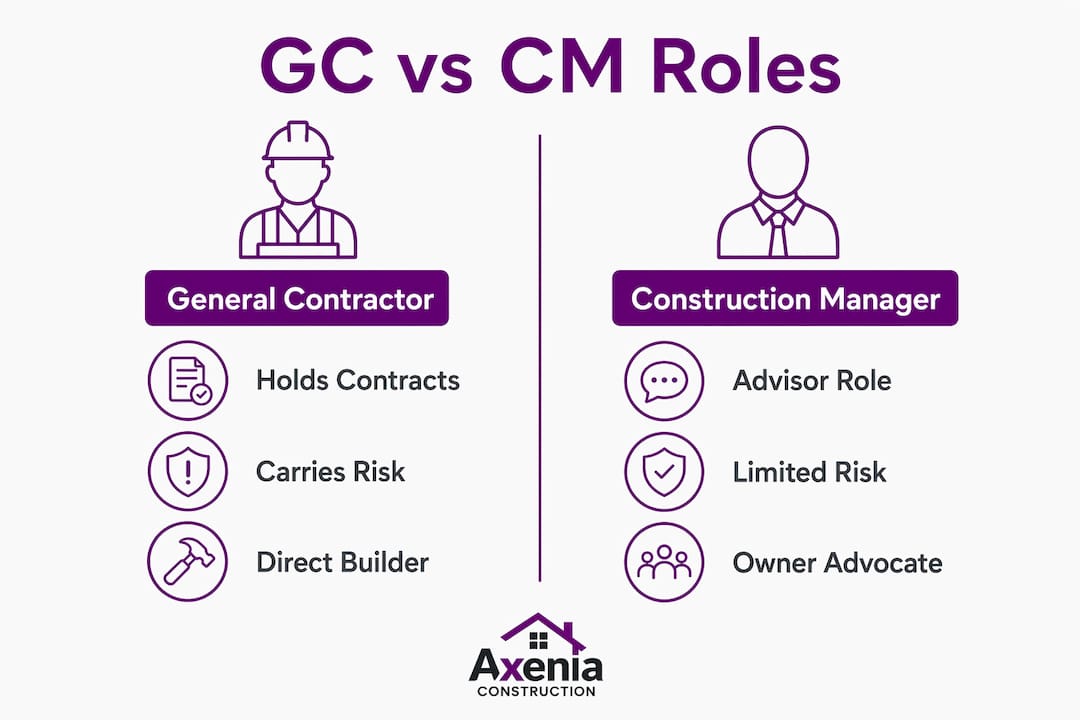
A general contractor is the primary builder on your project. The GC holds contracts with subcontractors, manages the job site, and takes legal responsibility for construction quality and safety. GCs are active predominantly during construction, coordinating trades, materials, and site execution to deliver the finished product per contract documents.
A construction manager, by contrast, acts as the owner’s advocate for coordination and overall project delivery. Agency CMs do not perform construction tasks but advise the owner on scheduling, budgeting, and contractor selection. The CM’s value is consultative, not physical. Think of the GC as the builder and the CM as the project strategist sitting on your side of the table.
The industry recognizes three distinct roles: the Owner’s Representative, the Construction Manager, and the General Contractor. Each has a distinct sphere of control, and confusing them is a documented cause of project failure. Knowing which professional you are hiring, and what they are contractually obligated to do, sets the foundation for every decision that follows.
What are the primary responsibilities of a general contractor?
General contractor responsibilities center on the physical build. The GC is your boots-on-the-ground leader, managing every trade and material that goes into your home or commercial space.
Core GC responsibilities include:
- Site management: The GC controls access, safety compliance, and daily operations on the job site.
- Subcontractor coordination: The GC holds direct contracts with electricians, plumbers, framers, and other specialty trades.
- Quality control: The GC is accountable for delivering work that meets the contract drawings and specifications.
- Permitting and inspections: In DC, Maryland, and Virginia, the GC typically pulls the required building permits and coordinates inspections with local authorities.
- Schedule and budget execution: The GC tracks progress against the agreed timeline and manages costs within the contracted scope.
The GC carries the construction risk. If a subcontractor performs defective work, the GC is liable to you as the owner. This accountability is what separates a GC from an advisory role.
Pro Tip: GCs increasingly offer preconstruction services such as budgeting and constructability reviews. If you want your GC involved before design is complete, write that expectation into the contract explicitly so there is no confusion about scope.
For residential renovations in the DC metro area, the GC model is the most common structure. You hire one licensed contractor, they manage the trades, and you have a single point of accountability. For larger commercial projects, the picture gets more complex.
What does a construction manager do and how do their roles vary?
Construction managers come in two distinct forms, and mixing them up creates serious problems. The two models are CM-as-Agent and CM-at-Risk. Each carries a fundamentally different relationship with risk and contracts.

CM-as-Agent acts purely as your advisor. This CM does not hold trade contracts and assumes no financial risk for construction performance. The owner holds all subcontracts directly. The CM-as-Agent earns a fee for coordination, scheduling, and budget oversight. This model works well for experienced owners who want control over trade contracts but need professional guidance.
CM-at-Risk is a different arrangement. This CM holds trade contracts and assumes construction risk, but only after a Guaranteed Maximum Price (GMP) is established. CM-at-Risk models involve the CM assuming trade contracts and some construction risk once the GMP is set. In practice, a CM-at-Risk functions similarly to a GC during the construction phase.
Key CM responsibilities across both models include:
- Preconstruction planning: CMs are typically hired earlier than GCs, often during the design phase, to provide cost estimates and schedule input.
- Budget oversight: The CM monitors costs and flags scope creep before it becomes expensive.
- Contractor selection: The CM helps evaluate and recommend trade contractors.
- Owner communication: The CM serves as the primary liaison between the owner, architect, and contractors.
- Schedule management: The CM tracks milestones and coordinates sequencing across all trades.
Pro Tip: Before signing any CM contract, confirm in writing whether your CM is acting as agent or at-risk. This distinction prevents misalignment on budget responsibility and liability that can surface mid-project at the worst possible time.
Construction managers provide value through advocacy and expertise, not direct trade management. This is a fact that owners frequently misunderstand, and the misunderstanding leads to unmet expectations on both sides.
How do risk and contract structures differ between a GC and a CM?
Risk is the clearest dividing line between these two roles. Where the risk sits determines who loses money when something goes wrong.
| Role | Holds Trade Contracts | Construction Risk | Contract Type | Owner Risk |
|---|---|---|---|---|
| General Contractor | Yes | Full risk | Lump sum or GMP | Low, GC absorbs most risk |
| CM-as-Agent | No | None | Fee-based advisory | High, owner holds all contracts |
| CM-at-Risk | Yes (post-GMP) | Shared after GMP | GMP contract | Moderate, shared after GMP set |
Under the standard GC model, the general contractor holds all construction risk. If costs overrun the agreed contract amount, the GC absorbs the difference in a lump-sum arrangement. This is why GC pricing tends to be higher upfront. You are paying for that risk transfer.
A CM-as-Agent arrangement shifts risk back to you as the owner. You hold the trade contracts, which means you are directly exposed if a subcontractor defaults or costs spike. The CM earns a fee regardless of construction outcomes. This model requires a more active and informed owner.
In DC, Maryland, and Virginia, local permitting requirements add another layer of consideration. The entity holding the general contractor license is typically the one responsible for pulling permits. In a CM-as-Agent structure, you may need a separate licensed GC to pull permits, which adds cost and coordination complexity. Clarifying this before you sign any contract saves significant headaches later.
How do project phases and workflow differ for a GC vs a CM?
The timing of engagement tells you a great deal about which professional fits your project.
- Design phase: CMs are typically brought in during design to provide cost estimates, flag constructability issues, and build preliminary schedules. GCs are rarely involved this early in a traditional delivery model.
- Preconstruction phase: The CM leads budget refinement, contractor prequalification, and long-lead procurement planning. A GC may offer preconstruction services if you request them, but this is not the default expectation.
- Construction phase: The GC takes the lead. The GC manages the site, coordinates trades, and drives daily progress. A CM-as-Agent continues in an oversight and advisory role, attending meetings and monitoring performance without directing the work.
- Closeout phase: Both roles have responsibilities here. The GC delivers punch list completion and warranty documentation. The CM verifies that all deliverables meet the owner’s requirements before final payment.
Rigorous information management including Requests for Information (RFIs), change orders, and submittals is critical regardless of which model you choose. Poor documentation causes delays whether you have a GC or a CM running your project. The project manager, in either model, serves as the central hub for this information flow.
Project management methodology matters as much as professional titles. A well-run GC using clear communication protocols will outperform a CM arrangement with poor documentation practices every time. The structure supports success, but the execution determines it.
What should DC, MD, and VA property owners consider when choosing?
Choosing between a GC and a CM comes down to your project’s size, your risk tolerance, and how involved you want to be day to day.
- Project size and complexity: Smaller residential renovations in Maryland or Virginia almost always work best with a GC. Larger commercial builds with multiple prime contractors benefit from a CM structure.
- Owner involvement: If you want to stay hands-off, a GC is the right choice. The GC manages everything and reports back to you. A CM-as-Agent requires you to be an active participant in contract decisions.
- Budget control: A CM-at-Risk with a GMP gives you a cost ceiling. A lump-sum GC contract also caps your exposure. A CM-as-Agent arrangement leaves you most exposed to cost escalation.
- Risk tolerance: If you want maximum protection, hire a GC or a CM-at-Risk. If you are an experienced developer who wants direct control over trade contracts, a CM-as-Agent may save you money.
- Local permits: In DC, Maryland, and Virginia, confirm which party holds the general contractor license and is responsible for permit applications before finalizing your contract structure.
A common owner pitfall is hiring a CM-as-Agent while expecting GC-level accountability. Clarifying this early in contracts prevents misalignment on budget and liability. Read the contract carefully, ask your attorney to review it, and confirm the risk allocation in writing before work begins.
For commercial project guidance specific to the DC metro region, understanding local licensing requirements and permit timelines is just as important as understanding the contract structure itself.
Key Takeaways
The most important decision in any construction project is understanding who holds the contracts, who carries the risk, and who manages the physical work before you sign anything.
| Point | Details |
|---|---|
| GC holds construction risk | The general contractor absorbs cost overruns and is liable for subcontractor performance. |
| CM-as-Agent carries no risk | The owner holds all trade contracts and bears direct financial exposure in this model. |
| CM-at-Risk shares risk post-GMP | The CM assumes trade contracts and risk only after a Guaranteed Maximum Price is established. |
| Engagement timing differs | CMs enter during design; GCs typically engage after design is complete. |
| Contract clarity prevents disputes | Defining role, risk, and scope in writing before work begins protects owners in DC, MD, and VA. |
Why role clarity is the most underrated part of any construction project
I have seen projects in the DC metro area go sideways not because of bad contractors or poor design, but because nobody agreed on who was responsible for what. An owner hires a CM thinking they have someone managing the build, then discovers mid-project that their CM-as-Agent has no authority to direct the trades. The trades answer to whoever holds their contract. If that is the owner, the owner is suddenly managing a construction site with no experience doing so.
The uncomfortable truth is that the title on a business card tells you almost nothing. A CM-at-Risk and a GC are functionally similar during construction. A CM-as-Agent and an Owner’s Representative are also very similar. What matters is the contract language, the risk allocation, and the scope of authority. I always tell property owners to read the contract as if the relationship will go badly, because that is when the language actually matters.
The other thing I have learned is that early engagement pays off. Whether you hire a GC with preconstruction services or bring in a CM during design, getting professional input before the drawings are finalized saves money. Design changes cost a fraction of construction changes. The owners who invest in that early coordination consistently have smoother projects and fewer surprises at the end.
— Arienne
Axeniaconstruction is ready to guide your next project
Axeniaconstruction is a licensed, women-owned general contractor based in Rockville, MD, serving homeowners and commercial property owners across DC, Maryland, and Virginia. We bring the same team from preconstruction through closeout, so you always know who is accountable for your project.

Whether you are planning a home renovation or a commercial build, we can help you understand which delivery model fits your goals and budget. Our general contracting services cover residential renovations, tenant buildouts, and commercial construction throughout the region. We believe in transparent communication and genuine relationships, not just contracts. Reach out to Axeniaconstruction today to discuss your project and get a clear picture of what the right structure looks like for you.
FAQ
What is the main difference between a general contractor and a CM?
A general contractor executes the physical construction and holds all trade contracts, while a construction manager coordinates and advises the owner without necessarily holding trade contracts or construction risk.
What does CM-at-Risk mean?
CM-at-Risk means the construction manager assumes trade contracts and shares construction risk with the owner, but only after a Guaranteed Maximum Price is agreed upon.
When should I hire a CM instead of a GC?
Hire a CM when your project is large and complex, requires extensive preconstruction planning, or when you want an advisor to represent your interests before a GC is selected.
Do I need both a general contractor and a construction manager?
Not always. On smaller residential projects in DC, MD, or VA, a GC alone is sufficient. On larger commercial projects, a CM-as-Agent may work alongside a GC to provide owner-side oversight.
Who pulls the building permits in DC, MD, and VA?
The licensed general contractor typically pulls building permits. In a CM-as-Agent structure, a separate licensed GC may be required to handle permitting, which adds cost and coordination steps.