
Hiring a licensed contractor is the single most effective way to protect your home, your money, and your legal standing during any renovation project. The term “licensed contractor” refers to a professional who has passed state-required exams, carries liability insurance and workers’ compensation coverage, and is accountable to a state licensing board. Understanding why hire a licensed contractor for your home project goes beyond quality preference. It is a legal and financial necessity that most homeowners only appreciate after something goes wrong.
What are the risks of hiring unlicensed contractors for home renovations?
The financial exposure from unlicensed work is severe. Homeowners who hire unlicensed contractors face average financial losses between $35,000 and $75,000 from substandard work and abandoned projects. In extreme cases, losses climb above $150,000 when teardown and redo costs are included. That is not a contractor problem. That is a homeowner crisis.

Legal consequences compound the financial damage. Operating without a license is a Class A misdemeanor in many states, carrying penalties up to one year in prison and $5,000 in fines per violation. Homeowners who knowingly hire unlicensed workers can share in that legal exposure. The risk is not theoretical. State enforcement agencies actively investigate and prosecute these cases.
Insurance is the hidden trap most homeowners miss. Standard homeowner’s insurance policies frequently exclude coverage for damage or injury resulting from unlicensed or unpermitted work. That means a fire caused by faulty wiring installed without a permit could leave you paying out of pocket for the full repair.
“Unlicensed contractors’ lack of insurance presents a primary danger, shifting liability for injuries and damage directly to homeowners.”
The contract problem is equally serious. Contracts with unlicensed contractors are often unenforceable, which means you have no legal avenue to recover deposits or losses from unfinished work. You cannot sue for breach of contract if the contract itself is void. That leaves you with no money, no finished project, and no legal recourse.
- Void contracts: Agreements with unlicensed workers often cannot be enforced in court.
- Worker injury liability: Homeowners can face $50,000 to $500,000+ in liability if an uninsured worker is injured on their property.
- Permit trap: If you pull permits on behalf of an unlicensed contractor, you become the contractor of record, legally responsible for payroll taxes, workers’ compensation, and all project liabilities.
- Insurance exclusions: Damage from unpermitted work is typically excluded from standard homeowner’s insurance claims.
- No complaint board access: Unlicensed contractors are not subject to state licensing boards, so you have no formal dispute channel.
How do licensed contractors provide legal and financial protection?
Licensed contractors must meet a defined set of requirements before they can legally work on your home. These requirements exist to protect you, not the contractor. Understanding them helps you see exactly what you are paying for when you hire a certified home contractor.
-
State exam and background check. Licensed contractors pass trade-specific exams and are screened for prior criminal history and financial responsibility. A contractor with a pattern of fraud or financial misconduct cannot obtain or keep a license.
-
Insurance and bonding. Licensed contractors carry general liability insurance and workers’ compensation. If a worker is injured on your property, their insurance pays. If their work damages your home, their liability policy covers it.
-
Permit and inspection compliance. Licensed contractors pull permits and schedule inspections through your local building authority. This process is not bureaucratic friction. It is the mechanism that catches errors before they become structural failures. Axeniaconstruction handles the full permit process on every residential project, so homeowners never face that administrative burden alone.
-
State contractor recovery funds. Many states maintain recovery funds that provide up to $30,000 in compensation to homeowners harmed by licensed contractors who fail to complete work. This safety net does not exist for unlicensed work.
-
Licensing board accountability. Licensed contractors are subject to state regulatory boards. You can file a formal complaint, and license revocation is possible for unresolved violations. That accountability is a powerful deterrent against poor workmanship.
Pro Tip: Ask your contractor for a certificate of insurance before any work begins. A legitimate licensed contractor will provide it without hesitation. If they stall or deflect, treat that as a serious warning sign.
Licensing also signals financial stability. A contractor who has maintained their license, kept insurance current, and avoided board complaints has demonstrated operational discipline over time. That track record matters more than any sales pitch.
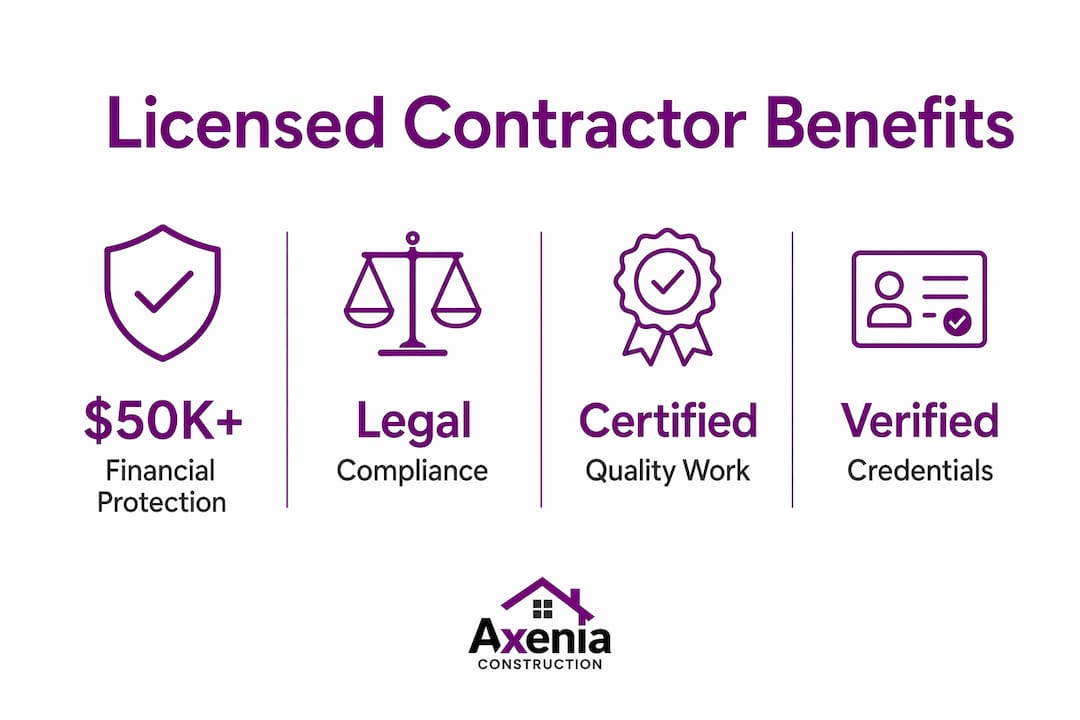
How can homeowners verify a contractor’s license and credentials?
Vetting a licensed contractor takes roughly 2–3 hours per candidate. That time investment is small compared to the cost of hiring the wrong person. Here is how to do it correctly.
- Check the state licensing board. Every state maintains a public database of licensed contractors. Search by name and license number. Confirm the license is active and covers the type of work you need.
- Review complaint history. The same database shows formal complaints and disciplinary actions. One resolved complaint is not disqualifying. A pattern of complaints is.
- Verify insurance directly. Ask for a certificate of insurance and call the insurer to confirm the policy is active. Do not accept a document without verifying it.
- Ask for references from recent projects. Speak to at least two previous clients about timeline, communication, and final quality.
- Use local trade associations. Organizations like the National Association of Home Builders connect homeowners with vetted, licensed professionals in their area.
You can also learn how to verify a contractor’s license in Maryland through Axeniaconstruction’s step-by-step guide, which walks you through the exact process for the DC, MD, and VA region.
| Red flag | What it signals |
|---|---|
| Refuses to provide license number | Likely unlicensed or operating under an expired license |
| Demands large upfront payment | High risk of project abandonment after deposit is collected |
| Claims no permit is needed | Either uninformed or deliberately avoiding oversight |
| No written contract offered | No legal protection for either party |
| Cannot provide insurance certificate | You assume full liability for injuries and damage |
Demanding large upfront payments and refusing to provide licenses are the two most consistent red flags across contractor fraud cases. Recognizing them early saves you from a costly mistake.
How do licensed contractors improve quality and home value?
Licensed contractors produce better work because the system requires it. Licensed work must meet building codes enforced through official inspections. That compliance directly affects the long-term resale value of your home. A buyer’s home inspector will flag unpermitted additions, substandard wiring, and non-code plumbing. Those flags kill deals or force price reductions.
The quality difference starts before the first nail is driven. Licensed contractors pass trade exams that test their knowledge of materials, methods, and safety standards. Many states also require continuing education to maintain licensure. That means a licensed contractor’s knowledge stays current with updated codes and construction techniques.
Pro Tip: When reviewing bids, ask each contractor which building code edition applies to your project and how they plan to document compliance. A licensed professional will answer immediately. An unlicensed one often will not know.
Licensed contractors also coordinate the full scope of a project. They manage subcontractors, schedule inspections, and maintain timelines. That coordination prevents the common home addition mistakes that cost homeowners thousands in rework. An unlicensed worker focused only on their trade leaves gaps that no one else fills.
- Code-compliant work passes inspections, which protects resale value and prevents costly teardowns.
- Documented permits create a paper trail that future buyers and their lenders require.
- Licensed project management reduces delays caused by uncoordinated subcontractors.
- Ongoing education requirements keep licensed professionals current on safety and materials standards.
- Accountability to licensing boards creates a direct incentive to deliver quality work and honor contracts.
Licensed contractors offer legal security, financial protection, and quality assurance that unlicensed workers structurally cannot provide. The benefits of hiring a licensed contractor are not abstract. They show up in your inspection report, your insurance claim, and your home’s sale price.
Key Takeaways
Hiring a licensed contractor is the most reliable way to protect your home investment, maintain legal compliance, and secure quality workmanship on any renovation project.
| Point | Details |
|---|---|
| Licensing prevents financial loss | Unlicensed work can cost homeowners $35,000–$75,000 in losses from substandard or abandoned projects. |
| Insurance and bonding protect you | Licensed contractors carry liability and workers’ compensation coverage, keeping you off the hook for on-site injuries. |
| Permits and inspections add value | Code-compliant, permitted work protects resale value and satisfies future buyers and lenders. |
| Vetting takes 2–3 hours per candidate | Check state licensing boards, verify insurance directly, and review complaint history before signing anything. |
| Contracts are legally enforceable | Licensed contractor agreements hold up in court; contracts with unlicensed workers are often void and unenforceable. |
What I’ve learned after years of watching homeowners skip this step
I have seen the same pattern repeat itself more times than I can count. A homeowner gets three bids. The licensed contractors come in at $28,000. An unlicensed worker quotes $16,000. The homeowner chooses the $16,000 option, reasoning that the work is simple and the savings are real. Six months later, they are calling a licensed contractor to fix what went wrong, and the repair bill exceeds the original licensed bid.
The lowest price is not the best value. That is not a cliché. It is a financial reality that shows up in contractor fraud cases, insurance denials, and failed home inspections across the country. The licensed contractor advantages are not premium features. They are baseline protections that every homeowner deserves.
What I find most frustrating is how avoidable these situations are. Vetting a contractor properly takes an afternoon. Checking a license number on your state’s board website takes five minutes. Asking for a certificate of insurance takes one phone call. These steps feel tedious when everything seems fine. They feel like lifesavers when something goes wrong.
The other mistake I see constantly is homeowners treating the contract as a formality. Read it. Understand the payment schedule, the scope of work, and the dispute resolution clause. A licensed contractor who resists putting details in writing is a contractor worth walking away from, regardless of their license status.
Good communication and a clear contract are not nice to have. They are the foundation of a project that finishes on time, on budget, and without regret.
— Arienne
Axeniaconstruction: licensed expertise for your next home project
Axeniaconstruction is a licensed, women-owned general contractor based in Rockville, MD, serving residential and commercial clients across the DC, MD, and VA region. Every project we take on is backed by full licensing, active insurance, and a transparent process from the first consultation to the final inspection.

We handle permits, coordinate subcontractors, and keep you informed at every stage. Our team specializes in residential renovation services that meet local building codes and pass inspections the first time. Whether you are planning a kitchen remodel, a home addition, or a full renovation, we bring the credentials and the communication that protect your investment. Reach out to Axeniaconstruction to schedule a consultation and get a clear, detailed bid from a contractor you can verify and trust.
FAQ
What does a licensed contractor have to prove to get licensed?
Licensed contractors must pass state-required trade exams, submit to background checks for criminal and financial history, and carry active liability insurance and workers’ compensation coverage. States can revoke a license for unresolved complaints or legal violations.
Can I be held liable if an unlicensed contractor gets hurt on my property?
Yes. Homeowners can face $50,000 to $500,000 or more in liability for worker injuries when the contractor lacks workers’ compensation insurance. Your standard homeowner’s insurance policy will likely not cover the claim if the work was unpermitted.
Why does a building permit matter for my home renovation?
Permits trigger official inspections that confirm work meets local building codes. Unpermitted work can fail a home inspection during a sale, void your homeowner’s insurance for related claims, and require costly teardown and redo at your expense.
How do I check if a contractor is licensed in my state?
Visit your state’s contractor licensing board website and search by the contractor’s name or license number. Confirm the license is active, covers the correct trade category, and shows no unresolved disciplinary actions.
What is a contractor recovery fund?
A contractor recovery fund is a state-administered program that compensates homeowners harmed by licensed contractors who fail to complete or properly perform work. Many states provide up to $30,000 through these funds. This protection is only available when the contractor holds a valid state license.