A Guaranteed Maximum Price (GMP) contract is defined as a pricing agreement that caps the total amount an owner pays for a construction project, regardless of actual cost overruns. The contractor absorbs any costs above that ceiling, while savings can be shared if the project finishes under budget. For construction professionals and project managers evaluating what is a GMP contract construction, this structure offers a clear financial boundary without sacrificing design flexibility. GMP contracts are most common on large, complex projects where cost certainty matters but the scope is still evolving. Axeniaconstruction works with this contract type regularly across commercial and government projects in the Rockville, MD area.
What is a GMP contract in construction?
A GMP contract, formally called a Guaranteed Maximum Price contract, sets an absolute ceiling on what the owner will pay. Every cost above that ceiling becomes the contractor’s financial responsibility. This is the defining feature that separates GMP from a standard cost-plus arrangement, where the owner absorbs all cost growth.
The contract imposes an absolute cost ceiling, which motivates the contractor to manage the budget efficiently throughout the project. Owners gain predictability. Contractors gain a clear financial target to work toward.
GMP contracts also differ from lump sum contracts. A lump sum fixes the price at the start with no visibility into how costs break down. A GMP contract uses an open-book approach, meaning the contractor discloses all actual costs to the owner. That transparency builds trust and gives owners real-time insight into where money is going.

What are the core components of a GMP contract?
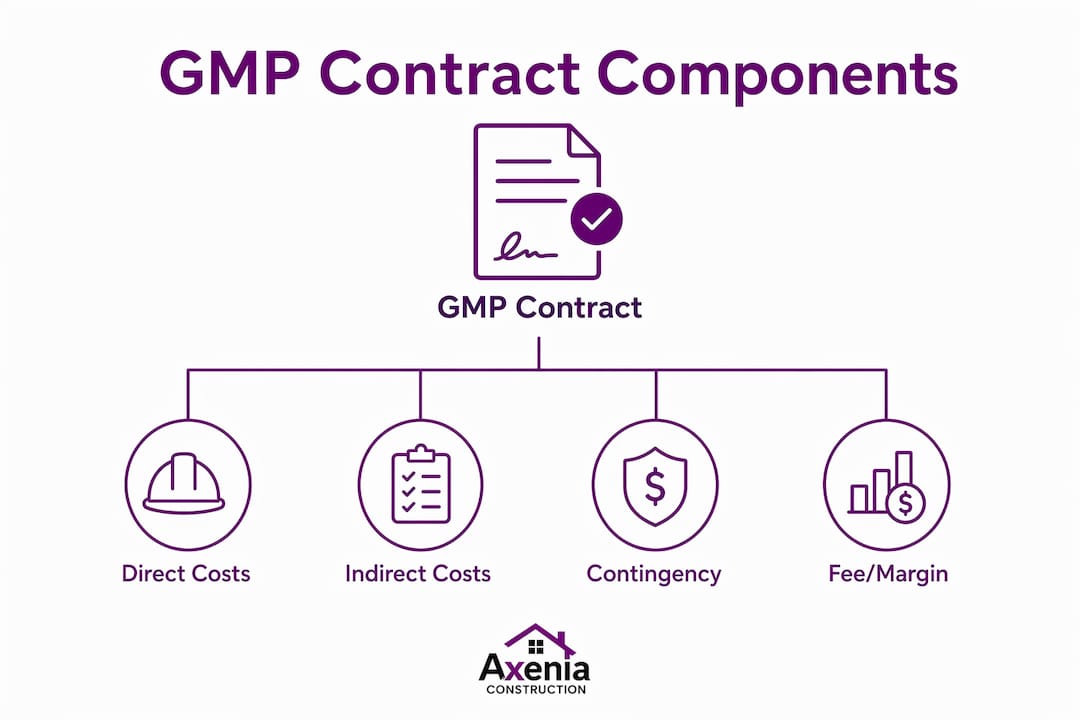
A GMP contract is built from four main cost categories. Understanding each one helps project managers evaluate whether a contractor’s GMP proposal is realistic.
| Cost Category | What It Covers |
|---|---|
| Direct costs | Labor, materials, and equipment used on-site |
| Indirect costs | Site supervision, temporary facilities, and utilities |
| Contractor’s fee | Overhead and profit margin |
| Contingency allowance | Reserve for unforeseen conditions within scope |
Direct costs form the largest portion of any GMP. Indirect costs cover the infrastructure needed to run the job site. The contractor’s fee is negotiated upfront and stays fixed. The contingency allowance is the most debated line item because it protects against surprises without inflating the GMP ceiling unnecessarily.
The open-book cost transparency requirement is what makes GMP contracts function. Owners can audit actual invoices, subcontractor bids, and material receipts. This visibility prevents contractors from padding line items and gives owners confidence that the GMP reflects real costs.
- Direct costs include all field labor, subcontractor work, and purchased materials.
- Indirect costs cover project management staff, site trailers, and temporary power.
- Contractor’s fee is typically a percentage of direct and indirect costs, agreed before signing.
- Contingency is held by the contractor but subject to owner review in well-drafted contracts.
Pro Tip: Negotiate an explicit contingency line item with audit rights. Contractors sometimes build hidden reserves into other cost categories rather than showing a transparent contingency amount. An open-book audit clause closes that gap.
How does a GMP contract work during a project?
The GMP contract operates through three financial mechanics: budget management, cost overrun handling, and shared savings distribution. Each mechanic shapes how the contractor and owner interact throughout the project lifecycle.
- Budget management. The contractor tracks all costs against the GMP ceiling in real time. Any cost that approaches the ceiling triggers a conversation with the owner before money runs out.
- Cost overrun handling. If actual costs exceed the GMP, the contractor pays the difference. The owner’s exposure stops at the agreed ceiling. This is the core financial protection the contract provides.
- Shared savings. If the project finishes under the GMP, many contracts split the difference between owner and contractor. This clause aligns project success goals and keeps the contractor motivated to find efficiencies rather than spend up to the ceiling.
- Scope change adjustments. Changes in scope can raise the GMP ceiling. Most contracts include a formal change order process that requires owner approval before the ceiling moves. Without this control, scope creep quietly inflates the GMP.
- Buyout phase. After the GMP is signed, the contractor negotiates final subcontractor pricing. The buyout phase post-GMP signing determines how savings from lower-than-expected subcontract bids are distributed. This is often a source of disputes if the contract does not define it clearly.
Pro Tip: The quality of the initial cost estimate is the single biggest predictor of GMP success. A weak estimate leads to an inflated contingency, disputes over scope, and a ceiling that does not reflect reality. Invest in a detailed pre-construction estimate before signing.
What are the benefits and limitations of GMP contracts?
GMP contracts reduce financial risk for owners while keeping contractors engaged in cost and schedule management. That combination is rare in construction contracting, which is why GMP has become the preferred structure for complex commercial projects.
Benefits for owners and contractors
- Cost certainty. The owner knows the maximum exposure before construction begins.
- Design flexibility. Unlike a lump sum, GMP accommodates design changes through formal change orders without voiding the contract.
- Contractor motivation. Shared savings clauses give contractors a financial reason to find efficiencies.
- Transparency. Open-book accounting reduces disputes and builds a collaborative relationship.
- Early contractor involvement. GMP contracts often bring the contractor in during design, which improves constructability and reduces surprises.
Limitations to plan for
- Higher initial price. Contractors price contingency conservatively when scope is uncertain, which can make the GMP ceiling look high compared to a lump sum bid.
- Substitution risk. Contractors may downgrade materials or subcontractor quality to stay within the GMP ceiling. Owners need active oversight to catch this.
- Scope creep exposure. GMP is vulnerable to scope creep when change order processes are loose. Small additions accumulate and push the ceiling higher than the owner anticipated.
- Complexity. GMP contracts require more administrative effort than lump sum contracts. Both parties need experienced project managers to run them well.
The balance of flexibility and cost certainty makes GMP better than a lump sum for evolving project scopes. The tradeoff is that GMP demands more attention from the owner throughout the project, not just at signing.
When should you use a GMP contract?
GMP contracts work best in specific project conditions. Choosing the wrong contract type for a project creates friction, disputes, and cost surprises that could have been avoided.
Ideal situations for a GMP contract
GMP fits large or complex projects where the design is not fully complete at the time of contracting. Hospital renovations, government facilities, and multi-phase commercial builds are common examples. These projects need cost certainty but cannot wait for a fully detailed set of drawings before engaging a contractor.
GMP also works well when the owner wants early contractor involvement. Bringing a general contractor into the design phase improves cost estimates and reduces design errors before they become field problems. The contractor’s real-world pricing knowledge shapes the design toward what is actually buildable within budget.
Projects requiring cost certainty but retaining flexibility for owner-driven changes are a natural fit. The formal change order process in a GMP contract gives owners control over scope additions while keeping the base budget protected.
How GMP compares to other contract types
| Contract Type | Cost Certainty | Design Flexibility | Owner Risk |
|---|---|---|---|
| GMP | High (capped) | Moderate | Low |
| Lump sum | High (fixed) | Low | Low |
| Cost-plus | Low | High | High |
| Time and materials | Low | High | High |
For a deeper look at how these contract structures compare across commercial projects, the types of commercial construction contracts guide covers each format with 2026 industry context. Choosing the right contract type before procurement starts saves significant time and money downstream.
Key Takeaways
A GMP contract caps the owner’s financial exposure while motivating the contractor to manage costs efficiently through shared savings, open-book transparency, and a formal change order process.
| Point | Details |
|---|---|
| GMP definition | A Guaranteed Maximum Price contract sets a ceiling on total project cost the owner pays. |
| Cost components | GMP includes direct costs, indirect costs, contractor’s fee, and a contingency allowance. |
| Shared savings | If costs finish under the GMP, owner and contractor split the difference per contract terms. |
| Substitution risk | Owners must monitor for material or subcontractor quality cuts when contractors face cost pressure. |
| Best use cases | GMP suits large, complex projects with evolving designs that need cost certainty and early contractor input. |
Why the buyout phase is the part most owners ignore
Here is what I have seen trip up otherwise well-run GMP projects: the buyout phase. Most owners focus all their energy on negotiating the GMP ceiling and then step back once the contract is signed. That is exactly the wrong moment to disengage.
After signing, the contractor goes out and finalizes subcontractor bids. If those bids come in lower than the GMP assumed, that gap is real money. Whether it flows back to the owner or stays with the contractor depends entirely on how the shared savings clause was written. Vague language here costs owners tens of thousands of dollars on mid-size projects.
I have also watched contractors build hidden contingencies into individual line items rather than showing a single transparent reserve. The total GMP looks reasonable, but the padding is distributed across a dozen categories where it is harder to spot. An open-book audit clause with the right to review subcontractor invoices is the only reliable defense against this.
The other thing I tell every project manager: do not underestimate how much a “small” scope change moves the ceiling. Owners often approve minor additions verbally, assuming they are covered by contingency. They are not. Each change needs a written change order that either adjusts the GMP or confirms it stays fixed. That discipline protects both parties and keeps the project relationship clean.
GMP contracts work well when both sides treat transparency as a shared value, not a negotiating position. When that trust exists, these contracts produce better outcomes than almost any other structure for complex commercial work.
— Arienne
How Axeniaconstruction approaches GMP projects
Axeniaconstruction brings the open-book discipline and pre-construction expertise that GMP contracts demand. As a licensed general contractor based in Rockville, MD, we work with commercial and government clients who need cost certainty without sacrificing flexibility during design and construction.
Our team gets involved early, before the GMP ceiling is set, to build estimates that reflect real subcontractor pricing and current material costs. That upfront work prevents the inflated contingencies and scope disputes that derail GMP projects. We also manage the buyout phase with full transparency, so our clients know exactly where savings come from and how they are shared. If you are planning a commercial project and want a contractor who treats the GMP as a partnership, explore our commercial construction services or reach out to discuss your project directly.
FAQ
What does GMP stand for in construction?
GMP stands for Guaranteed Maximum Price. It is a contract structure that caps the total cost an owner pays for a construction project, with the contractor absorbing any overruns above that ceiling.
How is a GMP contract different from a lump sum contract?
A lump sum fixes the price with no cost visibility, while a GMP contract uses open-book accounting so the owner can audit actual costs. GMP also allows formal scope changes; a lump sum typically does not.
Who benefits most from a GMP contract?
Owners benefit most because their financial exposure is capped. Contractors benefit when shared savings clauses reward efficient cost management below the GMP ceiling.
What happens if a GMP project goes over budget?
If actual costs exceed the GMP ceiling, the contractor pays the difference. The owner’s liability stops at the agreed maximum price, which is the primary financial protection the contract provides.
Can the GMP ceiling be changed after signing?
The GMP ceiling can increase through formal change orders when the owner approves scope additions or when unforeseen conditions outside the original assumptions arise. Without a written change order, the ceiling stays fixed.