
A construction change order is a signed amendment that changes scope, cost, or time on an active contract, and once executed, it becomes part of that contract. Do not let a crew start changed work until you have a signed change order in hand or, at minimum, a written construction change directive authorizing the work to proceed. Skip that step, and you risk losing your right to payment, schedule relief, or both.
TL;DR:
- Most change orders are triggered by owner upgrades, site conditions, or design errors, with larger projects experiencing more frequent and costly changes.
- Ensuring all change orders include signed documentation, scope details, cost, and schedule impacts prevents disputes and delays.
- Early coordination during the design phase significantly reduces the number and cost of late-stage change orders.
- Change orders should go through a clear process: log potential changes, gather backup, negotiate, and finalize with signatures before work proceeds.
- Using standardized forms and disciplined record-keeping minimizes administrative errors and controls cost overruns in construction projects.
Table of Contents
- What Is a Change Order in Construction, and Why Signatures Matter
- Common Reasons and Timing for Change Orders
- Change Order vs. Construction Change Directive vs. ASI
- What a Valid Change Order Must Include
- Who Pays for Change Orders, and How Markup Works
- The Change Order Process: From Request to Signature
- Documentation Habits That Prevent Change Order Disputes
- Why Design-Build Projects See Fewer Change Orders
- How Axenia Construction Handles Change Orders
- Treat Change Orders as Routine Contract Tools, Not Battles
- Get a Contractor Who Documents Every Change Order
- Where to Find the Standard Forms and Research
- Sources
- FAQ
What Is a Change Order in Construction, and Why Signatures Matter
A change order starts as a request but only becomes enforceable once it is written into the contract. The general contractor typically drafts the formal document, but the owner and architect both sign off, and on many commercial jobs the architect certifies that the change is consistent with the design intent. That triple check protects everyone.
Two forms show up on almost every well-run project: AIA G701, the standard change order form, and AIA A201, the general conditions that define how changes get authorized in the first place. A valid change order under these standards needs to nail down a few things:
- A clear statement of the added, removed, or altered work
- The adjusted contract sum, stated as a dollar figure, not a range
- The adjusted contract time, in calendar days
- Signatures from the owner, contractor, and typically the architect
Missing any one of those fields is often enough for a payment dispute to drag on for months.
Common Reasons and Timing for Change Orders
Owner-directed upgrades, unforeseen site conditions, design errors, and updated code requirements account for most change orders. Add a material substitution, driven by a supply shortage or a spec change, and you have covered the bulk of what triggers a change request on a typical job.
Timing matters as much as cause. Research analyzing large project databases found that many change orders surface in the final half of a project’s lifecycle, not the first, and that the average number of change orders climbs alongside the total contract value.
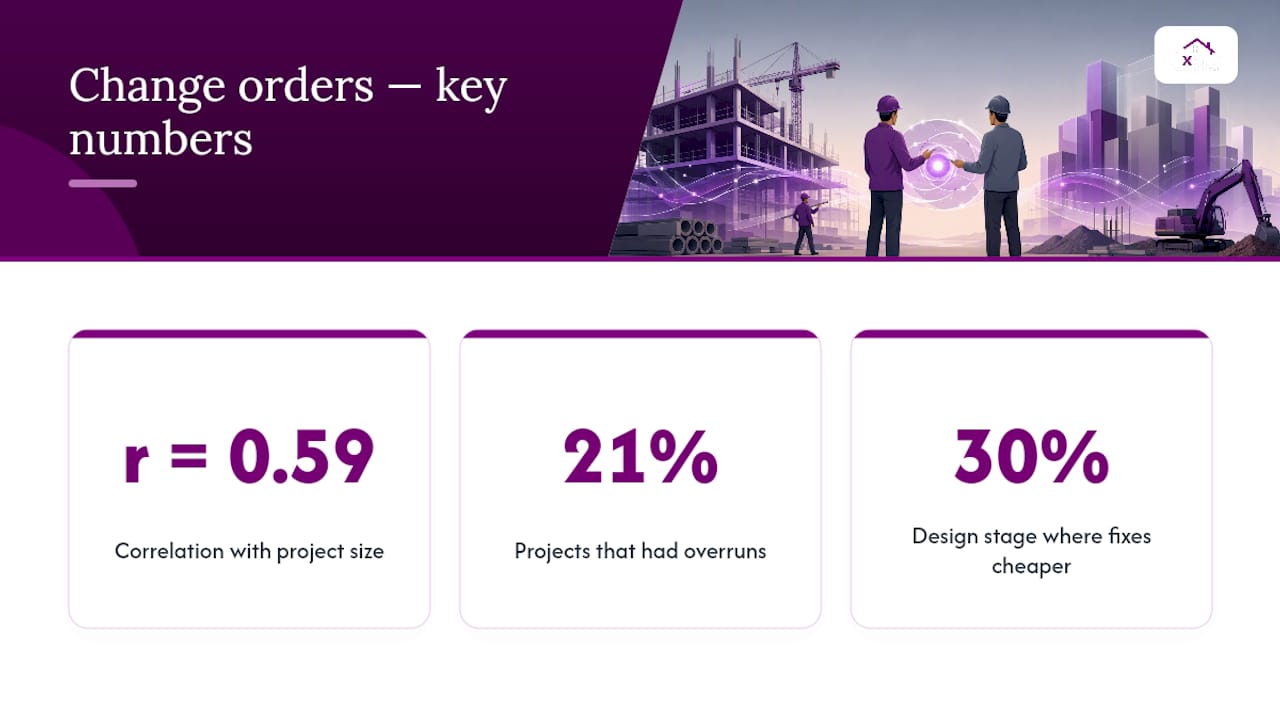
By the Numbers: A 125-project study found a positive correlation, r = 0.59, between project size and number of change orders, and 21% of the projects in that sample ran into cost overruns.
The practical lesson: early coordination between design and construction teams catches problems before they become late, expensive changes. A change caught at 30% design costs far less to fix than the same change caught after walls are framed.
Change Order vs. Construction Change Directive vs. ASI
These three instruments look similar on paper but carry very different risk. Knowing which one you are holding changes how you should respond.
- Change order (CO): Requires mutual agreement. Owner, contractor, and typically the architect all sign, and price and time are locked before work begins.
- Construction change directive (CCD): Lets the owner direct work to start before price or time is finalized. The contractor must proceed under A201’s directive provisions, then negotiate cost and schedule impact afterward, and the CCD converts into a change order once both sides agree on the numbers.
- Architect’s supplemental instruction (ASI): Reserved for minor clarifications, like a detail correction or a color selection, that do not alter cost or time at all.
If you are a contractor working under a CCD, track labor hours, material costs, and equipment time daily. That real-time record is your leverage once negotiation starts.
What a Valid Change Order Must Include
A complete change order reads like a mini contract amendment because that is exactly what it is. Confirm every one of these fields before anyone signs:
- Change order number and date
- Reference to the original contract number
- Detailed scope of the added, removed, or altered work
- Justification or reason code for the change
- Schedule impact, stated in calendar days
- Cost breakdown and the resulting updated contract sum
- Signature lines for owner, contractor, and architect
Supporting backup matters just as much as the form itself. Time-and-materials logs, supplier quotes, and labor hour records should travel with the change order, not sit in a separate email thread.
Pro Tip: File your backup documentation with the same change order number as the form itself. Disconnected paperwork is the single most common reason a legitimate change order gets challenged months later.
Who Pays for Change Orders, and How Markup Works
Payment responsibility follows the cause. Owner-directed upgrades get billed to the owner, full stop. Differing site conditions and design errors are murkier. Contract language, not general custom, decides who absorbs that cost, so read your differing-conditions clause before you assume the owner will pay.
Contractor markup on change order work commonly falls in a familiar band for overhead and profit, though the exact percentage should be spelled out in your contract, not assumed from industry habit. Watch for indirect costs too. These rarely show up on the invoice but hit the schedule hard:
- Schedule disruption and lost productivity on unrelated work
- Extra supervision hours to manage the changed scope
- Idle equipment sitting on site while a decision gets made
By the Numbers: Benchmark data across many completed projects puts the average cost change from change orders in the 4% to 5% range of total contract value, though individual projects can run well above or below that.
The Change Order Process: From Request to Signature
A clean change order process runs through three checkpoints before money or time officially moves.
- Log the potential change order (PCO). The moment anyone spots a needed change, whether it is a field condition or an owner request, write it down and log it. Verbal agreements do not hold up in a dispute.
- Collect the change order request (COR). Subcontractors submit backup, quotes, labor estimates, and material costs, on a set timeline, usually within days of the triggering event.
- Price, negotiate, and execute. The general contractor reviews subcontractor pricing, negotiates final numbers with the owner and architect, then routes the signed change order and updates the schedule of values and payment application to reflect the new contract sum.
Pro Tip: If work is already underway under a construction change directive, do not wait for the final number to start tracking costs. Convert to a signed change order the moment price and time are agreed, and back date the paper trail to the CCD’s issue date.
Documentation Habits That Prevent Change Order Disputes
Most change order disputes trace back to sloppy paperwork, not bad faith. Scattered emails, mismatched subcontractor and general contractor logs, and lost CORs are the leading causes of payment fights on change order work. Fix the process, and most disputes disappear before they start.
- Keep one shared change order log, and reconcile the general contractor’s version against subcontractor logs weekly.
- Enforce a hard rule: no changed work begins without a signed authorization in hand.
- Standardize your COR template so every subcontractor submits the same fields in the same order.
- Route signatures electronically so a change order does not sit on someone’s desk for two weeks.
Larger public projects benefit from the same discipline at scale. Government auditors have called for standardized data systems to track change order causes and impacts across public contracts, precisely because scattered records make it nearly impossible to spot patterns until costs are already out of control.
Why Design-Build Projects See Fewer Change Orders
Delivery method changes your change order exposure before a single nail gets driven. Design-build projects showed fewer change orders than design-bid-build projects in a direct comparison, largely because the contractor and designer collaborate on constructability from day one instead of handing off a finished design with unresolved conflicts.
- If minimizing change order risk is a priority, ask whether design-build delivery fits your project before you finalize a procurement method.
- Where design-bid-build is required, push for a pre-bid constructability review so field-level conflicts surface before contracts are signed, not after.
How Axenia Construction Handles Change Orders
A disciplined workflow on change orders includes capturing the request, logging it as a potential change order, negotiating pricing, executing a signed change order, then updating the schedule of values before any changed work proceeds. As a licensed, locally owned general contractor based in Rockville, transparent bid packages and clear change order terms are built into how projects are scoped from the start. Owners evaluating a contractor for an upcoming project can request a sample change order form and workflow during procurement, depending on the contractor.
Treat Change Orders as Routine Contract Tools, Not Battles
Most disputes start when one side treats a change order as an accusation instead of an update. Reframe it as neutral contract maintenance, and the tone of every negotiation shifts. Require signed CORs before work starts, hold a weekly change order reconciliation meeting, and most conflicts never get the chance to form.
— Arienne
Get a Contractor Who Documents Every Change Order
Axenia Construction gives project owners something most general contractors treat as an afterthought: a change order process that is written down, signed off, and tracked before work starts, not reconstructed from email threads after a dispute. That discipline shows up across general contracting, design-build, tenant buildout, and property management work, whether the project is a kitchen remodel in Rockville or a government tenant fit-out in Northern Virginia.

If you are scoping an upcoming renovation, commercial buildout, or government project, ask for Axenia Construction’s change order policy and sample change order form during your procurement conversation. Visit the general contracting services page to start that conversation and see how a documented process protects your budget and your timeline from day one.
Where to Find the Standard Forms and Research
- AIA G701 and A201 for standard change order forms and contract clauses
- ASCE research on change order frequency and project size
- AGC guidance and GAO reports on public-project change order practices
Sources
- Impacts of Change Orders on Cost and Schedule Performance and the Correlation with Project Size of DB Building Projects (ASCE)
- Impacts of Change Orders on Cost and Schedule Performance and the Correlation with Project Size of DB Building Projects (ResearchGate)
- Construction Change Orders: Fundamentals Every Party Should Know (AIA)
- Change Orders | Associated General Contractors of America
FAQ
What Constitutes a Change Order in Construction?
A change order is a written, signed amendment to a construction contract that alters the scope of work, the contract price, the schedule, or some combination of the three. It only takes legal effect once the owner, contractor, and typically the architect sign it.
Who Pays for Change Orders in Construction?
Payment responsibility depends on what caused the change. Owner-requested upgrades are billed to the owner, while costs tied to differing site conditions or design errors are allocated according to the specific language in the contract, not by default assumption.
How Do You Process a Change Order on a Construction Project?
The change starts as a logged potential change order, then a subcontractor submits a change order request with pricing backup, and the general contractor negotiates final terms with the owner and architect. Once signed, the schedule of values and payment application get updated to reflect the new contract sum.
How Common Are Change Orders on Construction Projects?
Change orders are the norm rather than the exception on most projects, and research shows the average cost change from change orders runs about 4% to 5% of total contract value. Larger projects tend to generate more change orders, and many surface in the back half of the project timeline rather than the front.