
A general contractor is the single professional who holds the prime contract with you, assumes full legal and financial responsibility for your renovation, and manages every moving part from the first permit to the final walkthrough. Without this central figure, you are left juggling separate contracts with plumbers, electricians, drywall crews, and tile setters while also tracking permits, inspections, and payment deadlines on your own. The role of general contractor in renovation work is far broader than most homeowners realize. Understanding what a GC actually does, and why that matters for your project, is the clearest path to a successful renovation.
What does a general contractor do in a renovation?
A general contractor, often called a GC, is the licensed professional who translates your design plans into a finished building. The industry term for this position is “prime contractor,” reflecting the fact that the GC holds the prime contract with the owner and assumes legal and financial responsibility for the entire project. Every other trade on your job site reports to the GC, not to you.
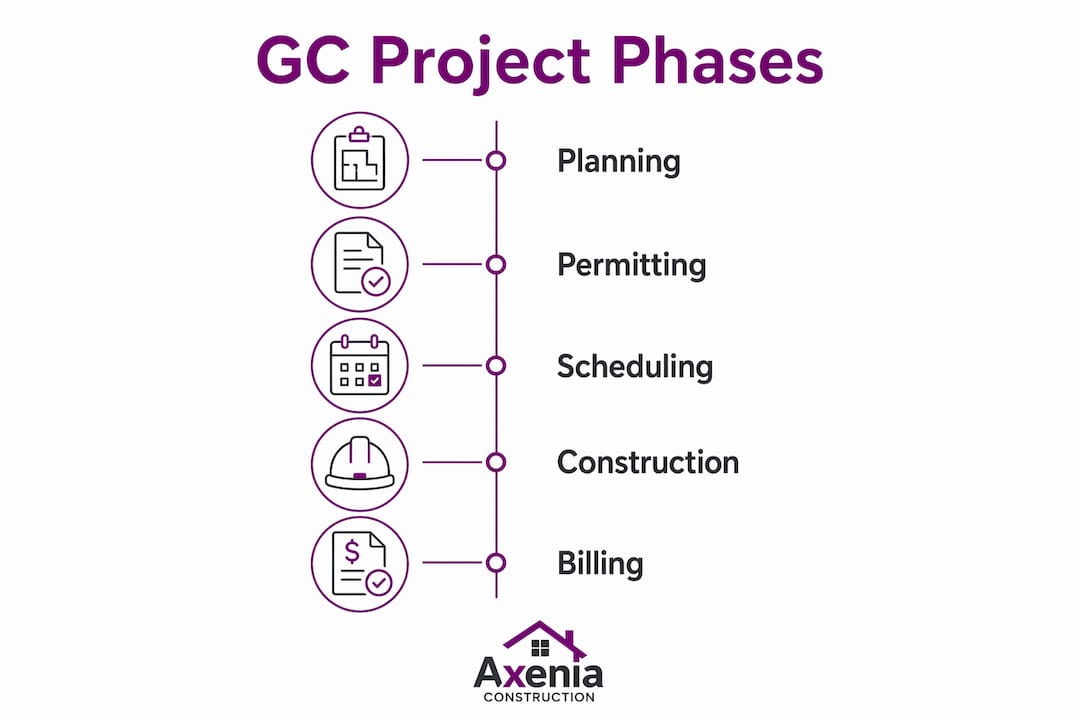
The GC’s scope covers three distinct phases. Before construction begins, the GC reviews drawings, prices the work, pulls permits, and lines up subcontractors. During construction, the GC schedules and sequences every trade, manages the job site, and tracks costs. After construction, the GC coordinates inspections, closes out permits, and delivers a completed project that meets code.

One detail surprises most homeowners: GCs typically self-perform only 10%–30% of the physical construction work. The rest goes to licensed subcontractors who specialize in plumbing, electrical, HVAC, framing, and finishes. The GC’s primary value is coordination and accountability, not swinging a hammer.
What specific responsibilities does a general contractor have?
General contractor responsibilities during a renovation cover a wide range of tasks that fall into four categories: people, schedule, money, and compliance.
Managing subcontractors and trades
- The GC hires, vets, and contracts with every subcontractor on the project.
- Plumbers, electricians, HVAC technicians, tile setters, and painters all work under the GC’s direction.
- The GC resolves disputes between trades and enforces quality standards on every scope of work.
- GCs act as traffic controllers on site, preventing plumbers and electricians from working simultaneously in the same wall cavity, which would cause costly rework.
Scheduling and sequencing
Sequencing is one of the most underappreciated parts of the job. Framing must be complete before rough electrical and plumbing begin. Rough inspections must pass before insulation goes in. Insulation must be complete before drywall closes the walls. Catching sequencing errors early during framing avoids expensive, multi-day reconstruction after drywall is already installed.
Permits, inspections, and code compliance
The GC pulls all required permits, schedules inspections with the local building department, and makes sure every trade meets applicable building codes. This protects you from fines, failed inspections, and problems when you sell the property.
Budgeting and billing
Renovation billing typically follows a 30-day payment cycle where the GC submits pay applications to you and pays subcontractors upon receipt. That cycle matters because it keeps lien waivers current and prevents mechanics’ liens from attaching to your property. The GC also manages change orders, tracks costs against the budget, and flags overruns before they spiral.
Pro Tip: Ask your GC to provide a schedule of values at the project start. This document breaks the contract price into line items by trade, so you can verify exactly what each payment covers.
How does a general contractor manage risks and legal responsibilities?
Risk management is the hidden engine of the GC role. Most homeowners see the finished tile and painted walls. They rarely see the dozens of decisions that kept the project from going sideways.
The GC absorbs several categories of risk on your behalf:
- Financial risk: The GC is responsible for paying subcontractors even if a billing dispute arises. You pay the GC; the GC pays the subs.
- Legal risk: The GC carries general liability insurance and, in most states, a contractor’s license bond. If a subcontractor causes property damage, the GC’s insurance responds first.
- Scheduling risk: If a subcontractor walks off the job or delivers materials late, the GC finds a replacement and adjusts the schedule without pulling you into the conflict.
- Scope creep risk: Formalizing change orders with documented scope, cost, and schedule impact before any work proceeds is the only reliable way to prevent budget overruns and disputes.
“Without a general contractor, homeowners are forced to manage dozens of separate contracts, scheduling conflicts, and legal liabilities on their own.” — Skyhorse Construction
The change order process deserves special attention. When you ask for a different tile, a relocated wall, or an upgraded fixture mid-project, the GC documents the change in writing before the work begins. That document records the new scope, the added cost, and any schedule impact. Skipping this step is the single most common cause of renovation budget disputes.
General contractor vs. subcontractors: what is the difference?
Understanding the difference between a GC and a subcontractor clarifies why hiring a renovation contractor matters so much.
| Category | General Contractor | Subcontractor |
|---|---|---|
| Contract relationship | Contracts directly with the homeowner | Contracts with the GC, not the homeowner |
| Scope of work | Manages the entire project from start to finish | Performs one specific trade (e.g., electrical, plumbing) |
| Legal accountability | Holds prime contract; liable for full project delivery | Liable only for their specific scope |
| Scheduling authority | Sets and enforces the master project schedule | Works within the schedule the GC assigns |
| Permit responsibility | Pulls all permits and manages inspections | May pull trade-specific permits under GC oversight |
| Insurance requirement | Carries general liability and workers’ comp | Carries trade-specific liability coverage |
A concrete example shows why this structure matters. Suppose your kitchen renovation requires the plumber to rough in a gas line before the cabinet installer arrives. If the plumber runs two days late, the cabinet installer shows up to an unready site, charges a trip fee, and reschedules for the following week. That one delay can push your project back by ten days. The GC anticipates this conflict, communicates with both trades in advance, and adjusts the schedule before anyone shows up to an empty job site.
Subcontractors are specialists. They are excellent at their trade and poor at managing the trades around them. That gap is exactly where the GC’s value lives.
What are the practical benefits of hiring a general contractor?
Hiring a renovation contractor delivers concrete advantages that go well beyond having someone to call when things go wrong.
- Single point of contact. You communicate with one professional. The GC translates your decisions into instructions for every trade on site. Without a GC, you manage separate relationships with a plumber, electrician, HVAC tech, framer, drywaller, painter, and tile setter simultaneously.
- Budget protection. The GC tracks costs in real time, flags variances early, and manages change orders formally. You always know where your money is going.
- Schedule accountability. The GC owns the master schedule and is contractually responsible for delivering the project on time. Delays cost the GC money, which creates a direct financial incentive to keep things moving.
- Permit and code expertise. The GC knows which permits your project requires, which inspections are mandatory, and which code requirements apply in your jurisdiction. Skipping a permit can void your homeowner’s insurance and create problems at resale.
- Pre-construction value. Integrating the GC in pre-construction allows early pricing and constructability reviews, preventing budget surprises after design finalization. This is the most cost-effective time to make changes.
Pro Tip: Bring your GC into the project during the design phase, not after drawings are finalized. Early involvement catches constructability problems before they become expensive change orders.
The peace of mind that comes from single-point accountability is real and measurable. You make one call. You receive one invoice. You have one professional who is legally responsible for the outcome.
Key takeaways
A general contractor is the legally accountable professional who manages every person, permit, payment, and risk in a renovation project, making the GC the most important hire you will make.
| Point | Details |
|---|---|
| Prime contract accountability | The GC holds the prime contract and assumes full legal and financial responsibility for your project. |
| Subcontractor management | GCs hire, schedule, and oversee all trades, self-performing only 10%–30% of the physical work. |
| Change order discipline | Every scope change must be documented in writing before work begins to prevent budget disputes. |
| Pre-construction involvement | Bringing the GC in during design prevents costly surprises after drawings are finalized. |
| Single point of contact | One GC replaces dozens of separate contracts, schedules, and legal exposures for the homeowner. |
Why I think most homeowners underestimate the GC role
After years of working in construction project management, the most consistent misconception I encounter is this: homeowners assume the GC’s value is tied to how often they show up on site. That assumption misses most of what actually protects your project.
Much of a GC’s work happens off-site, coordinating materials procurement, managing the billing cycle, tracking lien waivers, and communicating with subcontractors about schedule changes. A GC who spends three hours on the phone preventing a framing crew from showing up to an unready site has just saved you a week of delay. You never see that call. You just see the project staying on schedule.
The second misconception is that GC involvement begins when demolition starts. The most valuable thing a GC does is review your drawings before a single permit is filed. I have seen projects where a design called for a load-bearing wall to be removed without a structural engineer’s input, or where a bathroom layout required a drain location that conflicted with existing framing. Catching those issues in pre-construction costs almost nothing. Catching them after drywall is installed costs thousands.
My honest advice: hire your GC before you finalize your design. Treat the GC as a collaborator in the planning process, not a contractor you bring in to execute a finished plan. That shift in timing is the single change that most consistently produces better outcomes, fewer surprises, and a renovation that stays within budget.
— Arienne
Work with Axeniaconstruction on your next renovation
Axeniaconstruction is a licensed, women-owned general contractor based in Rockville, MD, serving residential and commercial clients throughout the DC, Maryland, and Virginia region.

We bring single-point accountability to every project, managing scheduling, permitting, subcontractor coordination, and budget tracking so you never have to. Whether you are planning a home renovation or a full commercial buildout, our team gets involved early, reviews constructability before drawings are finalized, and delivers projects on schedule and within budget. Explore our general contracting services or reach out directly to discuss your project. We are here to make your renovation straightforward, transparent, and worth every dollar.
FAQ
What is the role of a general contractor in a renovation?
A general contractor manages the entire renovation project, including hiring subcontractors, pulling permits, scheduling trades, tracking the budget, and ensuring code compliance. The GC holds the prime contract with the homeowner and is legally responsible for the project’s outcome.
How is a general contractor different from a subcontractor?
A general contractor manages the full project scope and contracts directly with the homeowner. Subcontractors specialize in one trade, such as plumbing or electrical, and contract with the GC rather than the homeowner.
Do I need a general contractor for a home renovation?
Any renovation involving multiple trades, permits, or structural changes benefits from a GC. Without one, you assume direct responsibility for managing contracts, scheduling conflicts, and legal liabilities across every trade on your project.
When should I hire a general contractor?
Hire your GC during the design phase, before drawings are finalized. Early GC involvement allows pricing and constructability reviews that prevent costly surprises after permits are filed.
What does a general contractor charge for a renovation?
GC fees vary by project size, scope, and region, and are not publicly standardized. Most GCs charge either a fixed fee or a percentage of total construction cost, which covers overhead, project management, insurance, and profit.