
Residential construction timeline planning is the process of organizing every phase, task, and trade required to complete a home build on schedule and within budget. A well-built home building schedule is not a luxury. It is the single most reliable tool for controlling costs, managing expectations, and keeping subcontractors aligned from day one. Whether you are building a production home or a fully custom residence, understanding how to structure your construction project timeline before breaking ground separates projects that finish on time from those that spiral into costly overruns.
What are the typical phases of a residential construction timeline?
A complete residential construction timeline planning framework covers two distinct periods: pre-construction and active construction. Pre-construction alone spans 2–6 months and includes design finalization, financing approval, soil testing, and permit review. That phase is the most common source of delays, and most homeowners underestimate how long it takes.
Once permits are approved, the active build begins. Production homes typically take 6–10 months to complete, while custom homes run 10–18 months. The difference comes down to design complexity, material lead times, and the number of decisions still being made mid-build.

The residential building phases follow a fixed sequence. Each phase depends on the one before it, which is why a delay in framing pushes back mechanical rough-in, drywall, and finishes in a chain reaction.
| Phase | Production home | Custom home |
|---|---|---|
| Pre-construction (design, permits, financing) | 2–4 months | 4–6 months |
| Site prep and foundation | 1–2 months | 1–3 months |
| Framing | 1–2 months | 2–3 months |
| Mechanical rough-in (MEP) | 1 month | 1–2 months |
| Drywall and interior finishes | 1–2 months | 2–4 months |
| Final inspections and punch list | 2–4 weeks | 4–6 weeks |
Regional factors also shift these numbers. Cold climates add weeks to foundation work in winter. High-permit-volume jurisdictions like Montgomery County, Maryland can extend the permit review process by several weeks beyond initial estimates. Build your schedule around local realities, not national averages.
Which tools help create a reliable home building schedule?
The most effective scheduling tools for residential construction are the Work Breakdown Structure (WBS), Gantt charts, and the Critical Path Method (CPM). Each serves a different purpose, and using all three together gives you full visibility over your project.
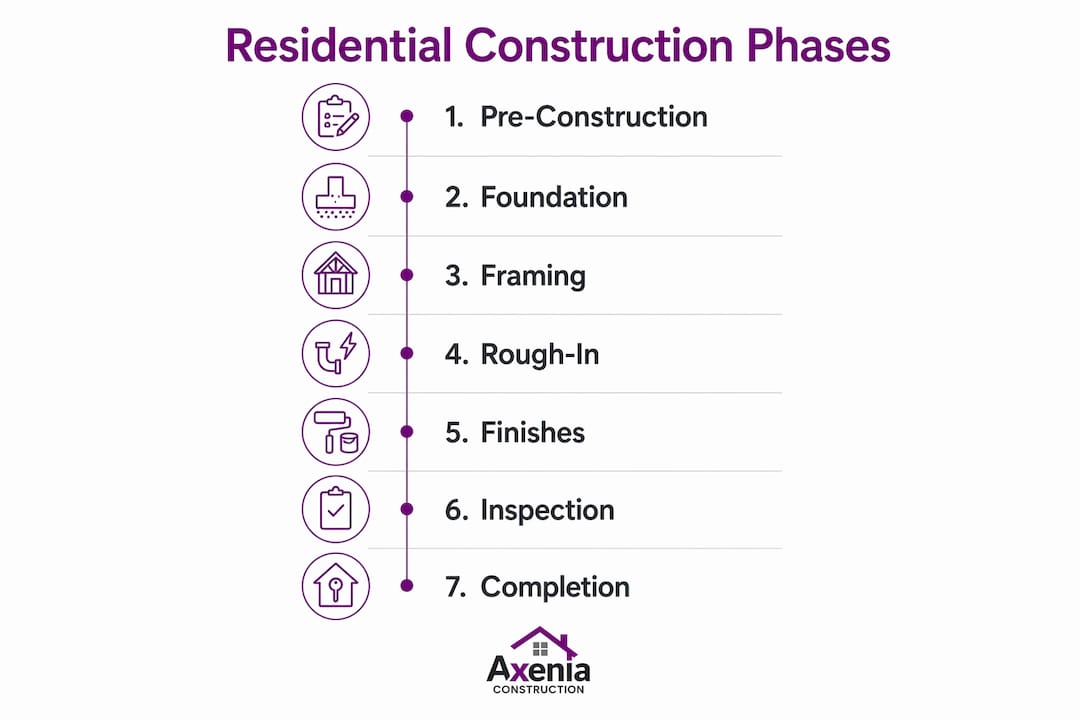
A Work Breakdown Structure breaks the entire project into individual tasks. Think of it as your master checklist before any dates are assigned. You list every deliverable, from soil testing to final paint touch-ups, and group them by phase. This prevents tasks from falling through the cracks when the schedule gets busy.
Gantt charts then assign start and end dates to each task and display them on a visual timeline. Tools like Microsoft Project, Buildertrend, and Procore all generate Gantt charts suited to residential builds. For homeowners who prefer a simpler option, a well-structured Google Sheets template works for tracking milestones without a steep learning curve.
CPM scheduling identifies which tasks directly control your finish date. Managing critical path tasks daily and tracking non-critical tasks weekly lets you focus resources where delays actually matter. Framing, MEP rough-in, and inspections are almost always on the critical path. Landscaping and exterior trim typically carry float, meaning they can shift a few days without affecting the move-in date.
- Identify all tasks using a WBS before assigning dates
- Map task dependencies so trades are sequenced correctly
- Assign float to non-critical tasks and protect critical path tasks from slippage
- Use Gantt charts to communicate the full schedule visually to all parties
- Update the schedule weekly, not monthly
Pro Tip: Contractors who share milestone-based schedules with all subcontractors from day one finish projects 2.3 weeks faster on average. Send the full Gantt chart to every trade before work begins, not just their individual scope.
How do you plan for delays and protect your construction schedule?
Delays are not a matter of if. They are a matter of when and how much. The most practical defense is building a time contingency directly into your schedule. Construction professionals recommend a 15–20% time buffer on all residential projects to absorb weather events, labor shortages, and inspection backlogs.
The most common delay sources in residential builds fall into four categories:
- Permit backlogs: Municipal review queues can add weeks to your pre-construction phase with no warning.
- Mid-build changes: Changing a floor plan or finish selection after framing begins can push the schedule back by weeks and increase costs significantly.
- Material lead times: Custom windows, specialty cabinetry, and HVAC equipment often carry 8–14 week lead times. Order early or substitute with stocked items.
- Trade coordination gaps: When subcontractors are not aligned on sequencing, one trade’s late finish delays the next trade’s start.
Finalizing all architectural plans and finish selections before ground-breaking is the single most effective way to prevent mid-build delays. Homeowners who treat the design phase as optional often pay for it twice: once in time and once in change order costs.
Seasonal scheduling also reduces weather risk. Scheduling exterior work during warm months and interior trades during colder months keeps the build moving regardless of the season and reduces downtime between phases.
| Delay cause | Mitigation strategy |
|---|---|
| Permit backlogs | Submit applications early; use an expediter in high-volume jurisdictions |
| Mid-build design changes | Finalize all selections before ground-breaking |
| Material lead times | Order long-lead items during pre-construction |
| Trade coordination gaps | Share the full schedule with all subs from day one |
| Weather disruptions | Schedule exterior work in warm months; build a 15–20% time buffer |
Pro Tip: Track schedule slippage in days, not weeks. A 3-day delay early in the project can compound into a 10–15 day delay at project end if left uncorrected. Catch it fast.
What are the best practices for monitoring your construction timeline?
The builder’s initial schedule is a starting point, not a contract. Treating the schedule as a living document updated throughout the build is the standard practice among experienced general contractors. Conditions change. Inspections get rescheduled. Materials arrive late. The schedule must reflect reality at all times.
Effective ongoing timeline management follows a consistent rhythm:
- Hold weekly site meetings with your general contractor to review progress against the schedule.
- Review the critical path first at every meeting. Non-critical tasks can wait; critical path slippage cannot.
- Update the Gantt chart after every meeting to reflect actual completion dates and revised forecasts.
- Flag any task running more than 3 days behind immediately and identify a recovery plan before the next meeting.
- Communicate changes to all subcontractors within 24 hours of a schedule revision. Surprises cost money.
- Document every change in writing, including the reason for the delay and the revised completion date.
Schedule slippage is the most reliable predictor of cost overruns and client dissatisfaction in construction projects. Staying ahead of it requires attention every week, not just when something goes wrong. Transparent communication between the homeowner, general contractor, and all trades is what keeps a project on track when conditions shift.
Key takeaways
Effective residential construction timeline planning requires a structured schedule, proactive contingency buffers, and weekly monitoring of the critical path throughout the entire build.
| Point | Details |
|---|---|
| Pre-construction sets the pace | The 2–6 month pre-construction phase is the most common delay source and must be managed proactively. |
| Production vs. custom timelines differ | Production homes take 6–10 months to build; custom homes typically require 10–18 months. |
| Buffer every schedule | Add a 15–20% time contingency to absorb weather, labor, and inspection delays. |
| Share the schedule with all trades | Contractors who share milestone schedules with all subcontractors finish 2.3 weeks faster on average. |
| Treat the schedule as a living document | Update the Gantt chart weekly and flag any slippage of 3 or more days immediately. |
Why timeline planning is the discipline most homeowners skip
I have seen homeowners spend months selecting tile and countertops, then hand the builder a vague “start in spring” instruction with no formal schedule attached. That gap between design enthusiasm and scheduling discipline is where most residential projects go wrong.
The misconception I encounter most often is that the schedule is the contractor’s job. It is a shared responsibility. When a homeowner does not understand the critical path, they make decisions that feel small but carry real consequences. Changing a window size after framing is complete is not a minor tweak. It is a permit amendment, a structural revision, and a 3-week delay wrapped into one request.
What I have found works consistently is treating the construction process as a management discipline from the first design meeting. That means finalizing every selection before ground-breaking, reviewing the schedule every week, and asking your contractor which tasks are on the critical path at every site visit. Those three habits alone prevent the majority of avoidable delays I have seen on residential projects.
Local conditions matter more than most guides acknowledge. A project in Rockville, MD faces different permit timelines, weather windows, and subcontractor availability than a build in Phoenix or Austin. Adaptive scheduling based on your specific jurisdiction and season is not optional. It is the difference between a project that finishes in month 14 and one that drags into month 20.
The homeowners and developers who finish on time are not lucky. They plan with specificity, communicate with transparency, and treat every 3-day slip as a problem worth solving today.
— Arienne
How Axeniaconstruction approaches residential timeline planning
At Axeniaconstruction, we build every residential project around a clear, shared schedule from the first conversation. Our design-build approach integrates planning, permitting, and construction under one roof, which eliminates the coordination gaps that cause most timeline failures.

We share detailed milestone schedules with every subcontractor before work begins, hold weekly progress reviews, and update the project timeline in real time so you always know exactly where your build stands. As a licensed, locally owned general contractor in Rockville, MD, we understand the permit timelines, seasonal conditions, and trade availability that affect projects in this region. If you are planning a residential build and want a team that treats your schedule as seriously as you do, explore our construction process to see how we manage every phase from pre-construction to move-in.
FAQ
How long does it take to build a house from start to finish?
The full timeline from pre-construction to move-in is typically 9–24 months. Pre-construction takes 2–6 months, production homes take 6–10 months to build, and custom homes require 10–18 months of active construction.
What is the most common cause of residential construction delays?
Permit backlogs and mid-build design changes are the two most frequent causes. Finalizing all architectural plans and finish selections before ground-breaking is the most effective way to prevent both.
How much time buffer should I add to my construction schedule?
Construction professionals recommend adding a 15–20% time contingency to every residential project schedule. That buffer accounts for weather events, labor shortages, and inspection delays that are difficult to predict in advance.
What is the critical path in a home building schedule?
The critical path is the sequence of tasks that directly determines your project’s finish date. Framing, MEP rough-in, and inspections are typically on the critical path. Delays to any critical path task push the entire move-in date back.
When should I finalize my finish selections for a new home build?
All finish selections, including flooring, cabinetry, fixtures, and windows, should be finalized before ground-breaking. Making selections during active construction causes schedule delays and often triggers costly change orders.