
A licensed contractor is a professional or business authorized by a state or local government to legally perform construction or trade work within a specific jurisdiction. That government-issued credential certifies minimum competency, legal compliance, and financial responsibility. For homeowners and business owners in Washington, DC, Maryland, and Virginia, understanding what does licensed contractor mean is the difference between a protected investment and a costly legal exposure. Licensing is not a formality. It is the foundation of every safe, permit-ready, code-compliant project you will undertake.
What does licensed contractor mean, and what are the requirements?
A licensed contractor meets specific standards set by state or local regulatory bodies, including trade exams, background checks, proof of insurance, and financial responsibility requirements. The exact bar varies by jurisdiction. What qualifies a contractor in Virginia does not automatically qualify them in Maryland or DC.
Licensing falls into two broad categories:
- General contractor license: Authorizes managing entire projects, pulling permits, and coordinating subcontractors. In some states, a general contractor license allows limited self-performance of certain trades.
- Specialty contractor license: Covers specific trades only, such as electrical, plumbing, HVAC, or roofing. General contractor licenses do not authorize self-performance of all specialty trades. Licensed subcontractors are often legally required for that work.
Beyond the exam, licensing boards in DC, Maryland, and Virginia typically require:
- Proof of general liability insurance
- Workers’ compensation coverage
- A surety bond
- Documented work experience (often 2–4 years in the trade)
- Periodic license renewal with continuing education
Licenses expire. A contractor who was licensed last year may not be licensed today. Renewal requirements keep credentials current and ensure contractors stay up to date with code changes.
Pro Tip: Ask every contractor for their license number before any conversation about scope or price. Then verify it directly through the Maryland Department of Labor, the Virginia Department of Professional and Occupational Regulation (DPOR), or the DC Department of Consumer and Regulatory Affairs (DCRA).

Licensed vs. unlicensed vs. bonded vs. insured: what is the difference?
These four terms describe distinct protections. Owners in the DC, MD, and VA area frequently confuse them, and that confusion creates real financial risk.
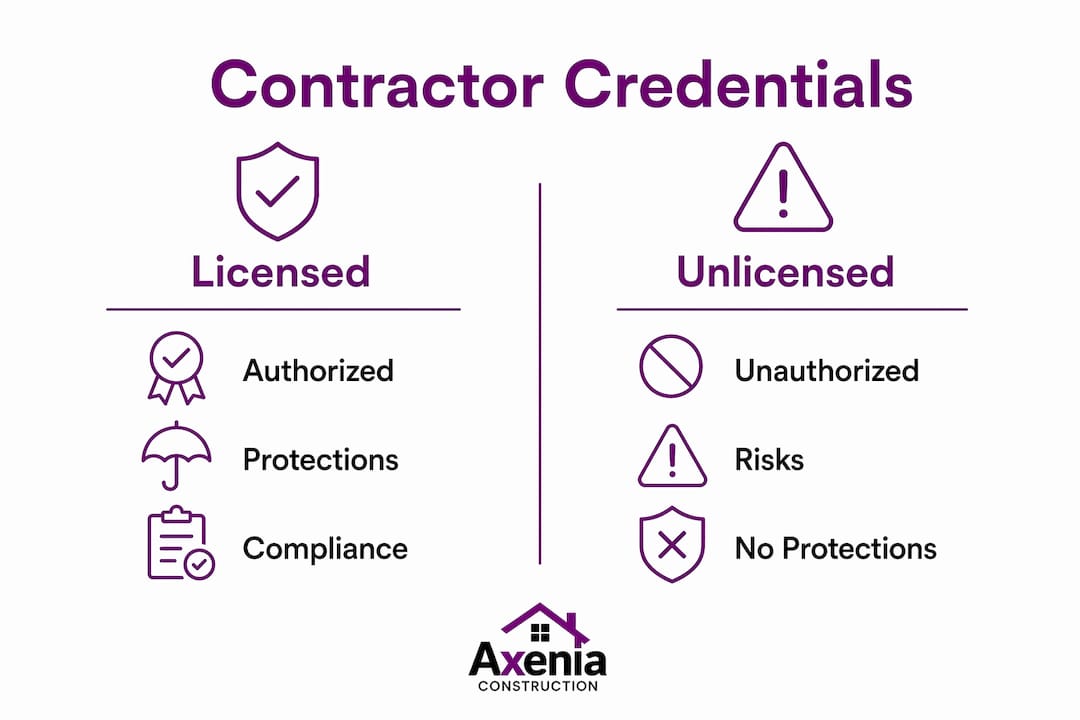
Licensed, bonded, and insured are separate credentials, each covering a different type of exposure. Here is how they compare:
| Credential | What it means | What it protects against |
|---|---|---|
| Licensed | Government-authorized to perform the work legally | Incompetent or unauthorized work; permit denials |
| Bonded | Surety bond in place if contractor fails to complete work | Financial loss if contractor abandons project or breaches contract |
| Insured (Liability) | General liability policy covers property damage or third-party injury | Damage to your property during construction |
| Insured (Workers’ Comp) | Covers medical costs if a worker is injured on your property | Your personal liability for on-site worker injuries |
| Unlicensed | No government authorization | No legal protection; contracts may be void |
Being bonded provides a financial remedy to the client if the contractor does not fulfill obligations. That is separate from licensing. A contractor can be licensed but not bonded, or bonded but uninsured. You need all three.
Unlicensed contractors may void contracts and prevent you from obtaining building permits or lien protections. That means if a dispute arises, you may have no legal standing to recover your money.
Pro Tip: Request a current certificate of insurance directly from the contractor’s insurance provider, not just a copy from the contractor. Certificates can be altered. A call to the insurer takes two minutes and confirms the policy is active.
Why hiring a licensed contractor matters in DC, MD, and VA
Hiring a licensed contractor is the primary way to ensure your project can obtain permits and comply with legal statutes in DC, Maryland, and Virginia. Without proper permits, you face fines, mandatory work stoppages, and the cost of tearing out completed work. That is not a hypothetical risk. It happens regularly to owners who hired unlicensed workers to save money upfront.
The practical benefits of hiring a licensed contractor include:
- Permit access: Only licensed contractors can legally pull permits in most DC, MD, and VA jurisdictions. Permits are required for structural work, electrical upgrades, plumbing changes, and most renovations above a basic threshold.
- Code compliance: Licensed contractors know current International Building Code (IBC) and local amendments. Non-compliant work can trigger failed inspections and costly corrections.
- Insurance protection: Licensed contractors are legally required to hold workers’ compensation and general liability insurance. Without that coverage, you as the property owner can be held liable for injuries on your own job site.
- Lien protections: Working with a licensed contractor gives you clearer legal standing if payment disputes arise with subcontractors or suppliers.
- Contractual enforceability: Contracts with unlicensed contractors are often unenforceable in court. You may have no legal recourse if the work is defective or incomplete.
Hiring an unlicensed contractor exposes property owners to legal and financial liability that no amount of upfront savings can offset. DC, Maryland, and Virginia all have enforcement mechanisms, including stop-work orders, fines, and contractor debarment. The owner who hired the unlicensed worker is not immune from those consequences.
How to verify and work with a licensed contractor
Verification takes less than 15 minutes and protects you from the most common hiring mistakes. Start with the license number.
- Verify the license online. Maryland licenses are searchable through the Maryland Department of Labor. Virginia licenses are verified through DPOR’s online lookup. DC contractor licenses are managed by the DCRA. Enter the contractor’s name or license number and confirm the license is active, not expired or suspended.
- Confirm the license classification matches your project. A general contractor license covers project management and permits. A specialty license covers only one trade. If your project involves multiple trades, confirm the GC holds the right classification and uses licensed subcontractors.
- Request proof of insurance and bonding. Ask for a certificate of insurance showing general liability and workers’ compensation. Confirm the bond amount is appropriate for your project size.
- Check for expired or suspended credentials. An expired or suspended license invalidates a contractor’s legal authority and may void insurance and permits. Do not assume a license is current because the contractor says it is.
- Ask the right questions. Ask: “What is your license number and classification?” “Are your subcontractors also licensed?” “Will you pull all required permits?” A contractor who hesitates on any of these questions is a red flag.
Registration differs from licensing. A registered contractor is on record with a government agency but may not have passed any competency exam or met financial responsibility standards. A registered but not licensed contractor may be unable to pull permits or legally perform the scope of work your project requires.
Pro Tip: Never assume a business license equals a contractor’s license. A business license allows a company to operate commercially. A contractor’s license authorizes specific construction work. They are issued by different agencies and cover entirely different things.
Key Takeaways
A licensed contractor is a government-authorized professional who meets minimum competency, insurance, and legal standards required to perform construction work in DC, MD, and VA.
| Point | Details |
|---|---|
| Licensed contractor definition | A government-authorized professional who passes exams, holds insurance, and meets jurisdictional standards. |
| Licensing vs. registration | Registration records a business; licensing verifies competency and legal authority to perform construction work. |
| Three credentials required | Licensed, bonded, and insured are separate protections. You need all three before hiring any contractor. |
| Permit and code compliance | Only licensed contractors can legally pull permits in DC, MD, and VA, protecting you from fines and stop-work orders. |
| Verification is your responsibility | Check license status through DPOR, Maryland Department of Labor, or DCRA before signing any contract. |
Licensing is the floor, not the ceiling
I have seen it play out more times than I can count. A homeowner in Montgomery County or a business owner in Alexandria hires someone with a polished website and a low bid, skips the license check, and ends up with unpermitted work that fails inspection. The contractor is unreachable. The owner pays twice.
Licensing boards enforce safety and financial accountability but do not select or rate contractors based on quality or craftsmanship. That is the part most owners miss. A license tells you the contractor cleared a legal minimum. It does not tell you whether they communicate well, manage timelines, or take pride in their work.
Licensed contractors meet minimum legal standards, but licensing does not guarantee craftsmanship or design quality. The due diligence does not stop at the license lookup. Call two or three past clients. Visit a completed project if you can. Ask how the contractor handled a problem mid-project, because problems always arise.
The DC, MD, and VA market has a specific wrinkle worth knowing. Licensing requirements differ across the three jurisdictions, and some contractors hold licenses in one state but not the others. If your project crosses jurisdictional lines, or if you own properties in multiple jurisdictions, confirm the contractor is licensed in each one. Do not assume a Maryland license covers work in Virginia.
My honest advice: treat licensing as your first filter, not your only filter. A licensed contractor who comes with strong references, clear communication, and a detailed written contract is the combination that actually protects your investment.
— Arienne
Work with a licensed contractor you can trust in DC, MD, and VA
Axeniaconstruction is a licensed, women-owned general contractor based in Rockville, MD, serving residential and commercial clients across Washington, DC, Maryland, and Virginia. Every project we take on is fully permitted, code-compliant, and backed by current insurance and bonding credentials. We believe you deserve transparency from the first conversation, not just a low bid.

Whether you are planning a home renovation or a commercial build-out, our team handles licensing, permits, and compliance so you never have to guess whether your project is protected. Explore our full range of services or reach out directly to start a conversation about your project. We are here to make the process clear, compliant, and worth your confidence.
FAQ
What does a licensed contractor mean legally?
A licensed contractor holds a government-issued credential authorizing them to legally perform construction or trade work within a specific jurisdiction. Without that license, contracts may be unenforceable and permits may be denied.
Is a licensed contractor the same as a bonded contractor?
No. Licensed means government-authorized to perform the work. Bonded means a surety bond is in place to protect you financially if the contractor fails to complete the job. Both credentials are separate and both matter.
How do I verify a contractor’s license in Maryland, Virginia, or DC?
Check Maryland licenses through the Maryland Department of Labor, Virginia licenses through the DPOR online lookup, and DC licenses through the DCRA. Enter the contractor’s name or license number to confirm the credential is active.
Can an unlicensed contractor pull permits in DC, MD, or VA?
No. Pulling permits requires a valid contractor’s license in DC, Maryland, and Virginia. Work done without permits can result in fines, mandatory demolition of completed work, and failed property inspections.
Does a business registration mean a contractor is licensed?
No. Registration differs from licensing: registration records a business with a government agency but does not verify competency or legal authority to perform construction work. Always confirm the contractor holds an active contractor’s license, not just a business registration.