
A performance bond is a surety guarantee that the contractor will complete the contract according to its terms, or the owner will be compensated up to the bond amount. According to USLegal, if the contractor defaults, the surety may complete the work, select a replacement contractor, or pay the obligee up to the bond amount. Every construction performance bond involves three parties:
- Principal: the contractor who purchases and is bound by the bond
- Obligee: the project owner who is protected by the bond
- Surety: the bonding company that guarantees the contractor’s performance
Owners should insist on a performance bond any time the financial or schedule risk of contractor default would be difficult to absorb, which on federal projects is not optional at all.
Key Takeaways
A performance bond in construction is a three-party surety guarantee that protects the owner up to 100% of the contract value if the contractor defaults, and federal law mandates bonds on public contracts above statutory thresholds.
| Point | Details |
|---|---|
| Core definition | A surety bond guaranteeing contractor completion; the surety pays or completes if the contractor defaults. |
| Federal requirement | The Miller Act and FAR 52.228-15 require bonds at 100% of contract price on federal construction jobs. |
| Typical premium range | Premiums generally fall between 0.5% and 3% of contract value, varying by contractor risk profile. |
| Claim preservation | Owners must send written default notice per bond terms promptly; missed notice can void a valid claim. |
| Verify your surety | Confirm the surety appears on Treasury Circular 570 before accepting any bond document. |
Table of Contents
- How a construction performance bond works from issuance to claim resolution
- Who the three parties are and what each one owes
- When performance bonds are required and the U.S. legal framework behind them
- What performance bond premiums typically cost and how sureties underwrite them
- How to get a performance bond: a step-by-step process for contractors
- What happens when a contractor defaults and how claims get resolved
- Advanced bond solutions and best practices that reduce schedule risk
- A contractor’s perspective on what owners often misunderstand about bonding
- Primary sources for further reading
- Sources
How a construction performance bond works from issuance to claim resolution
A bond begins with the surety’s underwriting review. Before issuing, the surety evaluates the contractor’s financial statements, project history, and liquidity to decide whether to back the work. Once approved, the contractor signs an indemnity agreement, the surety issues the bond, and the owner receives a formal bond document before work starts.
The penal sum is the maximum dollar amount the surety will pay. On many public projects, FAR 52.228-15 requires the penal amount to equal 100% of the original contract price, and the bond must be furnished before work begins. Private projects often follow the same 100% practice, though the amount is negotiable.
When a contractor fails to perform, the owner files a claim with the surety. The surety then investigates, typically by reviewing contract documents, payment records, and correspondence. Once the surety confirms a valid default, it chooses a remedy: hire a completion contractor, finance the original contractor to finish, or pay the obligee up to the penal sum.
| Stage | Action | Who Acts |
|---|---|---|
| Application | Contractor submits financials and project details | Contractor |
| Underwriting | Surety reviews risk and approves or declines | Surety |
| Issuance | Bond executed; indemnity agreement signed | Contractor + Surety |
| Bond delivery | Owner receives bond before work starts | Surety |
| Default notice | Owner notifies surety of contractor failure | Owner |
| Investigation | Surety reviews claim documentation | Surety |
| Remedy | Surety completes, replaces, or pays | Surety |
| Indemnity recovery | Surety seeks reimbursement from contractor | Surety |
Pro Tip: Keep a contemporaneous claim file from day one: dated photos of defective work, written notices to the contractor, and copies of all contract change orders. A well-documented file is the single strongest asset when a surety investigates your claim.
Who the three parties are and what each one owes
The three-party structure is what separates a performance bond from ordinary insurance, and understanding each role clarifies why the bond works the way it does.
- Principal (contractor): Purchases the bond, pays the premium, and is legally obligated to complete the contract. If the surety pays a claim, the contractor must reimburse the surety under the indemnity agreement.
- Obligee (owner): Receives the protection. The bond runs in the owner’s favor, meaning the owner can call on the surety if the contractor fails.
- Surety: Acts as a financial guarantor, not an insurer. The surety expects to be repaid by the contractor if it ever pays out.
AIA Contract Documents makes this distinction plain: the bond protects the obligee, not the contractor. Subcontractors are not automatically covered by the prime’s performance bond; they typically need their own bonds or rely on a payment bond for wage and material protections.
Pro Tip: Contractors should treat bonding capacity as a business-development asset. Clean financials, a low backlog-to-equity ratio, and a track record of on-time completions all improve the terms a surety will offer, which directly affects the size and type of projects you can bid. Investopedia’s surety overview frames being “bondable” as a financial health benchmark worth pursuing on its own merits.
When performance bonds are required and the U.S. legal framework behind them
Federal law is the clearest trigger. The Miller Act (40 U.S.C. Chapter 31) requires performance and payment bonds on federal construction contracts above statutory thresholds, and FAR clause 52.228-15 codifies the 100% penal-amount practice for those contracts. Contractors bidding federal work must plan for bonding before the first shovel hits the ground.
The Miller Act has required performance and payment bonds on federal construction contracts since 1935, making bonded federal construction one of the most durable owner-protection frameworks in U.S. procurement law.
Private projects follow no single mandate, but several common triggers push owners toward requiring bonds:
- Large commercial projects where lender financing is contingent on bonded completion
- Joint-venture arrangements where risk allocation among partners demands a guarantee
- Public-private partnerships and municipal contracts that mirror federal practice
- High-value residential projects where the owner’s exposure to default is significant
Treasury Circular 570 lists the sureties the federal government has approved to write bonds on public contracts. Owners on private projects can use the same list as a quality screen when evaluating a surety’s financial strength.
One practical note on waivers: payment bonds and performance bonds are separate instruments. Some private contracts allow payment-bond waivers for lower-tier subcontractors, but waiving a performance bond on a large project leaves the owner with no surety backstop if the prime fails. That trade-off deserves careful attention in contract negotiations.
What performance bond premiums typically cost and how sureties underwrite them
Premium is expressed as a percentage of the contract value, and the range varies considerably based on project size, the contractor’s risk profile, and the bond amount. Procore’s construction bond guide notes that premium percentages shift with project complexity and contractor financials, so no single rate applies universally.
Typical premium ranges: Industry guidance generally places performance bond premiums somewhere between 0.5% and 3% of the contract value for contractors with strong financials, though higher-risk profiles or smaller contractors may see rates above that range.
Sureties do not underwrite on premium alone. Investopedia’s surety criteria identifies the core factors:
- Financial statements: Two to three years of audited or reviewed financials showing profitability and working capital
- Backlog: The ratio of current work-in-progress to equity; too much backlog signals overextension
- Liquidity: Current ratio and cash position relative to project demands
- Performance history: Completed projects of similar scope and dollar value
- Credit score and references: Personal and business credit, plus owner and subcontractor references
- Management experience: Key personnel tied to the specific project type
Contract type also matters. A GMP contract with a defined ceiling gives the surety a clearer exposure picture than a cost-plus arrangement, which can affect both the premium rate and the surety’s willingness to bond the work at all.
How to get a performance bond: a step-by-step process for contractors
Projul’s bonding workflow guide describes the typical sequence from bid to bond delivery. Here is how it unfolds in practice:
-
Secure a bid bond first. Before award, most public and many private owners require a bid bond as a condition of bidding. This is the first formal contact with a surety and sets the stage for the performance bond application. The construction bid process explains how bid bonds fit into the award timeline.
-
Engage a licensed surety broker. Work with a broker who specializes in construction surety, not a generalist insurance agent. NASBP maintains a directory of qualified surety bond producers and is the best starting point for finding an experienced broker.
-
Assemble your financial package. Gather two to three years of financial statements (CPA-prepared at minimum, audited for larger bonds), a current work-in-progress schedule, a personal financial statement, and a project description with the contract documents.
-
Submit to underwriting. The surety reviews your package against the criteria above. Routine projects with strong financials can clear underwriting in a few days; complex or large-dollar bonds may take two to three weeks.
-
Execute the indemnity agreement. Before the bond is issued, you and often your spouse or business partners sign a personal indemnity agreement. This is the surety’s repayment guarantee if a claim is ever paid.
-
Deliver the bond to the owner. The surety issues the bond, and you deliver it to the owner before work begins. On federal contracts, FAR 52.228-15 is explicit: the bond must be furnished prior to the start of work.
Owners verifying a bond should request the original bond document, confirm the surety appears on Treasury Circular 570, and check that the penal amount matches the contract value.
What happens when a contractor defaults and how claims get resolved
Default does not automatically trigger a surety payout. The owner must follow the bond’s notice requirements precisely, or the claim can be contested. Most standard bond forms require written notice to the surety promptly after the owner declares the contractor in default, and many require a cure period before the surety’s obligations activate.
Once a valid default is established, the surety’s typical remedies are:
- Hire a completion contractor at the surety’s cost, up to the penal sum
- Finance the original contractor to finish, if the surety believes the contractor can complete with additional support
- Tender a cash payment to the owner up to the bond amount, leaving the owner to manage completion independently
- Negotiate a settlement when the cost to complete exceeds the penal sum or when liability is disputed
Contractor liability does not end when the surety pays. The indemnity agreement requires the contractor to reimburse the surety for every dollar paid out, plus costs. That exposure can include personal assets if personal indemnity was signed.
Pro Tip: Review your bond’s notice and cure provisions before a dispute escalates. Many owners lose valid claims not because the contractor was not in default, but because written notice was sent to the wrong party or sent too late. A construction attorney familiar with surety law can review your bond language before you need it.
For owners, the immediate steps after a contractor stops performing are: document all defects and incomplete work with dated photographs, send written default notice per the bond terms, mitigate damages where possible (do not let a half-finished roof sit open in a rainstorm), and avoid hiring a replacement contractor until the surety has had its required opportunity to respond.

Advanced bond solutions and best practices that reduce schedule risk
Standard performance bonds resolve claims, but they do not always resolve them quickly. Project stoppage during a surety investigation can cost owners more in schedule delay than the bond ever pays back. That gap is where advanced bond structures add real value.
Some performance bond products now include an Expedited Dispute Resolution (EDR) feature. Travelers describes EDR performance bonds as contractually limiting the adjudication window to approximately 45 days, which keeps work moving during disputes rather than freezing the site while a standard investigation runs its course. For time-sensitive commercial or government projects, that 45-day ceiling can be the difference between a manageable delay and a cascading schedule failure.
EDR-style bonds can materially reduce schedule risk by contractually limiting claim adjudication timelines, preserving site activity during disputes and protecting owners from the compounding costs of prolonged project stoppage.
Best practices that experienced owners and contractors use to get the most from bonding:
- Prequalify sureties by checking Treasury Circular 570 and reviewing the surety’s experience in your specific project type (federal, healthcare, industrial). A surety unfamiliar with your sector may handle claims more slowly.
- Maintain ongoing communication with your surety. Sureties that stay informed about project progress are faster to respond when problems arise. Proactive reporting builds the relationship that matters most during a claim.
- Choose sureties experienced in your project scope. A surety that regularly bonds federal construction understands FAR requirements and Miller Act claims; one that primarily writes commercial bonds may not.
Pro Tip: Ask your surety broker whether EDR bond products are available for your next project. The premium difference is often modest, and the schedule protection on a complex government or commercial job can far outweigh the incremental cost.
For deeper guidance on bonding in construction projects, including how to verify a contractor’s bond and what owners should request before signing a contract, Axeniaconstruction has published a dedicated resource that walks through both sides of the bonding relationship.
A contractor’s perspective on what owners often misunderstand about bonding
When we work with owners at Axeniaconstruction, one misunderstanding comes up more than any other: the assumption that a performance bond means the project will never have problems. It does not. What a bond does is give the owner a financial backstop and a defined process when problems become serious enough to constitute a default. The bond is not a substitute for choosing a qualified contractor in the first place; it is the safety net beneath that choice. From a contractor’s side, pursuing bonding is genuinely a discipline. Maintaining the financial health, clean records, and project history that sureties require pushes us to run tighter operations, which ultimately benefits every client we serve. As a licensed, women-owned general contractor serving residential, commercial, and government contracting clients in the Rockville, MD area, Axeniaconstruction carries the bonding capacity and track record that owners on both private and public projects should expect from their general contractor.
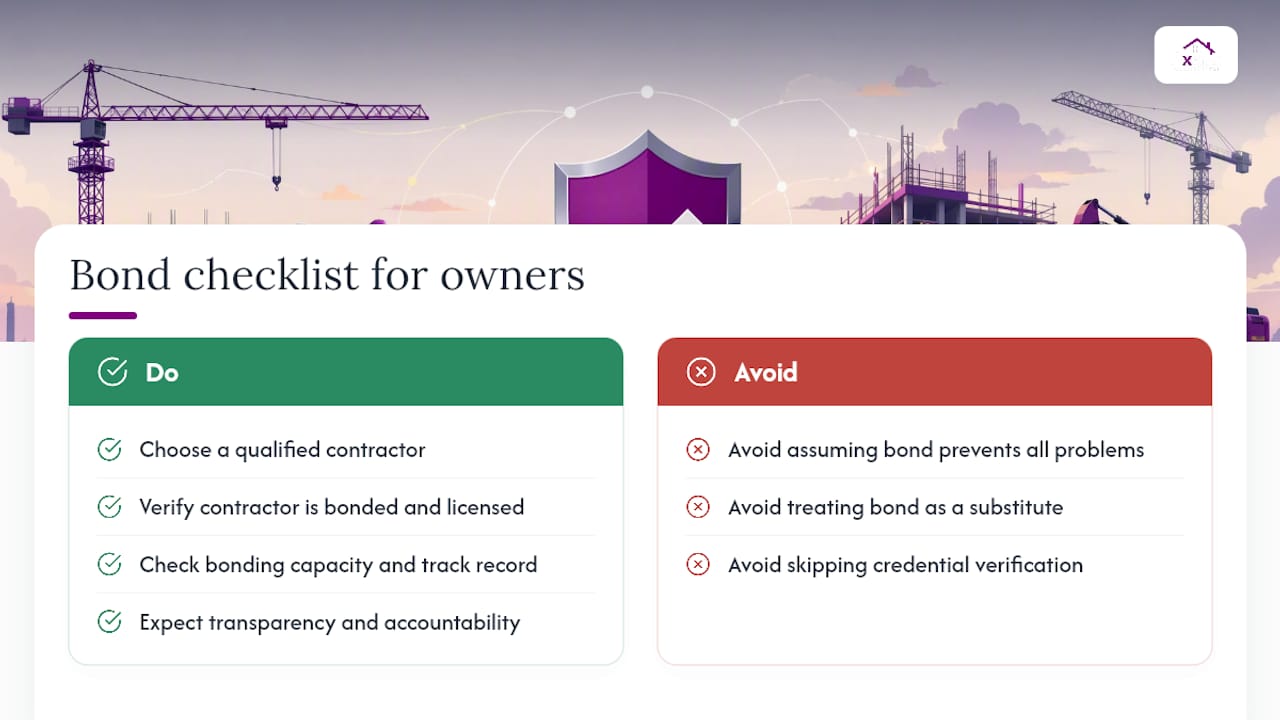
Ready to work with a bonded, licensed general contractor who brings transparency and genuine accountability to every project? Axeniaconstruction serves residential, commercial, and government clients across the greater Rockville, MD area.

Whether you are planning a home renovation or a commercial buildout, we bring the bonding, licensing, and collaborative approach your project deserves. Contact Axeniaconstruction today to discuss your project and verify our credentials.
Primary sources for further reading
These are the authoritative references for verifying statutory details, reading model bond language, and finding qualified surety professionals:
- Acquisition: The primary federal regulation governing performance and payment bond requirements, penal amounts, and timing for federal construction contracts.
- AIA Contract Documents — Performance Bonds 101: Industry-standard guidance on bond structure, the three-party relationship, and contractor obligations; also the source for AIA model bond forms (A312).
- NASBP — National Association of Surety Bond Producers: The leading industry organization for surety professionals; use their broker directory to find qualified surety bond producers in your market.
- Travelers EDR Performance Bonds: Product-level detail on Expedited Dispute Resolution bond features and how they limit claim adjudication timelines.
- USLegal Performance Bond Definition: A concise legal definition and summary of surety remedies; useful for quick statutory reference.
- Treasury Circular 570: The federal government’s approved list of certified surety companies; a reliable quality screen for owners on both public and private projects.
Sources
- Performance Bond Law and Legal Definition | USLegal, Inc.
- Performance Bonds 101: A Contractor’s Complete Guide | AIA Contract Documents
- Acquisition
- Performance Bonds for Construction Explained | Procore
- Performance bond — Investopedia
- Construction Performance Bonds Explained for GCs — Projul
- NASBP — National Association of Surety Bond Producers