
Most tenant turnovers cost a few hundred to a few thousand dollars per unit, and where yours lands depends on scope: light turns (paint touch-ups and deep cleaning) sit near the lower end, medium turns (new flooring or appliance repairs) land in the middle, and heavy turns (water damage, full flooring replacement, or electrical work) push toward the higher end. The sections below help you refine these numbers to your market, unit class, and renovation goals.
TL;DR:
- The national $800 to $2,300 benchmark can vary roughly threefold by market; compare at least three local quotes and track actual costs for 12 months.
- For heavy turns, add a 10% to 15% contingency; hidden water damage can require subfloor replacement and double the flooring cost.
- At $1,500 monthly rent, vacancy costs $50 daily; a $600 flooring upgrade pays back in nine months if it saves three days and adds $50 monthly.
- Repairs that maintain operating condition are generally deductible in the year incurred, while improvements that add value or extend useful life must be capitalized and depreciated.
Table of Contents
- Line-item cost breakdown: typical tasks and U.S. price ranges
- Benchmarks and market variation across U.S. rental markets
- Sample budgets and a cost table for light, medium, and heavy turns
- Calculating vacancy cost and deciding whether a bigger renovation pays off
- Repair versus improvement: U.S. tax rules for turnover work
- Choosing who does the work: contractor, specialty vendor, or in-house
- Turnover checklist and timeline to get a unit rent-ready fast
- Preventative maintenance that lowers future turn costs
- Common unexpected expenses and how to handle them
- How turnover renovations affect property value and rental pricing
- Budgeting per turn and building a replacement reserve fund
- A practical timeline and checklist to keep every turn on track
- What field experience teaches us about turn renovation timing
- How a general contractor can help manage your next turnover renovation
- FAQ
- Sources
Line-item cost breakdown: typical tasks and U.S. price ranges
Once you know which band your turn falls into, the next step is pricing the individual tasks that make up that total. Most line items fall into predictable ranges, though your local labor market will shift these numbers up or down.
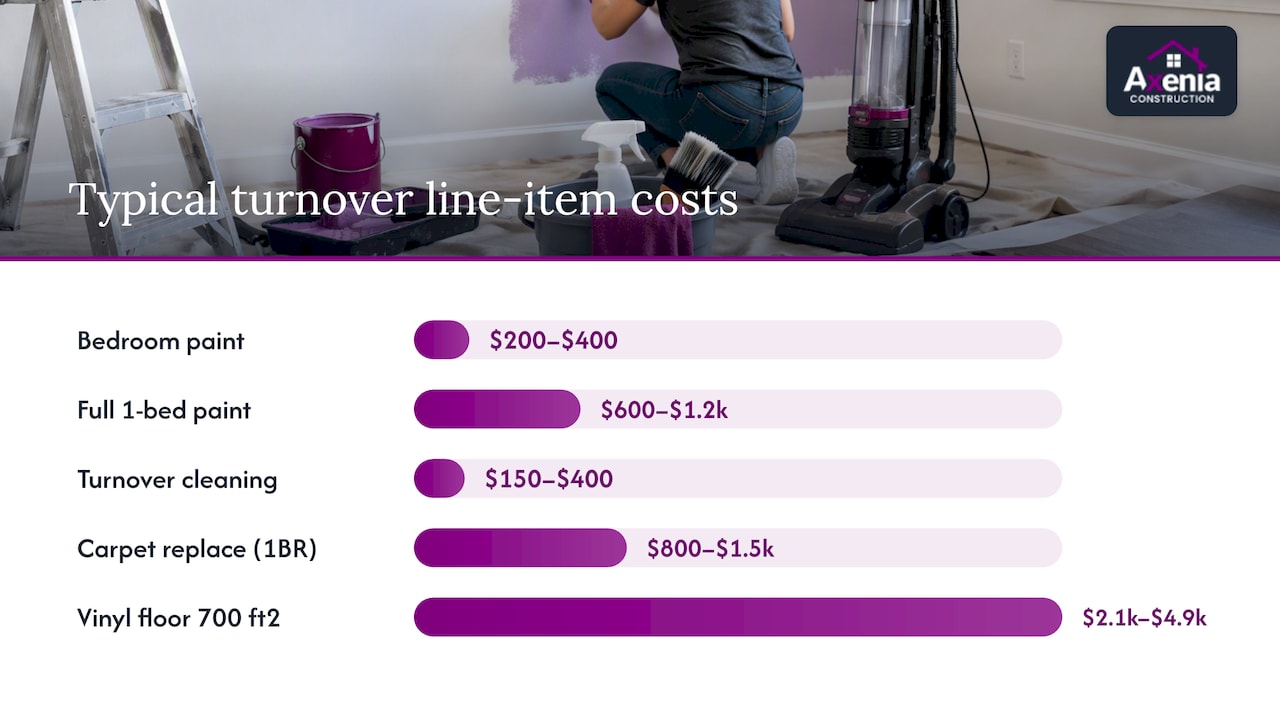
Painting remains one of the most common turn expenses. A single bedroom typically runs $200 to $400 for materials and labor, while a full one-bedroom unit often lands between $600 and $1,200 depending on wall condition and whether trim and ceilings need attention. Turnover cleaning, which covers deep cleaning of kitchens, bathrooms, and floors, usually costs $150 to $400 for a standard unit, rising toward $600 for units with heavy buildup or pet damage.
Flooring decisions carry some of the widest cost spreads. Carpet shampooing runs $75 to $150 and buys you another cycle if the carpet is still structurally sound, while full carpet replacement for a one-bedroom unit typically costs $800 to $1,500. Vinyl or laminate flooring, a popular upgrade for durability, usually falls between $3 and $7 per square foot installed, meaning a 700 square foot unit could run $2,100 to $4,900 for a full floor replacement.
Smaller repairs add up quickly but rarely break the budget individually:
- Drywall patching and minor repairs typically cost $75 to $250 per job, depending on the number of holes or cracks.
- Lock rekeying or replacement runs $50 to $150 per unit for standard deadbolts.
- HVAC filter changes and a basic service call generally cost $75 to $200.
- Appliance repair averages $100 to $300 per call, while full appliance replacement ranges from $400 for a basic refrigerator to $1,200 or more for a full kitchen suite.
For appliance decisions specifically, it helps to run the numbers before committing either way. Guidance on repair versus replace decisions can clarify when a repair still makes financial sense and when replacement is the smarter long-term move.
Labor and materials typically split close to 60/40 on small turns, with labor taking the larger share because most turnover tasks (painting, cleaning, patching) are labor-intensive rather than material-heavy.
Certain issues reliably push a turn from medium into heavy territory. Water damage from a slow leak often means replacing subflooring, not just surface flooring, which can double your flooring line item. Full floor replacement across multiple rooms, rather than spot repairs, adds both material and labor cost. Electrical or plumbing work, especially anything requiring a permit, brings in licensed trades at higher hourly rates and can extend your timeline by a week or more. When you spot these issues during move-out inspection, it’s worth pricing them separately rather than folding them into your standard turn estimate.
Benchmarks and market variation across U.S. rental markets
National averages are a useful starting point, but they can mislead you if your market runs hotter or cooler than the benchmark.
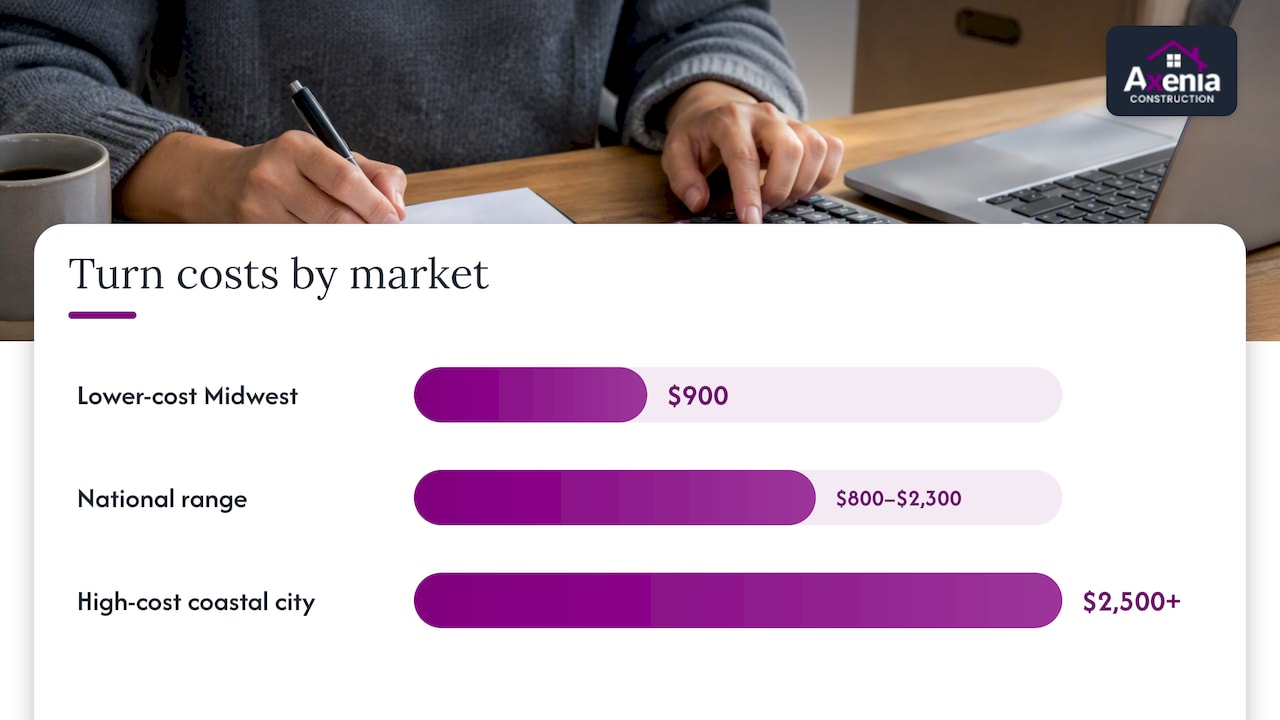
The all-in cost to turn a unit nationally ranges from $800 to $2,300, and that range can vary by roughly 3x between low-cost and high-cost markets. A unit that turns for $900 in a lower-cost Midwest market might cost $2,500 or more in a high-demand coastal city, driven by labor rates, material delivery costs, and vendor availability.
Asset class matters too. A Class A property with higher-end finishes will naturally cost more to restore to its original condition than a Class C property with basic finishes, simply because the materials themselves cost more. Seasonality also plays a role: turns scheduled during peak leasing season (typically late spring through late summer) often cost more because contractors and cleaning crews are in higher demand and can charge accordingly. Local vendor supply compounds this. Markets with higher overall turnover volume see more competition for the same pool of painters, cleaners, and flooring installers, which pushes prices up during busy stretches.
To build a benchmark that actually reflects your market, collect quotes from at least three local vendors for your most common turn tasks (painting, cleaning, and flooring) and compare them against the national range. Track your actual turn costs over the past 12 months if you have that data. This lets you calculate a local multiplier, essentially how much higher or lower your market runs compared to the national benchmark, so future budgets start from a realistic baseline rather than a national average that may not apply to you.
Sample budgets and a cost table for light, medium, and heavy turns
A light turn generally covers cosmetic refresh work: a fresh coat of paint, a deep clean, minor patching, and a lock change. A medium turn adds a flooring update, perhaps an appliance repair, and more substantial wall repair. A heavy turn includes significant flooring replacement, multiple appliance replacements, and often some electrical or plumbing work tied to water damage or code compliance.
Here’s how those categories typically break down by line item:
These figures assume a standard one-bedroom unit. Scale them up for larger units by adjusting the painting, cleaning, and flooring lines proportionally to square footage, since those three items track most closely with unit size. Labor rates in your market will also shift every row, so treat this table as a framework you populate with your own vendor quotes rather than a fixed price sheet.
A few practical notes for adapting this table:
- Round up rather than down when budgeting, since unexpected issues surface more often than pleasant surprises.
- Build in a 10% to 15% contingency line for heavy turns specifically, where hidden damage is more likely.
- Revisit your table every six months as vendor pricing shifts with seasonal demand.
Calculating vacancy cost and deciding whether a bigger renovation pays off
Every day a unit sits empty costs you real money, and that cost should factor directly into how much you spend on a turn. The basic formula is straightforward: divide your monthly rent by 30 to get a daily rate, then multiply by the number of vacant days.
Consider two short examples using illustrative numbers. For example, say a unit rents for $1,500 per month, which works out to $50 per day. If a standard turn takes 10 days, that’s $500 in vacancy cost before you even factor in renovation spending. Now say you’re deciding whether to spend an extra $600 upgrading flooring during that same turn. If the upgrade shortens your vacancy by 3 days (because the unit shows better and rents faster) and lets you raise rent by $50 per month, you recover the vacancy savings ($150) plus the rent increase pays back the remaining $450 investment in about nine months.
A few heuristics help you decide when to spend more versus when to keep it minimal:
- If your market has low vacancy and units rent within days regardless of condition, keep the turn minimal and prioritize speed over upgrades.
- If you’re trying to attract a higher-quality tenant or reduce future turnover, a targeted upgrade (flooring, fixtures) often pays for itself within a year.
- If your current tenant pool is price-sensitive, spending more rarely translates into higher achievable rent, so a light turn usually makes more sense.
- If you have multiple vacancies simultaneously, prioritize the units in your best locations or floor plans for upgrades, since those are the easiest to lease at a premium.
Pro Tip: Track your actual days-on-market before and after any upgrade so you can measure whether the investment genuinely shortened vacancy, rather than assuming it did.
Repair versus improvement: U.S. tax rules for turnover work
How you classify turnover expenses affects your tax bill, so it’s worth understanding the distinction before you file. According to IRS Publication 527, repair and maintenance expenses that keep a property in good operating condition are generally deductible in the year you incur them, while improvements that add value, prolong the property’s life, or adapt it to a new use must be capitalized and depreciated over time.
Publication 527 draws a clear line between repairs and improvements, and that distinction determines whether an expense is deducted immediately or depreciated over several years. Patching a wall, repainting, or fixing a leaky faucet typically qualifies as a repair. Replacing an entire roof, adding a room, or upgrading a full kitchen typically counts as an improvement, even if the triggering event was a tenant moving out.
Two safe harbors can simplify this for smaller turnover expenses:
- The de minimis safe harbor lets you deduct certain low-cost items immediately rather than capitalizing them, provided you meet the threshold and have an applicable financial statement or written policy in place.
- The routine maintenance safe harbor covers recurring activities, like periodic inspections or cleaning, that keep property in efficient operating condition, and these can generally be deducted as incurred.
For record-keeping, separate your turnover expenses by category as you incur them rather than sorting them out at tax time. Keep invoices, photos of the condition before and after, and a brief note on why each expense was necessary. This documentation matters most for larger turns where the repair-versus-improvement line is less obvious. Our guide to capital improvement versus repair documentation walks through specific tests and paperwork that help substantiate your classification. Because these rules have real exceptions and edge cases, it’s worth reviewing your specific situation with a CPA, especially for any turn that includes structural or system-wide work.
Choosing who does the work: contractor, specialty vendor, or in-house
The right choice depends on the scope and complexity of your turn. For light cosmetic work (painting, cleaning, minor patching), in-house maintenance staff or a single handyman often handles the job efficiently and at lower cost. For medium turns involving flooring or appliance work, specialty vendors who focus on one trade can offer competitive pricing, though you’ll need to coordinate scheduling between them yourself. For heavy turns involving multiple trades, permits, or structural work, a general contractor who manages the full scope typically reduces your coordination burden and schedule risk, since one party is accountable for sequencing and quality across trades.
Before you accept any bid, a short checklist keeps you from costly surprises later:
- Confirm the scope is written specifically, not just “flooring and paint,” but exact square footage, materials, and finish level.
- Get a firm timeline with start and completion dates, and ask what happens if trades fall behind.
- Ask whether pricing is unit rate or lump sum, since unit rates make it easier to adjust if scope changes mid-project.
- Clarify who pulls permits and who’s responsible for inspection scheduling.
- Request the change-order process in writing before work begins, so you know how added costs get approved.
- Ask about warranty terms on both labor and materials.
Watch for a few red flags when vetting a potential contractor: reluctance to provide a license number, no proof of liability insurance, or an unwillingness to provide recent references. Verify the license directly with your state licensing board rather than taking a contractor’s word for it, and call at least one reference to ask specifically about whether the final cost matched the original bid. Our guide to comparing contractor bids covers these evaluation steps in more depth.
Turnover checklist and timeline to get a unit rent-ready fast
Minimizing vacancy days starts with a tight, sequenced process rather than tackling tasks as they come to mind.
- Conduct a move-out inspection within 24 to 48 hours of the tenant vacating, documenting condition with photos and comparing against the move-in inspection.
- Order materials and schedule trades immediately based on what the inspection reveals, since flooring and cabinetry often have lead times of one to two weeks.
- Begin with any demolition or removal work, followed by repairs (drywall, electrical, plumbing) before cosmetic work starts.
- Schedule painting after repairs are complete but before flooring installation, since paint drips are easier to clean off existing floors than new ones.
- Install flooring once painting is fully dry, typically 24 to 48 hours after the final coat.
- Complete a final deep clean after all trades have finished, not before, since construction dust settles everywhere during the work itself.
- Photograph the completed unit and list it the same day the final clean wraps up.
For a fast re-rent, prioritize cleaning, paint touch-ups, and functional repairs (working locks, operational appliances) over cosmetic upgrades that don’t affect move-in readiness. Our renovation timeline examples illustrate how overlapping tasks across trades can shave several days off a typical turn.
Preventative maintenance that lowers future turn costs
The cheapest turnover renovation is the one you prevent through maintenance during the tenancy. Scheduling routine HVAC servicing, checking for slow leaks during periodic inspections, and addressing small issues (a loose cabinet hinge, a cracking caulk line) while a tenant is still in place keeps those problems from compounding into expensive repairs at move-out.
Routine mid-lease inspections, conducted with proper notice, let you catch water intrusion, pest issues, or appliance wear before they cause secondary damage. A slow leak caught early might cost $150 to fix; the same leak left unaddressed for months can mean replacing subflooring and drywall, pushing a turn from medium into heavy territory.
Choosing durable finishes during your last renovation cycle also pays off at the next turnover. Consumer Reports’ guidance on kitchen cabinets and flooring materials points toward options that hold up better over multiple tenancies, which reduces how often you need full replacement rather than spot repair. Batching preventative work across multiple units, scheduling the same vendor for HVAC checks across your whole portfolio in one visit, also reduces per-unit service costs through fewer mobilization fees.
Common unexpected expenses and how to handle them
Even a well-planned turn can surface costs you didn’t anticipate. Water damage hidden behind baseboards or under flooring is one of the most common surprises, often invisible until you pull up carpet or remove cabinetry. Pest issues, particularly from tenants who kept pets without disclosure, can mean replacing carpet padding or treating for fleas before new flooring goes in.
Outdated electrical panels or wiring that fails inspection partway through a renovation can add licensed electrician costs you hadn’t budgeted. Permit delays, especially in jurisdictions with backed-up inspection schedules, can extend your vacancy beyond what you planned for, adding vacancy cost on top of the repair itself.
When surprises do surface, get a written change order before work proceeds, so you have documentation if the added cost affects your tax treatment or requires owner approval.
How turnover renovations affect property value and rental pricing
A well-executed turnover does more than prepare a unit for the next tenant: it can shift what you’re able to charge for that unit going forward. Upgraded flooring or updated fixtures often let you justify a rent increase that a simple paint-and-clean turn wouldn’t support, since prospective tenants are comparing your unit against others in the same price range.
Over multiple turn cycles, the cumulative effect of choosing durable, attractive finishes can meaningfully shift your property’s position in the local rental market, from a unit that competes on price alone to one that competes on condition. This matters most in markets with meaningful competition among similar unit types, where a tenant touring three comparable units will often choose the one that shows best, even at a slightly higher rent.
That said, not every upgrade translates into higher achievable rent. The decision ultimately comes back to the vacancy cost and ROI calculation covered earlier in this guide: an upgrade only makes financial sense if the rent increase or reduced vacancy time outweighs the added renovation cost within a reasonable payback period.
Budgeting per turn and building a replacement reserve fund
Rather than treating each turn as a surprise expense, build it into your annual operating budget as a predictable line item. Start by calculating your average turn cost per unit type (light, medium, heavy) using the ranges and table above, then estimate how many turns you expect this year based on your historical turnover rate.
Beyond the annual turn budget, HUD guidance on underwriting and reserves recommends segregating a separate replacement reserve fund for larger capital items, flooring replacement across a whole building, roof work, or major system upgrades, distinct from your routine operating budget for cosmetic turns. This separation keeps a single expensive turn from blowing your monthly operating budget and ensures funds are available when a major system genuinely needs replacement.
A reasonable starting point is setting aside a fixed amount per unit per month into your reserve fund, then adjusting that figure annually based on your actual turn history and any planned capital projects. Review and update this reserve target every year rather than letting it run on autopilot, since material and labor costs shift from one year to the next.
A practical timeline and checklist to keep every turn on track
Beyond the day-to-day sequence covered earlier, it helps to think in terms of weekly milestones for a medium-to-heavy turn. Week one covers inspection, scope finalization, and material ordering. Week two covers demolition, repairs, and rough trade work (electrical, plumbing). Week three covers painting and flooring installation. Week four covers final cleaning, photography, and listing.
For lighter turns, this timeline compresses to one to two weeks total, since fewer trades are involved and materials are typically in stock rather than special-order. The key to hitting any timeline is overlapping tasks wherever safely possible, ordering materials before demolition finishes, for instance, rather than waiting for each step to fully complete before starting the next.
Keeping a simple written checklist for every turn, even a short one, reduces the chance of skipping a step under time pressure, and gives you a consistent record to compare against when you’re evaluating how a turn’s actual cost and timeline compared to your estimate.
What field experience teaches us about turn renovation timing
Licensed general contractors often see the same schedule squeeze play out across many turn renovations: a permit delay on electrical work pushes back painting, which pushes back flooring, and a planned 10-day turn becomes an 18-day turn. An integrated general contractor who manages trade sequencing directly can often absorb these delays better than separate vendors working independently, since one team is actively re-sequencing rather than waiting on a phone call.
We expect clear communication at every stage and thorough close-out documentation, photos, warranty details, and a final walkthrough, so owners have everything they need before the next tenant moves in.
— Arienne
How a general contractor can help manage your next turnover renovation
Coordinating multiple trades across a tight turnover window is where most owners lose time and money, not in any single line item but in the gaps between them. We offer general contracting services that manage that coordination directly, along with tenant buildout work for larger unit upgrades, design build services when a turn becomes an opportunity to reconfigure a space, and property management support for owners juggling multiple units.

Before requesting an estimate, it helps to have a few things ready:
- Photos of the unit’s current condition, room by room.
- A move-out inspection list noting specific damage or wear.
- Your target re-list date, so we can sequence trades to meet it.
- Any known issues from prior tenancies (recurring leaks, past repairs) that might affect scope.
With that information, we can scope your turn accurately and walk you through a realistic timeline and budget. Reach out through our general contracting page to get started on your next turn.
This article is general information, not a substitute for advice from a qualified financial advisor. Consult a qualified financial professional about your own circumstances before acting on anything here.
FAQ
What is the 30% rule in remodeling?
It’s a rough heuristic rather than a fixed standard, and for turnover renovations specifically, most turns fall well under this threshold since they address wear and tear rather than full remodels.
What is the 7% rule for rental property?
Rather than relying on an unverified rule, owners get more reliable results budgeting from actual local vendor quotes and tracked turn history, as outlined in the benchmarking section above.
How much is a typical tenant improvement allowance?
Tenant improvement allowances vary widely based on lease type, property class, and market, and there’s no single published national figure that applies across all cases. Our guide to negotiating tenant improvement allowances covers how these allowances are typically structured and negotiated.
Can I write off renovation expenses on a rental property?
Expenses that qualify as repairs, work that keeps the property in good operating condition without adding value or extending its life, are generally deductible in the year incurred under IRS Publication 527. Expenses that qualify as improvements must instead be capitalized and depreciated over time, so it’s worth classifying each turnover expense carefully and consulting a CPA for anything ambiguous.
How do I know if a turn should be light, medium, or heavy?
The classification depends on scope: light turns need only cosmetic refresh (paint, cleaning, minor patching), medium turns add a flooring update or appliance repair, and heavy turns involve significant flooring replacement, multiple appliance replacements, or electrical and plumbing work. Reviewing your move-out inspection against the line-item breakdown earlier in this guide will usually make the category clear.
Sources
- 2026 Multifamily Turn Cost Benchmark Report | Rent Ready
- Publication 527 (2025), Residential Rental Property | Internal Revenue Service
- Consumer Reports – kitchen cabinets buying guide
- HUD guidance on underwriting policies and tenant improvements