A construction schedule delay is any event that pushes a project’s completion date past the contractually agreed baseline, and the first moves that matter are updating the critical path method schedule with a current data date, documenting the impact as it happens, and sending any notice your contract requires. Most delays trace back to labor shortages, material lead times, design changes, permitting, or weather, and how you classify and document them determines whether you recover time, money, both, or neither.
TL;DR:
- Classify each event promptly: excusable delays usually earn time, delays caused by the owner may earn time and money, while contractor fault earns neither.
- A delay moves the completion date only if it affects the critical path or consumes available float; overlapping critical delays can limit relief under contract terms.
- Use Time Impact Analysis when monthly updates are reliable; when records have gaps, windows analysis can show critical path changes across project periods.
- Send written notice within the contract deadline, then support extension requests with an updated CPM schedule, impact narrative, affected activities, and mitigation record.
- Before paying to accelerate work, check whether resequencing can use available float elsewhere to recover time without added acceleration costs.
Table of Contents
- Types of Schedule Delays and Contract Categories
- Common Causes and Impacts of Schedule Delays
- How Delays Are Analyzed: CPM and Accepted Forensic Methods
- Practical Strategies to Prevent and Mitigate Schedule Delays
- Contract Procedures: Notices, Time Extensions, and Liquidated Damages
- Practitioner Checklist: A Contractor’s 7-30 Day Delay Response
- Why Technical Schedule Discipline Beats Legal-Only Responses
- How We Help You Keep Projects on Schedule
- FAQ
- Sources
Types of Schedule Delays and Contract Categories
Before you can fix a delay or ask for relief, you need to know what kind of delay you are looking at. Contracts generally sort delays into four buckets, and the label attached to an event decides who pays and whether the clock moves.
- Excusable delays arise from events outside either party’s control, such as unusual weather or owner-directed changes, and typically justify a time extension without liquidated damages.
- Compensable delays are excusable delays caused by the owner or its agents, entitling the contractor to both time and money.
- Non-excusable delays stem from the contractor’s own performance, such as poor sequencing or subcontractor default, and carry no relief.
- Concurrent delays happen when two independent critical-path delays overlap in the same time period, often splitting responsibility or barring damages depending on contract language and jurisdiction.
Classification also depends on whether the delayed activity sits on the critical path or carries float. A delay to a non-critical activity rarely moves the finish date unless it consumes enough float to become critical itself. ASCE 67-17 lays out 35 guiding principles for sorting these situations, including how to treat float, concurrency, and the chronology of delay events. Getting the category right at the time of the event, rather than months later during a dispute, is what protects your entitlement to a time extension or additional compensation.
Common Causes and Impacts of Schedule Delays
Schedule delays rarely come from one source. Labor shortages, late material deliveries, design changes issued mid-construction, slow permitting, and weather events each show up repeatedly across projects, and they compound when they hit at the same time.
Labor shortages are the most frequently cited disruption in recent industry surveys. The AGC 2025 Workforce Survey Analysis found that many firms report workforce shortages as their top source of project disruption, driven in part by policy and market pressures on the available labor pool. Separately, forensic reviews of large projects have pointed to permitting and design issues as major contributors to overruns, underscoring that the cause mix shifts by project type and owner.
When a delay hits, the cost impact rarely stays contained to the delayed activity itself.
- Idle labor and standing equipment accrue cost even when no work is happening.
- Extended general conditions, like site offices and supervision, run longer than priced.
- Acceleration to recover time often costs more than the float it buys back.
- Unresolved delays frequently convert into formal claims, adding legal and administrative expense.
How Delays Are Analyzed: CPM and Accepted Forensic Methods
Once a delay happens, the question becomes how to prove what caused it and how much time it consumed. U.S. practice leans on the Critical Path Method as the backbone, with several recognized forensic techniques layered on top depending on the dispute and the data available.
A reliable baseline CPM schedule, updated monthly with actual start and finish dates, is the foundation. The GAO Schedule Assessment Guide identifies confirming the critical path, maintaining reasonable total float, and running schedule risk analysis as core practices for a defensible schedule. Without that contemporaneous discipline, every forensic method below becomes weaker.
- Time Impact Analysis (TIA), sometimes called Schedule Impact Analysis, inserts a discrete delay event into the current schedule update to measure its effect on the critical path at the time it occurred.
- As-Planned vs. As-Built compares the original logic network against what actually happened, useful when updates were not kept current but weaker at isolating individual causes.
- Windows Analysis breaks the project into time periods and measures critical path shifts within each window, offering more granular apportionment than a single as-built comparison.
- Collapsed-as-built (but-for) schedules remove specific delay events from the as-built network to estimate what completion would have looked like without them, a technique often used for apportionment among multiple causes.
The American Bar Association’s summary of AACE practice confirms these methods, drawn from AACE International Recommended Practice 29R-03, as the accepted toolkit for quantifying delay and entitlement in U.S. disputes.
Pro Tip: Choose your analysis method based on what data you actually have: TIA works best with clean monthly updates, while windows analysis can rescue a project with gaps in its update history.
Practical Strategies to Prevent and Mitigate Schedule Delays
Preventing delays costs far less than analyzing and litigating them later, especially when you understand the work order scheduling process. A few habits, applied consistently, catch most problems before they reach the critical path.
- Maintain an integrated CPM schedule with monthly updates and run periodic schedule risk analysis to spot near-critical activities before they slip.
- Order long-lead items early and explore prefabrication for components that routinely bottleneck delivery.
- Build subcontractor relationships and staffing plans that account for regional labor shortages rather than assuming crews will show up on demand.
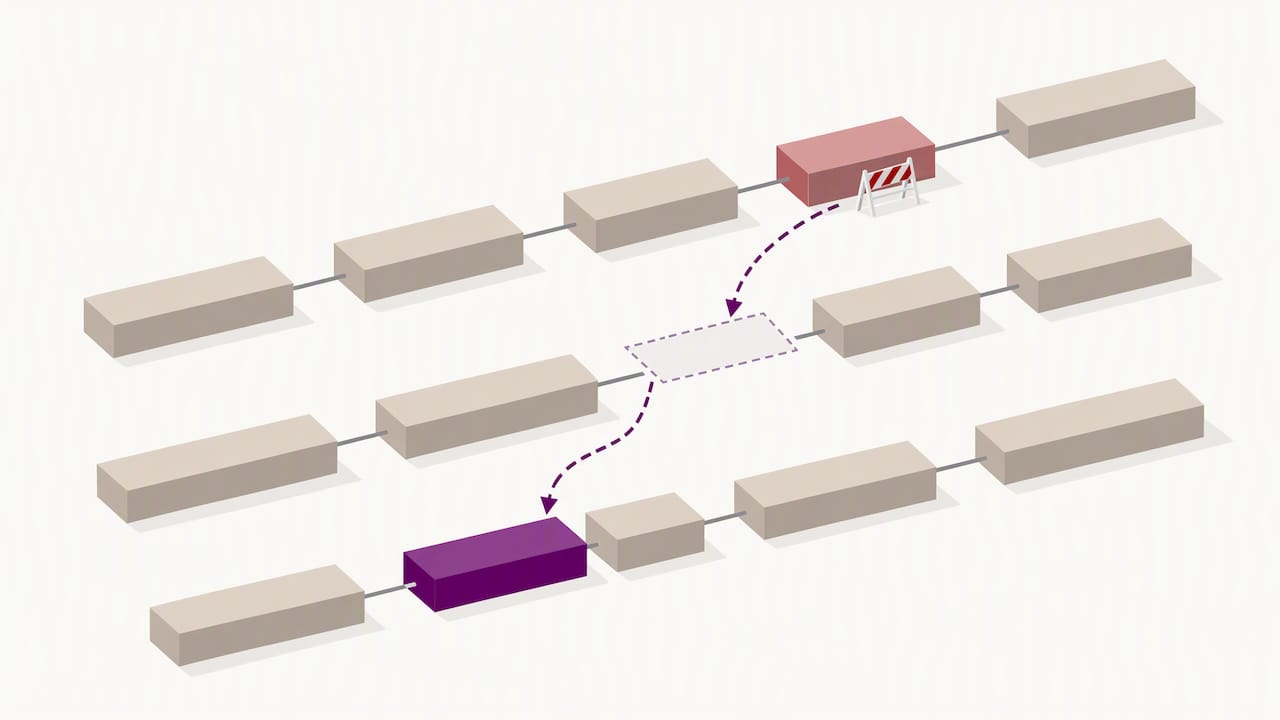
- Manage float as a shared project resource, re-sequencing work before accepting acceleration costs when a true critical delay appears.
- Use site photos, daily logs, drone surveys, and BIM coordination to create a contemporaneous record that supports both prevention and, if needed, later claims.
Design-build delivery can also reduce exposure to one of the biggest delay drivers: late design changes during construction. Research on delivery methods has found that design-build projects tend to show better schedule performance than traditional design-bid-build, largely because design and construction teams coordinate earlier.
Pro Tip: Re-sequence before you accelerate. Acceleration buys back time at a premium cost, while re-sequencing often recovers days for free if your schedule has usable float elsewhere.
Contract Procedures: Notices, Time Extensions, and Liquidated Damages
Technical analysis only protects you if the contract paperwork is in order. Most construction contracts require written notice within a set number of days after a delay event, and missing that window can waive your right to a time extension even when the delay was clearly excusable.
A solid time-extension request typically includes:
- An updated CPM schedule showing the delay’s effect on the critical path.
- A written narrative explaining the cause, timing, and duration of the impact.
- A list of specific critical activities affected and by how many days.
- A description of mitigation steps already taken or proposed.
Agencies and owners often formalize this through contract specifications that set specific dates for baseline, monthly, and final schedule submittals. Indiana DOT’s CPM schedule requirements illustrate a common pattern: progress estimates can be withheld if schedules are not submitted or accepted on time. Concurrent delays complicate liquidated damages further, since a contractor-caused delay running alongside an excusable one may still limit or eliminate relief, depending on how the contract addresses concurrency.
Practitioner Checklist: A Contractor’s 7-30 Day Delay Response
When a schedule-impact event hits, the sequence you follow in the first month shapes whether you recover time, money, or neither.
- Within days, update the schedule’s data date, log the event, and preserve photos and daily reports as contemporaneous evidence.
- Within two weeks, if the event touches the critical path, prepare a short Time Impact Analysis or as-built revision quantifying the effect.
- At the next monthly update, flag near-critical activities and submit mitigation proposals in writing to the owner.
- At closeout, finalize the accepted schedule and narrative so it stands on its own if a claim ever follows.
Why Technical Schedule Discipline Beats Legal-Only Responses
We have seen enough projects up close to believe this: most delay disputes are really documentation failures wearing a legal costume. A contemporaneous CPM, updated honestly every month, resolves more disagreements than any letter from counsel. Build that habit before you need it.
— Arienne
How We Help You Keep Projects on Schedule
Schedule control is not a separate service we bolt on. It runs through every project we manage, from the first baseline CPM to the final closeout narrative, because we apply disciplined scheduling habits on all projects.

| What we offer | Why it matters for schedule control |
|---|---|
| General Contracting | Hands-on schedule management from mobilization through closeout |
| Design Build | Earlier coordination between design and construction reduces late-stage changes |
| Government Contracting | Coordination of schedule submittals and timeline management for government projects |
| Tenant Buildout | Coordinated permitting and sequencing for commercial spaces prone to delay |
If your project is already showing signs of slippage, or you would rather build the discipline in from day one, we welcome a conversation about a schedule review or mitigation proposal. Explore our general contracting services to see how we structure schedule oversight into every contract we sign.
FAQ
Why are construction projects delayed?
Construction projects are most often delayed by labor shortages, late material deliveries, design changes issued during construction, slow permitting, and weather. Recent industry surveys from the AGC identify workforce shortages as a leading disruption for many firms, and these causes frequently overlap on the same project.
Is construction expected to slow down in 2026?
We do not have a sourced forecast on overall construction activity in the coming years, so we cannot state a reliable industry-wide trend here. What we can say is that labor availability, documented in recent workforce surveys, remains a factor project teams should plan around regardless of broader market conditions.
What are considered excusable delays in construction?
Excusable delays come from events outside either party’s control, such as unusual weather or owner-directed changes, and they typically justify a time extension. Whether an excusable delay also becomes compensable depends on whether the owner or its agents caused it, a distinction laid out in standards like ASCE 67-17.
What are the different types of schedule delays in construction projects?
The main categories are excusable, compensable, non-excusable, and concurrent delays, each carrying different consequences for time and money. Classification also depends on whether the delayed work sits on the critical path, since only critical-path delays typically push the finish date.
What documentation do I need to request a time extension?
A time-extension request should include an updated CPM schedule showing the delay’s effect, a written narrative of the cause and duration, a list of affected critical activities, and a record of mitigation steps taken. Agencies and owners often tie this to formal baseline, monthly, and final schedule submittal requirements, as seen in state DOT contract specifications.
Sources
- Understanding construction scheduling (American Bar Association summary of AACE practice)
- GAO Schedule Assessment Guide
- ASCE 67-17 Schedule delay analysis (ANSI/ASCE/CI 67-17)
- Indiana DOT CPM schedule requirements (example state specs)
- AGC 2025 Workforce Survey Analysis