
In Rockville, the loudest construction work is allowed on weekdays from 7 a.m. to 5 p.m. Outside that window, and all day on weekends and holidays, noise has to meet the stricter general limits in the Montgomery County Noise Control Law. Those limits are expressed in decibels, not just clock times, so “allowed hours” is really a question of how loud, when and where.
We are a general contractor in Rockville, and noise comes up in nearly every pre-construction conversation, from homeowners who want to know what their neighbors will hear and from owners who need to schedule work around tenants. This guide explains the rules in plain language, shows how to plan a quiet-aware schedule, and covers what to do if noise crosses the line.
TL;DR
- Weekdays, 7 a.m. to 5 p.m.: construction noise may reach 75 dBA, or 85 dBA with a Noise Suppression Plan.
- Evenings, nights, weekends and County holidays: general noise limits apply, which are much lower (55 to 67 dBA depending on time and property type).
- Rockville follows the Montgomery County Noise Control Law, so the County sets the numbers and takes complaints.
- Report violations to MC311 during business hours or the police non-emergency line, 301-279-8000, after hours.
- Night or extended work needs advance approval. Ask your contractor how it plans to stay within the rules before you sign.
Table of Contents
- Who sets construction noise rules in Rockville
- The hours and decibel limits at a glance
- Can work happen outside the usual hours?
- Noise disturbance: the rule behind the numbers
- How to report construction noise in Rockville
- Planning a project around the noise rules
- Our perspective: quiet is a scheduling decision
- Working with a Rockville general contractor
- FAQ
- Sources
Who sets construction noise rules in Rockville
Construction activity in Rockville is regulated under the Montgomery County Noise Control Law. The City of Rockville adopts the County noise ordinance in its development review process so that noise from individual parcels is handled consistently.
That means there is no separate Rockville clock for jackhammers. If you are searching for a city-only schedule, you will not find one. The County’s Department of Environmental Protection (DEP) publishes the standards that apply to Rockville addresses.
Two practical points follow:
- Check the address. The City can respond only to requests within Rockville city limits, and it offers an address finder so you can confirm whether a property is inside them. Many Rockville mailing addresses sit outside the city boundary but still inside the County.
- Zoning has its own rules. Rockville’s zoning ordinance includes targeted limits, such as a curfew on delivery and loading operations next to residential zones between 10:00 p.m. and 7:00 a.m., which the approving authority can relax if sound barriers keep noise to 55 dBA or less at the lot line.
The hours and decibel limits at a glance
The County defines construction as temporary activity tied to site preparation, assembly, erection, repair, alteration or demolition of structures or roadways. Noise is measured on the receiving property, no closer than 50 feet from the source.
Here is the County’s standard summary, as published by DEP:
| Time of day | Residential receiving property | Non-residential receiving property |
|---|---|---|
| Weekdays, 7 a.m. to 5 p.m. | 75 dBA (85 dBA with a Noise Suppression Plan) | 75 dBA (85 dBA with a Noise Suppression Plan) |
| Weekdays, 5 p.m. to 9 p.m. | 65 dBA | 67 dBA |
| Weekdays, 9 p.m. to 7 a.m. | 55 dBA | 62 dBA |
| Weekends and holidays, 9 a.m. to 9 p.m. | 65 dBA | 67 dBA |
| Weekends and holidays, 9 p.m. to 9 a.m. | 55 dBA | 62 dBA |
DEP notes that in most circumstances the receiving property is treated as residential, so the residential column is the one that usually matters. It also notes that start times are delayed and noise levels are lower on County holidays.
What the numbers mean in practice
The weekday 7 a.m. to 5 p.m. window is the only time heavy equipment gets a higher allowance. After 5 p.m. the limit drops by roughly 10 dBA at a residential property. Because decibels are logarithmic, a 10 dBA drop sounds about half as loud to most people, so a task that is routine at 2 p.m. can be a clear violation at 6 p.m.
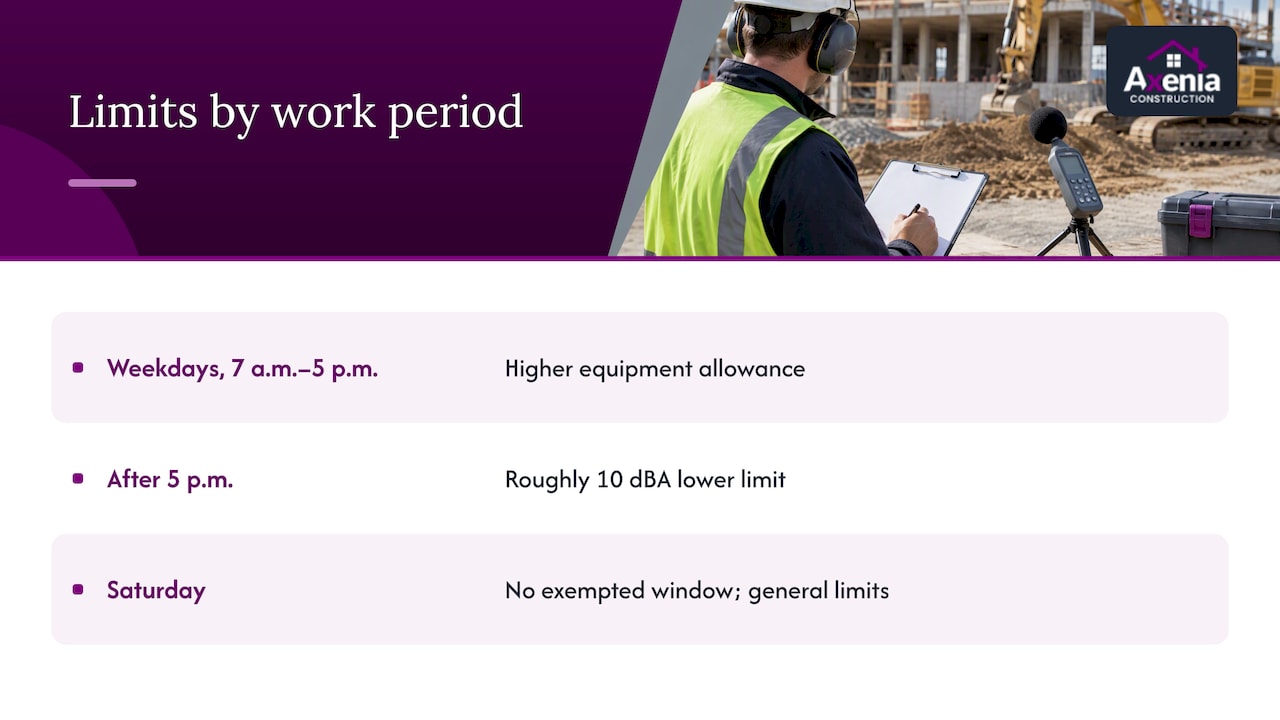
On a Saturday, there is no exempted window at all. Weekend work has to meet the general limits, which makes loud demolition, saw-cutting or heavy compaction a poor fit for weekends at a home with close neighbors. Quieter tasks, such as interior finish work, may fit within the limit, but the measurement is what counts, not the type of task.
What is a Noise Suppression Plan
A Noise Suppression Plan is the County’s route to the higher 85 dBA weekday ceiling. It documents how the project will limit noise, for example through equipment choices, barriers and sequencing. We treat it as a planning tool for larger commercial and multi-unit jobs where loud phases cannot be avoided, and not as something a single-room remodel needs.
Can work happen outside the usual hours?
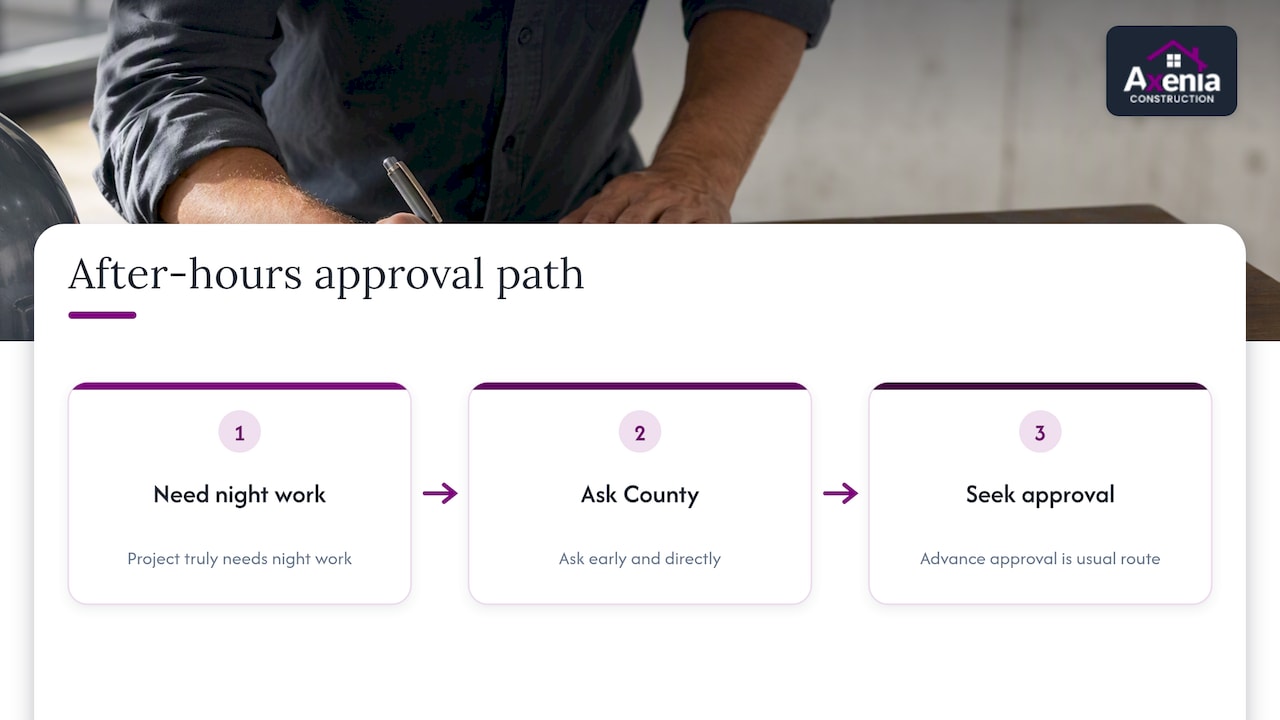
Sometimes, but not by default. The County’s approach is that outside 7 a.m. to 5 p.m. on weekdays, the general standards apply. If a project truly needs night work, the usual route is advance approval. For example, a County road project at Brink Road Bridge applied for a Temporary Noise Waiver through DEP to allow night work.
That example is public infrastructure, and a private project should not assume a waiver is easy to get. If a schedule depends on after-hours work, ask early and ask the County directly. Requirements differ by jurisdiction. For example, we have written about how after-hours construction permits work in DC, where the process is different from Montgomery County’s.
Noise disturbance: the rule behind the numbers
Meeting the decibel table is not the only test. Construction is also subject to the County’s noise disturbance provisions. DEP explains that disturbance criteria are intentionally subjective, because noise events often happen randomly, when no enforcement officer with a sound-level meter is around.
In plain terms: a crew can be inside the posted time window and still generate a valid complaint if the noise is unreasonably disruptive. Good contractors treat the clock as a ceiling, not a target.
How to report construction noise in Rockville
If you believe a site violates the Noise Control Law, you have three options, depending on timing:
- Two-Party Noise Complaint. DEP says residents who believe a construction site violates the law can file a Two-Party Noise Complaint.
- MC311 during business hours. Noise violations during regular business hours can be reported to MC311.
- Police non-emergency line after hours. Disturbances outside regular business hours go to the Montgomery County police non-emergency number, 301-279-8000, as listed on the same DEP page.
Before you report, gather what makes a complaint easy to act on:
- The exact address of the site and where you were standing
- The date, start time and end time of the noise
- What equipment or activity you heard
- Short video clips with timestamps
- Whether the site is within Rockville city limits or elsewhere in the County
A calm conversation with the site supervisor often solves it faster than a complaint. Reputable contractors post a contact number for exactly this reason.
Planning a project around the noise rules
Whether you are the owner or the neighbor, the rules are easier when the schedule is built around them from day one.
For homeowners
Before a kitchen, bath, addition or deck project starts, ask your contractor:
- Which phases are loudest (demolition, framing, cutting tile, concrete) and when will they be scheduled?
- Will weekend work be needed, and if so, what kind?
- How will neighbors be notified?
- Who answers the phone if someone complains?
Permits are part of the same conversation. If you are planning a bathroom job, our guide to Rockville bathroom permits covers when you need one. For kitchens with gas work, see Maryland kitchen remodel permits. Early permitting also keeps loud phases from sliding into evenings because of lost weeks. Our page on permit expediting in Maryland explains how delays happen and how to avoid them.
For commercial owners and property managers
Tenant buildouts often happen next to occupied suites, so the non-residential limits (67 dBA in the evening, 62 dBA at night) are only part of the story. Your lease and your neighbors’ leases may restrict noisy work during business hours. In practice that can push demolition to early morning or evening, where the County’s lower limits apply. Settle this with the landlord and adjoining tenants before you set a schedule.
For neighbors and HOAs
HOA and condo rules can be stricter than the County’s. If your association limits work hours, those limits apply on top of the law, so read the governing documents before you accept a contractor’s proposed schedule.
Our perspective: quiet is a scheduling decision
Most noise complaints we hear about trace back to surprises, not to the work itself. A neighbor who knows that demolition lasts three days and ends by 4 p.m. usually tolerates it. A neighbor who hears a saw at 6:30 p.m. with no warning does not.
That is why we build noise into the project schedule instead of treating it as an afterthought. We sequence loud work early in the job, confirm the permit path and local rules before mobilizing, and keep communication open with the client and the people next door. As a women-owned firm that works across Maryland, DC and Northern Virginia, we also know the rules change at every border, and a plan that works in Rockville may not work in DC or Arlington. Learning those differences is part of local permitting expertise, and it is what lets us promise a schedule we can keep.
Our advice to anyone hiring a contractor: ask how the crew will protect your neighbors, not only how it will protect your budget. Good answers are specific.
— Arienne
Working with a Rockville general contractor
If you are planning a renovation, an addition or a commercial buildout in Rockville, we can walk through the schedule, the permits and the noise plan with you before work begins. Learn more about our general contracting services in Rockville, or if your project spans design and construction, our design-build approach keeps one team accountable for both.

To discuss a project, visit Axenia Construction and tell us about the work, the address and the timeline.
FAQ
What time can construction start in Rockville?
On weekdays, the higher construction noise allowance begins at 7 a.m. and runs until 5 p.m. Outside those hours, the lower general limits apply. On weekends and holidays, the daytime period begins at 9 a.m., and the County notes start times are delayed on County holidays.
Is construction allowed on Saturdays and Sundays in Rockville?
Work is not banned outright, but the weekday exemption does not apply. Weekend noise has to stay within 65 dBA for residential receiving properties from 9 a.m. to 9 p.m., and 55 dBA after 9 p.m. Loud work is hard to fit in those limits, so most contractors avoid it.
How loud can construction be during the day?
On weekdays from 7 a.m. to 5 p.m., the limit is 75 dBA, or 85 dBA with a Noise Suppression Plan. It is measured on the receiving property, no closer than 50 feet from the source.
Who do I call about construction noise at night?
Call the Montgomery County police non-emergency line at 301-279-8000 for disturbances outside regular business hours. During business hours, report it to MC311. If the noise is a repeated problem, you can also file a Two-Party Noise Complaint with DEP.
Does Rockville have its own separate noise ordinance?
Rockville adopts the Montgomery County Noise Control Ordinance in its development review, so the County’s numbers are the ones to use. The city’s zoning code adds specific limits, such as the overnight curfew on deliveries and loading near residential property.
Sources
- Construction Noise, Montgomery County DEP
- Noise Control, Montgomery County DEP
- Environmental Guidelines, City of Rockville
- Contact, City of Rockville
- Decibel Limits in Rockville, MD, CityRuleLookup
- Brink Road Bridge closure update, Montgomery County