
An allowance is a set amount in your contract for something you know you need but have not chosen yet, such as tile, light fixtures or a countertop. A contingency is a reserve for problems nobody can see yet, such as rot behind a wall or a code change. One covers a known item with an unknown price. The other covers an unknown event. A sound construction budget needs both, kept separate and written clearly into the contract.
We are a licensed general contractor in Rockville, MD, and we explain this on almost every first walkthrough. Confusing the two is one of the most common reasons owners feel surprised by a final invoice.
TL;DR
- An allowance is a placeholder for a known scope item whose selection or price is not final. A contingency is a reserve for unforeseen conditions.
- If an allowance item costs more or less than budgeted, the contract sum is adjusted by change order. Unused contingency typically goes back to the owner, unless the contract says otherwise.
- Commonly cited contingency ranges are 5–10% for new construction and 10–20% for remodeling, because older buildings hide more.
- Ask for both to be listed as separate lines, with who controls them and how approvals work written down.
Table of Contents
- The core difference in plain terms
- What an allowance covers
- What a contingency covers
- How much to set aside
- What happens when each runs out, or is not used
- Writing both into your contract
- Where each one shows up in common projects
- Our perspective
- Work with a contractor who itemizes
- FAQ
- Sources
The core difference in plain terms
Lawyers who write on construction contracts describe an allowance as an amount established in the contract documents for prescribed items not specified in detail. The same paper uses a shorthand that sticks: allowances are for “known unknowns,” and contingencies are for “unknown unknowns.”
The American Institute of Architects describes a contingency as a predetermined amount or percentage of the contract held for unpredictable changes, such as price escalation, design changes or necessary changes on site.
Here is the practical version:
| Allowance | Contingency | |
|---|---|---|
| What it covers | A scope item you know is coming, but whose selection or price is not final | Costs from events or conditions no one can predict |
| Typical example | Kitchen tile, plumbing fixtures, cabinet hardware | Rotted subfloor, outdated wiring behind a wall, a code requirement found at inspection |
| Who decides how it is spent | The owner, through selections | Defined in the contract, usually by approval from the owner |
| If the cost differs | Contract sum adjusted by change order | Unused funds usually return to the owner |
| When it shrinks | As selections are made and priced | As risks are cleared during construction |
What an allowance covers
An allowance exists because a contractor cannot price what has not been picked. If you have not chosen a backsplash by the time the contract is signed, we carry an amount for it so the total price is realistic. When you choose, we compare the real cost against that amount.
Typical allowance items in a home project:
- Tile, flooring and countertop materials
- Plumbing fixtures and faucets
- Lighting fixtures
- Cabinet hardware
- Appliances, if you are buying through us
In commercial work, the same idea applies to finishes, signage, specialty equipment or a discrete piece of scope that is not yet designed. Public project specifications make this clear. A District of Columbia government set of AIA master specifications for bidders notes that specifications may define several kinds of allowances, including lump-sum, unit-cost, quantity and contingency allowances.
What the allowance number includes
Read this line carefully, because it causes most disputes. Under the standard AIA A201-2017 general conditions, allowances cover the cost of materials and equipment, while labor, overhead and profit for those items are typically included in the contract sum, unless the documents say otherwise.
In practice, a $6,000 tile allowance in an A201-style contract is a figure for the tile itself. Installation labor is priced separately in the base contract. If your contract does not follow that structure, the document should say plainly what the allowance includes. Ask us to spell it out line by line.
How an allowance is settled
When the real price of an allowance item differs from the budget, the contract sum is adjusted by change order. Spend less and you get a credit. Spend more and the difference is added. Either way it is documented, not absorbed quietly.
On AIA contracts, the owner may also direct who supplies allowance-covered items, as long as the contractor has no reasonable objection. That matters if you want to buy your own fixtures or use a supplier you trust.
What a contingency covers
A contingency is a reserve for risk. It pays for the things that cannot be priced because they cannot be seen: conditions inside walls, under floors and above ceilings, or events outside anyone’s control.
Two versions appear in contracts:
- Owner contingency: held by the owner for scope changes, regulatory updates or cost increases outside the original contract.
- Contractor contingency: carried in the contractor’s price to absorb risks inside the contractor’s scope, such as unforeseen conditions or subcontractor adjustments. Industry guidance on both types draws this same line.
It also notes what contingency should not pay for: administrative overhead, financing costs, or owner-driven scope expansions. Those belong in the normal change order process. If you decide to upgrade from a standard vanity to a custom one, that is a change, not a surprise, and it should not drain the reserve meant for real unknowns.
For a deeper look at how project managers size these reserves, see our guide on construction contingency budgets.
How much to set aside
There is no official percentage. Published ranges are a starting point, and they vary with risk. One widely cited contractor guide puts contingency at 5–10% of project cost for new construction and 10–20% for renovations, because existing structures conceal conditions.
What moves your number up or down:
- Age of the building. A 1950s Bethesda rambler or a rowhouse in DC can hide knob-and-tube wiring, galvanized pipes or past repairs. A new shell has fewer unknowns.
- How much has been designed. Complete drawings and finished selections reduce risk. Vague plans increase it.
- How much you will open up. Gutting a kitchen to the studs exposes more than a cabinet swap.
- Permitting and inspections. Jurisdictions in Maryland, DC and Northern Virginia have different review processes, and a correction at inspection can add cost.
- Your own tolerance. If a $20,000 surprise would strain you, carry more.
Here is a simple worked example. A remodel has a base contract of $100,000. Using a 10–20% range, you would hold $10,000 to $20,000 as a separate reserve. Separately, you might have $8,000 in allowances for tile, fixtures and lighting inside the contract price. Those are different pots with different jobs.
The Associated General Contractors of America, in its planning guide for owners, recommends separating the net budget from the contingency reserve for transparency. It also suggests a risk-based reserve that is monitored through project phases and reduced as risks are cleared. That is good practice for any owner, large or small.
What happens when each runs out, or is not used
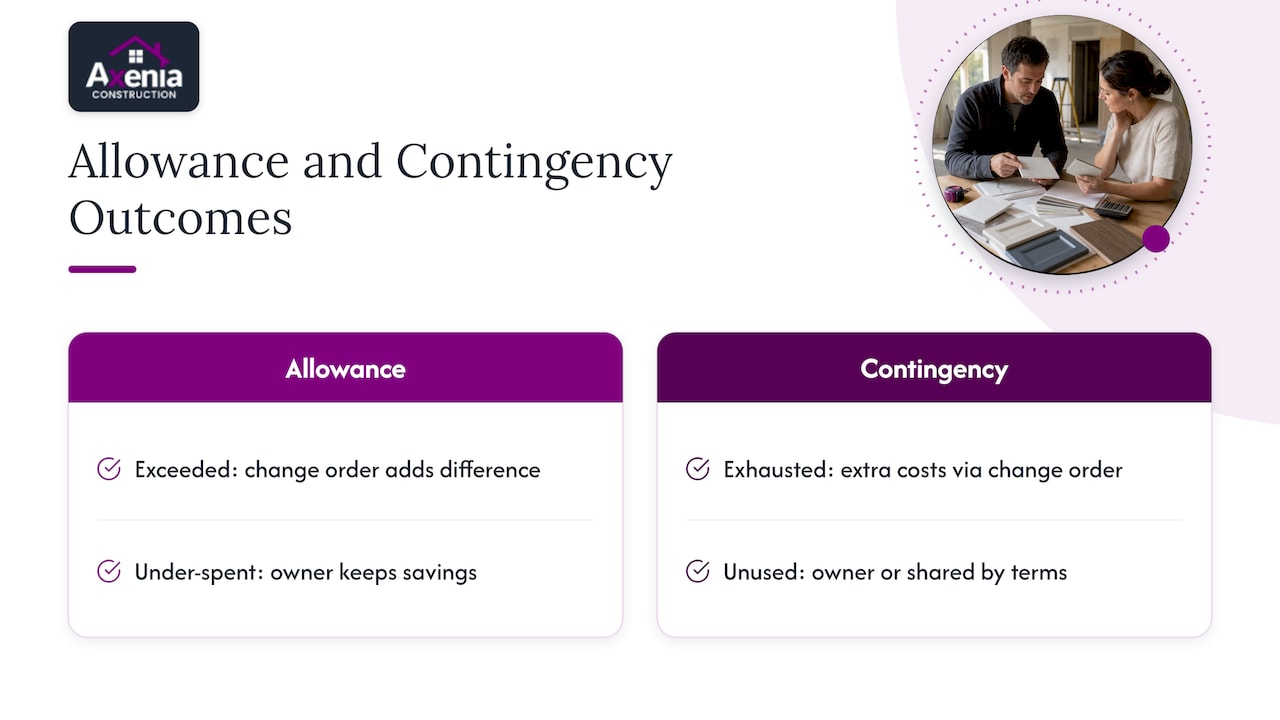
Allowance exceeded. A change order raises the contract sum by the difference. Nothing is hidden. You approve the new number before the item is ordered, which is why selections should be made early.
Allowance under-spent. The contract sum is reduced by change order. You keep the savings.
Contingency exhausted. If real problems use up the reserve, additional costs also run through a change order. This is why we suggest owners keep a little in personal reserve beyond the contract on older homes.
Contingency unused. Unused contingency often reverts to the owner at closeout. The AIA standard documents say the same: it typically reverts to the owner or is shared based on negotiated terms, particularly in guaranteed maximum price agreements.
The contract type changes how these play out. In a fixed-price contract, the contractor’s contingency is buried in the price. In cost-plus, it is usually shown openly. Our checklist for cost-plus versus fixed-price homeowner contracts walks through that choice, and our overview of commercial contract types covers the same for business owners.
Writing both into your contract
A clear clause saves arguments. Contingency clauses should define how funds are accessed, including notices, backup documentation and approvals, and specify what the funds may be used for.
Before you sign, look for these items:
- A separate line for each allowance, with a description, a dollar amount and what the amount includes (materials only, or materials and installation).
- A separate line for contingency, stated as a dollar figure or percentage, and labeled owner or contractor.
- Who approves spending. Written approval before any draw, with a short explanation and photos or invoices.
- Settlement rules. How overages and savings are handled, and when the change order is issued.
- What happens to unused contingency. Returned, shared or retained, in writing.
- Selection deadlines. The date by which you must choose each allowance item so the schedule holds.
The same discipline that keeps bid documents complete, as explained in this piece on tender specification paperwork, applies to a home or tenant contract: what is not on paper tends to become a dispute later.
If you are a Maryland homeowner, the state also sets rules for the paperwork. The Maryland Home Improvement Commission requires that a home improvement contract be in writing, signed by each party and describe the work and materials, and that the homeowner receive a signed copy before work starts. Allowance and contingency lines belong in that written description.
If you want to know what a complete estimate should list in the first place, read what a contractor estimate includes.
Where each one shows up in common projects
Kitchens and baths
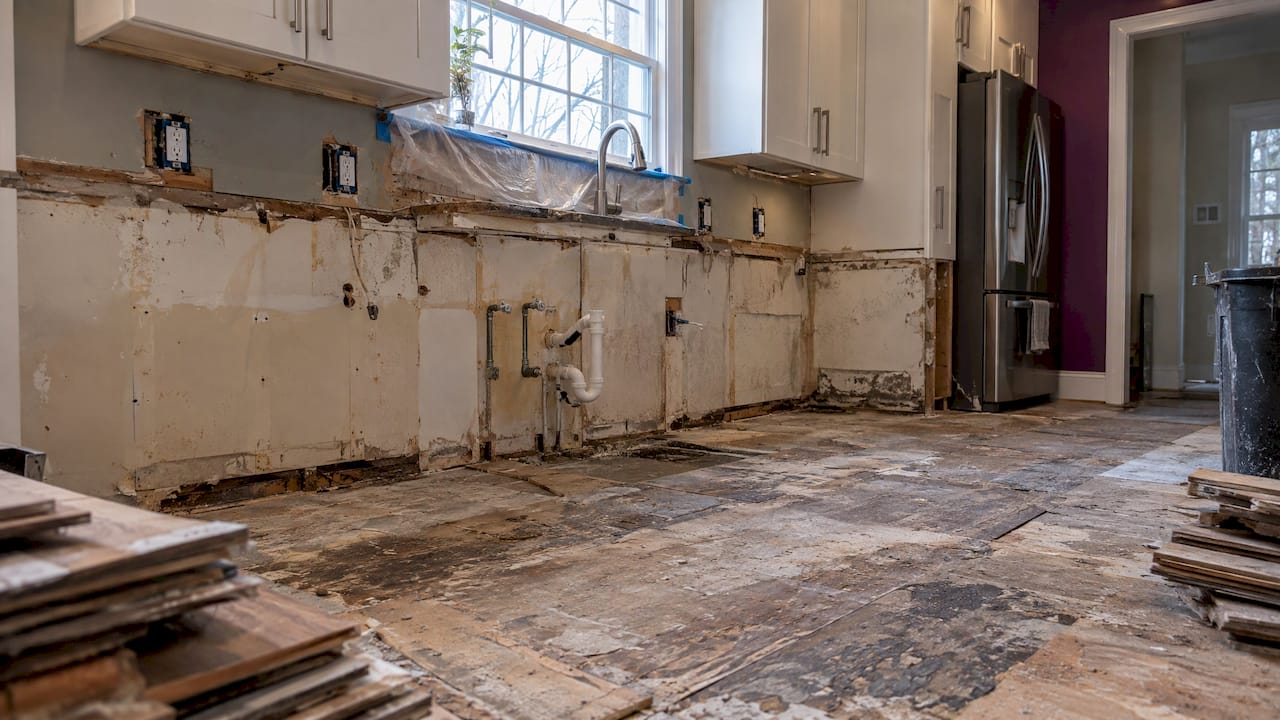
Allowances do the heavy lifting here, since finishes drive cost. Contingency covers what appears once the old cabinets and floors come out. Our kitchen remodel budget planning guide shows how to think through those categories.
Whole-home and open floor plans
Removing a wall can reveal wiring, ductwork or structural surprises. This is contingency territory, and it is also where owners should keep it separate from upgrades. See our open floor plan scenarios for budget ranges framed by risk.
Commercial tenant buildouts
The word “allowance” also has a second meaning in leases. A tenant improvement allowance is money a landlord contributes toward your buildout. That is a different instrument from a construction allowance in a contract, though the two interact. Before you sign a lease, review how to negotiate a tenant improvement allowance and why to lock it in before a shell space buildout. For smaller scopes, our conference room buildout budget guide applies the same reserve thinking.
Our perspective
We see the same pattern on projects around Rockville, DC and Northern Virginia. Budgets rarely fail because an owner picked an expensive faucet. They fail because nobody separated a choice from a surprise.
That is why we put allowances and contingency on separate lines and explain each one at the start. An allowance is a conversation about your taste and priorities. A contingency is a conversation about risk. Mixing them makes both harder to manage.
As a women-owned firm built on transparent communication, we prefer to show you the number, show you what it includes and ask for your approval before it is spent. Our integrated design-build approach helps, because finishes can be selected while drawings are developed, which shrinks allowances before work starts.
The best budget is one you can read in five minutes and trust for the whole project.
Arienne
Work with a contractor who itemizes
Whether you are renovating a kitchen, finishing a tenant space or managing a property, we can help you build a budget where every dollar has a label. Our general contracting team works with homeowners, commercial owners and government clients across Maryland, DC and Northern Virginia, and our design-build service brings design and pricing together early.
To discuss your project and how we would structure allowances and contingency for it, visit Axenia Construction and request a conversation.
FAQ
Is a contingency the same as an allowance?
No. An allowance is a placeholder for a known item whose final selection or price is not set. A contingency is a reserve for unforeseen conditions. The first is spent on something you chose. The second is spent only when something unexpected happens.
How much should I budget for contingency?
Common guidance is 5–10% for new construction and 10–20% for remodeling. Older buildings, partial designs and larger demolition push the figure higher. Keep it as its own line, separate from your base budget.
What happens to unused contingency money?
It often goes back to the owner at closeout, or it is shared if the contract has incentive terms. The contract should say which. Confirm this before you sign, especially on guaranteed maximum price agreements.
What are the main types of allowances?
Specifications commonly define lump-sum, unit-cost, quantity and contingency allowances. In residential work, the lump-sum allowance is the most familiar, such as a fixed dollar amount for lighting fixtures.
Sources
- The Use and Misuse of Allowances and Contractor Contingency (Ogletree)
- Construction One-Minute Read: Allowance or Contingency? (Ogletree)
- Managing the contingency allowance (AIA)
- AIA Document A201-2017 sample
- AIA Master Specifications, Instructions to Bidders (DC DGS)
- Construction Contingency guide (Mastt)
- Construction Contingency for General Contractors (Bolster)
- Project Planning Guide for Owners and Project Teams (AGC)
- The Contractor’s Contingency clause guide
- Maryland Home Improvement Contracts (MHIC)
- Guardrail tender specifications