If you are changing how a building or space in Washington, DC is used, for example turning an office into a clinic or a retail shop into a restaurant, you need a new Certificate of Occupancy (C of O) before the new use begins. Depending on the scope, you may also need a construction permit for the work itself. Both go through the Department of Buildings (DOB), and the C of O application is filed in DOB’s online platform, Certifi. Below is how the pieces fit together, what to prepare, and where projects usually lose time.
TL;DR
- DC does not issue a stand-alone “change of use permit”. A change in use, occupancy load or tenant floor layout requires a new Certificate of Occupancy.
- The C of O is reviewed for zoning and construction-code compliance, and any related construction permits need approved final inspections first.
- DOB’s stated review timeframe for use- or load-change applications is seven business days from acceptance, but the clock stops whenever DOB asks for more information.
- Starting a new use without approval can bring fines, a stop work order and neighbor or Attorney General action.
- Settle zoning first, then design and permits, then construction and inspections, then the C of O.
Table of Contents
- What “change of use permit” means in DC
- When a new Certificate of Occupancy is required
- Check zoning before you design anything
- Documents you need and how to apply
- Fees and review time
- Inspections and approvals before you can operate
- What happens if you change use without approval
- A sensible order of operations
- Our perspective
- Bring in a contractor who plans for the C of O
- FAQ
- Sources
What “change of use permit” means in DC
People search for a change of use permit, but the paperwork in DC has two parts that work together.
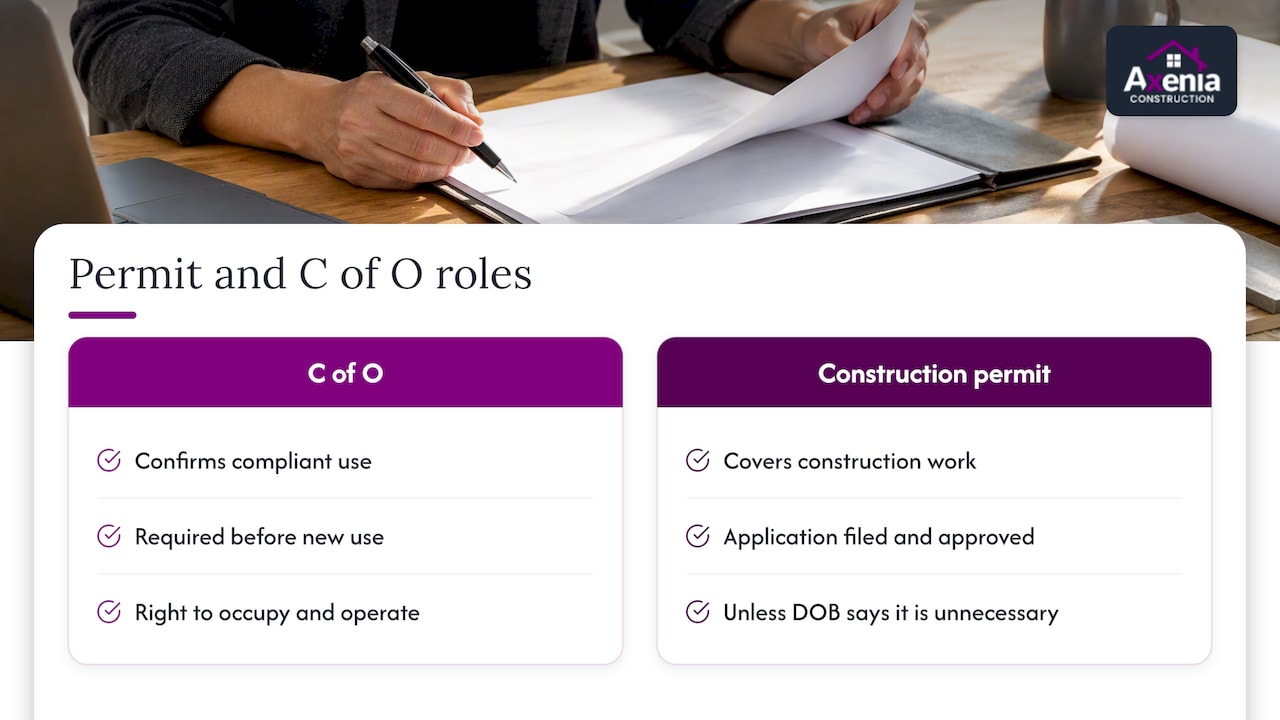
The first is the Certificate of Occupancy. Under the DC construction code provision on certificates of occupancy, a C of O states that the use complies with the applicable Zoning Regulations and Construction Codes, including building, electrical, plumbing, mechanical and fire-protection requirements. Nobody may use a structure, land or part of either for any purpose, or change the use or load, until one has been issued, except as provided in the Zoning Regulations.
The second is the construction permit. Per the same provision, a construction permit application must be filed and approved unless DOB determines one is not required, and the C of O is required before the new use starts. In plain terms: the building permit covers the work, and the C of O covers the right to occupy and operate the space for that use.
That difference matters for planning. A permit can be approved and the work finished, but if the C of O is not issued, you cannot open the doors for the new use.
When a new Certificate of Occupancy is required
The DC code says a new C of O is required for a change in use, occupancy load or tenant floor layout. Typical triggers for commercial owners include:
- Converting office space to medical, dental or other clinical use
- Turning retail or storefront space into a restaurant or food service
- Splitting one tenant space into two, or combining suites, which changes the layout and load
- Moving a new tenant into space whose last certificate describes a different use
- Adding assembly, education or daycare use to a building that did not have it
Not every space needs one. DOB’s overview of the permitting process notes that single-family homes, individual units in apartment buildings and individual suites in office buildings do not require C of Os. Residential owners who are simply renovating a house are usually dealing with building permits, not a change of use. Where a home is being converted to a different kind of occupancy, confirm with DOB before you plan the work.
If you want to occupy a previously vacant building temporarily, DOB’s Pop-Up Permits program offers a streamlined C of O for temporary use of up to one year, combining the mechanics of the building-permit and C of O processes. It is worth asking about when you want to test a concept before committing to a full buildout.
Check zoning before you design anything
The most expensive surprise in a change of use is discovering late that the zone does not allow the use. Do this check first.
The DOB Office of the Zoning Administrator reviews applications, including C of O applications, for conformity with the DC Zoning Regulations and allowable uses. According to the Zoning Regulations, the Zoning Administrator’s role is to verify that the proposed use is permitted in the specific zone district and that occupant loads are compliant.
Before signing a lease or purchase contract, we suggest you:
- Identify the zone district for the address.
- Confirm the proposed use is permitted there, or what relief it would need if it is not.
- Review the last Certificate of Occupancy on file to see what the space is currently approved for.
- Ask your contractor and architect to estimate the occupant load for the new layout.
If the use is not permitted as of right, the path changes and may involve the zoning relief process, which adds time and should be priced into your decision. A lease contingency tied to zoning and C of O approval protects you here.
Documents you need and how to apply
Applications run through Certifi, DOB’s platform for applying for, tracking and receiving approved Certificates of Occupancy. DOB’s use change one-pager lists what applicants should have ready:
- Proof of legal right to use the property, such as a lease or deed
- Copies of previous Certificates of Occupancy
- Approved permits and final inspections for all related permits, if construction was required
In practice, we also gather the floor plan showing the proposed layout, the occupant-load calculation, and any special-inspection reports the use may trigger. Having these assembled before you file is the single easiest way to avoid information requests that stop the review clock.
A note on registration: DOB requires users to register to file permit applications online, so set up accounts early, well before your target filing date.
Fees and review time
Two numbers drive most owner questions: what it costs and how long it takes.
| Item | What DOB publishes |
|---|---|
| Fee basis | Generally based on the property’s square footage |
| Base fee, spaces of 5,000 sq ft or less | $42 plus a $33 filing fee, with tiered rates for larger properties |
| Review timeframe, use or load change | Seven business days from the date the application is accepted for review |
| Clock stops when | A division or agency requests information |
| Inactive application | Deemed abandoned after more than 180 days; a new application and all fees are required |
Fee schedules are updated from time to time, so check DOB’s current schedule before you budget. The C of O fee is also a small part of the total. The real costs sit in design, construction permits, construction and any code upgrades the new use triggers. Our office build-out cost guide for DC shows how those line items stack up per square foot.
The seven-day figure applies to the C of O review itself. It does not include the time to design the space, obtain construction permits, build, and pass final inspections. Those steps usually take far longer, so plan your lease start or opening date around the whole sequence, not the review clock.
Inspections and approvals before you can operate
The C of O comes last, and DOB checks that everything before it is closed out. Per DOB’s Certifi FAQs, all related permits must have completed, approved final inspections before the C of O application is approved and issued. If a special-inspection report is required, it must be completed, submitted by the agency and approved by DOB.
Three practical points:
- Conditional certificates. A code official may issue a conditional C of O for a building or a portion of it before all permitted work is complete, if it can be safely occupied, and may specify when the certificate expires. Ask early whether this applies, because it can let part of a space open sooner.
- Posting. The certificate must be conspicuously posted in or on the premises where anyone entering can see it. Houses of worship in Group A-3 have an exception for sanctuary and nave areas.
- Business licensing is separate. DOB’s zoning FAQs state that a C of O does not replace any license needed to conduct business at the premises, and direct applicants to the Department of Licensing and Consumer Protection (DLCP) for license information.
For many commercial uses, accessibility upgrades are part of the scope as well. Our ADA compliance guide for commercial buildings explains what owners should review before design begins. If your plan involves splitting a space, review the demising wall requirements too, since new walls change both the layout and the occupant load.
What happens if you change use without approval
Skipping the process rarely saves time. DC’s penalties are written to make that clear:
- Work without a required permit can result in a $2,000 fine per infraction, and repeat violations can reach $4,000 per infraction. DOB will not release a Stop Work Order until the permit fee is paid.
- Zoning violations, including unauthorized changes of use, may be punished by a fine of up to $100 per day for each day the violation continues (DCMR Title 11, Section 305.1).
- The Office of the Attorney General, or a neighbor specially damaged by the violation, may begin proceedings to stop the violation or prevent illegal occupancy (Section 305.2).
Beyond the fines, an unpermitted use can complicate insurance, financing, a sale or a lease renewal. If work has already started without the right permits, stop, document what is done and talk to your contractor about the corrective path before inspectors find it for you.
A sensible order of operations
This is the sequence we walk owners through on commercial change-of-use projects:
- Confirm zoning and the existing C of O. Do this before you commit to a lease or purchase.
- Define the scope and occupant load. Layout drives both code requirements and the load on the certificate.
- Design with the code in mind. Egress, fire protection, plumbing fixtures, accessibility and mechanical systems all depend on the new use.
- File construction permits and respond quickly to review comments.
- Build and schedule inspections as work is completed, keeping the approved final inspections organized for the C of O.
- File the C of O in Certifi with your documents assembled.
- Post the certificate and confirm any business licenses with DLCP.
If noisy or disruptive work has to happen outside normal hours in an occupied building, see our note on after-hours construction permits in DC. For the bigger picture of managing a commercial job from budget to closeout, our commercial renovation process guide covers the stages in detail.
Our perspective
Owners tend to treat the Certificate of Occupancy as the last form on the list. We treat it as the first question. When a client tells us they are looking at a space, we ask what the last certificate says, what the zone allows, and what occupant load the new layout creates, because those answers decide whether the space is worth leasing at all.
A change of use is a coordination problem more than a paperwork problem. Zoning, design, construction permits, inspections and the C of O all depend on one another, and a gap in any one stops the others. That is why we favor one accountable team, with clear communication from the first walkthrough through the final inspection. Our integrated design-build approach keeps the designer and builder working from the same set of assumptions, so code questions are answered before they become change orders.
We are a women-owned, licensed general contractor based in Rockville, and we work with permitting in DC, Maryland and Northern Virginia. For us, building genuine relationships means telling you early what the process will require, so your new use opens on a schedule you can trust.
Arienne
Bring in a contractor who plans for the C of O
If you are weighing a space for a new use, we can help you map the work against the permit and C of O sequence before you commit. Our tenant buildout team handles layout, MEP coordination, permitting and construction for commercial spaces across DC, and our general contracting services cover renovation projects of other types.
For a closer look at how we approach commercial spaces, read our guide to a tenant fit-out in DC, or see how we handle an office to medical conversion, one of the most common change-of-use projects. When you are ready to talk through your address, contact Axenia Construction and we will start with the questions above. You can also review what to look for in a contractor in our guide to finding a licensed general contractor in Washington DC.
FAQ
Is there a separate “change of use permit” in DC?
Not as a stand-alone document. A change in use, occupancy load or tenant floor layout requires a new Certificate of Occupancy, and a construction permit is required for the work unless DOB determines one is not needed. Think of it as a permit for the work and a certificate for the use.
How long does DOB take to review a use change?
DOB lists a review timeframe of seven business days from the date the application is accepted for review, for use- or load-change applications. The clock stops if a division or agency requests information, so complete submissions move fastest. Design, permits and construction are separate from that review.
Do I need a C of O to rent out a single suite in an office building?
DOB states that individual suites in office buildings, single-family homes and individual units in apartment buildings do not require C of Os. If the new tenant’s use changes the building’s overall use or load, confirm with DOB. A C of O also does not replace any business license you need.
What if my application sits idle?
If a C of O application is inactive for more than 180 days, DOB deems it abandoned and subject to cancellation. You would need to file a new application and pay all fees again, so keep the review moving and respond to requests promptly.
Sources
- Overview of Permitting Process, DOB
- Pop-Up Permits, DOB
- Frequently Asked Questions, DC Office of Zoning
- Title 11 DCMR Zoning Regulations
- Certifi FAQs, DOB
- Certificate of Occupancy One Pager, Use Change, DOB
- Building Permit Fee Schedule, DOB
- Certificate of Occupancy and Zoning Tips and FAQs, DOB
- Report Illegal Construction, DOB