Most retail buildouts in Maryland land somewhere between about $126 and $157 per square foot for a standard in-line store, and far higher for shell space or specialty concepts. Those are national and Southeast averages, not a Maryland quote, so treat them as the starting line. Your real number depends on what the space looks like today, what your brand needs it to become, and what Montgomery, Prince George’s, Howard or Baltimore County requires before the first wall goes up. Below, we walk through the benchmarks, the line items people forget, the permit math, and a simple way to build your own budget.
TL;DR
- Cushman & Wakefield’s 2026 guide puts the average in-line retail fit-out at $157 per square foot nationally and $126 in the Southeast. Use them as a floor for planning, not a bid.
- Second-generation space (a former store) costs much less to convert than a bare shell, and specialty or high-end concepts cost the most.
- Construction is only part of the budget: design, permits, landlord fees, fixtures, signage, IT and contingency add up quickly.
- In Montgomery County, the FY 2027 alteration permit fee is 3% of the cost of construction, plus a filing fee.
- A tenant improvement (TI) allowance rarely covers everything, so negotiate it before you sign the lease.
Table of Contents
- What the benchmarks say about retail buildout cost
- How the space itself changes the price
- The costs that never appear on the contractor’s invoice
- Maryland permits, fees and inspections
- How TI allowances change what you actually pay
- How to build your own retail buildout budget
- Our perspective: price the scope, not the square foot
- Work with a Maryland retail buildout team
- FAQ
- Sources
What the benchmarks say about retail buildout cost
The most useful public benchmark is the 2026 U.S. Retail Fit Out Cost Guide from Cushman & Wakefield. It reports an average in-line retail fit-out of $157 per square foot nationally and $126 per square foot in the Southeast. The figure is based on a survey of 15 general contractors in 15 U.S. markets.
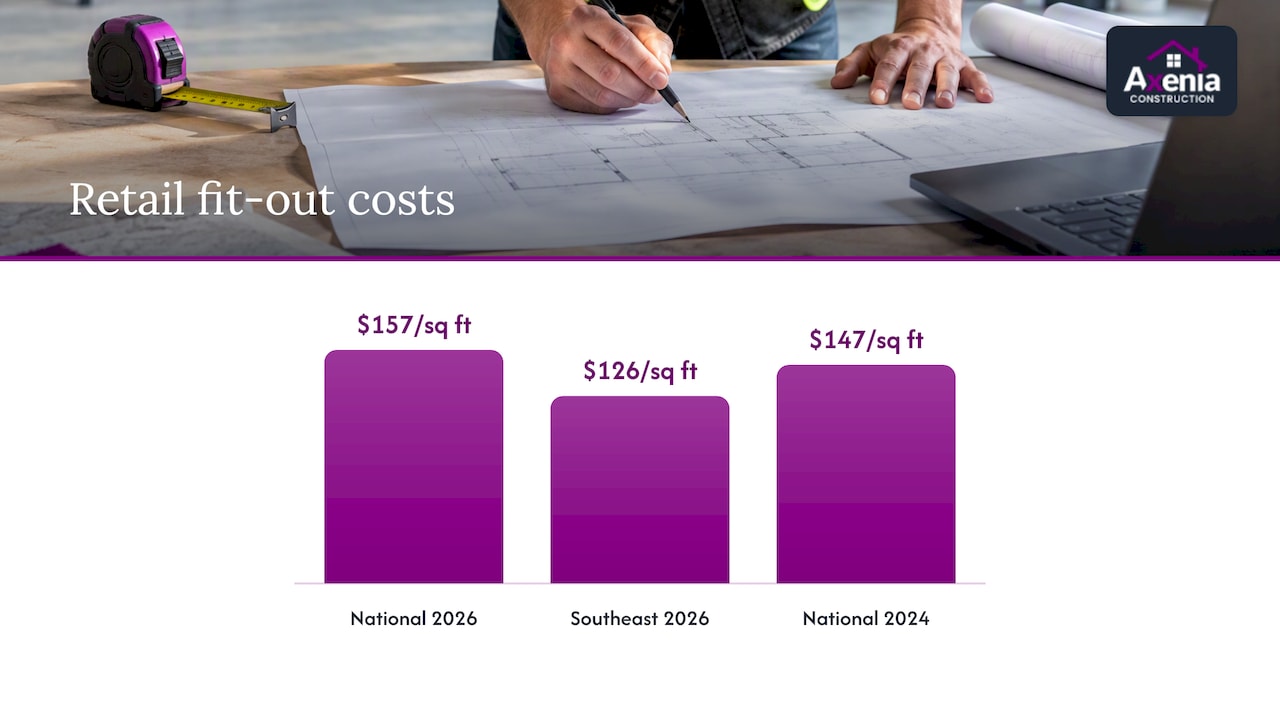
The previous generation of the same research is a good reality check on what the number includes. ICSC’s summary of the 2024 guide put the national in-line average at $147 per square foot. That benchmark assumed a store of roughly 1,800 square feet in a strip center, with a customer area, back-of-house space and two ADA-compliant restrooms. It excluded furniture, fixtures and equipment.
Two things follow from that:
- The benchmark is a plain, code-compliant strip-center store. A boutique with custom millwork, a salon with plumbing at every station or a food-forward concept will sit above it.
- Fixtures and equipment are a separate budget line. Many first-time retailers compare a contractor’s number with a headline average and forget that the shelving, counters and point-of-sale systems are not in it.
The Southeast figure of $126 is not a Maryland price. The Washington and Baltimore corridor is a high-cost labor market, so we would not plan a Maryland project at the Southeast average. Plan between the Southeast and national averages as a first pass, then replace the estimate with a contractor’s real scope-based number as soon as you have a lease or a letter of intent.
A quick worked example
Say you are taking 2,000 square feet in a Rockville or Bethesda center.
| Planning assumption | Per square foot | 2,000 sq ft total |
|---|---|---|
| Southeast average | $126 | $252,000 |
| National average | $157 | $314,000 |
That is construction only, before design fees, permits, fixtures, signage or contingency. The spread between the two rows is $62,000, which shows why a first-pass range is more honest than a single number.
How the space itself changes the price
The starting condition of the space matters more than almost any finish you pick. Commonly cited retail benchmarks run along these lines, and the order is consistent across the industry:
- Second-generation space. A former retail or restaurant unit already has some ductwork, restrooms, lighting and sprinkler heads. Benchmarks for this category tend to sit around $50 to $120 per square foot.
- Shell or cold-shell space. Bare concrete and a roof. Everything has to be built, including restrooms, HVAC distribution, electrical service, ceilings and storefront. Benchmarks commonly run from about $100 to $200 or more per square foot.
- High-end or specialty retail. Custom finishes, specialty lighting, refrigeration, display millwork or extra plumbing push many projects to $200 to $300 or more per square foot.
These ranges come from contractor-published guides, so read them as directional. What matters is the pattern: every system you have to build from scratch moves you up a tier. If you are choosing between two spaces, the cheaper rent can be the more expensive space once you add the buildout. We cover the shell scenario in more detail in our guide for commercial tenants who need to lock in TI allowance before a shell space buildout.
What pushes a Maryland price up or down
- Skilled trades. Cushman & Wakefield’s guide points to shortages in HVAC, electrical and plumbing, along with local demand, as cost drivers. Those are the trades a retail buildout leans on most.
- Existing MEP condition. MEP stands for mechanical, electrical and plumbing. If the existing HVAC cannot carry your load, or the electrical panel needs an upgrade for lighting and equipment, that is where surprises hide.
- Fire protection. Sprinkler and fire alarm modifications are common when you change the layout.
- Accessibility. Restrooms, routes of travel and the sales counter all need to meet ADA requirements.
- Storefront and signage. A new glass storefront, an entry change or a landlord-mandated sign package can be a surprisingly large line.
- Finish level. Polished concrete and exposed ceilings can cost less than drywall and acoustic tile, but custom millwork and feature walls reverse that.
- Schedule. Compressing a timeline for an opening date usually means overtime and premium pricing on materials.
The costs that never appear on the contractor’s invoice
A retail budget is larger than the construction contract. A complete owner budget can include architecture, engineering, surveys, consultants, permits and plan review, testing, landlord fees, insurance, furniture, fixtures, equipment, IT, security, signage, moving, temporary operations and contingency. Break them into four groups so nothing slips through.
Soft costs (before construction)
- Architect and engineers
- Survey or as-built drawings of the space
- Permit and plan review fees
- Expediting or consultant fees if the project is complex
Hard costs (the construction contract)
- Demolition and site preparation
- Framing, drywall, ceilings and flooring
- HVAC, electrical, plumbing and fire protection
- Storefront, doors and restrooms
Owner costs (outside the contract)
- Fixtures, shelving, counters and furniture
- Point-of-sale, network, cameras and security
- Signage
- Insurance and landlord review or supervision fees
Opening costs
- Inventory and moving
- Rent during construction, if the lease starts before you can open
- Staff training and marketing
The rent line deserves special attention. If your lease commencement date arrives before your store can open, every week of delay costs you rent on a space you cannot trade from. That is often the most expensive line in a delayed project, and it is why timeline planning belongs in the budget conversation. Our tenant buildout timeline guide explains how long each phase tends to take.
Maryland permits, fees and inspections
Permit rules vary by county, so confirm with your local jurisdiction. Montgomery County is the one we can show with current numbers.
For FY 2027 (July 1, 2026 to June 30, 2027), the Montgomery County commercial building fee schedule lists the fee for repairs, alterations and accessory structures as the cost of construction multiplied by 0.03. The same page sets the commercial filing fee for alterations at 50% of the permit fee or $833.30, whichever is greater.
Here is what that looks like on a hypothetical $250,000 construction cost:
| Item | Calculation | Amount |
|---|---|---|
| Alteration permit fee | $250,000 × 0.03 | $7,500 |
| Filing fee | 50% of $7,500 | $3,750 |
This is our arithmetic from the published formulas, not a county quote. Whether the filing fee is credited against the permit fee, and which other fees apply, should be confirmed with the county’s permitting department for your exact scope.
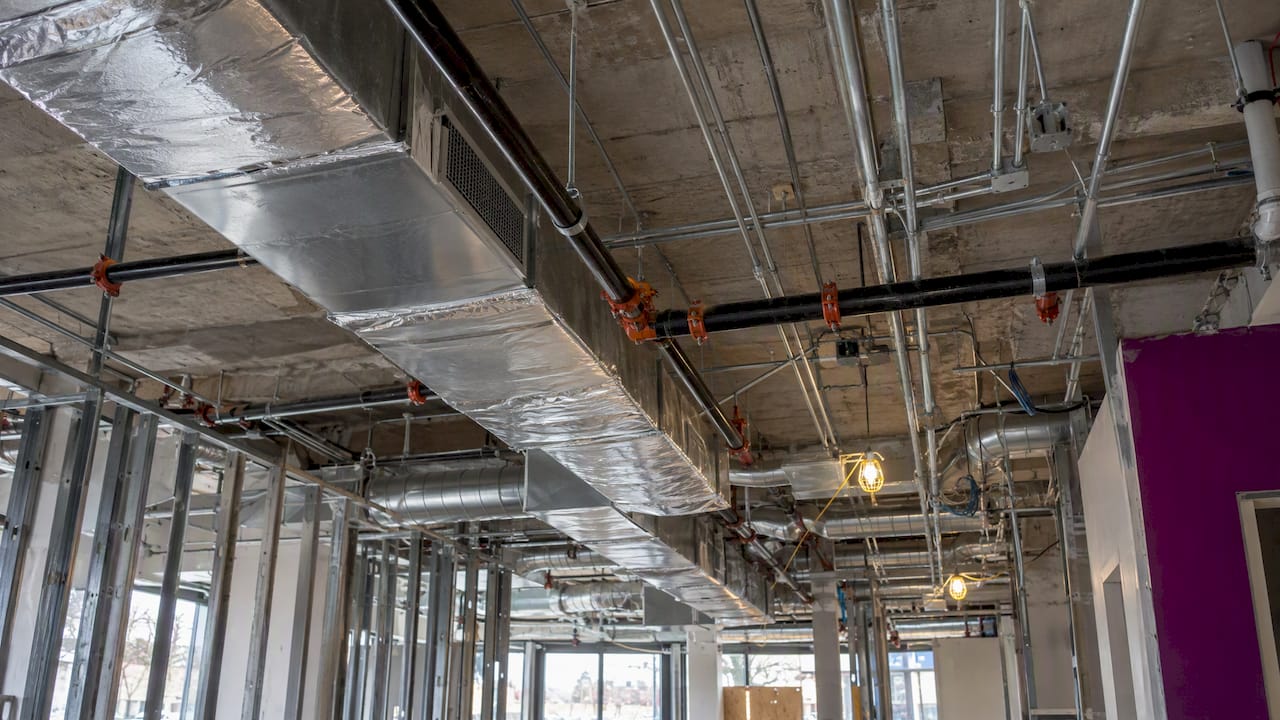
The fee is only one piece. Montgomery County’s commercial interior alteration process, often called a tenant fit-out, may require separate trade permits for electrical, mechanical, fire alarm and fire protection work. Final building and mechanical inspections happen only after all required trade permits are approved. In practice, that means your electrician, HVAC contractor and fire protection contractor each have paperwork that has to line up before you can close out the project, and a missed trade permit can hold up your opening.
If you are outside Montgomery County, ask the local permitting office the same three questions: what is the fee formula, which trade permits are separate, and what has to be approved before final inspection.
How TI allowances change what you actually pay
A tenant improvement allowance is money the landlord contributes toward your buildout, usually stated as a dollar amount per square foot. Industry guides often use an example of around $25 per square foot, and they consistently caution that allowances rarely cover the whole project. Three habits will protect you:
- Know the difference between four numbers. The TI allowance, the construction estimate, the construction contract and the total project budget are not the same figure. Reconcile the lease’s eligibility rules and exclusions before you calculate your funding gap.
- Expect to pay first. Many leases reimburse after completion, so you may need to fund the work upfront and wait for the landlord’s payment under the lease terms.
- Negotiate before you sign. Allowance, free-rent period and who builds the space are all easier to change before the lease is executed.
On a 2,000 square foot space, a $25 allowance is $50,000. Against the $252,000 to $314,000 range above, that leaves a gap of roughly $202,000 to $264,000 before soft and owner costs. Our guide to negotiating a tenant improvement allowance covers lease language and the accounting implications.
How to build your own retail buildout budget
Follow these steps in order. They take you from a rough range to a number you can finance.
- Define the concept. Write down the layout, number of fitting rooms or treatment stations, restroom count, storage needs and any specialty equipment.
- Get the lease terms. Note the delivery condition, TI allowance, rent commencement date, and landlord approval requirements.
- Set a first-pass range. Multiply the square footage by the Southeast and national averages, then adjust up for specialty finishes or shell condition.
- Walk the space with a contractor. An on-site review of existing HVAC, electrical, plumbing and fire protection turns a guess into a scope.
- Add soft, owner and opening costs. Use the four groups above.
- Add contingency. A common planning habit is to hold 10% to 20% of construction cost in reserve, with older buildings and shell spaces at the higher end. That is a rule of thumb, not a regulation.
- Build the schedule backwards from opening. Allow time for design, permit review, construction and final inspections, and compare it with your rent commencement date.
If you want a deeper walkthrough of what is and is not included, read our guide on U.S. retail buildout costs beyond the per-square-foot average.
Our perspective: price the scope, not the square foot
We are a women-owned general contractor based in Rockville, and we work across Maryland, DC and Northern Virginia. The question we hear most is “what does it cost per square foot?” It is a fair question, and a risky one to rely on.
A per-square-foot figure is an average of many different projects. It hides whether the space has working HVAC, whether the restrooms already meet accessibility rules and whether the landlord requires a particular storefront. Two 2,000 square foot stores can differ by six figures without either contractor being wrong.
What protects a retailer is transparent communication early: a site walk, a written scope, clear allowances for items you have not selected yet, and an honest conversation about permit timing in your county. We have seen that anxiety about a fit-out drops quickly once the owner can see where every dollar goes. Think of the empty unit as a blank canvas, and the budget as the plan that lets you finish the painting without stopping halfway.
Our advice: bring us in before you sign the lease if you can. A short review of the space can change what you negotiate for.
— Arienne
Work with a Maryland retail buildout team
Axenia Construction handles tenant buildouts for retail and commercial tenants, with local permitting experience in Maryland, DC and Northern Virginia. If you prefer one team for design and construction, our design-build service keeps both under one contract.
Send us your lease draft or the address of the space you are considering. We will walk it with you, explain the scope in plain language and help you build a budget you can take to your lender and landlord. You can start at our general contracting page.
FAQ
How much does a retail buildout cost per square foot in Maryland?
There is no official Maryland average. Cushman & Wakefield’s 2026 guide reports $157 per square foot nationally and $126 in the Southeast for in-line retail. Shell space and specialty concepts can run well above that, so get a scope-based estimate for your specific unit.
Does the buildout budget include fixtures and equipment?
Usually not. The benchmark behind the national average excluded furniture, fixtures and equipment. Budget shelving, counters, point-of-sale, security, IT and signage separately.
How much are permit fees for a retail alteration in Montgomery County?
For FY 2027, the alteration fee is 3% of the cost of construction, and the filing fee is 50% of the permit fee or $833.30, whichever is greater. Separate trade permits for electrical, mechanical and fire systems may also be required. Confirm the current schedule with the county before you finalize the budget.
Will a TI allowance cover my whole buildout?
Rarely. Allowances are negotiated per square foot and often reimbursed after completion. Plan for a funding gap and confirm eligible costs and exclusions in the lease.
How much contingency should I hold?
Many owners hold 10% to 20% of construction cost, depending on the age and condition of the space. Older buildings and shell spaces justify the higher end.
Sources
- 2026 U.S. Retail Fit Out Cost Guide, Cushman & Wakefield
- Store fit-out costs, ICSC Exchange
- Commercial Building Fees, Montgomery County Department of Permitting Services
- Commercial Interior Alteration Building Permit Process, Montgomery County