
If you’re ready to hire, Axeniaconstruction is a licensed, locally owned, women-owned general contractor based in Rockville, MD, and one of the strongest design-build options for Maryland homeowners. Request a site visit and ask upfront for proof of license, a certificate of insurance, and three portfolio examples from projects similar to yours. That first conversation tells you nearly everything you need to know about how a remodeler operates.
Axeniaconstruction handles the full arc of a residential project, from initial design through final inspection, under a single contract. That single-team model reduces the friction that typically comes from coordinating separate architects, designers, and subcontractors. For a whole-home remodel, Maryland pricing runs roughly $150 per square foot, with a typical variance of ±$50 per square foot depending on scope and finishes. Kitchens and bathrooms fall within their own ranges, covered in the cost table below.
TL;DR: Axeniaconstruction is a licensed Maryland design-build GC worth contacting first. Verify license and insurance before signing anything, get three written estimates, and confirm who pulls permits. Request a consultation to get started.
Table of Contents
- What services do remodeling companies in Maryland typically offer?
- What licenses, insurance, and permits should you verify before hiring?
- How do you evaluate and hire a Maryland remodeling company?
- Why does the design-build model give Maryland homeowners an advantage?
- Key Takeaways
- What working with Maryland homeowners actually looks like
- Axeniaconstruction: licensed Maryland design-build remodeling, from first sketch to final walkthrough
- Helpful resources for Maryland homeowners
What services do remodeling companies in Maryland typically offer?
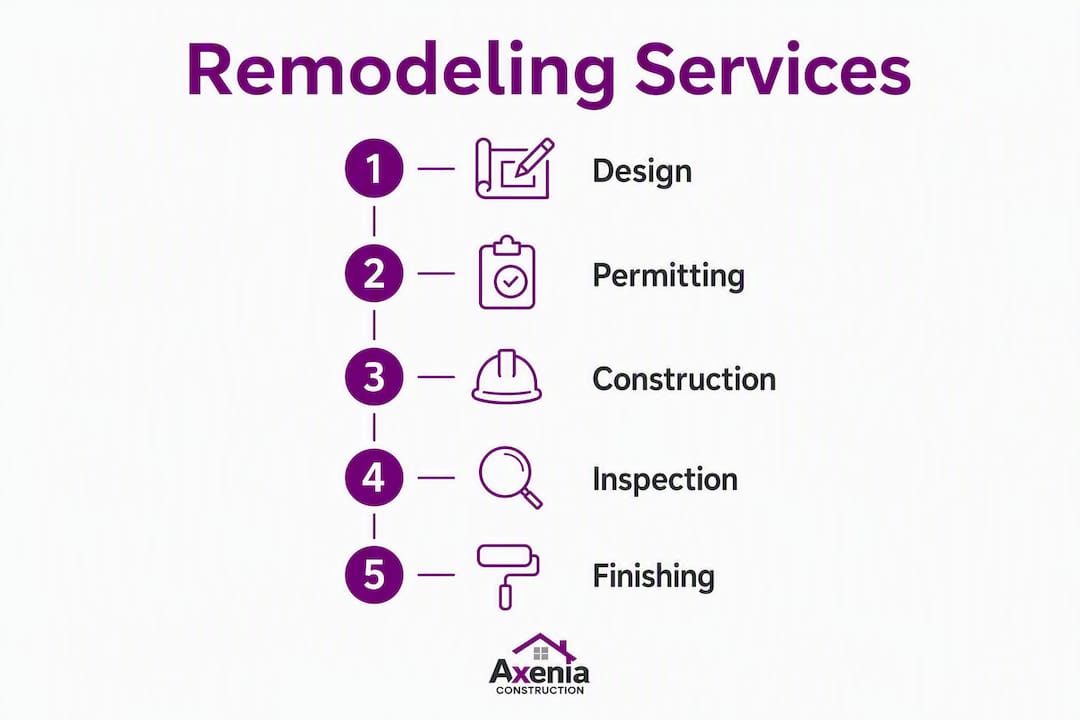
Most full-service Maryland remodelers cover a wider range of project types than homeowners expect. Before you start calling for estimates, confirm that a company handles your specific scope. Here are the core categories and what each one actually means:
- Kitchen remodels: Cabinet replacement or refacing, countertop installation, appliance upgrades, layout changes, and electrical or plumbing rerouting. A full kitchen remodel involves all of the above; a cosmetic refresh may touch only surfaces.
- Bathroom remodels: Tile, fixtures, vanities, shower or tub replacement, and ventilation. Luxury bathroom work in areas like Potomac often includes custom tile work and heated floors. See Axeniaconstruction’s Potomac bathroom remodel guide for local specifics.
- Home additions: Expanding the footprint of your home, whether a single-room bump-out, a two-story addition, or a full second floor. Additions require structural engineering, permits, and foundation work.
- Whole-home renovations: A phased or simultaneous overhaul of multiple rooms, often including MEP (mechanical, electrical, plumbing) upgrades throughout.
- Decks and outdoor living: Deck construction, screened porches, pergolas, and hardscaping. These projects vary widely in permit requirements by county.
- Accessory dwelling units (ADUs): A self-contained living unit added to an existing property, either attached or detached. ADU rules vary significantly by Maryland county, so local permit experience matters here more than almost anywhere else.
- Basement finishing: Converting unfinished space to livable square footage, including egress windows, insulation, framing, and mechanical work.
- Design-build delivery: Rather than hiring an architect separately and then bidding the project to contractors, a design-build firm handles both under one contract. This is the model Axeniaconstruction uses and the one that tends to produce the fewest surprises on scope and cost.
Specialty work, such as historic home restoration, government projects, or commercial tenant buildouts, requires a contractor with documented experience in that category. Ask to see portfolio examples, not just a claim that they “do historic work.”
What licenses, insurance, and permits should you verify before hiring?
Maryland does not issue a single statewide general contractor license the way some states do. Instead, licensing and registration requirements vary by county and project type. Before signing a contract, confirm the following.

License and registration
Ask for the contractor’s Home Improvement Commission (MHIC) license number and verify it through the Maryland Department of Labor’s online lookup. Any contractor performing home improvement work in Maryland for compensation must hold a valid MHIC license. Also confirm local business registration for the county where your project is located.
Insurance checklist
Require certificates of insurance for both general liability and workers’ compensation. General liability protects your property if the contractor causes damage; workers’ compensation covers injuries to workers on your site. Without it, you may be liable for a worker’s medical costs. Ask for the certificate to name you as an additional insured and confirm the policy is current, not expired.
Written contracts and warranties
A solid written contract must include a detailed scope of work, an itemized estimate or clear allowances, a payment schedule tied to milestones (not arbitrary dates), a change-order process requiring your written approval, permit responsibilities, lien release language, and a warranty term. If a contractor hands you a one-page agreement with vague language, that is a red flag, not a starting point for negotiation.
Permits and Maryland building departments
For most structural, electrical, plumbing, and HVAC work, a permit is required. Your contractor should pull permits in their name, not yours. Permit timelines vary by county: some Maryland jurisdictions process permits in two to three weeks; others, particularly for additions or ADUs, can take several months. Confirm the expected permit timeline with your contractor and verify it directly with your county building office before finalizing your project schedule.
Pro Tip: Ask your contractor for the permit application number once it is submitted. You can then track its status directly through your county’s online portal, which gives you an independent view of where the project stands before construction begins.
Statistic to know: According to Maryland Department of Labor data, contractors performing home improvement work without a valid MHIC license face fines and potential criminal charges. Verifying your contractor’s license number takes less than two minutes and protects you from unlicensed operators who have no accountability under state law.
How do you evaluate and hire a Maryland remodeling company?
The evaluation process has a clear sequence. Follow it and you will avoid the most common hiring mistakes Maryland homeowners make.
Step-by-step hiring framework
- Confirm license and insurance first. Before you discuss scope or price, verify the MHIC license and request insurance certificates. This step eliminates unqualified candidates immediately.
- Define your scope in writing. Write down what you want done, your must-haves, and your budget range before the first meeting. Contractors give more accurate estimates when they have a clear brief.
- Get three written estimates. Verbal quotes are not comparable. Each written estimate should include scope, materials (with allowances specified), timeline, payment schedule, and exclusions.
- Normalize the allowances. If one estimate includes a $2,000 appliance allowance and another includes $5,000, the lower bid may not actually be cheaper. Require each contractor to use the same allowance figures so you are comparing equivalent scopes.
- Check references and portfolio. Ask for two to three references from projects completed in the past 18 months, ideally in your county. Call them. Ask about timeline accuracy, communication, and how change orders were handled.
- Interview the project manager, not just the salesperson. The person who runs your job site matters more than the person who sells you the contract.
- Confirm permit handling. Ask directly: “Will you pull all required permits, and will they be in your name?” The answer should be yes.
- Review the payment schedule. A reasonable schedule ties payments to completed milestones. A large upfront cash request (more than 10–15% before work begins) is a warning sign.
Questions to ask during estimate meetings
- Which subcontractors will you use, and how long have you worked with them?
- How do you handle change orders, and what is the approval process?
- Who is my single point of contact throughout the project?
- What is your process if a permit is delayed?
- How do you handle demolition debris and site cleanup?
- What warranty do you provide on labor, and how do I make a claim?
Red flags to watch for
- No written contract or a contract with vague scope language
- Requests for more than 15% upfront in cash
- Inability to provide a current insurance certificate
- No local references or portfolio examples from Maryland projects
- Pressure to sign quickly or skip the permit process
Typical cost ranges for Maryland projects
Maryland whole-home remodels typically cost an average price per square foot, with some variance based on finishes and scope. The table below reflects typical ranges for common project types.
| Project Type | Typical Cost Range | Key Cost Drivers |
|---|---|---|
| Kitchen remodel | Varies widely | Cabinet quality, layout changes, appliances |
| Bathroom remodel | Varies widely | Tile, fixtures, plumbing rerouting |
| Home addition | Costs depend on size and complexity | Size, structural complexity, permits |
| Whole-home renovation | Costs vary significantly per square foot | Scope, finishes, MEP upgrades |
A common budgeting heuristic is to keep your total renovation budget below a moderate portion of your home’s current market value to protect resale economics. Treat it as a planning guardrail, not a hard ceiling, especially in high-value Maryland markets where renovation costs and home values both run above national averages.
End-to-end project timeline
| Phase | Typical Duration | What Affects It |
|---|---|---|
| Design and planning | Several weeks | Scope complexity, design-build vs. separate architect |
| Permit procurement | Varies from weeks to months | County, project type, completeness of application |
| Demolition and rough-in | About a few weeks | Site conditions, hazardous materials |
| Construction and finishes | Several weeks to months | Scope, material lead times, subcontractor availability |
| Final inspections and punchlist | Up to several weeks | Inspector scheduling, outstanding items |

Permit timelines are the most unpredictable variable in Maryland. Contractors with regular experience in your county can often give you a realistic estimate based on recent project history, which is one concrete reason to prioritize local experience when comparing firms.
Pro Tip: When comparing estimates, require each contractor to list exclusions explicitly. “Allowances” and “exclusions” are where budget surprises hide. A detailed exclusions list tells you exactly what you will be paying for separately.
Why does the design-build model give Maryland homeowners an advantage?
The traditional remodeling process splits responsibility: you hire an architect, the architect produces drawings, you bid those drawings to contractors, and you manage the gap between what was designed and what gets built. Every handoff is a potential source of scope creep, cost overruns, and schedule delays.
Design-build delivery closes that gap by putting design and construction under one contract and one team. The practical result is that pricing is coordinated with design decisions from the start, so the estimate you receive reflects what will actually be built, not an architect’s optimistic assumption about contractor costs. Homeowners who engage a design-build firm earlier in the planning phase tend to get more accurate fixed estimates because there is no translation layer between the designer and the builder.
Axeniaconstruction operates on this model for residential projects across Maryland, including home additions in Rockville and kitchen remodels in Bethesda. The benefits for homeowners are concrete:
- Single point of accountability: One contract, one team, one phone call when something needs to be resolved.
- Fewer change orders: When the same team designs and builds, design decisions are priced in real time, not retroactively.
- Tighter schedule reliability: No waiting for a separate architect to revise drawings before a contractor can proceed.
- Integrated warranty: Labor and design decisions are covered under the same agreement.
Ask any contractor you are evaluating for a reference from a project where a design change occurred mid-construction. How they handled it tells you more about their process than any sales presentation.
Key Takeaways
Choosing the right Maryland remodeler comes down to verified credentials, a written scope, and a contractor whose local experience matches your project type and county.
| Point | Details |
|---|---|
| Verify license and insurance first | Confirm the MHIC license number and request current certificates for general liability and workers’ compensation before any other conversation. |
| Require a detailed written estimate | Every estimate must include scope, allowances, payment milestones, exclusions, and a change-order process requiring your written approval. |
| Design-build reduces surprises | A single-team design-build firm coordinates pricing with design decisions from the start, producing more accurate estimates and fewer mid-project changes. |
| Budget with the 30% rule as a guardrail | Keep total renovation costs below 30% of your home’s current value as a planning reference, especially in high-value Maryland markets. |
| Axeniaconstruction is a licensed Maryland option | A women-owned, locally based design-build GC in Rockville, MD, covering residential remodels, additions, kitchens, baths, and decks across Maryland. |
What working with Maryland homeowners actually looks like
We have pulled permits in Montgomery County, Prince George’s County, and surrounding jurisdictions, and the honest truth is that no two county building departments operate on the same timeline or checklist. That local knowledge is not a marketing claim; it is the difference between a project that starts on schedule and one that stalls for six weeks waiting on a revision request we could have anticipated.
Our process starts with a site visit and a written scope before any numbers are discussed. We do not hand you a ballpark and call it an estimate. Every project gets a detailed written contract with milestone-based payments, a defined change-order process, and a clear warranty on labor. If you want to see recent project photos or speak with a past client in your area, we will connect you directly. View our project portfolio or reach out to schedule a site visit and start the conversation.
Axeniaconstruction: licensed Maryland design-build remodeling, from first sketch to final walkthrough
Hiring a general contractor for a kitchen remodel, bathroom renovation, home addition, or whole-home project is one of the largest financial decisions most homeowners make. Axeniaconstruction gives Maryland homeowners a single, accountable team that handles design, permitting, construction, and warranty under one contract, with no finger-pointing between a separate architect and a separate builder.
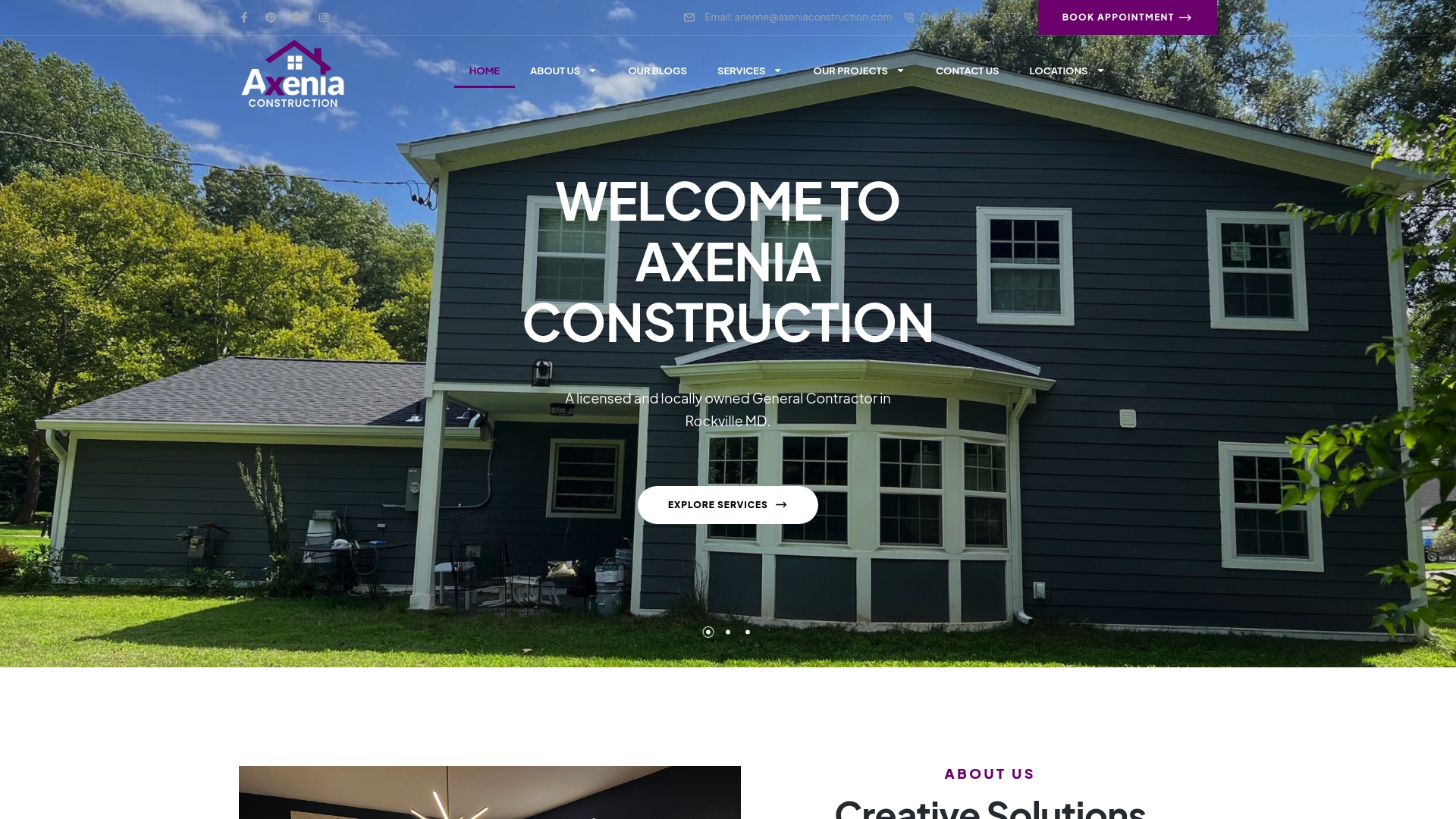
We specialize in residential home renovations across Maryland, including kitchens, bathrooms, additions, decks, and full-home remodels, with the local permitting experience to keep your project moving. As a licensed, women-owned general contractor based in Rockville, we bring the same process discipline to a bathroom refresh as to a two-story addition.
Ready to move from research to a real plan? Request a free consultation and we will schedule a site visit, walk your space, and deliver a written estimate with a clear scope, timeline, and payment schedule. Bring your inspiration photos and your budget range; we will handle the rest.
Helpful resources for Maryland homeowners
| Resource | What It Covers | Why It Matters |
|---|---|---|
| Axeniaconstruction Home Renovations | Full residential service overview | Confirms scope of services and starting point for estimates |
| Design-Build Remodeling in Maryland | Design-build process explained | Helps you understand single-team delivery before comparing firms |
| Maryland Whole-Home Remodel Pricing | Cost benchmarks for Maryland projects | Use as a reference when evaluating estimates |
| Top Remodeling Tips for Maryland | Practical homeowner preparation guidance | Covers cost, timeline, and decision-making for Maryland projects |
| Home Addition Planning Guide | Addition-specific timeline and permit expectations | Useful before your first contractor meeting |
| Axeniaconstruction Project Portfolio | Completed project case studies | Review before requesting references or scheduling a site visit |
Before your first contractor meeting, bookmark the pricing benchmark and the design-build explainer. Bring the permit and scope questions from this article to that meeting. A contractor who answers them clearly and in writing is one worth taking seriously.
Recommended
- Top Home Remodeling Tips in Maryland for 2026: Boost Value & Comfort – Axenia Construction
- Design-Build Remodeling in Maryland: Why Homeowners Are Choosing One Team for Everything – Axenia Construction
- Luxury Bathroom Remodel Companies in Potomac, Maryland: What Homeowners Should Know Before Renovating – Axenia Construction
- Kitchen Remodeling in Bethesda, MD: Upgrade Your Home with Modern Design – Axenia Construction