A construction warranty is a legally binding promise from a contractor that their work will meet defined quality standards and remain free from defects for a specific period after project completion. This guarantee covers everything from workmanship and materials to mechanical systems and structural integrity. For homeowners and commercial property owners in the DC, Maryland, and Virginia area, understanding what is construction warranty protection means knowing exactly what your contractor owes you, when coverage starts, and how to enforce your rights if something goes wrong.
What types of construction warranties exist?
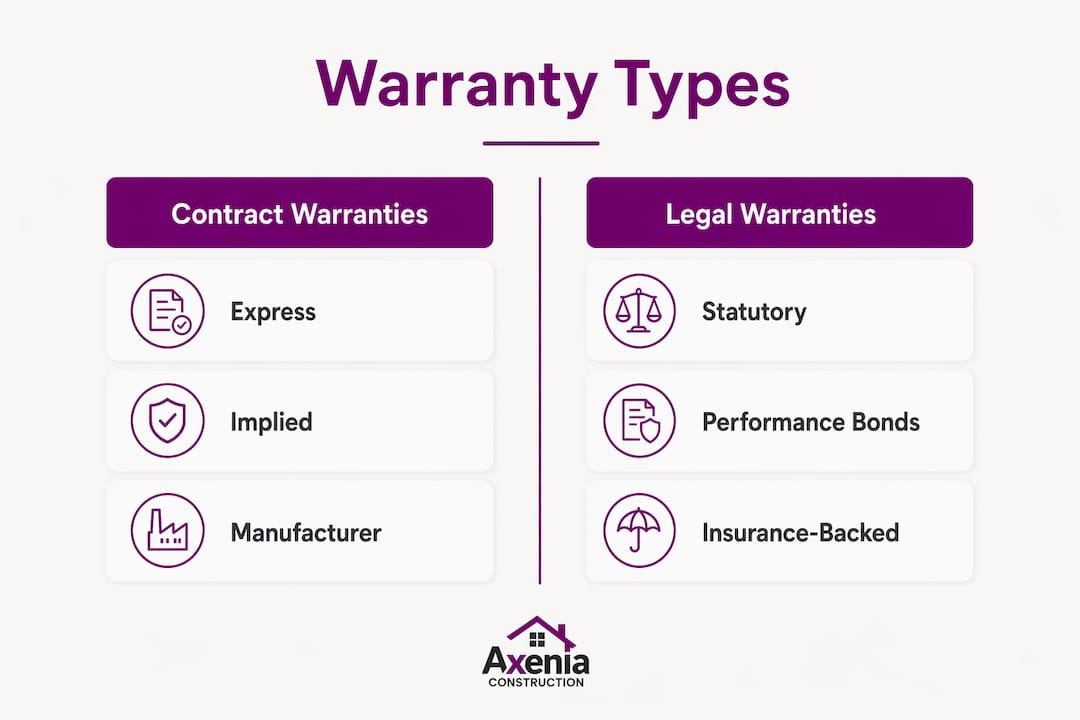
Construction warranties fall into four main categories, and each one protects you differently.
Express warranties are written promises in your contract. Your contractor commits to specific standards, repair obligations, and time limits. These are the warranties most owners focus on, but they are not the only protection you have.

Implied warranties exist by common law, even when your contract says nothing about them. The implied warranty of habitability requires a builder to deliver a home that is safe and livable. The implied warranty of good workmanship requires the work to meet professional standards. You do not need to negotiate for these. They apply automatically.
Manufacturer warranties cover specific products installed in your building, such as roofing systems, windows, and HVAC units. These are separate from your contractor’s warranty. Manufacturer warranties often extend beyond contractor warranty periods but carry their own conditions, including product registration and certified installation requirements. If your roofer installs shingles without following the manufacturer’s installation specs, that product warranty can be voided entirely.
Statutory warranties are mandated by state law and vary by jurisdiction. Maryland, Virginia, and DC each have their own residential construction statutes that set minimum warranty floors for new home construction.
What does a construction warranty typically cover?
Standard construction warranty coverage includes:
- Workmanship and materials: Defects caused by poor installation or substandard products
- Mechanical systems: Plumbing, electrical, and HVAC failures linked to installation errors
- Structural integrity: Foundation issues, load-bearing wall failures, and major framing defects
- Exterior systems: Roofing, siding, and waterproofing failures
What does a construction warranty exclude?
Warranty exclusions include normal wear and tear, owner misuse or neglect, and failures caused by inadequate maintenance, such as skipping annual HVAC servicing. These exclusions are strictly enforced. If you repaint a wall with a product that causes moisture damage, that repair falls on you, not your contractor.
Pro Tip: Read your contract’s exclusion list before signing. Vague language like “owner-caused damage” can be interpreted broadly. Ask your contractor to define each exclusion in writing.
How long do construction warranties last?
Warranty duration depends on what is being covered. Residential construction commonly follows the 1-2-10 tiered warranty model:
- One year for workmanship and materials defects
- Two years for mechanical systems, including plumbing, electrical, and HVAC
- Ten years for major structural defects that make a building unsafe or uninhabitable
This structure exists because different components fail on different timescales. A leaky faucet connection shows up within months. A foundation crack may take years to develop. The tiered model matches coverage to risk.
Commercial construction contracts often follow a standard one-year warranty from substantial completion, covering workmanship and materials defects at no cost to the owner. That one-year baseline is the floor, not the ceiling. Your contract can and should specify longer periods for critical systems.
When does the warranty clock start?
Warranty periods commonly start at milestones such as substantial completion, final acceptance, or beneficial occupancy. They do not start at contract signing or final payment. This distinction matters. If your project reaches substantial completion in june but you do not move in until september, your one-year workmanship warranty may expire before you have lived in the space long enough to notice problems.
Your contract must define the start date explicitly. Ambiguous language like “upon project completion” creates gaps that contractors can exploit. For DMV owners, this is especially relevant because permitting delays and phased occupancy are common in the region. Review your commercial construction contract terms carefully before signing to confirm the warranty trigger is clearly defined.
How does a construction warranty work when you need to file a claim?
Filing a warranty claim follows a clear process, but most owners make avoidable mistakes that slow resolution or void coverage entirely.
The core steps are:
- Document the defect immediately. Photograph the issue, note the date, and describe the problem in writing. Vague complaints like “the floor feels uneven” are harder to enforce than “the hardwood floor in the master bedroom has a 3/4-inch gap along the north wall, first observed on march 15.”
- Send written notice to your contractor. Email creates a timestamp. Verbal complaints do not. Your contract likely specifies a notification deadline. Missing it can forfeit your claim.
- Allow the contractor reasonable access. Most contracts require you to give the contractor an opportunity to inspect and repair before you hire someone else. Skipping this step can void your warranty.
- Escalate if the contractor does not respond. If the contractor ignores your notice, send a formal demand letter. If that fails, consult a construction attorney.
Timely notice and thorough documentation are the most effective ways to avoid lengthy warranty disputes and secure repairs quickly. Disputes that drag on can take well over a year to resolve. Good records prevent that.
Pro Tip: Keep a dedicated warranty folder for every project. Store your contract, punch list, substantial completion certificate, and all written communications in one place. If a dispute arises, you will have everything you need within minutes.
What happens if your contractor goes out of business?
A contractor’s warranty is only as strong as the contractor’s ongoing existence. If your contractor dissolves or declares bankruptcy, enforcing warranty obligations becomes extremely difficult. This is not a rare scenario. Small contractors close regularly, especially after economic downturns. Verifying your contractor’s financial stability and licensing status before signing is one of the most practical steps you can take. Understanding the difference between a general contractor and a construction manager also helps you know who holds warranty responsibility on your project.
What protections exist beyond a standard construction warranty?
A warranty is one layer of protection. Two additional tools provide coverage that warranties cannot.
| Protection Type | What It Covers | Key Limitation |
|---|---|---|
| Construction warranty | Defects in workmanship, materials, and systems after completion | Only enforceable while contractor remains solvent |
| Performance bond | Project completion if contractor defaults mid-project | Does not cover post-completion defect repair |
| Payment bond | Ensures subcontractors and suppliers are paid | Protects against liens, not defects |
Performance bonds guarantee project completion by a surety company if a contractor defaults. They do not guarantee defect-free work after the project closes. That distinction is critical. A performance bond protects you during construction. A warranty protects you after.
Insurance-backed warranty products are available in the market and provide coverage even if the original contractor is no longer in business. These products are more common in residential new construction than in commercial projects. They typically require the contractor to be enrolled in the program at the time of construction.
Verifying contractor solvency and requiring surety bonds on larger projects adds a meaningful layer of security. For DMV property owners undertaking significant renovations or commercial builds, requiring both a performance bond and a clearly written warranty in the contract is the most protective combination available.
Key Takeaways
A construction warranty is your primary contractual protection against defects, but its value depends entirely on how clearly it is written and how proactively you manage it.
| Point | Details |
|---|---|
| Know your warranty type | Express, implied, manufacturer, and statutory warranties each cover different risks and require different actions. |
| Follow the 1-2-10 model | Residential warranties typically run one year for workmanship, two years for systems, and ten years for structural defects. |
| Confirm your start date | Warranty coverage begins at substantial completion, not contract signing. Ambiguous language creates dangerous gaps. |
| Document everything | Written notice, photographs, and timestamps are the difference between a resolved claim and a voided one. |
| Verify contractor stability | A warranty is unenforceable if the contractor dissolves. Surety bonds add protection when contractor solvency is uncertain. |
What I have learned about construction warranties after years in the DMV market
The most common mistake I see property owners make is treating the warranty conversation as something that happens after the project ends. By then, it is too late to negotiate the terms that matter most.
The warranty language in your contract is where your real protection lives. Vague phrases like “contractor will remedy defects” without specifying timelines, notice requirements, or covered systems leave you exposed. I always recommend owners push for explicit definitions: what triggers the warranty, what the contractor must do within how many days, and what documentation is required to file a claim. The home renovation contract review guide we put together for DC, MD, and VA owners walks through exactly what to look for before you sign.
The second thing I have seen trip up owners repeatedly is the contractor solvency issue. A warranty from a contractor who closes shop six months after your project wraps is worth nothing. In the DMV market, where construction activity is high and smaller firms cycle in and out, this risk is real. Ask for proof of licensing, insurance, and bonding before you commit. A contractor who resists that request is telling you something important.
The good news is that owners who stay organized and communicate in writing almost always come out ahead. Warranty claims that are documented clearly and submitted on time get resolved. The ones that drag on for years are almost always the ones where the owner waited too long or kept everything verbal.
— Arienne
Axeniaconstruction’s commitment to warranty-backed work in the DMV area
Axeniaconstruction is a licensed, women-owned general contractor based in Rockville, MD, serving homeowners and commercial property owners across DC, Maryland, and Virginia. Every project we deliver comes with clearly defined warranty terms, written documentation, and a team that stays reachable long after the final walkthrough.

Whether you are planning a home renovation or a commercial build-out, we make sure you understand your coverage before work begins. Our clients receive transparent contracts, detailed punch lists, and direct access to our project team throughout the warranty period. Explore our general contracting services or reach out to discuss your project and what warranty protection looks like with Axeniaconstruction on your side.
FAQ
What is a construction warranty in simple terms?
A construction warranty is a contractor’s written promise to repair defects in workmanship, materials, or systems for a defined period after project completion, at no cost to the owner.
How long does a construction warranty last?
Residential warranties commonly follow the 1-2-10 model: one year for workmanship and materials, two years for mechanical systems, and ten years for major structural defects.
When does a construction warranty start?
Warranty coverage typically starts at substantial completion or final acceptance, not at contract signing or final payment. Your contract should define this date explicitly.
What does a construction warranty not cover?
Warranties exclude normal wear and tear, owner neglect, misuse, and failures caused by inadequate maintenance. These exclusions are strictly enforced regardless of the defect’s severity.
What is the difference between a construction warranty and a performance bond?
A performance bond guarantees project completion if a contractor defaults during construction. A construction warranty guarantees defect repair after the project is complete. They serve different purposes and should both be required on significant projects.