
A subcontractor is defined as an individual or business hired by a general contractor to perform a specific portion of a larger construction project, without any direct contract with the project owner. This distinction shapes every payment, liability, and performance conversation on a job site. For homeowners and business owners in DC, MD, and VA, understanding what is a subcontractor means knowing who is actually doing the work on your property and what rights you have if something goes wrong. The relationship is more layered than most owners realize, and knowing the structure protects your investment.
What is a subcontractor’s legal relationship with contractors and owners?
A subcontractor operates under a separate agreement with the general contractor and has no direct contract with the end client. This two-tier structure is the foundation of how most construction projects are organized. The project owner signs a contract with the general contractor. The general contractor then signs separate contracts with each subcontractor.

This arrangement has real consequences for you as an owner. You cannot directly enforce performance against a subcontractor or withhold payment from them. Your legal rights flow strictly through your contract with the general contractor. If a plumber does poor work, your dispute is with the general contractor, not the plumbing firm.
Key implications of this two-tier structure include:
- No privity of contract: You have no direct legal relationship with subcontractors, which limits your ability to sue them directly in most cases.
- Payment flow: The general contractor pays subcontractors from the funds you provide. Delays in your payments can cascade down to subcontractors and stall work.
- Liability management: The general contractor assumes responsibility for subcontractor performance under your agreement.
- Dispute resolution: Any performance failures by a subcontractor are handled through the general contractor, who is your single point of accountability.
From a tax standpoint, a subcontractor is legally an independent contractor, not an employee. The IRS evaluates this classification using three categories: behavioral control, financial control, and the type of relationship between the parties. This distinction protects project owners from tax liabilities tied to worker misclassification.
Pro Tip: Always ask your general contractor for a list of subcontractors before work begins. Knowing who is on your property and what they are responsible for gives you a clearer picture of your project’s risk profile.
What are the common types of subcontractors in construction?
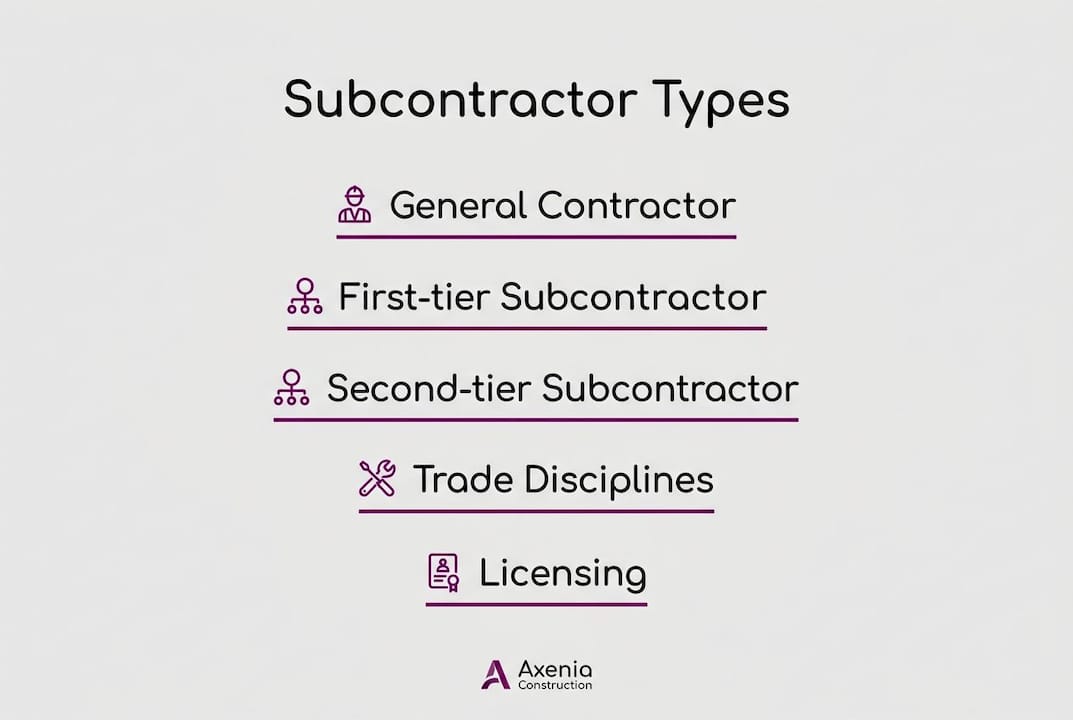
Subcontractor classification follows two axes: tier position and trade discipline. Understanding both helps you ask better questions when reviewing your general contractor’s project plan.
Tier position
A first-tier subcontractor contracts directly with the general contractor. A second-tier subcontractor contracts with the first-tier firm, not with the general contractor. Subcontracting chains can extend to second-tier firms, which complicates payment flow and project oversight. As an owner, you may never meet a second-tier subcontractor, but their work failures still affect your timeline and budget.
Trade disciplines
The most common trade subcontractors on residential and commercial projects in DC, MD, and VA include:
- Electrical: Wiring, panel installation, lighting, and code compliance work. Maryland and Virginia both require state-issued electrical contractor licenses.
- Plumbing: Water supply, drainage, and fixture installation. DC, MD, and VA each have separate licensing requirements for plumbing contractors.
- HVAC: Heating, ventilation, and air conditioning systems. Specialty contractor licenses are mandatory in this trade across the region.
- Concrete and masonry: Foundations, flatwork, and structural elements.
- Drywall and framing: Interior wall systems and structural framing.
- Painting and finishing: Interior and exterior coatings and surface preparation.
- Roofing: Waterproofing, shingle installation, and flashing work.
State-level licensing is mandatory for many of these trades. When you work with Axeniaconstruction, we verify that every subcontractor we engage holds the appropriate license for their trade and jurisdiction before they set foot on your project.
| Trade | Typical scope | Licensing required |
|---|---|---|
| Electrical | Wiring, panels, lighting | Yes, state-issued |
| Plumbing | Pipes, fixtures, drainage | Yes, state-issued |
| HVAC | Heating and cooling systems | Yes, specialty license |
| Concrete | Foundations, flatwork | Varies by jurisdiction |
| Roofing | Waterproofing, shingles | Yes, in MD and VA |
How does subcontracting work in practice for DC, MD, and VA owners?
The primary reason general contractors use subcontractors is to manage specialized labor without the overhead of full-time employment. This shifts the risk and administrative burden of specific trade tasks to the firm best equipped to handle them. For you as an owner, this means access to deep trade expertise without hiring a dozen specialists yourself.
Here is how the process typically unfolds on a local renovation or commercial build:
- Bidding and selection: The general contractor solicits bids from qualified subcontractors for each trade scope. They evaluate price, licensing, insurance, and past performance. A reputable general contractor like Axeniaconstruction uses a vetted network built over years of local project experience.
- Contract execution: The general contractor signs individual agreements with each subcontractor. These contracts define scope, schedule, payment terms, and quality standards.
- Coordination and scheduling: The general contractor sequences subcontractor work to avoid conflicts. For example, rough electrical and plumbing must be completed and inspected before drywall can close the walls.
- Quality oversight: The general contractor inspects subcontractor work at key milestones. They are responsible for ensuring each trade meets the project specifications and local building codes.
- Payment processing: The general contractor pays subcontractors based on completed work, typically tied to the payment schedule in your prime contract.
You can learn more about how this coordination works by reviewing the role of a general contractor in renovation projects.
One underappreciated benefit of subcontracting is risk transfer. When a licensed electrical subcontractor performs work, their license and insurance cover defects in that trade. The general contractor carries the overall project liability. This layered coverage protects you far better than hiring individual tradespeople directly.
A real challenge worth knowing: payment disputes or work failures at the second-tier level still impact your overall project timeline and budget, even though you have no direct oversight of those firms. This is why choosing a general contractor with strong subcontractor management practices matters as much as the subcontractors themselves.
Pro Tip: Before signing your prime contract, ask your general contractor how they handle subcontractor non-performance. A clear answer tells you a lot about how organized and experienced they are.
What is the difference between a subcontractor, an independent contractor, and a general contractor?
These three roles are often confused, but they serve distinct functions on any construction project. Knowing the difference helps you understand who is accountable for what.
| Role | Who they contract with | Primary responsibility |
|---|---|---|
| General contractor | Project owner | Overall project delivery, scheduling, and quality |
| Subcontractor | General contractor | Specific trade scope within the larger project |
| Independent contractor | Project owner directly | Standalone tasks hired outside a general contract |
A general contractor manages the entire project and is your primary point of contact. They hold the prime contract with you and are responsible for delivering the finished product. A subcontractor works under the general contractor’s direction on a defined portion of the work, such as all electrical or all plumbing. An independent contractor, by contrast, is hired directly by the project owner for a specific task, with no general contractor in between.
The distinction matters most when something goes wrong. If a subcontractor causes damage, your claim goes to the general contractor. If an independent contractor you hired directly causes damage, you deal with them and their insurer without a general contractor buffer. For complex projects in DC, MD, and VA, working through a licensed general contractor provides a layer of accountability that direct hiring does not.
What regulations affect subcontractors on government or federally funded projects?
Federal regulations add another layer of complexity for subcontractors working on government projects in the DC, MD, and VA region. This area has a high concentration of federally funded construction, so these rules are directly relevant to many local owners and developers.
Key regulations and standards include:
- Davis-Bacon Act (40 U.S.C. § 3141–3148): Subcontractors on federally funded projects must pay laborers and mechanics wages consistent with local prevailing rates. This applies to all tiers of subcontractors, not just first-tier firms.
- State licensing requirements: Maryland, Virginia, and DC each maintain separate contractor licensing boards. A subcontractor licensed in Maryland is not automatically licensed to work in Virginia.
- OSHA safety standards: All subcontractors must comply with Occupational Safety and Health Administration regulations on federally funded sites, including fall protection, hazard communication, and site safety plans.
- Certified payroll reporting: On Davis-Bacon covered projects, subcontractors must submit weekly certified payroll records to the contracting agency.
Axeniaconstruction manages government contracting projects with full compliance across these requirements. We handle certified payroll, prevailing wage verification, and multi-jurisdiction licensing so that project owners are never exposed to compliance gaps.
Key Takeaways
A subcontractor is a specialized trade professional hired by a general contractor, not the project owner, making the general contractor your sole legal point of accountability on any construction project.
| Point | Details |
|---|---|
| Subcontractor definition | A subcontractor contracts with the general contractor, not the project owner, for a specific trade scope. |
| No direct legal relationship | Owners cannot enforce performance or withhold payment directly from subcontractors. |
| Two-tier hierarchy | First-tier subcontractors contract with the GC; second-tier firms contract with first-tier firms, adding oversight complexity. |
| Licensing is mandatory | Electrical, plumbing, and HVAC subcontractors require state-issued licenses in DC, MD, and VA. |
| Federal projects add requirements | Davis-Bacon Act prevailing wage rules apply to all subcontractor tiers on federally funded work. |
Why understanding subcontractors changed how I advise owners
Most owners I work with come into a project focused entirely on the general contractor. That focus is correct, but it is incomplete. The subcontractors are the people who physically build your project. Their skill, licensing, and reliability determine the quality of what you end up with.
The most common mistake I see is owners who assume the general contractor’s reputation automatically guarantees subcontractor quality. It often does, but not always. A general contractor under budget pressure may substitute a lower-cost subcontractor mid-project. Owners who understand the subcontractor structure know to ask about substitutions and to require written notice before any trade firm is swapped out.
The second thing I have learned is that second-tier subcontractors are the hidden variable in most project delays. An owner sees a concrete pour fall behind schedule and blames the general contractor. The real cause is often a second-tier supplier or specialty firm that the owner has never heard of. Understanding that this layer exists helps you ask the right questions during project reviews.
My honest advice: treat subcontractor transparency as a selection criterion when choosing your general contractor. Ask who they use for electrical, plumbing, and HVAC. Ask how long those relationships have been in place. A general contractor who can answer those questions confidently has built a real network. One who cannot is assembling a team on the fly, and that is a risk you carry.
— Arienne
Axeniaconstruction’s approach to subcontractor management in DC, MD, and VA
At Axeniaconstruction, we manage every subcontractor relationship so you do not have to. As a licensed general contractor based in Rockville, MD, we have built a vetted network of trade specialists across electrical, plumbing, HVAC, concrete, and finishing work. Every subcontractor we engage holds the required state license for DC, MD, or VA and carries full insurance coverage.

Whether you are planning a residential renovation or a commercial build, we coordinate all subcontractor scheduling, quality inspections, and compliance requirements under one contract with you. You get a single point of accountability and a team that communicates clearly at every stage. Our general contracting services are designed to give you confidence from the first permit to the final walkthrough. Contact Axeniaconstruction to discuss your project and meet the team that will build it.
FAQ
What is a subcontractor in simple terms?
A subcontractor is a licensed trade professional hired by a general contractor to complete a specific part of a construction project, such as electrical, plumbing, or HVAC work. They do not have a direct contract with the project owner.
Does a project owner have legal rights over subcontractors?
No. Project owners have no direct legal relationship with subcontractors. All rights and remedies flow through the prime contract with the general contractor.
What is the difference between a first-tier and second-tier subcontractor?
A first-tier subcontractor contracts directly with the general contractor. A second-tier subcontractor contracts with the first-tier firm, adding a layer of separation from the project owner and general contractor.
Do subcontractors need to be licensed in Maryland, Virginia, and DC?
Yes. Trades such as electrical, plumbing, and HVAC require state-issued specialty contractor licenses in Maryland, Virginia, and DC, and a license from one jurisdiction does not automatically apply in another.
What is the Davis-Bacon Act and does it affect subcontractors?
The Davis-Bacon Act (40 U.S.C. § 3141–3148) requires all subcontractors on federally funded construction projects to pay laborers prevailing local wage rates. This applies to every tier of subcontractor on covered contracts.