In Washington, DC, construction is legally allowed 7:00 am to 7:00 pm, Monday through Saturday. Work outside those hours or on legal holidays generally requires an approved After-Hours Permit from the Department of Buildings (DOB). Interior tasks like painting are exempt, and work in the public right-of-way goes through DDOT instead.
TL;DR:
- Each DOB request covers no more than 30 days, so schedule renewals for longer work and group tasks to reduce repeat applications.
- Interior painting, wallpapering, carpet installation, and cleaning are exempt, but those activities remain subject to the District’s general noise controls.
- Eligible one or two family residential projects use the Permit Wizard; other after hours applications go through the Citizen Access Portal.
- Sites within 500 feet of a residential zone require written support from the local ANC or Single Member District representative with the application.
- DOB reviews applications by the following business day; work in streets, sidewalks, or roadways instead requires approval from DDOT.
Table of Contents
- What are the legal construction hours in Washington, DC?
- When do you need an After-Hours Permit from the Department of Buildings?
- Work that is commonly exempt from an After-Hours Permit
- How to apply for an After-Hours Permit: step-by-step checklist
- If your work affects the public right-of-way: DDOT after-hours permits
- ANC and neighborhood support: when it’s required and how to get it
- Permit duration, fees, and typical review timeline
- Enforcement risks and how to report illegal after-hours construction
- Practical compliance and scheduling tips from local contractors
- Why a licensed local contractor makes permitting easier
- How Axenia Construction can help with permitting, ANC coordination, and after-hours work
- FAQ
- Sources
What are the legal construction hours in Washington, DC?
The District sets a clear window for building work, and DOB points to the same hours on its noise regulations page. Staying inside that window means no after-hours permit is needed for most jobs.
- Construction is allowed Monday through Saturday, 7:00 am to 7:00 pm.
- Work outside the authorized hours, including Sundays and legal holidays, requires an approved permit.
- Noise rules in the DC Municipal Regulations still apply during legal hours.
- DOB publishes the official holiday list, and we check it before locking any schedule.
When do you need an After-Hours Permit from the Department of Buildings?
Construction outside the legal window generally requires an After-Hours Permit, with listed exceptions such as certain interior tasks, according to DOB’s After-Hours Permit page. That includes early morning starts, evening pours, overnight work and holiday shifts.
- Work before 7:00 am or after 7:00 pm, any Sunday work, and holiday work all need approval.
- DOB issues these permits for construction sites only. It has no jurisdiction over the public right-of-way, so DDOT handles those requests.
- Each request is capped at 30 days, so longer projects need a renewal.
Build the cap into your schedule from day one. Because each request is limited to 30 days, plan for renewals if the work extends beyond that period.
Work that is commonly exempt from an After-Hours Permit
Some interior tasks are quiet and contained enough that DOB leaves them out of the permit requirement. DOB lists these common examples:
- Interior painting
- Wallpapering
- Carpet installation
- Cleaning
Exempt does not mean unregulated. These activities remain subject to the District’s general noise controls in DCMR Chapter 20, so a vacuum or a stereo at midnight can still bring a complaint. If your task is not on the list, confirm it with DOB before you schedule the crew.
How to apply for an After-Hours Permit: step-by-step checklist
The application is online, and choosing the wrong portal is the most common early mistake. Here is the path we follow.
- Pick the right route. After-hours permits go through the Citizen Access Portal, while the Permit Wizard is the route for eligible one- and two-family residential projects, as DOB explains.
- Enter the dates and hours of the after-hours work, and note how close the site sits to any residential zone.
- Attach supporting documents, including a signed construction contract where required.
- Upload written ANC or Single Member District support if the site is within 500 feet of a residential zone.
- Submit and watch for a response. DOB reviews applications by the following business day, and if plan review is triggered, follow any ProjectDox requests promptly.
Pro Tip: Gather the documents you need before opening the portal to make the submission easier.
For general steps beyond this permit, our guide on understanding permits for your renovation project covers the documentation homeowners should prepare.
If your work affects the public right-of-way: DDOT after-hours permits
When your activity occupies or digs into public space, DOB is the wrong door. DDOT authorizes after-hours work on streets, sidewalks and roadways, a boundary DOB confirms.
- For work in the public right-of-way, check DDOT’s permitting requirements.
- DOB permits do not cover work in the public right-of-way.
- Confirm the required approval before beginning work.
Outdoor projects bring their own staging puzzles. Installers like Artificial Grass Installers handle decking and backyard work, and the same lesson applies: know where your site ends and public space begins before the first truck arrives.
ANC and neighborhood support: when it’s required and how to get it
If your site is within 500 feet of a residential zone, DOB requires written support from the local Advisory Neighborhood Commissioner or the Single Member District representative, per its after-hours guidance. The application must include this support.
- Include written support from the local ANC or Single Member District representative with your application.
- Find your commissioner through anc.dc.gov, and reach out early, since commissioners balance neighbor concerns and may ask questions first.
- Share your hours, the type of work and your noise plan so the representative has relevant information.
Permit duration, fees, and typical review timeline
Plan around three numbers: how long the permit lasts, what it costs and how fast it moves.
- After-hours permits run a maximum of 30 days per request, so schedule renewals before the first one expires.
- DOB’s building permit fee schedule shows small repair permits at modest flat amounts and percentage-based fees for larger projects.
- DOB reviews after-hours permit applications by the following business day, and the schedule also lists the issuance desk’s walk-in hours.
The smallest alteration and repair fees on the schedule fall in a $33 to $71.50 range, while higher-value work is charged as a percentage of project value (DOB fee schedule). Budget the permit fee as part of your overall cost, not an afterthought.
Enforcement risks and how to report illegal after-hours construction
Unpermitted work outside legal hours may create compliance problems. Check with DOB about the consequences and requirements for your project.
If you suspect illegal after-hours work next door, DOB’s reporting page explains how to file a complaint. Include:
- The exact address of the site
- The date and time the work occurred
- The type of work or equipment you heard or saw
- Photos or video, if you can safely capture them
For contractors, the lesson is simple: confirm permit requirements before scheduling work outside legal hours.
Practical compliance and scheduling tips from local contractors
Most delays we see come from preparation, not regulation. A few habits keep jobs moving.
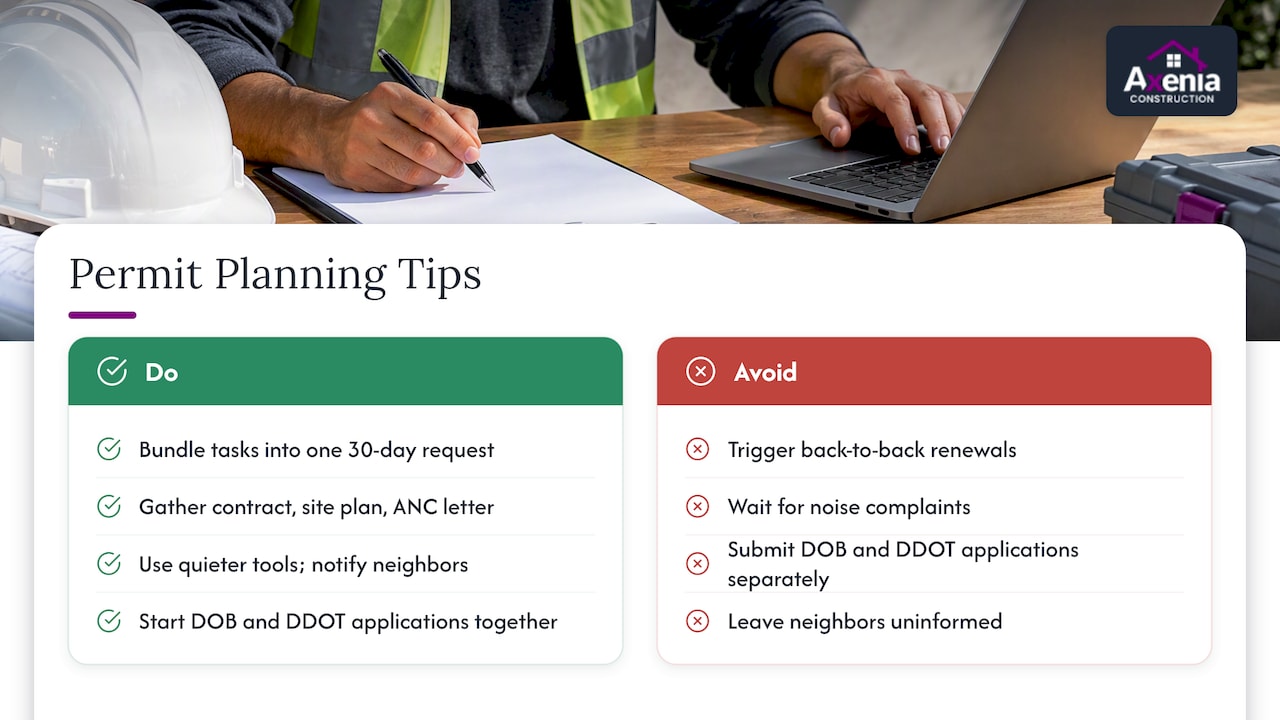
Bundle your after-hours tasks so one 30-day request covers as much as possible instead of triggering back-to-back renewals. Gather the signed contract, site plan and ANC letter before submitting, because a complete file gets reviewed faster. Reduce noise before anyone complains: quieter tools, equipment placed away from bedrooms and a heads-up to neighbors go a long way. And if the job touches public space, start the DOB and DDOT applications together so one does not hold up the other.
Pro Tip: Send neighbors a short note with your dates and a contact number before the first night shift. A note can help keep neighbors informed about the schedule.
Why a licensed local contractor makes permitting easier
I have seen projects run into problems when an ANC letter is missing or an application is sent to the wrong portal. A local contractor familiar with permitting may be able to help with paperwork, commissioner outreach and scheduling. If your project needs after-hours work, ask any contractor you interview how they manage DOB and DDOT permits. The answer tells you a lot. Our guide to finding a licensed general contractor in Washington DC is a good place to start.
— Arienne
How Axenia Construction can help with permitting, ANC coordination, and after-hours work
Permit rules shouldn’t slow down your project, and with the right partner they don’t have to. We are a licensed local general contractor serving DC, Maryland and Northern Virginia, and we manage the permitting steps so you can stay focused on the build.

- We prepare and submit DOB applications, including the documents that speed review.
- We handle outreach to ANC commissioners and Single Member District representatives.
- We schedule off-hours work around permit limits and neighborhood needs.
- We coordinate DOB and DDOT timelines when your job touches public space.
Learn how we expedite permits and cut delays, then talk with us about your project through our general contracting services. Tell us your address and schedule, and we will map out the permits you need.
FAQ
What happens if I build without the required permit?
Unpermitted work can trigger stop-work orders, fines and inspections from DOB. You may also have to correct or remove finished work. Getting the permit first can help avoid complications.
Does the After-Hours Permit apply to Sundays?
Yes. Work on Sundays and legal holidays falls outside the legal window and needs an approved After-Hours Permit from DOB. Check the DOB noise page for the holiday list.
How long does DOB take to review an after-hours application?
DOB reviews applications by the following business day. If plan review is required, follow any ProjectDox requests.
Do I need neighbor approval for after-hours work?
If the site is within 500 feet of a residential zone, you need written support from the local ANC or Single Member District representative. Farther away, that requirement does not apply.