
What does a general contractor in Washington, DC actually do?
A licensed general contractor in Washington, DC is the professional who holds the entire construction process together. From the first permit application to the final walkthrough, they coordinate every moving part: hiring and supervising subcontractors, managing schedules, sourcing materials, and keeping the project aligned with DC’s building codes. Think of them as the single point of accountability on a job site.
DC takes licensing seriously. The DC Department of Consumer and Regulatory Affairs requires all contractors performing construction activities to hold a valid, current license, and that license demands ongoing renewals and compliance documentation. Letting a license lapse mid-project can trigger stop-work orders and costly delays.
Here is what a licensed DC general contractor typically handles:
- Pulling and managing all required building permits
- Hiring, scheduling, and overseeing specialty subcontractors (electrical, plumbing, HVAC)
- Coordinating inspections at each phase of construction
- Maintaining compliance with DC building codes and zoning regulations
- Communicating progress and changes directly to the property owner
- Managing the project budget and tracking change orders
The pre-construction phase alone, which covers design review, permit applications, and contractor vetting, can take weeks in DC. Having a licensed GC who knows the local process shortens that timeline considerably.
How do general contractors and building contractors differ in DC?
The terms get used interchangeably, but they describe genuinely different roles. A general contractor manages the full scope of a project: planning, permitting, subcontractor coordination, and delivery. A building contractor typically focuses on the physical construction execution itself, often working under a GC rather than leading the project independently.
In practice, this distinction shapes who owns the risk and the relationships. The GC holds the prime contract with the property owner and carries responsibility for every trade on site. The building contractor executes a defined scope, usually framing, concrete work, or structural assembly, without the broader coordination duties.
Here is how the two roles compare:
- General contractor: holds the owner contract, manages all subs, pulls permits, owns project schedule and budget
- Building contractor: executes a specific construction scope, typically reports to the GC, may not hold independent permits
- Licensing overlap: both require valid DC licenses for their respective scopes, but the GC license covers broader project authority
- Owner relationship: property owners contract directly with the GC; the building contractor relationship is usually GC-to-sub
For larger residential renovations or any commercial project in DC, you want a licensed GC at the helm. If you are weighing different contracting structures, the design-build vs. traditional GC comparison is worth reading before you sign anything.
How to choose a trustworthy licensed contractor in DC
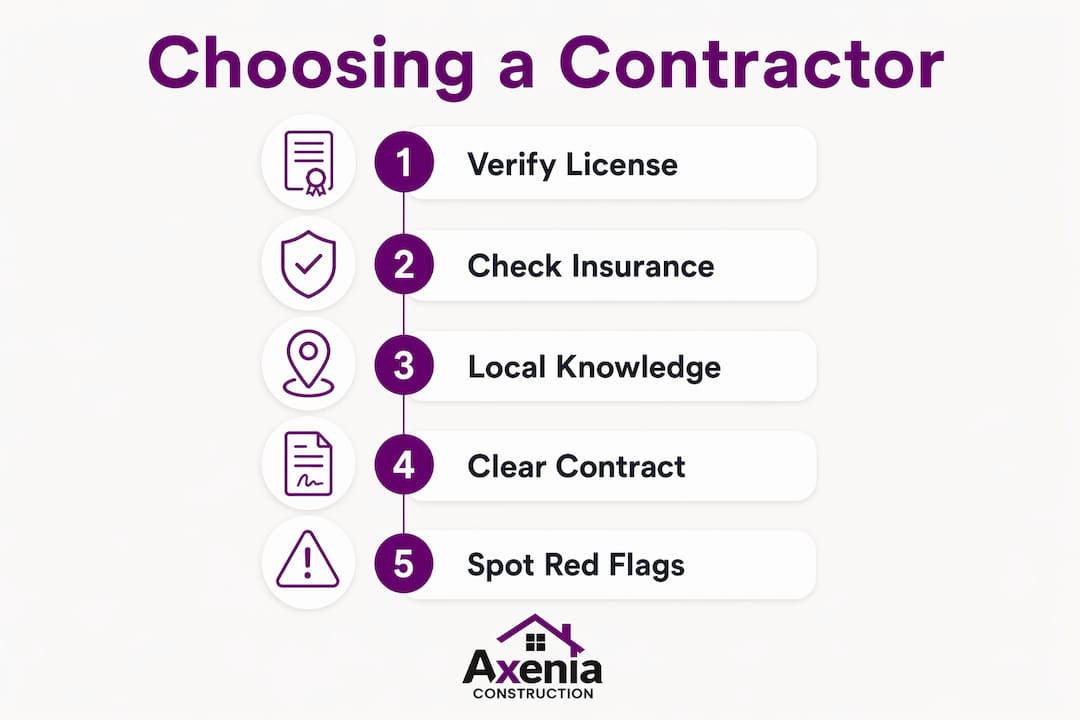
Choosing the right GC for a Washington project comes down to three things: verified credentials, local knowledge, and clear communication. Here is how to work through each one.
Verify the license and insurance first
Before any conversation about scope or price, confirm that the contractor holds an active DC license. You can verify licenses directly through the DC Department of Consumer and Regulatory Affairs database. DC also requires proof of insurance and bonding before a contractor can legally operate. Ask for the certificate of insurance, confirm the coverage amounts, and check that it has not expired.

Ask the right questions during your interview
A qualified GC will answer these without hesitation:
- What is your active DC license number, and can I verify it?
- Who are your primary subcontractors, and how long have you worked with them?
- How do you handle permit delays or stop-work orders?
- What does your contract include regarding change orders and cost overruns?
- Can you provide references from DC projects similar in scope to mine?
Know the red flags
Walk away if a contractor asks for a large cash deposit upfront, cannot produce a license number, avoids discussing permits, or gives you a verbal-only agreement. Aggressive low bids that undercut every other estimate by a wide margin often signal that the contractor plans to cut corners or pile on change orders later. Poor communication during the bidding phase only gets worse once construction starts.
Understand what the contract must include
A solid construction contract covers the full project scope, payment schedule tied to milestones, permit responsibilities, a change order process, and a clear timeline with completion benchmarks. Review the home renovation contract guide before you sign, especially for residential projects. Missing any of these elements creates disputes that are expensive to resolve.
Prioritize local permit expertise
DC’s permitting process is genuinely complex, and historic districts like Georgetown add another layer of regulatory review. A GC without hands-on DC permit experience can stall your project for months waiting on approvals they did not anticipate. Ask specifically about their experience with DC’s Department of Buildings and whether they have managed projects in historic or overlay zones.
Pro Tip: Ask your GC for the permit application number once it has been submitted. You can track its status directly through the DC Department of Buildings portal, which gives you an independent view of where your project stands without relying solely on contractor updates.
Key Takeaways
Hiring a licensed general contractor in Washington, DC requires verifying active credentials, confirming insurance and bonding, and choosing someone with direct experience navigating DC’s permit process.
| Point | Details |
|---|---|
| Licensing is mandatory | DC requires all contractors to hold a valid, current license with ongoing renewals. |
| GCs own the full project | General contractors manage permits, subs, schedule, and budget; building contractors execute a defined scope. |
| Verify before you hire | Confirm licenses through the DC Department of Consumer and Regulatory Affairs and request proof of insurance. |
| Contracts protect you | A written contract must cover scope, payment milestones, change orders, and permit responsibilities. |
| Local permit knowledge matters | DC’s complex permitting, especially in historic districts, requires a GC with direct DC Department of Buildings experience. |
Ready to start your project with a trusted DC-area contractor?

Axeniaconstruction is a licensed, women-owned general contractor serving Washington, DC, Northern Virginia, and the surrounding metro area. We bring genuine local expertise to every project, from residential renovations to commercial builds, and we handle the permit coordination, subcontractor management, and code compliance so you do not have to. Our team builds real relationships with clients, not just buildings.
Explore our general contracting services or browse our home renovation work to see what we can do for your property. When you are ready to talk, we are here.