
A kitchen renovation is defined as a structured construction process divided into sequential phases, each building directly on the last. Understanding kitchen renovation phases explained in the right order prevents costly rework, keeps your budget intact, and gives you realistic expectations from day one. The industry term for this structured approach is a remodeling sequence, and it typically covers ten distinct stages: planning and design, permitting, ordering, demolition, rough-in plumbing and electrical, insulation and drywall, cabinetry, countertops, flooring, and final fixtures. Axeniaconstruction guides Rockville-area homeowners through every one of these stages, and we have seen firsthand how knowing the sequence changes the entire experience.
What are the key phases of a kitchen renovation?
A full kitchen remodel follows ten sequential phases, and skipping or reordering any of them creates expensive problems downstream. The logic is simple: you cannot install countertops before cabinets, and you cannot close drywall before rough-in inspections pass. Every phase gates the next.
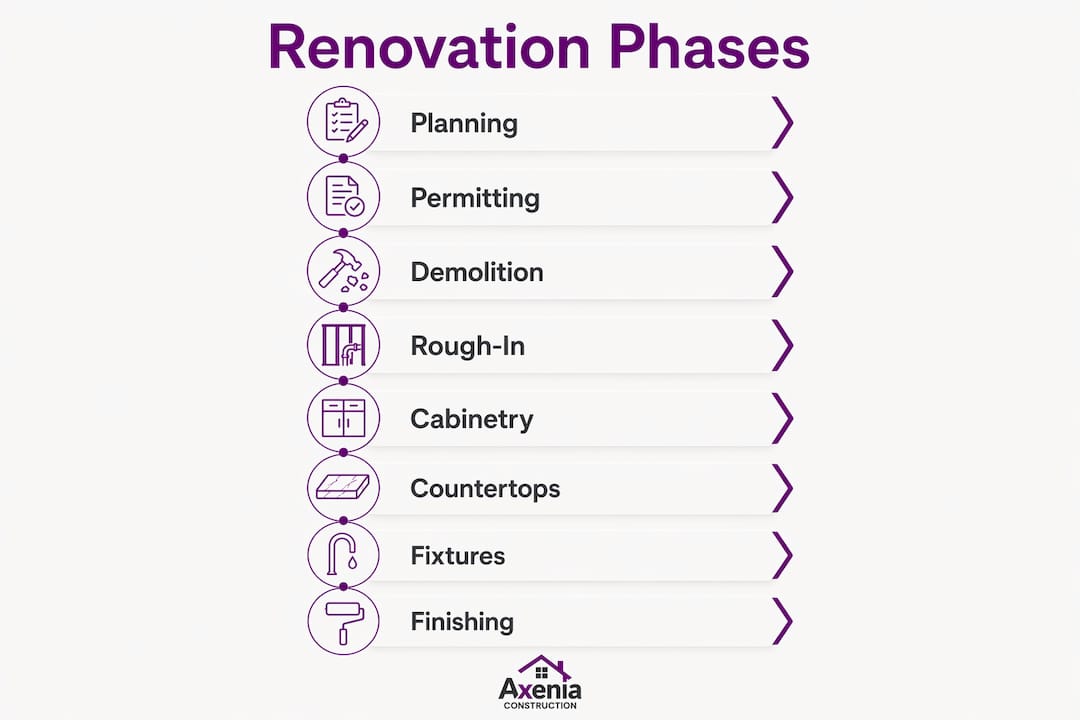
Here is the standard remodeling sequence:
- Planning and design. You finalize the layout, select materials, and set a budget. This phase determines remodel success more than any other because decisions made here control every downstream cost and inspection.
- Permitting and ordering. You submit permit applications and place cabinet orders simultaneously. Running these in parallel saves weeks.
- Demolition. Existing cabinets, flooring, and fixtures come out. This phase often reveals surprises inside the walls.
- Rough-in plumbing and electrical. Licensed trades relocate pipes, drains, and circuits to match the new layout.
- Insulation and drywall. Walls close only after rough-in inspections pass. No exceptions.
- Cabinetry installation. Cabinets go in first and must be perfectly level before any countertop work begins.
- Countertop templating and fabrication. A fabricator measures the installed cabinets on site. Cabinet leveling precision is treated as a milestone because errors here force costly countertop replacements.
- Flooring. Hard flooring installs after cabinets to protect finished surfaces.
- Fixtures and appliances. Plumbers and electricians return to connect sinks, faucets, lighting, and appliances.
- Final inspection and punch list. The jurisdiction inspects completed work, and your contractor walks through a punch list of remaining items.
Pro Tip: Level your cabinets to within 1/8 inch before calling the countertop fabricator. Any adjustment to cabinet height or flooring after templating invalidates the measurements and may require a full countertop replacement.
The table below shows how each phase connects to the next and what triggers the transition.

| Phase | Key task | What gates the next phase |
|---|---|---|
| Planning and design | Finalize layout and materials | Signed plans and budget approval |
| Permitting and ordering | Submit permits, order cabinets | Permit approval and cabinet delivery |
| Demolition | Remove existing kitchen | Rough-in inspection scheduling |
| Rough-in and drywall | Plumbing, electrical, insulation | Passed rough-in inspection |
| Cabinetry and countertops | Install cabinets, template, fabricate | Leveled cabinets, sink on site |
| Flooring and finishing | Floors, fixtures, appliances | Final inspection clearance |
How long does each kitchen renovation phase typically take?
A full kitchen renovation usually takes 6–9 months from the initial design meeting to the final walkthrough. That number surprises most homeowners who expect a few weeks of construction. The reality is that material lead times and permit reviews consume most of the calendar before a single wall comes down.
Here is a realistic phase-by-phase timeline:
| Phase | Typical duration |
|---|---|
| Planning and design | 2–6 weeks |
| Permitting and ordering | 6–8 weeks (run in parallel) |
| Demolition | 1 week |
| Rough-in plumbing and electrical | 2–4 weeks |
| Insulation and drywall | 1–2 weeks |
| Cabinetry installation | 1–2 weeks |
| Countertop templating and fabrication | 2–3 weeks |
| Flooring | 1 week |
| Fixtures, appliances, and finishing | 1–2 weeks |
| Final inspection and punch list | 1–2 weeks |
Custom cabinet lead times typically run 6–12 weeks and often determine when construction can actually start. This is why placing the cabinet order the moment permits are submitted is standard practice, not optional. Permits themselves usually take 1–3 weeks for approval, though jurisdictions with heavy workloads can push plan review to 3–6 weeks.
Countertop fabrication adds another layer. From templating to installation typically takes 10–15 business days, with fabrication alone running 7–14 business days. That means any delay in cabinet installation pushes countertops back by the same amount, plus the full fabrication window.
Pro Tip: Schedule your countertop templating appointment the same day your cabinet installation is confirmed complete. Waiting even two days to call the fabricator adds two days to your countertop delivery, and those days compound across the rest of your timeline.
What are the common challenges in kitchen renovation phases?
The most disruptive problems in kitchen remodeling come from dependencies, not from the work itself. When one phase slips, every phase after it slips too. Knowing where the pressure points are lets you plan around them.
Demolition frequently uncovers hidden damage including outdated wiring, corroded plumbing, and water-damaged framing. Each discovery triggers additional work and, often, additional inspections. A project that planned one week for demolition can stretch to three if the walls reveal knob-and-tube wiring or galvanized pipes that need full replacement.
Permit delays are the other major schedule risk. A full remodel typically requires building, plumbing, and electrical permits, plus 4–6 separate inspections throughout the project. If your jurisdiction requires plan review before issuing permits, that review alone can take 3–6 weeks. Missing a single inspection sign-off means drywall cannot close, which halts all subsequent phases.
Common challenges homeowners face across the remodeling sequence include:
- Late material decisions. Changing your countertop material after templating forces a new template appointment and restarts the fabrication clock.
- Cabinet delivery delays. A cabinet order that arrives two weeks late pushes every downstream phase by the same two weeks.
- Inspection scheduling gaps. Some jurisdictions book inspections 5–10 business days out. Factor this into your rough-in timeline.
- Scope creep during demolition. Discovering a load-bearing wall where you planned an open concept requires structural engineering and new permits.
- Appliance lead times. High-end appliances from brands like Wolf, Sub-Zero, or Thermador can carry 8–16 week lead times. Order them during the design phase.
The critical-path risks in kitchen remodeling almost always trace back to cabinet lead times, permit and inspection sequencing, and the hard requirement that rough-in inspections pass before drywall closes. Treat these three as your project’s non-negotiable checkpoints.
How do homeowners prepare for and manage renovation phases effectively?
Thorough planning before demolition starts is the single most effective way to protect your timeline and budget. Every decision you defer to mid-construction costs more than it would have cost upfront, because trades are already on site and waiting.
Use a kitchen remodel checklist to lock in your selections before permits are submitted. This means finalizing cabinet style and dimensions, countertop material, appliance models, plumbing fixtures, and flooring. Your contractor cannot order materials or submit accurate permit drawings without these decisions in hand.
Setting up a temporary kitchen is not optional during demolition and construction. It is a practical necessity that reduces daily stress. A folding table, a microwave, a coffee maker, and a mini-fridge in an adjacent room keeps your household functional for the 6–9 weeks between demolition and appliance connection.
Practical preparation steps that make a real difference:
- Confirm all material selections before demo day. Changes after demolition cost two to three times more than changes made during design.
- Coordinate delivery windows with your contractor. Cabinets, appliances, and countertop materials each need a confirmed delivery date tied to the construction schedule.
- Attend every phase walkthrough. Walk the space with your contractor after rough-in, after cabinet installation, and before drywall closes. These are your last low-cost opportunities to catch errors.
- Build a 10–15% contingency into your budget. Hidden damage, permit fees, and material price changes are common. A contingency prevents them from stopping the project.
- Document everything in writing. Change orders, material substitutions, and schedule adjustments should all be confirmed by email or signed document.
Pro Tip: Ask your contractor for a renovation project plan that maps each phase to a calendar date. A written schedule gives you a baseline to measure against and makes it easier to spot delays before they compound.
Key Takeaways
A kitchen renovation succeeds or fails in the planning phase, because every downstream phase depends on decisions and orders placed before demolition begins.
| Point | Details |
|---|---|
| Follow the remodeling sequence | Ten phases build on each other; skipping any one creates rework and added cost. |
| Order cabinets with permits | Custom cabinets take 6–12 weeks; ordering them at permit submission prevents construction delays. |
| Treat templating as a milestone | Cabinets must be installed and leveled before the countertop fabricator arrives on site. |
| Plan for hidden damage | Demolition regularly reveals outdated wiring or plumbing that adds time and inspections. |
| Lock in all selections early | Every deferred decision during construction costs more than the same decision made during design. |
What I have learned from guiding homeowners through every phase
The homeowners who finish their kitchen renovations on time and on budget share one trait: they made every material decision before demolition started. The ones who struggle almost always say the same thing: “We thought we could figure out the countertop later.” Later, in construction, means expensive.
The phase dependency that catches people off guard most often is the cabinet-to-countertop sequence. Homeowners see cabinets go in and assume countertops follow within days. What they do not see is the fabrication window sitting behind the templating appointment. If cabinets are installed on a Monday and you call the fabricator on Friday, you are looking at countertops in three weeks at the earliest. Call on Monday, and you shave four days off the wait. That gap matters when you are living without a kitchen sink.
Permit timelines also deserve more respect than most homeowners give them. I have seen projects stall for six weeks waiting on plan review in jurisdictions with backlogged building departments. Submitting permits the day your design drawings are finalized, not the day you feel ready to start, is the move that separates smooth projects from frustrating ones.
The most honest advice I can offer: treat the planning phase as the real construction. The physical work is almost mechanical once every decision is locked in. When you walk into demolition with signed permits, confirmed cabinet orders, and every material selection finalized, the rest of the remodeling sequence runs the way it is supposed to. Delays still happen. Hidden damage still shows up. But you have the margin to absorb them without derailing the whole project.
— Arienne
Axeniaconstruction handles every phase of your kitchen remodel
Knowing the phases is one thing. Having an experienced team manage them is another.

Axeniaconstruction is a licensed, women-owned general contractor based in Rockville, MD, and we specialize in residential renovation services that cover every phase of a kitchen remodel, from design and permitting through final inspection. We coordinate cabinet orders, schedule trades, manage inspections, and keep your project on a written timeline so nothing falls through the cracks. If you are planning a kitchen renovation and want a contractor who treats phase sequencing as seriously as you do, contact Axeniaconstruction for a consultation. We build genuine relationships with every client, and that starts with a transparent conversation about your project before any work begins.
FAQ
What are the phases of a kitchen renovation?
A kitchen renovation follows ten phases: planning and design, permitting and ordering, demolition, rough-in plumbing and electrical, insulation and drywall, cabinetry, countertop templating and fabrication, flooring, fixtures and appliances, and final inspection. Each phase must be completed in sequence because each one gates the next.
How long does a full kitchen renovation take?
A full kitchen renovation typically takes 6–9 months from the initial design meeting to the final walkthrough. Most of that time is consumed by cabinet lead times of 6–12 weeks and permit review periods of 1–6 weeks, not by the physical construction itself.
Do I need permits for a kitchen remodel?
Permits are required when you move walls, relocate plumbing, or add electrical circuits. A full kitchen remodel typically requires building, plumbing, and electrical permits and involves 4–6 separate inspections throughout the project.
Why does cabinet installation happen before countertop templating?
Countertop fabricators measure directly off installed cabinets, so cabinets must be in place and perfectly level before templating. Any change to cabinet height or flooring after templating invalidates the measurements and can require a full countertop replacement.
What causes the most delays in kitchen renovation phases?
The most common delay sources are custom cabinet lead times, permit review backlogs, hidden damage discovered during demolition, and late material decisions that restart fabrication timelines. Building a 10–15% schedule and budget contingency protects against all four.