A construction bond is a three-party surety agreement in which a bonding company (the surety) guarantees to a project owner (the obligee) that a contractor (the principal) will fulfill its contract obligations — covering both performance and payment. If the contractor fails, the surety steps in to remedy the default, then seeks reimbursement from the contractor. That financial backstop is what makes bonding one of the most important risk-management tools in U.S. construction.
Here are the core facts at a glance:
- Bond types: Bid bonds, performance bonds, payment bonds, and maintenance/warranty bonds are the most common; specialty bonds (mechanics lien bonds, subdivision bonds, supply bonds) address specific project needs.
- Who requires them: Public agencies are required by statute to demand bonds on covered projects; private owners may require them on large or high-risk work.
- Who pays: The contractor pays the bond premium, typically rolling it into the bid price.
- Typical premium range: 1%–3% of the contract amount for established contractors, though rates can start as low as 0.5% depending on project size and contractor financials.
- Federal trigger: The Miller Act requires performance and payment bonds on federal construction contracts above the statutory threshold; most states have parallel “Little Miller Acts.”
Table of Contents
- How does bonding in construction projects actually work?
- Who are the three parties to a construction bond?
- What are the main types of construction bonds?
- Why do owners require bonds, and who do they protect?
- When are bonds required on U.S. construction projects?
- Who pays for construction bonds, and what do they cost?
- How do contractors get bonded?
- What happens when a bond claim is made?
- How are surety bonds different from construction insurance?
- Practical tips from a licensed general contractor at Axeniaconstruction
- Key Takeaways
- A perspective on bonding from Axeniaconstruction
- Useful sources and where to read more
How does bonding in construction projects actually work?
A bond is not a line of credit or an insurance policy. It is a guarantee. When a surety issues a bond, it is telling the project owner: “If this contractor fails, we will make it right.” That commitment flows from a careful underwriting process, not a blanket promise.
Underwriting and issuance. Before issuing a bond, the surety evaluates the contractor’s financial statements, credit history, work experience, current backlog, and management depth. If the contractor’s profile is strong, the surety issues the bond document along with an indemnity agreement, which obligates the contractor (and often its principals personally) to reimburse the surety for any losses paid on a claim.
The project lifecycle of a bond. The sequence typically runs like this: the contractor submits a bid bond with the proposal; upon award, performance and payment bonds are issued before the contract is signed; the contractor executes the work; and if a default occurs, the owner files a claim. The surety then investigates, selects a remedy, and later pursues the contractor for recovery.
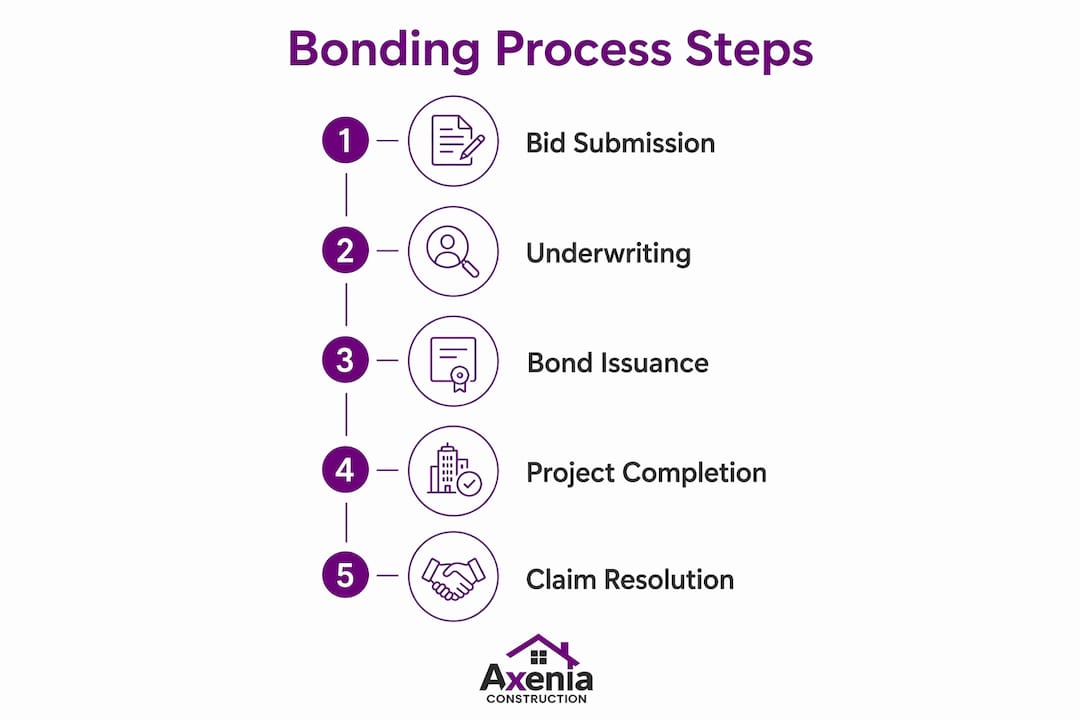
Surety obligations after a valid claim. Once a claim is confirmed, the surety’s options often include helping the original contractor finish, hiring a replacement contractor, or paying the obligee directly for damages. After settling, the surety pursues the contractor for indemnification. That recovery obligation is a fundamental difference from how standard insurance works, and it is why sureties invest heavily in contractor vetting before issuing any bond.
Who are the three parties to a construction bond?
Every construction bond involves exactly three parties, each with distinct responsibilities. Understanding each role prevents confusion when a claim arises.
- Principal (the contractor). The principal is the party whose performance is being guaranteed. The contractor applies for the bond, pays the premium, signs the indemnity agreement, and is ultimately responsible for fulfilling the contract. If the surety pays a claim, the contractor owes that money back.
- Obligee (the owner or public agency). The obligee is the party protected by the bond. On a public project, this is typically a government agency; on a private project, it is the property owner or developer. The obligee can call on the bond if the principal defaults.
- Surety (the bonding company). The surety is the financial guarantor. It underwrites the contractor’s risk, issues the bond, investigates claims, and arranges remedies. Most surety companies operate as subsidiaries or divisions of insurance companies, though their business model is fundamentally different from traditional insurance.
A simple scenario: a municipal agency (obligee) awards a road contract to a paving firm (principal). The paving firm abandons the project mid-way. The agency declares default, files a claim with the bonding company (surety), and the surety arranges for a replacement contractor to complete the work. The surety then pursues the paving firm for the costs incurred.
What are the main types of construction bonds?
The four bonds you will encounter on almost every bonded project are bid, performance, payment, and maintenance/warranty bonds. Beyond those, several specialty bonds address specific project structures or risk scenarios.
Bid bond
A bid bond assures the owner that the contractor has submitted its bid in good faith and will sign the contract at the bid price if awarded. The National Institute of Governmental Purchasing defines it as a written agreement guaranteeing that a bidder will accept a contract if it is awarded. Bid bonds are typically issued for 5% of the total bid price, though some statutes or local policies require a different percentage. There is generally no direct premium charge for a bid bond when performance and payment bonds are also purchased.

Performance bond
A performance bond protects the owner from financial loss if the contractor fails to complete the contract according to its terms. It is issued after award, before the contract is signed, and is typically set at 100% of the contract price. On a $2 million school renovation, for example, the performance bond guarantees the owner can recover the full contract value if the contractor walks off the job or delivers defective work.
Payment bond
A payment bond guarantees that the contractor will pay its subcontractors, laborers, and material suppliers. Like the performance bond, it is usually issued at 100% of the contract price. On public projects, where mechanics liens cannot be placed against government property, the payment bond may be the only financial protection available to unpaid subcontractors and suppliers.
Maintenance/warranty bond
A maintenance bond extends coverage beyond project completion, guaranteeing the contractor will correct defects that appear during a defined post-completion period. Maintenance bonds commonly cover 1–2 years after substantial completion, though the exact term is set in the contract. This is closely related to the workmanship warranty obligations you can read about in our construction warranty guide for DMV property owners.
Specialty bonds
Several less-common bonds address specific situations:
- Mechanics lien bond (lien release bond): Substitutes for a recorded mechanics lien, allowing work to continue while a payment dispute is resolved.
- Subdivision bond: Required by municipalities when a developer must complete public infrastructure (roads, utilities) as a condition of subdivision approval.
- Supply bond: Guarantees a material supplier will deliver specified materials per contract terms.
- Completion bond: Used primarily on development or film projects to guarantee project completion to a lender or investor.
On high-value projects, lenders or procurement rules may layer multiple bonds together. A large federal building contract, for instance, will typically carry a performance bond, a payment bond, and a maintenance bond simultaneously.
Why do owners require bonds, and who do they protect?
Owners require bonds to transfer the financial risk of contractor default away from themselves and onto a surety. That transfer is the core logic of bonding in construction, and it benefits a wider group than just the owner.
The primary beneficiaries of construction project bonding are:
- Project owners (obligees): Protected against the cost of contractor non-performance, abandonment, or defective work.
- Subcontractors and suppliers: Payment bonds guarantee they get paid even if the general contractor fails, and on public projects, the payment bond is often their only recourse since mechanics liens cannot attach to public property.
- Taxpayers: On publicly funded projects, bonds mean that contractor failure is remedied at the surety’s expense, not the public’s.
- Lenders and investors: Bonds reduce the risk that a project will stall or fail, protecting the collateral backing a construction loan.
Bonding also functions as a pre-qualification filter. If a contractor is bondable, a surety has already vetted its finances, experience, and track record. That vetting gives owners a meaningful signal of contractor credibility before a single shovel hits the ground. On public projects, bonding is mandated by statute precisely because the low-bid system does not otherwise guarantee that the cheapest bidder is the most capable.
When are bonds required on U.S. construction projects?
The short answer: always on covered federal projects, usually on state and municipal public works, and at the owner’s discretion on private projects.
Federal requirement. The Miller Act requires performance and payment bonds on federal construction contracts above the statutory threshold. Contractors bidding on federal work should verify current thresholds directly with the relevant agency, as the dollar trigger can be updated by regulation.
State and local requirements. Most states have enacted “Little Miller Acts” that mirror the federal statute for state-funded projects, with their own thresholds and bond amount rules. Municipal governments and school districts often have additional bonding policies. The CTAS guidance for Tennessee illustrates how state statutes can specify bond amounts as a percentage of contract price for public works above certain dollar thresholds.
Common triggers for bonding requirements include:
- Public procurement above a statutory dollar threshold (federal, state, or municipal)
- Lender or investor requirements on privately financed projects
- Owner-requested protection on large or complex private contracts
- Developer or municipality conditions tied to subdivision or site plan approval
Private projects. Surety bonds are not legally required on most private work, but many sophisticated owners and lenders require them anyway. The Arizona DOT’s surety bond guidance notes that alternative forms of financial security, such as letters of credit, do not provide the same 100% performance and payment protection that surety bonds offer.
Pro Tip: Review the contract documents and any applicable state procurement statutes at the very start of the bid stage. Bond requirements, amounts, and eligible surety companies are often specified in the solicitation package, and missing a bonding deadline can disqualify an otherwise strong bid.
Bond duration generally spans the life of the construction contract, with maintenance bonds extending coverage into the post-completion period. The construction project timeline directly affects how long a performance bond remains active and, in some cases, how the premium is adjusted if the contract amount changes.
Who pays for construction bonds, and what do they cost?
Contractors pay the bond premium. In practice, the cost is almost always folded into the contractor’s bid price, so the owner indirectly bears it as part of the contract sum.
Premium ranges for established contractors typically run 0.5%–3% of the contract amount, depending on project size, type, duration, and contractor financials.
A contractor with strong credit, audited financials, and a clean project history will generally land at the lower end of that range. A newer firm or one with thinner working capital may pay closer to the top.
What moves the premium up or down?
| Factor | Lower premium | Higher premium |
|---|---|---|
| Contractor credit | Strong personal and business credit | Marginal or limited credit history |
| Financial statements | Audited, healthy working capital | Compiled only, thin margins |
| Project size | Smaller, within proven capacity | Large relative to contractor’s backlog |
| Project complexity | Straightforward civil or building work | Specialized or high-risk scope |
| Contract duration | Short-term | Multi-year |
| Collateral/indemnity | Not required | Required by surety |
Simple example. A contractor wins a $1.5 million public school renovation. At a 1.5% premium rate, the performance and payment bond costs roughly $22,500. The contractor includes that figure in the bid, so the school district effectively pays it as part of the contract price. If the contractor’s financials improve over time and the rate drops to 1%, the same bond would cost $15,000, a meaningful competitive advantage on a competitive bid.
Strong bonding terms are not just a cost item. A contractor who can offer lower premiums and higher capacity has a real edge when competing for public work, because the savings flow directly into a more competitive bid price.
How do contractors get bonded?
Bonding starts with an application to a surety, usually through a licensed surety broker, and requires a package of financial and operational documentation. Starting early matters: assembling a complete submission takes time, and many bid deadlines do not leave room for last-minute underwriting.
- Engage a surety broker. A broker with construction experience knows which sureties specialize in your project type and can advocate for favorable terms on your behalf.
- Prepare financial statements. Audited statements carry the most weight; compiled statements are acceptable for smaller bonds. The surety will look at working capital, net worth, and profitability trends.
- Document your work history. Provide a list of completed projects with contract values, project types, and owner references. Relevant experience matching the scope you are bidding is a major underwriting factor.
- Disclose your current backlog. The surety needs to know how much work you already have under contract to assess whether you have the capacity to take on more.
- Submit credit information. Both personal and business credit are reviewed, especially for smaller firms where the principals’ personal finances are closely tied to the company’s.
- Provide proof of licensing and insurance. Current contractor licenses and general liability/workers’ compensation certificates are standard requirements.
- Share the contract terms. The surety will review the specific contract you are bonding, including scope, schedule, payment terms, and any unusual risk provisions.
The underwriting framework most sureties use is built around three factors: character (reputation, references, integrity), capacity (experience, equipment, workforce, backlog), and capital (financial strength, working capital, net worth). A weakness in any one area can affect the bond rate or require collateral. Underwriting for bonds may also require collateral or indemnity when a contractor’s financial profile is marginal.
Pro Tip: Clean up aged receivables and strengthen your working capital position before applying for a bond. Sureties read a high receivables balance as a sign of collection problems, which directly affects your perceived capacity. A reputable surety broker can also help you identify and address underwriting weaknesses before they become a rejection.
What happens when a bond claim is made?
A bond claim is not the end of a project. It is the beginning of a structured process that the surety manages, with defined obligations to both the owner and the contractor.
Step 1: Notice of default. The owner formally declares the contractor in default. This step is critical: the surety has the right to investigate before taking any action, and an improper default declaration can expose the owner to liability.
Step 2: Surety investigation. The surety conducts an impartial review of the facts, including the contract documents, payment records, change orders, and correspondence. This protects the contractor’s right to contest an improper default.
Step 3: Temporary measures. While the investigation is underway, the surety may take steps to preserve the project, such as securing the site or arranging for critical subcontractors to continue work.
Step 4: Remedy selection. Once the investigation confirms a valid default, the surety selects from its available options, which are typically spelled out in the bond itself. These options include: financing the original contractor to complete the work, hiring a replacement contractor, re-bidding the project for completion, or paying the penal sum of the bond directly to the owner.
Step 5: Indemnification. After settling the claim, the surety pursues the contractor for recovery under the indemnity agreement. This is a legally enforceable obligation, and it can extend to the personal assets of the contractor’s principals if they signed personal indemnity.
Timelines vary widely. A straightforward payment dispute on a small project may resolve in weeks; a complex default on a multi-year contract can take months or longer. Throughout the process, thorough documentation is your best protection on either side of the claim.
Pro Tip: Whether you are an owner or a contractor, keep a complete, organized file of the contract, all change orders, payment applications, lien waivers, and written communications throughout the project. That documentation is the foundation of any claim or defense, and gaps in the record almost always hurt the party that created them.
How are surety bonds different from construction insurance?
This is one of the most common points of confusion in construction risk management, and the distinction matters practically.
A surety bond is a guarantee of performance, not a transfer of risk. The surety expects no loss: it underwrites the contractor carefully, and if it does pay a claim, it recovers the money from the contractor through indemnification. The contractor remains financially responsible throughout.
Construction insurance, by contrast, is designed to compensate the insured for unforeseen losses. A general liability policy pays for third-party bodily injury or property damage. A builder’s risk policy covers physical loss to the project itself. In neither case does the insured typically owe the insurer repayment after a covered claim.
Key differences at a glance:
- Who is protected: A bond primarily protects the obligee (owner); insurance primarily protects the insured (contractor or owner, depending on the policy).
- Indemnity/recovery: A bond creates a recovery obligation against the contractor; standard insurance does not.
- Claims handling: Bond claims trigger a surety investigation and a remedy process; insurance claims trigger an adjuster review and a payment process.
- Purpose: Bonds guarantee contract performance and payment; insurance covers casualty, liability, and property loss.
A practical example: a subcontractor falls on the job site and is injured. That is a workers’ compensation and general liability event, handled through insurance. The general contractor abandons the project before completion. That is a performance bond event, handled through the surety. Both scenarios can occur on the same project, which is why bonded projects almost always carry insurance as well.
Practical tips from a licensed general contractor at Axeniaconstruction
At Axeniaconstruction, we work on public and private projects across the DMV region, and bonding is part of our standard project preparation on government contracting and larger commercial work. These are the lessons we have seen matter most in practice.
For contractors:
- Build your bond-ready packet before you need it. Waiting until a bid deadline to assemble financial statements and references is a recipe for missed opportunities. Keep your surety submission current year-round.
- Manage your bonding capacity actively. Bonding capacity is finite: the surety sets a maximum amount it will have bonded for you at any one time. A large disputed project can tie up capacity and prevent you from bidding new work. Resolve disputes promptly and communicate with your surety broker when your backlog shifts significantly.
- Maintain clean financials. Consistent project margins, timely billing, and low aged receivables all strengthen your underwriting profile. A single bad year can move your premium rate meaningfully.
- Cultivate your surety relationship. Your surety broker is an advocate, not just a vendor. A broker who knows your business can help you navigate capacity questions, flag underwriting concerns early, and sometimes secure better terms than you would get by approaching a surety directly.
For owners:
- Write clear contract language that aligns with surety expectations. Vague scope, open-ended change-order provisions, and ambiguous completion milestones create disputes that complicate bond claims.
- When hiring a general contractor for a significant project, ask for evidence of current bonding capacity and request a sample bond form before award. A contractor who cannot produce these documents quickly is a yellow flag.
- Verify the contractor’s bonding history, not just their license. A contractor who has had bonds called in the past may still be licensable but may face higher premiums or reduced capacity.
One pattern we see repeatedly: contractors who treat bonding as a checkbox rather than a financial tool tend to be caught off guard when a dispute ties up their capacity mid-bid season. Proactive bonding management is part of running a healthy construction business, not just a compliance requirement.
Key Takeaways
Construction bonds are three-party surety agreements that guarantee contractor performance and payment, required by statute on U.S. federal public works under the Miller Act and commonly required on state and private projects as well.
| Point | Details |
|---|---|
| Three-party structure | Every bond involves a principal (contractor), obligee (owner), and surety (bonding company). |
| Who pays the premium | Contractors pay bond premiums, typically 0.5%–3% of the contract amount, usually rolled into the bid. |
| Main bond types | Bid, performance, payment, and maintenance/warranty bonds each protect a different project phase. |
| Federal and state triggers | The Miller Act covers federal contracts; most states have Little Miller Acts with their own thresholds. |
| Capacity and documentation | Bonding capacity is finite; clean financials and complete project records protect both contractors and owners. |
A perspective on bonding from Axeniaconstruction
Bonding is often framed as a bureaucratic hurdle, especially for contractors new to public work. We see it differently. When we pursue government contracting or larger commercial projects, our bonding status is one of the first signals we send to a prospective client about how we run our business. A surety has already reviewed our financials, our project history, and our capacity before we ever walk into a pre-bid meeting. That vetting is not just a formality; it is a genuine quality signal for the owner.
,.
What we have found in practice is that owners who understand bonding ask better questions during procurement, and contractors who manage their bonding capacity proactively win more work. The two sides of this equation are more connected than most people realize. A well-structured bond requirement in a contract document makes the surety’s job easier, which keeps premiums lower for the contractor, which ultimately keeps the project more competitive for the owner.
If you are planning a project and want to work with a bonded, licensed general contractor who takes risk management seriously, our services overview is a good place to start.
Useful sources and where to read more
These are the primary references we recommend for verifying bonding statutes, understanding surety fundamentals, and researching jurisdictional requirements.
- Bonds on Construction Projects, CTAS (University of Tennessee): A detailed breakdown of bid, performance, and payment bond definitions and statutory requirements, with specific Tennessee statute references that illustrate how state-level rules work in practice.
- The Importance of Surety Bonds in Construction, Arizona DOT: A thorough primer on surety bond mechanics, underwriting criteria, and the risk-transfer logic behind bonding on public and private projects. Widely cited by procurement professionals.
- Construction Bond, Investopedia: A clear, accessible definition of the three-party structure and the main bond types, useful for owners and stakeholders who are new to surety concepts.
- A Contractor’s Guide to Construction Bonds, Procore: Practical guidance on payment bonds, lien waivers, underwriting criteria, and claims processes, written for contractors managing bonded projects.
- Construction Bonds: Types, Costs, and How They Work, Young Architect: Covers premium ranges, the Miller Act, and bond cost mechanics in a format accessible to architects and contractors alike.
- How Long Does a Surety Bond Last, CommercialSurety: Explains bond duration by type, including the post-completion coverage period for maintenance/warranty bonds.
For jurisdictional thresholds and state-specific statutes, go directly to your state’s procurement office or department of general services website. Requirements vary significantly by state, project type, and contract value. For project-specific underwriting questions, a licensed surety broker is the most reliable first call.
This article is general information about construction bonding in the United States, not legal or financial advice. Verify current statutory thresholds, bond amounts, and contract requirements with the relevant public agency, your surety broker, or a qualified attorney for your specific project.