
A commercial build out is the construction work performed inside an existing commercial space to customize it for a specific tenant’s operational and design needs, governed by lease agreements, building codes, and permit requirements. Known formally as tenant improvement (TI) construction, a build out is distinct from base building work. It covers everything inside the building envelope: walls, ceilings, flooring, lighting, HVAC distribution, and specialty finishes. For property owners and developers, understanding what a commercial build out entails, who pays for what, and how permitting works is the difference between a project that closes on time and one that bleeds budget for months.
What is commercial build out scope and types?
TI construction is distinct from base-building work and governed by lease assignments and permits. That distinction matters because it defines who controls the project, who pays for overruns, and what happens when code compliance expands the scope beyond the original plan.
A typical commercial build out includes:
- Interior partitions and walls: framing, drywall, and soundproofing to divide open floor plates into offices, conference rooms, or retail zones
- Ceilings and flooring: drop ceilings, polished concrete, carpet tile, luxury vinyl plank, or specialty surfaces depending on use
- Mechanical, electrical, and plumbing (MEP): HVAC distribution, electrical panels and circuits, plumbing fixtures, and data/telecom rough-in
- Lighting: recessed fixtures, pendant lighting, emergency egress lighting, and controls
- Finishes and millwork: paint, wall coverings, cabinetry, reception desks, and built-in shelving
- Signage and specialty installations: branded elements, ADA-compliant signage, and security systems
The scope shifts significantly by property type. An office build out focuses on private offices, open workstations, and conference rooms. A retail build out prioritizes customer-facing finishes, display fixtures, and point-of-sale infrastructure. Restaurant build outs are the most complex, requiring commercial kitchen exhaust, grease traps, and health department approvals on top of standard permits.
A first-generation build out starts from raw shell space, meaning the landlord delivers four walls, a roof, and basic utilities stubbed in. A second-generation build out works with an existing layout from a prior tenant, which can reduce costs but may also require demolition of incompatible improvements.

Pro Tip: In a second-generation space, always commission a conditions assessment before signing the lease. Hidden deficiencies in existing MEP systems can cost more to remediate than starting from shell.
How do tenant improvement allowances work?
TI allowances are negotiated landlord contributions expressed in dollars per square foot, documented in the lease, with the tenant paying all costs that exceed the allowance. The allowance is a credit applied against construction invoices, not a cash payment deposited into your account. That distinction catches many tenants and owners off guard.
The formula is straightforward: TI allowance equals the negotiated dollar-per-square-foot rate multiplied by the total leased square footage. A 5,000 SF office suite with a $60/SF allowance yields $300,000 toward construction. If the build out costs $380,000, the tenant owes the $80,000 difference.
Current market ranges for 2026 vary meaningfully by property class and use:
| Property Type | Initial Lease TI Range | Renewal TI Range |
|---|---|---|
| Class A Office (5+ year lease) | $50–$90/SF | $25–$50/SF |
| Retail | $30–$70/SF | $15–$35/SF |
| Restaurant | $80–$180/SF | $40–$90/SF |
| Industrial | $10–$30/SF | $5–$15/SF |
Renewal TI allowances are generally 30 to 50% of initial TI because the space is already built out and landlord risk is lower. A tenant renewing a Class A office lease should expect to negotiate $25 to $50/SF rather than the $80 to $150/SF range typical for a new lease. That gap matters when planning a refresh or reconfiguration at renewal.
Two financial models govern how TI funds flow. In a reimbursement model, the tenant manages design and construction, pays contractors directly, and submits documentation to the landlord for reimbursement. In a turnkey model, the landlord manages the build out and delivers a finished space. Turnkey builds place design and construction management with the landlord, while tenant-controlled builds give the tenant direct control over contractor selection and quality.
The lease Work Letter exhibit defines exactly which items the TI allowance covers and which are excluded. Soft costs like architect fees, permit fees, and furniture are sometimes excluded entirely. Understanding what the Work Letter covers versus excludes is critical because owners frequently misinterpret TI allowance as all-inclusive, which exposes them to unexpected out-of-pocket costs.
Pro Tip: Enter TI allowance negotiations with a detailed cost estimate from a licensed general contractor. A credible number anchors the conversation and gives you negotiation leverage that vague requests never achieve.
What are the permitting and regulatory requirements?
Permits are not optional paperwork. They are the legal mechanism that authorizes construction and protects both landlord and tenant from liability. The International Existing Building Code (IEBC) governs most commercial build outs in the United States, and its alteration level tiers directly determine how much compliance work your project triggers.
- Level 1 alterations cover minor work like replacing finishes without changing occupancy or layout. Compliance requirements are minimal.
- Level 2 alterations involve reconfiguring space, adding or removing walls, or modifying MEP systems. These trigger accessibility upgrades in the work area and often in the path of travel.
- Level 3 alterations affect more than 50% of the building’s aggregate area. Higher IEBC alteration levels trigger more comprehensive compliance work, affecting build out scope and who pays for it. Accessibility, egress, and fire protection upgrades can add significant cost beyond the original construction budget.
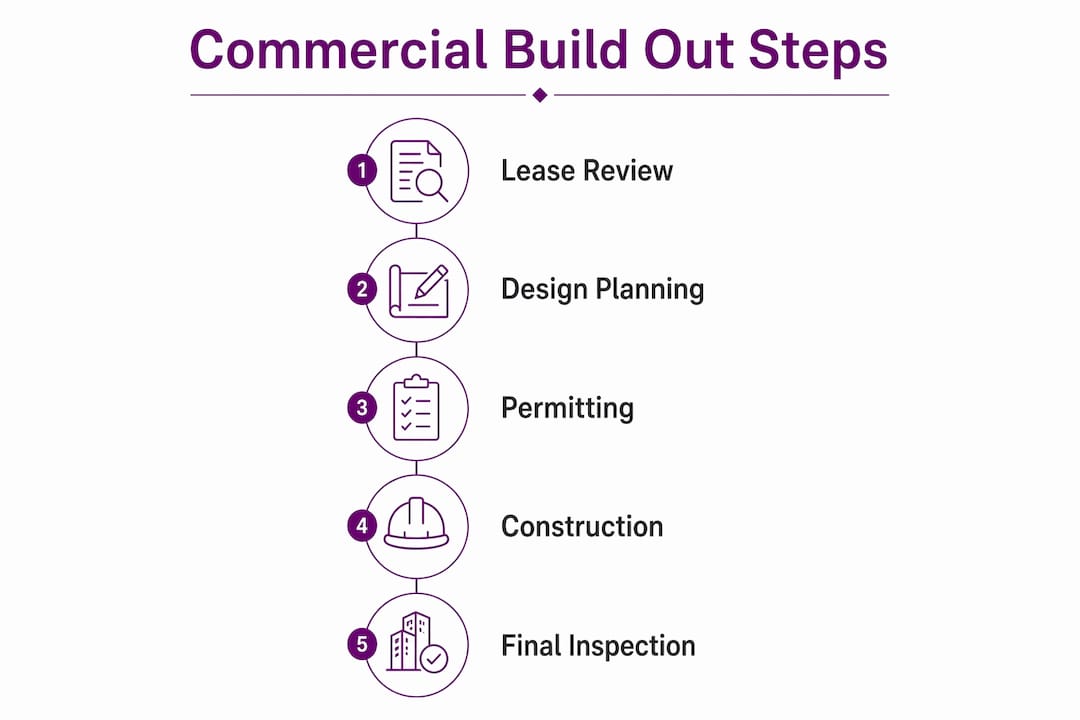
The permit application process runs through the local Authority Having Jurisdiction (AHJ), which is typically the municipal building department. For restaurant and healthcare build outs, the fire marshal and health department conduct parallel reviews. Coordinating these agencies from the start prevents the most common delay scenario: a building permit approved while the health department review is still pending, leaving contractors idle.
Permit reviews for commercial TI projects typically take 4 to 12 weeks depending on the municipality. High-volume jurisdictions like Washington DC, Los Angeles, and New York City trend toward the longer end. Submitting for permit before finalizing every design detail, using a phased or parallel submission strategy, compresses the overall timeline. Skipping or compressing early permit review phases pushes delays downstream into plan check and construction, making parallel submissions one of the highest-value planning decisions you can make.
Knowing when a building permit is required for specific scope items helps you avoid stop-work orders, which are far more disruptive and expensive than the permit fees themselves.
How to plan and manage a commercial build out effectively
Effective planning starts before the lease is signed. The decisions made during lease negotiation, contractor selection, and permit strategy determine whether a build out finishes on time and within budget or becomes a protracted cost dispute.
- Engage a general contractor early. A licensed GC can provide a pre-lease cost estimate that informs TI allowance negotiations. Waiting until after lease execution to price the build out is one of the most common and costly mistakes property owners make.
- Read the Work Letter in detail. Identify every exclusion, every landlord approval requirement, and every documentation trigger for reimbursement. Reimbursement documentation triggers such as milestone completions and lien waivers are non-negotiable conditions in most leases.
- Establish a realistic critical path. Map permit submission, review, and approval against your target occupancy date. Build in contingency for AHJ review cycles, not just construction duration.
- Clarify contract delivery method upfront. The construction process and risk allocation differ substantially between turnkey and tenant-controlled projects. Turnkey builds shift design and construction risk to the landlord but reduce tenant control over quality and contractor selection. Tenant-controlled builds give you direct oversight but require active project management.
- Budget for compliance costs separately. IEBC Level 2 and Level 3 compliance work, accessibility upgrades, and fire protection improvements are frequently underestimated. Treat them as a separate line item, not a contingency.
- Require lien waivers at every payment milestone. This protects the property from mechanic’s liens filed by subcontractors who were not paid by the general contractor.
Hiring experienced contractors reduces cost and risk for property managers and owners, particularly when compliance complexity is high. A GC with direct experience in your property type and local jurisdiction will anticipate code triggers that a less experienced team misses entirely.
Key takeaways
A commercial build out succeeds when lease terms, TI allowance structures, permitting strategy, and contractor selection are aligned before construction begins.
| Point | Details |
|---|---|
| Definition of build out | TI construction inside an existing building envelope, governed by lease and local building codes. |
| TI allowance is a credit | Landlord contributions are expressed in $/SF; tenants pay all costs above the negotiated amount. |
| IEBC alteration levels matter | Higher alteration levels trigger compliance upgrades that expand scope and cost beyond base construction. |
| Permit timelines are long | Municipal reviews take 4 to 12 weeks; parallel submissions compress the overall project schedule. |
| Work Letter defines everything | Read every exclusion and reimbursement trigger before signing to avoid unexpected out-of-pocket costs. |
What I’ve learned after years of commercial build outs
The single most underestimated document in any commercial build out is the lease Work Letter. Most property owners read the rent schedule and the TI allowance number, then stop. The Work Letter is where the real financial exposure lives. I have seen tenants walk into a build out expecting a $300,000 landlord contribution, only to discover that the Work Letter excludes permit fees, architect fees, and any work above standard building-grade finishes. Their actual out-of-pocket cost was nearly double what they planned.
The other pattern I see consistently is treating TI allowance negotiation as a separate conversation from construction pricing. It is not. The strongest negotiating position comes from presenting a detailed, line-item cost estimate from a licensed contractor before you finalize the lease. Landlords respond to specificity. A vague request for “more TI” gets a polite no. A request backed by a $420,000 contractor estimate for a space where the landlord offered $60/SF gets a real conversation.
On the permitting side, the instinct to delay permit submission until drawings are 100% complete is almost always wrong. Submitting at 90% and responding to comments in parallel with finalizing details saves weeks. In markets like the DC metro area, where AHJ review cycles run long, that time savings is the difference between opening on schedule and paying rent on a space you cannot occupy.
Finally, the choice between turnkey and tenant-controlled delivery is not just a financial decision. It is a risk and quality decision. If you want direct control over contractor selection, material quality, and construction oversight, tenant-controlled is the right model. If you want to transfer that complexity to the landlord and focus on your business, turnkey makes sense. Neither is universally better. The right answer depends on your capacity to manage a construction project and your tolerance for the tradeoffs each model carries.
— Arienne
How Axeniaconstruction supports your build out
Axeniaconstruction is a licensed, women-owned general contractor based in Rockville, MD, with direct experience managing commercial build outs for office, retail, and government clients across the DC metro area. From pre-lease cost estimating and permit coordination to full construction management, the team handles every phase of the commercial construction process with the attention to detail that complex TI projects demand. Whether you are negotiating a TI allowance and need credible cost data, or you are ready to break ground and need a contractor who knows local AHJ requirements, Axeniaconstruction brings the expertise and relationships to keep your project on schedule and within budget.
FAQ
What is the definition of a build out in commercial real estate?
A commercial build out is tenant improvement (TI) construction performed inside an existing building envelope to customize the space for a specific tenant’s use. The scope, costs, and responsibilities are defined by the lease agreement and local building codes.
What is the difference between a build out and a renovation?
A build out typically refers to constructing improvements in a previously unfinished or raw commercial space, while a renovation modifies an already-finished space. In practice, both involve TI construction, but the starting condition of the space affects cost, permitting level, and project complexity.
How much does a commercial build out cost per square foot?
Build out costs vary by property type and finish level. Restaurant build outs carry the highest TI allowance ranges at $80 to $180/SF, while Class A office spaces typically run $50 to $90/SF for initial leases, and industrial spaces fall at the lower end of the spectrum.
How long does a commercial build out take?
Timeline depends on scope and permitting. Permit reviews alone take 4 to 12 weeks depending on the municipality, and construction typically adds 8 to 20 weeks for standard office or retail projects. Restaurant and healthcare build outs with multi-agency reviews run longer.
Who manages a commercial build out, the landlord or the tenant?
Either party can manage the build out depending on the contract delivery method in the lease. Turnkey builds are landlord-managed; tenant-controlled builds give the tenant direct oversight of design and construction with the landlord reimbursing costs up to the agreed TI allowance.