
The commercial renovation process is a structured sequence of phases that transforms an existing commercial space to meet new operational, aesthetic, or regulatory requirements. It spans from initial goal-setting and design through permitting, phased construction, inspections, and final handover. Property owners and managers who understand this sequence before breaking ground make better decisions, avoid costly surprises, and keep their businesses running through the work. This guide walks you through every stage, including the permitting details and commissioning steps that most overviews skip entirely.
What is the commercial renovation process, phase by phase?
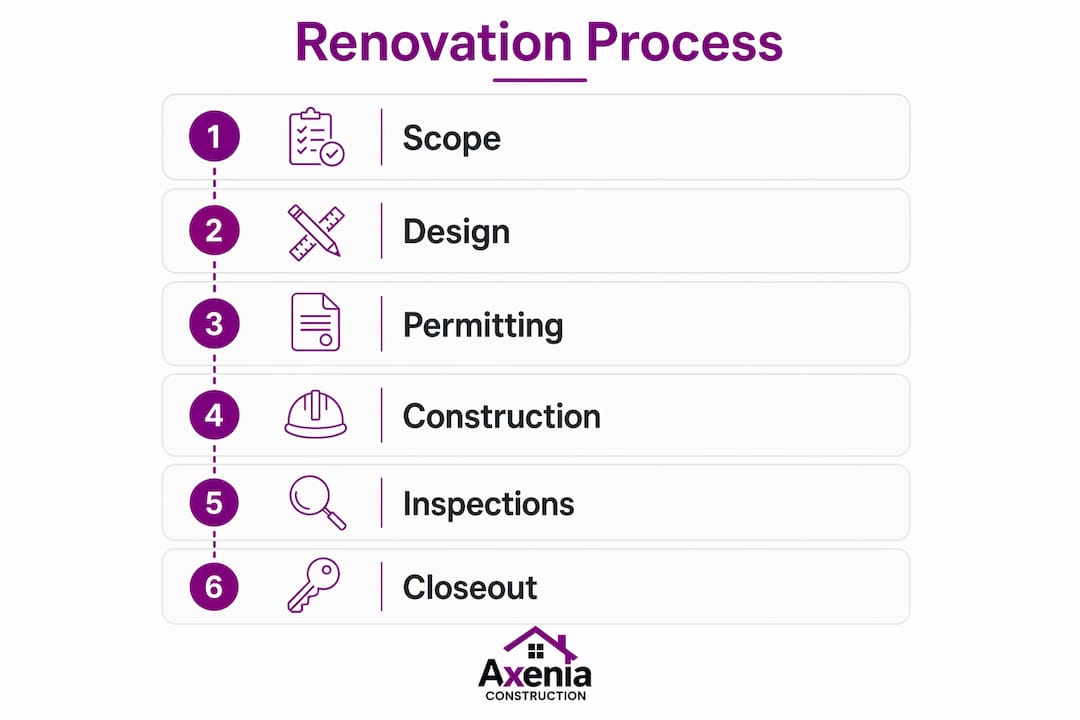
The commercial renovation process is managed as a sequence of six defined phases: goal setting, design, permitting, construction, inspections, and handover. Each phase has specific deliverables, and skipping or rushing one creates problems in the next. Here is what each phase actually involves.
Phase 1: Scope Definition and Goal Setting
This is where you define what the project must accomplish. You set your budget, identify functional requirements, and document any constraints such as lease terms, operational hours, or tenant agreements. Locking your scope early is the single most powerful thing you can do. Early scope decisions prevent surprises and delays that compound through every downstream phase.
Phase 2: Design Development
Your design team produces architectural drawings, MEP (mechanical, electrical, and plumbing) plans, and structural documents. These drawings are not just blueprints. They are the legal documents your permit applications depend on. A related concept worth knowing here is Tenant Improvement (TI), the industry term for renovations that customize a leased commercial space. Understanding the difference between a commercial build-out and a full renovation helps you scope the right level of design work from the start.

Phase 3: Permitting
Permit applications go to your local building authority along with your design documents and fee payments. Reviews often proceed in parallel across departments to reduce overall approval time. For example, the City of Spokane routes plans simultaneously to multiple departments after payment, enabling concurrent review. That parallel approach can cut weeks off your schedule if your documents are complete and accurate.
Phase 4: Construction
Construction sequencing follows a standard order: site preparation, demolition, framing, MEP rough-in, insulation, drywall, finishes such as ceilings and flooring, and then the punch list. Deviating from this sequence without a clear reason creates rework. MEP work, for instance, must be inspected before walls close, so scheduling those inspections at the right moment is not optional.
Phase 5: Inspections
Construction inspection programs include multiple milestone checks, covering rough framing, MEP systems, fire and life safety, and the final walkthrough, rather than a single final inspection. Each milestone is tied to the issuance of a Certificate of Occupancy (CO) or a temporary CO. Missing an inspection window can stall the entire project.
Phase 6: Handover and Closeout
The project closes with a complete documentation package: as-built drawings, equipment warranties, maintenance manuals, and permit closeout records. Your CO is issued only after authorities confirm all inspections passed and documentation is in order.
Pro Tip: Schedule your first permitting pre-application meeting before design is complete. Many jurisdictions offer this at no cost, and it surfaces code issues while changes are still cheap.
How do permitting and compliance shape your renovation timeline?
Permitting is the phase most property owners underestimate, and it is the one most likely to delay your project. Structural changes, MEP modifications, and fire safety upgrades all require permits. That means your design documents must be complete and code-compliant before you submit, not after.
The multi-department review process adds complexity. Building, fire, zoning, and sometimes health departments each review your plans independently. Fees are paid at submission, and review timelines vary by jurisdiction, project size, and current workload. Some cities process commercial permits in two weeks; others take three months.
Renovations can also trigger compliance upgrades beyond the area you are actually altering. Under many building codes, including Florida’s, ADA path-of-travel upgrades may be required when renovation costs exceed a defined threshold relative to the building’s market value. That means a targeted office refresh could require accessible restroom upgrades in a different part of the building entirely.
Key permitting realities every property owner should know:
- Scope lock matters. Changing your design after permit submission triggers a resubmittal, resets review timelines, and often generates additional fees.
- Fire protection reviews are separate. Tenant Improvement projects often require a distinct fire alarm review that runs on its own schedule and affects your construction start date.
- Closeout documentation is non-negotiable. Permit closeout packages must include as-built drawings and certifications. Missing items delay your CO and your ability to legally occupy the space.
- Floodplain and substantial improvement rules apply. If your renovation cost exceeds 50% of the building’s market value, floodplain regulations may require the entire structure to be brought into current compliance.
“Treating the permit process as a formality is the most expensive mistake a property owner can make. It is a regulatory review with real consequences for your schedule and your budget.”
How do you keep your business running during a commercial renovation?
Maintaining business continuity during a commercial remodeling process requires a phasing plan built before construction starts. A phasing plan divides the project into sequential work zones, so construction progresses through one area while the rest of the building stays operational. Effective phasing balances operational continuity with construction progress, minimizing disruption to tenants, employees, and customers.
Here are the practical strategies that work:
- Zone the work. Divide your space into construction zones and operational zones. Rotate construction through zones in a sequence that keeps at least part of the building accessible at all times.
- Use temporary barriers. Dust walls, hoarding panels, and temporary partitions protect occupants from construction debris, noise, and safety hazards. These are not optional on active-occupancy projects.
- Schedule noisy or disruptive work off-hours. Demolition, concrete cutting, and MEP rough-in generate significant noise and dust. Schedule these activities during evenings or weekends when foot traffic is lowest.
- Communicate proactively. Weekly updates to tenants, employees, and customers about upcoming work, access changes, and expected noise levels reduce complaints and build trust. Silence creates anxiety.
- Align inspection scheduling with operations. Inspections require the construction area to be accessible and clear. Coordinate with your contractor to schedule inspections during windows that do not disrupt peak business hours.
Pro Tip: Build a two-week buffer into your phasing plan for each zone. Inspections, material deliveries, and subcontractor schedules rarely align perfectly, and that buffer prevents one delay from cascading into the next zone.
What is commissioning and why does it matter?
Commissioning (abbreviated Cx) is the structured process of testing, verifying, and documenting that all building systems perform as designed after construction is complete. It is not a final walkthrough. It is a disciplined verification program that catches problems before they become the building owner’s permanent responsibility.
A commissioning plan covers four sequential steps:
- Pre-functional testing. Individual components such as air handlers, electrical panels, and plumbing fixtures are checked before system-level testing begins.
- Functional performance testing. Systems are tested under actual operating conditions. HVAC is run through heating and cooling cycles. Lighting controls are tested for proper sequencing. Fire suppression systems are activated and verified.
- Documentation and training. All test results are recorded. Operations and maintenance staff receive training on system controls and maintenance requirements.
- Post-occupancy review. Commissioning plans are updated throughout the project and become part of the final closeout records. Post-occupancy warranty reviews can extend up to 10 months after handover.
Commissioning matters because systems that pass individual inspections can still fail when integrated. An HVAC unit may work in isolation but create pressure imbalances when connected to the full duct network. A fire alarm panel may test correctly but fail to communicate with the suppression system. Commissioning catches these integration failures before occupancy. For property owners, it also creates a documented baseline for future maintenance and warranty claims. Hiring an experienced general contractor who coordinates commissioning alongside construction closeout protects your investment long after the crew leaves.
Key takeaways
The commercial renovation process succeeds when scope is locked early, permits are treated as a critical path item, and commissioning is built into the closeout plan from the start.
| Point | Details |
|---|---|
| Six defined phases | Every commercial renovation follows goal setting, design, permitting, construction, inspections, and handover in sequence. |
| Scope lock prevents cost overruns | Changing design after permit submission triggers resubmittals, resets timelines, and adds fees. |
| Parallel permit reviews save time | Routing plans to multiple departments simultaneously reduces approval time when documents are complete. |
| Phasing plans protect operations | Dividing work into zones keeps your business running while construction progresses through the space. |
| Commissioning protects your investment | Functional testing and documentation before occupancy catches integration failures and creates a maintenance baseline. |
What i’ve learned after years of commercial renovation projects
The property owners who have the smoothest renovations share one habit: they treat the planning phase as the most expensive phase, even though no construction is happening yet. Every hour spent resolving a design conflict or a code question before permit submission saves days of rework in the field.
The owners who struggle almost always made the same mistake. They approved a design, submitted for permits, and then changed their minds about the layout or the MEP configuration. That triggers a resubmittal. The review clock resets. The contractor’s schedule shifts. Subcontractors reschedule. What looked like a minor revision costs three to six weeks and real money.
The other pattern I see consistently is the assumption that inspections happen once, at the end. In reality, multiple milestone inspections occur throughout construction, and each one is a gate. Miss the rough MEP inspection window, and you cannot close the walls. Miss the framing inspection, and you cannot install insulation. These are not bureaucratic inconveniences. They are the checkpoints that protect you legally and financially.
My honest advice: hire your design and construction partners before you finalize your budget, not after. The right team will tell you what the project actually costs and what the permit timeline actually looks like in your jurisdiction. That information changes your plan. Getting it early means you make decisions with accurate data. Getting it late means you make decisions under pressure.
— Arienne
Ready to start your commercial renovation? Axeniaconstruction can help.
Axeniaconstruction is a licensed, women-owned general contractor based in Rockville, MD, specializing in commercial renovations, tenant build-outs, and government projects. We manage every phase of the commercial remodeling process, from initial scope definition and design coordination through permitting, phased construction, and final commissioning. Our team brings transparency and genuine collaboration to every project, so you always know where your renovation stands.
Whether you are updating an office, reconfiguring a retail space, or completing a full interior overhaul, we are here to guide you through every step. Explore our commercial construction services or contact Axeniaconstruction directly to discuss your project goals and timeline.
FAQ
What does the commercial renovation process include?
The commercial renovation process includes six phases: scope definition, design development, permitting, construction, inspections, and final handover. Each phase produces specific deliverables required to advance to the next stage.
How long does a commercial renovation take?
Timeline depends on project size, permit review speed, and construction complexity. Small tenant improvements may take 8–16 weeks, while full-floor renovations with complex MEP work can run 6–12 months.
What permits are required for a commercial renovation?
Most structural, MEP, and fire safety work requires building permits. Depending on your jurisdiction and project scope, separate fire protection, zoning, and health department reviews may also apply.
What is commissioning in a commercial renovation?
Commissioning is a structured testing and documentation process that verifies all building systems perform as designed before occupancy. It includes functional performance testing, staff training, and a post-occupancy warranty review that can extend up to 10 months.
How do you renovate a commercial space without closing the business?
A phasing plan divides the project into sequential work zones, keeping part of the building operational throughout construction. Temporary barriers, off-hours scheduling for disruptive work, and proactive communication with occupants are the core tools for maintaining business continuity.