
Before you contact a single lender, secure a lender-ready, itemized contractor bid and a clearly scoped as-completed plan. That one document drives your loan amount, your appraisal, and your approval odds more than your credit score alone.
Here is what lenders will expect from day one:
- A signed, line-item bid from a licensed, insured general contractor
- A project timeline with start and completion dates
- A contingency reserve (a lender-required percentage of project cost)
- Basic financial documents: pay stubs, tax returns, bank statements, mortgage statement (common lender requirements)
- Proof of homeowners insurance (if applicable) and current title status
Table of Contents
- Your home renovation loan application guide: the full document checklist
- Which renovation loan fits your project?
- How to get contractor bids lenders and appraisers will accept
- What is an as-completed appraisal and how does it affect your loan?
- How the lender-controlled draw process works
- Typical timelines, fees, and contingency budgets to plan for
- How to choose your contractor and lender before signing anything
- Key Takeaways
- What most homeowners get wrong about renovation loans
- Axeniaconstruction makes lender-ready bids straightforward
- Useful sources
Your home renovation loan application guide: the full document checklist
Assembling a complete packet before your first lender call prevents underwriting delays and positions you as a serious borrower. Organize your documents into three groups.
Financial documents:
- Federal tax returns and W-2s covering recent years
- Recent pay stubs and bank statements
- Current mortgage statement and payoff balance (if applicable)
- Proof of homeowners insurance (if applicable)
Property documents:
- Recent appraisal (if available)
- Title report or title insurance commitment (as provided)
- Permit history for the property
- HOA approval letter (if applicable)
Contractor packet:
- State/local contractor license number and verification
- Certificate of insurance (COI) showing contractor coverage
- Notarized, line-item bid with separate labor and material costs by trade
- Subcontractor list with license and insurance info
- Proposed draw schedule and project timeline
- Permit plan identifying which trades require permits
Pro Tip: The lender orders the as-completed appraisal, but you pay for it upfront, typically at closing or before. Budget for draw inspection fees as well — these are charged per inspection visit and can often be financed into the loan, but they still affect your total project cost.
Which renovation loan fits your project?
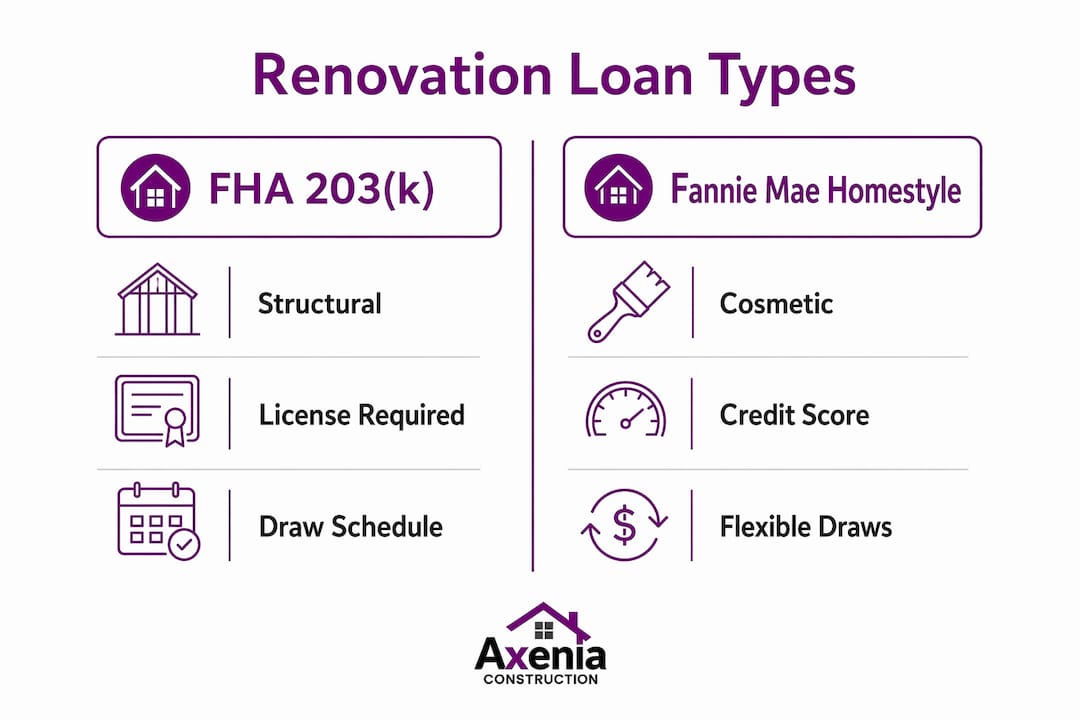
Matching your loan type to your project size and credit profile is the first real decision in the renovation financing process. Each program has distinct lender requirements and contractor expectations.
| Loan Type | Best For | Key Lender Requirement | Draw Mechanics |
|---|---|---|---|
| FHA 203(k) Standard | Structural work, major rehabs, buyers with lower down payments | HUD consultant required | Multiple draws; HUD consultant oversees |
| FHA 203(k) Limited | Non-structural repairs under program cap | — | Fewer draws; no HUD consultant |
| Fannie Mae HomeStyle | Large value-adding projects, purchase or refinance | Licensed contractor required; as-completed appraisal required | Up to 5 draws; contingency reserves often required |
| HELOC | Phased or ongoing projects with existing equity | Varies by lender; equity-based | Revolving draws as needed |
| Home Equity Loan | Single large payment, fixed scope | Varies by lender; equity-based | Lump sum |
| Cash-Out Refinance | Homeowners with significant equity | Min. 20% equity typically required | Lump sum at closing |
| Personal Loan | Small, fast projects | Credit and income based; no collateral | Lump sum; no draw process |
| Construction-to-Perm | Major additions or near-total rebuilds | Licensed GC required; detailed plans | Phased construction draws |
Government-backed loans like the FHA 203(k) and Fannie Mae HomeStyle suit large-scale projects and buyers with limited cash, but they add paperwork and stricter project management compared with HELOCs or personal loans. The HomeStyle loan can be used for purchase or refinance. It is sized on the as-completed value, with renovation costs limited to 75% of the expected finished value.
Key constraints to keep in mind:
- FHA 203(k) Standard requires a HUD consultant, which adds fees and an oversight layer
- HomeStyle requires work to be completed within 15 months of closing
- Personal loans are unsecured and carry higher rates, but generally have no draw process or inspection requirements
How to get contractor bids lenders and appraisers will accept
Lenders scrutinize the contractor packet closely. Vague quotes are one of the most common underwriting rejection triggers. A bid that says “kitchen remodel: $45,000” tells an appraiser nothing and gives a lender no basis for a draw schedule.
A lender-ready bid should include:
- Trade-by-trade labor costs: Framing, electrical, plumbing, HVAC, tile, finish carpentry listed separately
- Material allowances with unit costs: Cabinets, countertops, fixtures with specified allowance amounts
- Permit fees: Listed as a line item, not buried in overhead
- Contingency line: Stated as a percentage (10%–20%) with a brief explanation of scope uncertainty
- Change-order language: How scope changes are priced and approved
To vet a licensed general contractor before submitting the packet, confirm the license through your state’s contractor licensing board, verify the COI directly with the insurer, and ask specifically whether the contractor has completed lender-backed projects before. A contractor familiar with draw schedules and independent inspections will save you weeks of coordination. Our guide to the general contractor’s role explains what to expect from a GC throughout the permit and inspection process.
Pro Tip: Ask your contractor for a sample lien waiver and confirm they will provide conditional and unconditional lien waivers at each draw. Missing lien waivers are one of the top causes of draw delays.

What is an as-completed appraisal and how does it affect your loan?
The as-completed appraisal is the lender’s estimate of your home’s market value after all planned renovations are finished. Lenders base the maximum loan amount on that projected value, not on today’s value. If the appraisal comes in lower than expected, you must cover the shortfall out of pocket, reduce the project scope, or renegotiate pricing with your contractor.
Detailed bids feed directly into the appraiser’s work. The appraiser uses your scope of work, material specifications, and comparable sales of similarly upgraded homes in your neighborhood to arrive at a finished value. Vague allowances (“flooring TBD”) give the appraiser nothing concrete to work with.
Common appraisal pitfalls:
- Over-improving for the neighborhood (a $150,000 kitchen in a $300,000 market rarely appraises at full cost)
- Allowance items without specifications
- Planned work that requires permits not yet pulled
Pro Tip: Before the appraisal is ordered, pull recent sales of renovated comparable homes in your area and share them with your lender. This context helps the appraiser find the right comps and reduces the chance of a low value.
How the lender-controlled draw process works
Renovation funds go into a lender-controlled escrow account and are released only after independent inspections verify that milestone work is complete. This is not a lump-sum disbursement. The draw process adds time to every payment cycle, and your contractor must plan cash flow accordingly.
Typical draw sequence:
- Loan closes; renovation funds are placed in escrow
- Contractor mobilizes and completes the first phase of work
- Contractor submits a draw request with invoices and receipts
- Lender sends an independent inspector to verify milestone completion
- Inspector approves; lender authorizes payment from escrow
- Process repeats for each phase
- Final draw released after occupancy permit and lien waiver clearance
For each draw, expect to provide: a contractor draw request form, supporting invoices, an independent inspector’s report, and updated lien waivers from all subcontractors. Lenders typically hold back a percentage of the final draw (often 10%) until the project receives a certificate of completion or occupancy permit.
Pro Tip: Build the draw schedule directly into the construction contract. Specify which milestones trigger each draw request so your contractor and the lender’s inspector are aligned from day one.
Typical timelines, fees, and contingency budgets to plan for
| Phase | Typical Duration |
|---|---|
| Pre-approval and lender selection | 1–2 weeks |
| Appraisal and underwriting | 2–4 weeks |
| Loan closing | 1–2 weeks |
| Contractor mobilization | 1–2 weeks |
| Construction and phased draws | Varies by scope |
| Final inspection and close-out | 1–3 weeks |
Fees to budget for beyond your loan amount:
- Appraisal fee (as-completed): amounts vary by location and property type
- HUD consultant fee (FHA 203(k) Standard): varies; financeable but adds to project cost
- Per-draw inspection fees: charged each time an inspector visits; financeable into the loan but still increase total cost
- Permit fees: project-specific; listed in the contractor bid
- Contingency holdback: lenders commonly require a percentage reserve for older homes or projects with structural uncertainty
For a realistic view of phase durations by project type, the renovation timeline examples we publish walk through common scopes from bathroom updates to full additions.
Pro Tip: Lender draw processing typically takes about one to two weeks per cycle. Your contractor needs to plan for that float. Discuss payment timing before signing the contract so there are no cash-flow surprises mid-project.
How to choose your contractor and lender before signing anything
A contractor who has never worked with a renovation loan draw schedule will slow your project. A lender unfamiliar with HomeStyle or 203(k) products will slow your approval. Both choices matter equally.
Questions to ask your contractor:
- Have you completed projects financed through FHA 203(k) or Fannie Mae HomeStyle loans?
- Do you provide line-item bids with separate labor and material costs by trade?
- Will you submit draw requests with supporting invoices and accept independent inspector visits?
- Do you provide conditional and unconditional lien waivers at each draw?
- Can you provide references from lender-backed projects?
Questions to ask your lender:
- Do you offer FHA 203(k) and Fannie Mae HomeStyle products in-house?
- What is your typical draw processing time from request to payment?
- Do you have a preferred inspector network, and what are the per-draw fees?
- How do you handle change orders mid-project?
Red flags that should pause the transaction: a contractor who cannot provide a line-item bid, a contractor without verifiable insurance, a lender who has never processed a renovation loan product, or any party who discourages you from pulling permits.
Pro Tip: Prequalify with at least two or three lenders before committing. Rates, draw timelines, and appetite for change orders vary significantly, and the lender’s renovation experience affects your project schedule as much as their rate.
Key Takeaways
A lender-ready, itemized contractor bid is the single document that most directly determines your loan amount, your appraisal outcome, and your draw schedule — get it right before anything else.
| Point | Details |
|---|---|
| Contractor bid is the foundation | A line-item bid with trade-by-trade labor and material costs drives the as-completed appraisal and the draw schedule. |
| As-completed appraisal sets your limit | Lenders size the loan on projected finished value; a low appraisal forces cash out of pocket or a reduced scope. |
| Draw process adds time | Funds release only after independent inspections verify milestone completion, adding 5–10 business days per draw cycle. |
| Vet both contractor and lender | Choose a GC with draw-schedule experience and a lender with proven renovation loan products to avoid costly delays. |
| Axeniaconstruction prepares lender-ready packets | Axeniaconstruction provides itemized bids, permit coordination, and draw-ready documentation for homeowners in the DC, MD, and VA area. |
What most homeowners get wrong about renovation loans
The biggest misconception we see is that a renovation loan is just a bigger personal loan with a few extra steps. It is not. It is a lender-managed construction project with escrow controls, inspection gates, and appraisal dependencies that most homeowners have never navigated before.
The second mistake is treating the contractor bid as a formality. Homeowners often bring a rough estimate to a lender meeting, get a conditional approval, and then discover during underwriting that the vague bid cannot support the appraisal. The project stalls, the contractor reprices, and the timeline collapses. We have seen this pattern delay closings by six to eight weeks.
What actually works is sequencing the process correctly: get the detailed bid first, use it to anchor the as-completed appraisal, then approach lenders with a complete packet. Lenders respond to preparation. A borrower who walks in with a notarized, line-item bid, a licensed contractor’s COI, and a proposed draw schedule signals that the project is real and manageable. That signal matters in underwriting.
Axeniaconstruction’s project planning resources and contract review guides are built specifically to help homeowners produce the documentation lenders expect, before the first lender call.
Axeniaconstruction makes lender-ready bids straightforward
Producing a bid packet that satisfies underwriting, supports an appraisal, and coordinates with a draw schedule is exactly what Axeniaconstruction does for homeowners and property owners in the DC, Maryland, and Virginia area. As a licensed, women-owned general contractor based in Rockville, MD, we prepare line-item bids, manage permit applications, coordinate lender inspections, and handle lien-waiver documentation at every draw.
If you are preparing a renovation loan application and need a contractor who understands the lender’s requirements from day one, we are ready to help. Visit our home renovations service page or our general contracting page to learn more about how we work, and contact us to request a bid packet for your project.
Useful sources
- How to Apply for a Renovation Loan: Step by Step (LegalClarity) — covers the draw process, escrow mechanics, and fee structures for renovation loans
- Consumer Guide: Financing a Renovation When You Buy (NAR) — explains FHA 203(k) and HomeStyle program differences, equity considerations, and program selection
- HomeStyle Renovation Loan: The Complete Guide (JVM Lending) — details as-completed appraisal mechanics, draw counts, and appraisal shortfall risks
- HomeStyle Renovation (Fannie Mae) — official program guidelines including draw limits, contingency rules, and completion timelines
- How To Pay For Home Improvements (Bankrate) — practical cost ranges and financing comparisons across loan types
- Mortgages and Loans for Home Renovations (Bankrate) — overview of renovation loan types, credit requirements, and equity considerations
- Home Renovation Loans: Contractor Packet Guidance (Truss Financial Group) — explains what lenders require in contractor documentation and why vague bids trigger rejections
- Home Renovation Project Planning Guide (Axeniaconstruction) — step-by-step planning templates and lender-ready scope guidance for homeowners