
Get at least three written, itemized bids and compare them line-by-line before you make any hiring decision. That single discipline separates homeowners who finish renovations on budget from those who absorb a cascade of change orders they never saw coming. Consumer-protection guidance echoes this standard: two bids produce a coin-flip result; three reveal a pricing pattern and expose outliers. The moment you have all three in hand, your first session reviewing them should look like this:
- Save every bid as a PDF and name each file with the contractor’s name and date.
- Write a one-paragraph baseline scope that every bidder priced against, noting any deviations you noticed.
- Open a spreadsheet and create three columns, one per contractor, with rows for every major line item.
- Flag any bid that omits a deposit amount, skips permit language, or requests an unusually high upfront payment.
Those four steps cost you less than an hour and protect you from the most common and expensive mistake in renovation hiring: choosing a number without understanding what it actually includes.
Table of Contents
- How many contractor estimates should you collect?
- What to look for inside each bid
- How to level bids side-by-side using a spreadsheet
- Understanding contract and pricing types before you sign
- Red flags that should pause your hiring decision
- Follow-up questions and verification steps before you sign
- Realistic cost and timeline expectations for renovation projects
- How to make a final decision using a value-based scoring approach
- Key Takeaways
- What bids actually reveal: a contractor’s perspective
- Axeniaconstruction makes bid comparison and project planning clearer
- Authoritative sources for verifying credentials and consumer guidance
How many contractor estimates should you collect?
Three written bids is the floor, not a suggestion. With only two estimates, you have no reference point for what a fair price looks like. A third bid gives you a pattern: if two contractors have similar prices and the third is dramatically lower, that gap almost always points to a scope omission or an unrealistic allowance, not superior efficiency.
When to go beyond three:
- Complex or multi-trade projects (full kitchen gut, whole-home renovation, structural changes) benefit from four or five bids because the scope variables multiply.
- Specialty trades like HVAC, electrical panel upgrades, or custom millwork warrant separate sub-bids even when a general contractor is managing the project.
- Wide variation that persists after you normalize for scope is a signal to collect one more bid and recheck your baseline scope document.
Before you schedule any site visits, write a baseline scope document that every contractor prices against. Include drawings or sketches, appliance model numbers if relevant, finish grades (builder, mid-grade, or premium), and any site-access constraints. Contractors who price the same document produce bids that are actually comparable. Those who price their own assumptions produce bids that look different for reasons that have nothing to do with price.
Pro Tip: Send each contractor the same PDF scope document by email so you have a paper trail confirming they all priced the same work. That email thread becomes your first line of defense if a contractor later claims the scope was different.

What to look for inside each bid
A professional bid is a technical document, not a sales brochure. Read it that way. The line-item structure tells you far more than the bottom line.

Line items and specificity
Every major task should show labor and materials separately, with quantities attached. A vague line like “demo and haul-away” hides cost differences. A specific line reads: “Demo of existing 150 sq ft kitchen, dumpster rental, disposal fees — $1,850.” That level of specificity converts an unclear entry into something you can actually compare across bids.
Check for:
- Labor vs. materials split on every major trade (framing, tile, plumbing, electrical)
- Quantities in measurable units (sq ft, linear ft, number of fixtures)
- Brand or grade callouts for materials (e.g., “Kohler Memoirs toilet” vs. “toilet allowance — $300”)
- Unit rates where applicable, so you can convert and compare
Administrative and contract items
Before you read a single dollar amount, confirm these are present:
- Contractor’s license number (verify it independently at your state licensing board)
- Certificate of insurance listing general liability and workers’ compensation
- Payment schedule tied to project milestones, not arbitrary dates
- Deposit amount and percentage
- Warranty terms for both labor and materials
- Who pulls permits and whether permit fees are included
- Subcontractor names or disclosure that subs will be used
Permit handling is one of the most commonly mishandled items in renovation bids. Some contractors include permit fees and pull all permits themselves; others exclude fees or expect you to pull them. Unpermitted work can jeopardize your homeowner’s insurance and complicate resale. Confirm this in writing before you sign anything.
Inclusions, exclusions, and allowances
The exclusions list is where risk hides. A bid with no explicit exclusions section is not a clean bid; it is an ambiguous one. Force every contractor to list what is not included. Common traps include “as needed” or “if required” language attached to tasks like waterproofing, subfloor repair, or mold remediation. Those phrases shift the cost of surprises entirely to you.
Allowances are normal in renovation bids, but they can be used to make a quote look artificially low. An allowance set well below market is one of the most reliable sources of later change orders. If a bid shows a $200 tile allowance for a master bath, ask the contractor what a realistic tile selection at that budget actually looks like. Get the answer in writing.
Pro Tip: Ask each contractor to send you a written list of every item explicitly excluded from their bid. If they resist, that resistance tells you something important about how they handle accountability.
How to level bids side-by-side using a spreadsheet
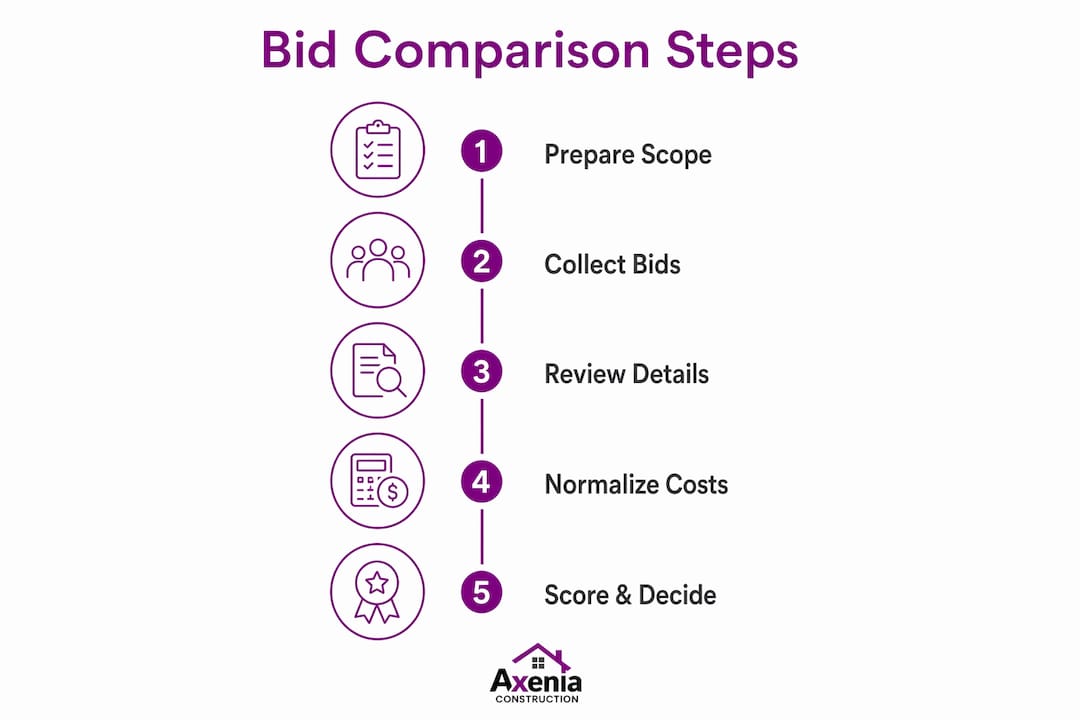
Comparing renovation contractor bids by total price alone is a reliable way to make the wrong decision. The right method is bid leveling: building a master checklist of every task, mapping each bid to that checklist, and adding realistic costs for anything a contractor left out.
Step-by-step workflow
- Build the master task list. Pull every line item from all three bids and combine them into one master list. Items that appear in every bid form your baseline. Items that appear in only one or two bids are your comparison gaps.
- Map each bid to the master list. For every row, mark whether each contractor included the item and at what price. Use “included,” “excluded,” or “allowance” as status labels.
- Price the gaps. For any item a contractor excluded, add a realistic market estimate to their total. Common omissions that add thousands include dumpster rental, final cleaning, permit fees, cabinet hardware, and backsplash installation.
- Convert lump sums to unit rates. Divide any lump-sum line by its quantity to get a $/sq ft, $/linear ft, or $/fixture rate. This unit-rate conversion reveals whether price differences come from labor, materials, or margin.
- Calculate normalized totals. Add the gap-fill estimates to each contractor’s raw total. Now you are comparing real costs, not optimistic summaries.
Pro Tip: If one contractor’s bid is dramatically more detailed than the others, send that format to the other two and ask them to reissue their proposals aligned to the same structure. Most professional contractors will do this without complaint.
Bid comparison template
| Comparison dimension | Contractor A | Contractor B | Contractor C |
|---|---|---|---|
| Scope completeness / exclusions | Full scope, 3 exclusions listed | Missing demo, no exclusions | Full scope, 5 exclusions listed |
| Materials and allowances | Mid-grade, brand callouts | Allowances only, below market | Premium grade, itemized |
| Labor vs. materials breakdown | Separated by trade | Lump sum only | Separated by trade |
| Timeline and milestone dates | —, 4 milestones | “— to 10 weeks, TBD” | —, 5 milestones |
| Contract type and payment schedule | Fixed price, 4 milestone payments | Cost-plus, 50% upfront | Fixed price, 3 milestone payments |
| Permits, insurance, and warranties | Included, 2-year labor warranty | Excluded, warranty included | Included, 1-year labor warranty |
| Change order policy | Written, signed before work | Verbal approval accepted | Written, signed before work |
The normalized total column is the one that matters. Large price divergences between bids commonly trace back to scope gaps and omitted services rather than genuine efficiency differences.
Understanding contract and pricing types before you sign
The pricing model in a bid determines who absorbs cost surprises. Recognizing the model early changes how you read every number in the document.
- Fixed-price (lump-sum): One total for a defined scope. The contractor absorbs cost overruns within that scope; you pay for changes via written change orders. Best for well-defined projects with complete drawings.
- Cost-plus: You pay actual costs plus a contractor fee (typically a percentage or fixed markup). Flexible for projects where scope is still evolving, but your final cost is not known at signing. Ask for a guaranteed maximum price clause.
- Unit pricing: Priced per measurable unit (per sq ft of tile, per linear ft of trim). Common in flooring and painting. Easy to compare across bids; watch for different unit definitions.
- Allowances and provisional sums: Placeholders for items not yet selected (fixtures, tile, appliances). Normal in early-stage bids, but allowances set below market are a common low-ball tactic.
Payment schedules should tie to milestones, not calendar dates. A reasonable structure for a mid-size renovation might look like: 10% at contract signing, 25% at demolition complete, 25% at rough-in inspections passed, 25% at substantial completion, and 15% at final walkthrough and punch-list close. Many states cap initial deposits by statute; for example, California’s Contractors State License Board limits deposits to a small percentage of the contract price or a fixed amount, whichever is less, for home improvement contracts. Check your state’s rules before agreeing to any deposit.
Pro Tip: Avoid paying a large upfront deposit on any residential renovation. Excessively high upfront requests may indicate contractor cash-flow problems that could affect your project.
Red flags that should pause your hiring decision
Some warning signs in a bid are immediate stops. Others warrant a clarifying conversation. Know the difference before you dismiss a contractor or, worse, sign with one you should not.
High-priority red flags (stop and verify)
- A one-line total with no breakdown. A verbal or single-line price is not a bid; it is an opening position.
- No license number or an unverifiable one. Check your state licensing board directly.
- Missing certificate of insurance. Call the insurer to confirm the policy is active.
- Deposit request exceeding 50% of the contract, or a cash-only payment requirement.
- Long exclusions lists with no pricing for the excluded items, or no exclusions list at all.
- “As needed” or “if required” clauses attached to tasks that are predictably necessary (subfloor leveling, waterproofing, electrical upgrades to code).
Medium-priority red flags (ask before deciding)
- Allowances that are obviously below current market prices for the specified finish level.
- Vague timelines with no milestone dates or a “start date TBD” after contract signing.
- References listed but no contact information provided, or references who cannot be reached.
- Refusal to name subcontractors or disclose that subs will be used on the project.
Before you sign any contract, run this quick verification sequence: Call the contractor’s insurer to confirm general liability and workers’ comp are active. Look up the license number on your state’s contractor licensing portal. Call at least two references and ask specifically about how the contractor handled unexpected costs and schedule changes. Request a written list of all subcontractors and their license numbers. Any contractor who objects to these steps is telling you something important.
When you spot a high-priority red flag, do not negotiate around it. Request written clarification. If the contractor refuses to put the clarification in writing, treat that refusal as a disqualifying signal and contact your state’s consumer-protection office or the Better Business Bureau if you need to escalate.
Follow-up questions and verification steps before you sign
The site visit and bid review are not the end of your due diligence. A short verification sequence before you sign protects you from the most common post-contract disputes.
Verification checklist
- Confirm the license number is active and in good standing at your state licensing board.
- Request a certificate of insurance naming you as an additional insured for the project duration.
- Call at least two references; ask specifically how the contractor handled change orders and schedule delays.
- Confirm in writing who pulls which permits and whether permit fees are included in the bid total.
- Verify warranty terms: what is covered, for how long, and what the claims process looks like.
Documents to require before any payment
- A signed contract with the full scope of work attached as an exhibit.
- A written change-order process specifying that no additional work begins without a signed, priced change order.
- A milestone-based payment schedule matching the contract.
- Certificates of insurance for the contractor and any named subcontractors.
Use these short, direct questions during follow-up calls or emails:
- “Please confirm in writing which permits you will pull and whether permit fees are included in your bid total.”
- “Can you send me a written list of every item explicitly excluded from your scope?”
- “What is your process for pricing and approving change orders before work begins?”
- “Who are the subcontractors you plan to use, and can you provide their license numbers?”
Pro Tip: Send every clarifying question by email, not phone. Written responses become part of your project record and can be referenced if a dispute arises later. A contractor who insists on verbal-only answers is creating ambiguity that will cost you money.
If a contractor refuses to provide any of these items in writing, contact your state attorney general’s consumer-protection division or the Better Business Bureau for guidance on next steps.
Realistic cost and timeline expectations for renovation projects
Cost ranges for renovation projects vary widely based on scope, materials, structural complexity, and local labor markets. Understanding the key drivers helps you evaluate whether a bid is in a reasonable range without relying on a single national figure.
What drives cost variability
- Layout changes: Moving walls, plumbing, or electrical panels adds structural and permitting costs that can double a simple cosmetic renovation budget.
- Material grade: The difference between builder-grade and premium finishes on a kitchen remodel can represent a significant portion of the total project cost.
- Structural conditions: Older homes frequently reveal subfloor damage, outdated wiring, or inadequate insulation once demolition begins.
- Contractor markup: Normal markup ranges vary but typically apply to materials and subcontractor costs, with general contractor total project markups being a substantial percentage of the project cost.
Timeline expectations and schedule risk
Minor bathroom refreshes may take a few weeks, full kitchen gut-and-rebuilds several weeks to a few months, and whole-home renovations often take multiple months depending on complexity, permits, and structural issues. Review typical renovation milestone sequences to test whether a contractor’s proposed schedule is realistic for your project type.
Timeline differences affect cost in two ways. A compressed schedule may carry a premium for overtime labor or expedited material delivery. A vague or extended timeline increases the risk of subcontractor scheduling gaps, which can stall a project for weeks.
Pro Tip: Build a contingency budget to cover unforeseen conditions, varying based on project complexity and structural work involved. Ask each contractor how they handle unforeseen conditions in writing before you sign.
| Project type | Typical timeline | Key cost drivers |
|---|---|---|
| Minor bath refresh | 2–3 weeks | Fixtures, tile, labor |
| Full kitchen remodel | — to 10 weeks | Cabinetry, appliances, layout changes |
| Master bath gut | 4+ weeks | Plumbing relocation, tile, waterproofing |
| Whole-home renovation | 4+ months | Structural, permits, multi-trade coordination |
How to make a final decision using a value-based scoring approach
Once your bids are normalized, the decision is not purely mathematical. A contractor who scores well on price but poorly on communication and references is a risk, even at a lower number. A simple scoring matrix keeps the decision defensible and grounded in the factors that actually predict project success.
Weighted scoring criteria
| Criterion | Weight | What to evaluate |
|---|---|---|
| Normalized price | — | Total after gap-fill, not raw bid |
| Scope completeness | — | Exclusions list, specificity of line items |
| Timeline confidence | 15% | Milestone dates, schedule logic |
| References and warranty | 15% | Reference quality, warranty length and terms |
| Communication and clarity | 10% | Response time, willingness to put things in writing |
| Payment terms | 10% | Milestone structure, deposit percentage |
Score each contractor 1–5 on every criterion, multiply by the weight, and sum the results. A contractor scoring above 4.0 on a weighted basis is generally a strong hire. A score below 3.0 warrants either negotiation on specific terms or rejection.
When the lowest normalized price is the right choice
Choose the lowest normalized bid when: the scope is complete and specific, the contractor’s references are strong, the payment schedule is milestone-based, and the warranty terms are comparable to the other bids. A lower price with full scope coverage is genuine value.
When to choose a higher-priced bid
A higher bid is often the better choice when it includes a more detailed change-order process, a longer warranty, a more experienced team for your specific project type, or a contractor whose references consistently describe on-budget, on-schedule delivery. The goal of comparing bids is clarity on accountability and risk, not just the lowest number.
After choosing, take these steps immediately:
- Request the final contract with the full scope attached as an exhibit.
- Confirm the permit plan in writing before the start date.
- Schedule a pre-construction meeting to walk the site and align on milestone dates.
- Set up a shared communication channel (email thread or project management app) for all project correspondence.
Key Takeaways
Normalizing bids line-by-line, not comparing raw totals, is the single most important discipline in choosing a renovation contractor.
| Point | Details |
|---|---|
| Get three written bids minimum | Two bids produce a coin-flip result; three reveal a pricing pattern and expose outliers. |
| Normalize before you compare | Add realistic costs for excluded items to every bid before comparing totals. |
| Watch exclusions and deposit terms | Missing exclusions and deposits above — these are the two most reliable risk signals in any bid. |
| Verify license and insurance independently | Call the insurer and check your state licensing board before signing, not after. |
| Axeniaconstruction offers bid review support | Axeniaconstruction’s contract review and planning resources help homeowners in the DC/MD/VA area evaluate bids and scope documents before they sign. |
What bids actually reveal: a contractor’s perspective
Most homeowners read a bid looking for the total. Experienced contractors read it looking for assumptions. The assumptions buried in a bid tell you more about a contractor’s reliability than the price does.
Here is what we look for when reviewing a competitor’s bid or evaluating a subcontractor proposal: Are the allowances realistic for the finish level specified? Does the sequencing make sense (rough-in before drywall, waterproofing before tile)? Are subcontractor responsibilities clearly delineated, or is there ambiguity about who owns the transitions between trades? A bid that answers those questions without being asked is a bid from a contractor who has managed enough projects to know where disputes originate.
The conventional wisdom says to get three bids and choose the middle one. We think that advice is incomplete. The middle bid is not inherently the safest choice; the most complete bid is. A contractor who writes a thorough exclusions list, specifies allowances with realistic market context, and ties payment to milestones is showing you how they will manage your project, not just how they priced it. That transparency is the real signal.
One thing homeowners consistently underestimate: the cost of a vague bid is not paid at signing. It is paid in change orders, schedule delays, and disputes over who was responsible for something nobody wrote down. Open communication and a detailed written scope beat a low price every time on complex projects. At Axeniaconstruction, our approach to bid clarity and contract structure reflects that belief. We write scopes that leave as little to interpretation as possible, because ambiguity is expensive for everyone.
Axeniaconstruction makes bid comparison and project planning clearer
Sorting through three renovation bids, each formatted differently and priced against slightly different assumptions, is genuinely time-consuming. Axeniaconstruction helps homeowners in the DC, Maryland, and Virginia area cut through that complexity with practical resources and direct contractor support.

Our home renovation services include scope-writing guidance, contract review support, and bid-normalization help for homeowners who want a professional set of eyes before they commit to a contractor. Whether you are planning a kitchen remodel, a bathroom gut, or a whole-home renovation, we can help you build the baseline scope document that makes every bid comparable and the comparison spreadsheet that reveals what each contractor actually included.
Before you reach out, have your bids saved as PDFs, a written description of your project scope, and any site photos that show existing conditions. That preparation lets us give you specific, useful feedback rather than general guidance. To get started, visit our general contracting services page or reach out directly to schedule a consultation.
Authoritative sources for verifying credentials and consumer guidance
When you are ready to verify a contractor’s license, check consumer-protection standards, or dig deeper into bid comparison methodology, these are the sources worth consulting.
- State contractor licensing boards: Every state maintains an online license lookup. California’s Contractors State License Board is one of the most detailed, and most states offer equivalent portals. Search “[your state] contractor license lookup” to find yours.
- Better Business Bureau (bbb.org): Useful for checking complaint history and resolution records for contractors in your area. Not a substitute for license verification, but a valuable secondary check.
- Diamond Certified (diamondcertified.org): Provides guidance on getting accurate remodeling bids and a directory of certified contractors who have passed independent quality and customer satisfaction research.
- Axeniaconstruction homeowner resources: The construction bid process guide and renovation scope guide explain bid terminology, common contract clauses, and how to write a scope document that produces comparable estimates.
Use the state licensing board and insurer verification steps before any payment. Use the BBB and Diamond Certified resources to supplement reference checks. Use Axeniaconstruction’s guides to build your comparison framework and scope document before you invite contractors to bid.