
A contractor estimate is a formal document outlining the expected costs and scope of work for a construction or renovation project. Understanding what it contains helps you evaluate bids fairly, plan your budget accurately, and avoid costly surprises once work begins. At its core, a well-prepared estimate covers:
- Company and client information: Contractor’s business name, license number, contact details, and your project address
- Scope of work: A detailed description of every task the contractor will perform
- Itemized materials and labor: Separate line items for materials, quantities, and labor hours
- Equipment and subcontractor costs: Any specialized machinery or trade-specific work priced out individually
- Permits and fees: Government-required permits passed through as direct costs
- Payment terms: Deposit requirements, milestone payments, and final payment conditions
- Project timeline: Estimated start and completion dates
- Exclusions: A clear list of what the contractor will NOT do or supply
- Validity period: Estimates typically carry a 30-day validity to protect against material and labor price fluctuations
- Signature block: Space for both parties to acknowledge the document
This document is non-binding. It is a cost approximation used for planning, not a contractual commitment to a fixed price.
Table of Contents
- What a contractor estimate breakdown actually contains
- How contractor estimates differ from quotes
- How to write a professional contractor estimate
- Why detailed estimates reduce risk and build trust
- Axeniaconstruction brings this level of detail to every project
- Key Takeaways
What a contractor estimate breakdown actually contains
Every line in a professional estimate tells you something specific about how your money will be spent. Knowing how to read those lines is the difference between a smooth project and a dispute-filled one.
Scope of work is the backbone of the entire document. A strong scope statement names exactly which rooms, surfaces, or systems are included, and just as importantly, which are not. A clearly defined scope establishes project boundaries that control both cost and expectations. Vague language like “kitchen renovation” without specifying cabinet replacement, countertop material, or appliance installation leaves room for disagreement later.
Materials breakdown should list specific products by brand or grade, quantities, and unit costs. When a contractor writes “tile” without specifying the tile type, you have no way to verify whether the price reflects a $3-per-square-foot ceramic or a $15-per-square-foot porcelain. Ask for the specification.

Labor costs cover the hours estimated per task multiplied by the applicable rate. Burdened labor rates include the contractor’s overhead, workers’ compensation insurance, and profit margin. The Small Business Administration notes that overhead and profit are legitimate business costs, and a contractor who buries them in a single number makes verification impossible.
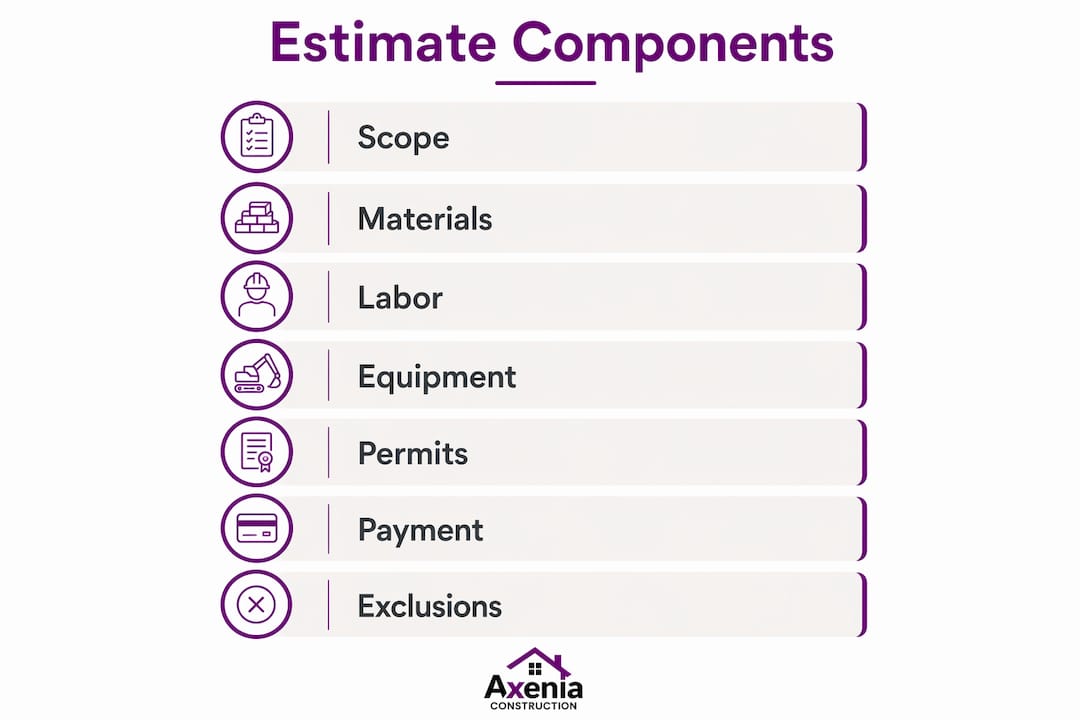
Equipment and subcontractor costs should appear as separate line items. If a plumber or electrician is handling part of your project, their portion of the work should be identifiable in the estimate. This transparency helps you understand subcontractor selection and whether those costs are reasonable.
Permits and fees are typically passed through to you at cost. Confirm this in writing. Some contractors mark up permit fees; others do not. Either approach is acceptable as long as it is disclosed.
Payment schedule matters more than most homeowners realize. Payment schedules tied to milestones protect you by linking payments to completed work rather than calendar dates. A standard structure is a deposit for established contractors within a typical industry range, progress payments at defined milestones, and a final payment upon verified completion.

Exclusions are where disputes are born. Missing exclusions mean you should assume nothing is included, which leads to extra costs appearing mid-project. Every item the contractor does not cover should be spelled out explicitly.
Pro Tip: Always request a line-item breakdown rather than a lump-sum figure. Lump-sum estimates that bundle labor and materials prevent accurate comparison and create opportunities for unexpected upcharges after the contract is signed.
How contractor estimates differ from quotes
These two terms are often used interchangeably, but they carry different legal and practical weight.
- An estimate is a preliminary, non-binding approximation. It is based on the contractor’s best assessment of scope and current pricing, but it can change as the project details become clearer. Use estimates for early-stage budget planning and contractor comparison.
- A quote (sometimes called a bid) is a firm, binding price offered after the project scope is fully defined. Once you accept a quote, the contractor is generally committed to that price for the agreed scope.
- Validity periods differ too. Quotes typically carry a 30-day window before material and labor costs can shift the number. Estimates may have a shorter or longer window depending on market conditions.
- When you receive each: Contractors provide estimates early in the planning process, often before drawings are finalized. Quotes come later, once the scope is locked and the contractor can price with precision.
- Contractual implications: A signed quote becomes the foundation of your construction contract. An estimate does not. If you are moving toward a signed agreement, confirm that the document you are signing is based on a firm quote, not an approximation.
Understanding this distinction protects you. Accepting an estimate as though it were a fixed price is one of the most common mistakes homeowners make during the pre-construction phase.
How to write a professional contractor estimate
Whether you are a contractor preparing a document or a homeowner who wants to know what a quality estimate looks like, the structure below reflects industry best practices.
Business and client details belong at the top. The contractor’s name, license number, insurance information, and contact details establish credibility immediately. The client’s name, project address, and date of issue follow.
Division-based cost grouping organizes work by phase or trade: demolition, framing, MEP (mechanical, electrical, plumbing), insulation, drywall, finishing, and so on. Contractors using division-based templates tend to produce more thorough estimates and overlook fewer costs. This structure also makes it easier for you to compare bids from multiple contractors on an apples-to-apples basis.
Itemized costs with quantities and units are non-negotiable in a professional document. Each line should show the item description, quantity, unit of measure, unit cost, and extended total. A kitchen remodel estimate with 20 or more line items showing exactly what is included builds confidence and prevents misunderstandings far better than a single-line total.
Payment schedule should specify the deposit amount, each milestone trigger, and the final payment condition. A reasonable deposit typically runs 10–25% of the total project cost; anything higher than that warrants a direct conversation about why.
Timeline should include a realistic start date and a projected completion date, with notes about any dependencies such as permit approval or material lead times. For more context on realistic scheduling, the residential construction timeline planning process is worth reviewing before you finalize your project plan.
Terms, exclusions, warranty, and signature lines close the document. Warranty terms should specify what is covered, for how long, and under what conditions. The signature block confirms mutual acknowledgment.
Pro Tip: Use a structured, phased template every time. Structured estimate templates reduce the risk of omitting critical cost categories and give clients a consistent, professional document they can trust.
Why detailed estimates reduce risk and build trust
A thorough estimate does more than list costs. It sets the terms of your working relationship with a contractor before a single nail is driven.
Scope creep is the leading cause of budget overruns in residential and commercial construction. It happens when work expands beyond the original agreement because the boundaries were never clearly defined. A detailed estimate with explicit inclusions and exclusions is the most effective tool for preventing it.
Detailed estimates build trust by aligning expectations between contractor and client from day one. When both parties can point to the same document and see exactly what was agreed, disputes lose their footing. The FTC’s guidance on avoiding home improvement scams specifically recommends getting detailed written estimates before signing any contract.
The practical benefits of a thorough estimate include:
- Easier cost verification: You can check material prices independently when brands and quantities are specified
- Fairer contractor comparison: Line-item breakdowns let you compare bids on the same scope, not just the bottom line
- Clearer payment protection: Milestone-based payment schedules reduce your financial exposure at every stage
- Reduced change-order risk: A well-defined scope leaves less room for contractors to add costs mid-project
- Smoother project flow: Everyone on the job knows what is included, which reduces miscommunication between trades
Treat the estimate as a roadmap, not just a price list. A contractor who resists providing a detailed breakdown may be working from an undefined scope, which puts your budget at risk before the project even starts.
Axeniaconstruction brings this level of detail to every project
Getting a thorough, transparent estimate should not feel like pulling teeth. At Axeniaconstruction, we build detailed, line-item estimates into our standard process because we believe you deserve to know exactly where your money is going before you commit to anything.
As a licensed, women-owned general contractor based in Rockville, MD, we work with residential homeowners, commercial clients, and government partners across the DC, Maryland, and Virginia region. Our design-build services integrate planning and execution under one roof, which means the estimate you receive reflects real costs from the team that will actually do the work. No hand-offs, no inflated subcontractor markups passed along without explanation.
Every estimate we prepare includes a full scope of work, itemized materials and labor, a milestone-based payment schedule, and a clear exclusions list. We do this because transparent communication is the foundation of every relationship we build. When you are ready to move forward with your project, request a detailed estimate from our team and see the difference that genuine transparency makes.
Key Takeaways
A contractor estimate is a non-binding planning document, and its value depends entirely on how much detail it contains.
| Point | Details |
|---|---|
| Core components | Every estimate should include scope of work, itemized materials, labor, permits, payment terms, timeline, and exclusions. |
| Estimate vs. quote | An estimate is non-binding and used for planning; a quote is a firm price that forms the basis of a contract. |
| Payment schedule standard | A reasonable deposit runs 10–25% of the total project cost, with remaining payments tied to completed milestones. |
| Exclusions protect you | Missing exclusions mean you should assume nothing is included, leaving you exposed to surprise costs mid-project. |
| Axeniaconstruction’s approach | Axeniaconstruction provides line-item estimates with a full scope, milestone payments, and explicit exclusions for every project. |