
A progress payment is a partial payment made during a construction project for work that has been completed, instead of one lump sum at the end. The contractor bills for the work in place, usually once a month or at agreed milestones, the owner reviews the request, and money moves in steps that follow the building. Below, we explain the mechanics, the math, and what to put in your contract, including the rules that matter in Maryland, DC and Virginia.
TL;DR
- Progress payments tie money to verified work: a monthly percentage-complete bill or a payment at each milestone.
- Each request rests on a schedule of values, a payment application and backup such as lien waivers and photos.
- The amount due is work completed plus approved changes, minus prior payments and retainage. Retainage is commonly 5 to 10 percent.
- A large deposit is not automatically normal. Maryland caps deposits on home improvement contracts at one-third of the price.
- Write the schedule, the proof of completion, who approves and the due date into the contract before work starts.
Table of Contents
- What progress payments are and why projects use them
- Two common ways to structure the payments
- How a progress billing cycle runs, step by step
- How the amount due is calculated
- Is it normal to pay a contractor 50% upfront?
- Building a payment schedule that prevents disputes
- Rules in Maryland, DC and Virginia
- Our perspective
- Plan your project payments with Axenia
- FAQ
- Sources
What progress payments are and why projects use them
Progress payments let a contractor bill incrementally as the job advances. In Procore’s overview of progress payments, they are based on the percentage of work complete, and they are typically monthly or sent at set completion points such as 30%, 60% and 100%.
The reason is cash flow. Course material from HSM University on project cost control explains that a contractor’s cash position runs negative for much of a job. Payment arrives weeks after the month the work was done, retainage is held back until near the end, and wages go out weekly while payment comes monthly. Without progress payments, the contractor would finance your building from its own pocket.
For owners, the same structure protects you. You pay for what has been built and verified, not for promises. That is why the term “progress billing” and “progress payments” describe two sides of one process: the contractor bills, the owner pays.
Two common ways to structure the payments
Most contracts use one of two models. Which fits depends on the project.
| Model | How it works | Best fit |
|---|---|---|
| Percentage of completion (monthly) | Contractor reports the percent complete on each line of the schedule of values and bills that share each month | Larger or longer projects with many trades |
| Milestone payments | A fixed amount is due when a defined stage is finished, such as framing complete or rough-in passed | Projects that divide cleanly into separate stages, like a deck, a bath or an addition |
Procore’s guide to contractor payment schedules notes that milestone schedules work best when a project can be treated as a series of smaller separate projects. Public agencies use milestone payments too. The Federal Highway Administration describes payments for finishing a predetermined milestone on or ahead of schedule, with possible per-day disincentives for missing target dates.
How the contract is priced shapes the schedule as well. If you are weighing lump sum, cost-plus or guaranteed maximum price, our guide to design-build pricing models shows how each one affects what you are billed and when.
How a progress billing cycle runs, step by step
The details vary by contract, but the sequence is consistent.
- Agree on the schedule of values (SOV) before work starts. For stipulated sum or guaranteed maximum price contracts, the contractor typically prepares a detailed SOV for the owner’s agreement. It lists each item of material and labor by cost, according to the AIA Contracts guidance on payment processes. If you want to see what an approvable one looks like, read how to build a schedule of values in seven steps.
- Collect completion data. Procore’s description of the billing cycle has the project team aggregate completion data and verify it against the physical status of the work before anything is submitted.
- Submit the payment application. The same AIA guidance says percentage-based billing typically uses G702 and G703 forms with an updated SOV. Subcontractors send their requests to the general contractor, who compiles them with its own into one package. City Tech’s construction management course notes say applications are typically due at least 10 days before the payment due date.
- Review. An architect reviews and recommends payment when providing contract administration. Otherwise the owner reviews the application.
- Pay. Payment follows within the contract’s stated window, minus retainage.
- Repeat until closeout. Final payment is typically due after substantial completion, a passed final inspection and completion of punch-list items.
What goes into a payment application
A typical pay application has three parts, per Procore’s guide to payment applications: a formal request for payment, an SOV showing completed work items, and supporting documents. The form itself should show the project name, application number, owner, architect and contractor details, the period covered, change order details, and the financial picture: contract total, value of work completed to date, amount currently due and balance remaining.
Backup depends on the project. Procore’s progress billing article lists lien waivers, certified payroll, photos, bills of materials and stored-material insurance documents among the common requirements.
Before billing, the general contractor also verifies each subcontractor’s request: percent complete, quantities and values of delivered materials, vendor invoices, approved change orders and the retention amount. Contractors who track profit as the job runs, rather than at the end, also tend to bill more accurately. This overview of work-in-progress accounting for contractors shows how incremental billing connects to margin.
How the amount due is calculated
The usual formula is simple. Completed value plus approved additions, less previous payments, retainage and approved deductions. ONES’s payment terms guide adds that the exact calculation depends on the contract.
Here is a worked example with round numbers for illustration only, not a quote.
| Line | Amount |
|---|---|
| Contract sum | $200,000 |
| Approved change order added | $10,000 |
| Adjusted contract sum | $210,000 |
| Work completed to date (40%) | $84,000 |
| Retainage at 10% | $8,400 |
| Earned, less retainage | $75,600 |
| Previous payments | $40,000 |
| Current payment due | $35,600 |
Notice the change order. Approved changes become new or adjusted SOV lines, so the SOV always adds up to the current contract sum, as os.construction explains. Unsigned changes do not belong in a bill. Our piece on signing construction change orders first covers how to keep that clean.
Retainage
Retainage is money the hiring party withholds to help ensure the work is complete and of high quality. Procore reports it is commonly 5 to 10 percent of each progress payment, often flowing down to subcontractors, and it is released when punch-list items are done and required documents are turned in. Siteline’s subcontractor guide gives the same range.
Rates can step down. One published university procedure uses 5% before substantial completion, 2% afterward and none at final payment, and it excludes the value of incomplete punch-list items from the total. That makes the punch list financially meaningful. See what a punch list is and why it matters.
Stored materials
If the contract allows it, a contractor can bill for materials purchased but not yet installed. Owners may ask for photos showing the materials are safely stored and proof of insurance on them. When the contract does not allow stored materials, the contractor generally floats those costs until installation. Decide this up front, especially for custom cabinetry, windows or long-lead equipment.
Is it normal to pay a contractor 50% upfront?
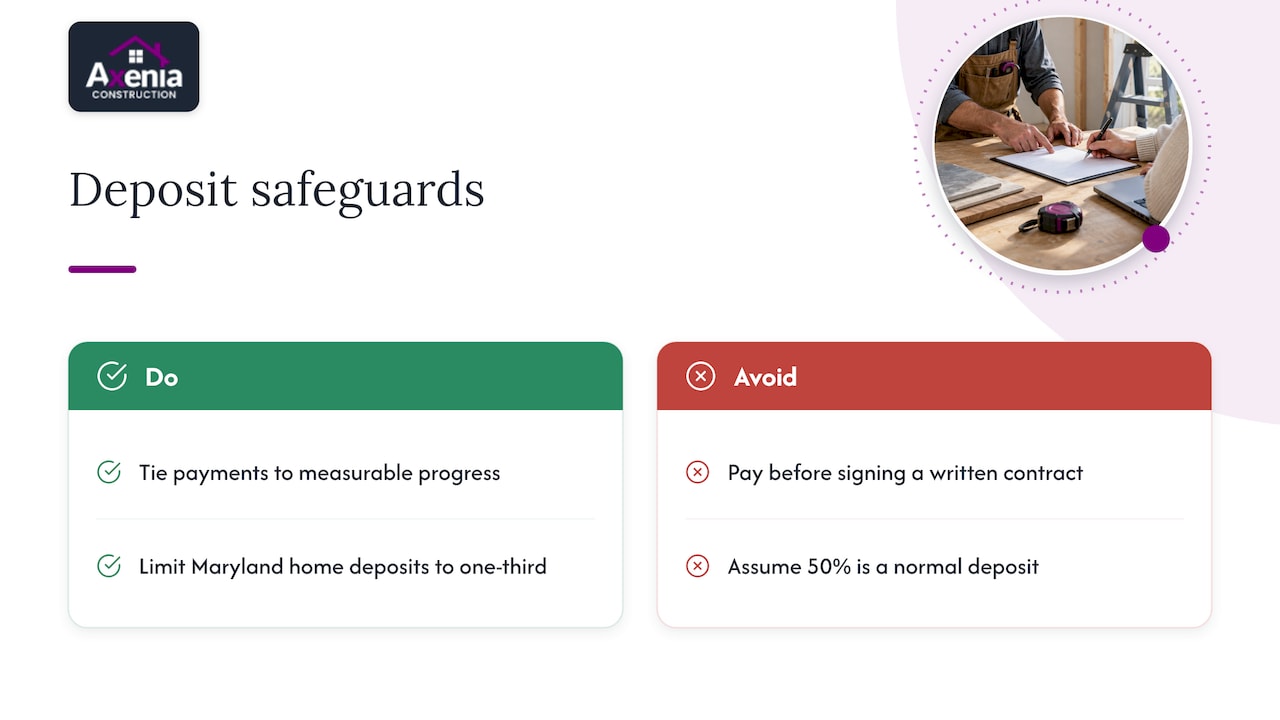
Not as a default, and for home projects the law often limits it. In Maryland, home improvement contractors may not take more than one-third of the contract price as a deposit, and they cannot collect money before a written contract is signed. That is a state rule for home improvement work, so check the current Maryland Home Improvement Commission guidance for your project. DC and Virginia have their own licensing rules for residential work, so confirm them with the relevant licensing agency before you sign.
A reasonable deposit covers mobilization, permits and initial orders. After that, payments should follow measurable progress. If a contract asks for half the price before a shovel moves, ask what the money pays for and how the rest will be tied to completed work. A clear schedule answers that question quickly.
Homeowners financing a project should also know that lenders often release funds in draws that follow the same logic. Our home renovation loan application guide explains how to line up financing with your payment schedule.
Building a payment schedule that prevents disputes
Vague schedules cause most payment arguments. ONES recommends that each payment specify what work must be completed, how completion is measured, who reviews and approves, the amount payable and when payment is due after approval.
A workable checklist:
- Name observable milestones. “Rough electrical passed inspection” is clear. “Mostly done” is not.
- Match payments to the SOV. Each draw should trace back to line items.
- Name the approver and the response time. Who signs, and how many days do they have?
- State the retainage rate and release trigger.
- Address stored materials and change orders. Say what is allowed and what paperwork is needed.
- List the backup documents. Lien waivers, photos, inspection sign-offs.
- Define final payment. Tie it to substantial completion, final inspection and the punch list, and see our construction closeout checklist.
Schedule delays also affect billing, since milestones slide when work slips. Our guide to a fix for construction schedule delays covers how to keep the payment calendar honest.
Rules in Maryland, DC and Virginia
Payment timing and retainage are regulated more heavily on public work than on private work. These points come from official texts and a regional law firm summary. Rules change, so confirm current law with a construction attorney for your contract.
- Maryland private work: A Smith Currie summary of prompt payment says progress payments are as agreed, with final payment due 30 days after completion unless the parties agree otherwise.
- Maryland public work: the same summary lists payment due 30 days after the later of the contractual due date or the invoice.
- Maryland public retainage: with 100% payment and performance security furnished, State Finance and Procurement § 17-110 limits contract retainage to 5% of the total contract amount and requires release within 120 days after satisfactory completion, or after resolution of disputes or claims.
- Paying down the chain: COMAR 21.07.02.05-2 requires a contractor to pay subcontractors and suppliers an undisputed amount within 10 days after receiving a progress or final payment.
- Virginia public work: Smith Currie lists 30 days for state agencies and 45 days for localities after invoice or receipt of services, whichever is later, unless otherwise agreed. Its table also gives DC timelines for private and public work.
If you are bidding public work, our government contracting team works within these payment structures.
Our perspective
Most payment friction we see starts before a single wall is framed. A schedule that says “30% at midpoint” invites disagreement. A schedule tied to inspected, photographed, line-by-line progress does not.
We build every project around transparent communication, so the schedule of values, the milestones and the backup documents are shared and understood before the first bill goes out. That is easier for you to review and easier for us to defend.
Our integrated design-build approach helps here too. When design and construction sit under one roof, scope is defined earlier, and a well-defined scope makes a cleaner payment schedule. We also know the permitting and inspection rhythm in Maryland, DC and Northern Virginia, so we place inspection-based milestones where they belong in the real sequence of work.
Our advice: ask for a payment plan you can explain to your lender, your partner or your board in two minutes. If you can, it is probably a good plan.
Arienne
Plan your project payments with Axenia
We are a licensed, women-owned general contractor in Rockville, MD, serving homeowners, commercial property owners and government clients across Maryland, DC and Northern Virginia. We walk you through the scope, schedule and payment structure before work begins, so you always know what is being built and what is being billed.

Whether you are planning a kitchen, an addition or a tenant improvement, start with our general contracting services or contact us through our site to talk through your project.
FAQ
What is the difference between progress payments and progress billing?
Progress billing is what the contractor does: invoicing incrementally for completed work or reached milestones. A progress payment is the money the owner pays in response. In practice, people use the terms almost interchangeably.
How often are progress payments made?
Most often monthly, based on percentage complete. Some contracts pay at set milestones or completion points instead, such as 30%, 60% and 100%. Your contract should state the frequency and the due date after approval.
What documents support a payment request?
A payment application, a schedule of values showing work completed, and backup such as lien waivers, photos, certified payroll, bills of materials and stored-material insurance documents where the contract requires them. Exact requirements depend on the contract.
How much retainage is typical?
Commonly 5 to 10 percent of each progress payment. On Maryland public contracts with full payment and performance security, the statute caps contract retainage at 5%. Release usually follows completed punch-list items and required closeout documents.
Is it normal to pay 50% upfront?
Usually not. A smaller deposit covering startup costs is more typical, and Maryland limits home improvement deposits to one-third of the contract price. Tie later payments to measurable progress.
Sources
- Guide to Progress Payments on Construction Projects (Procore)
- Construction Progress Billing (Procore)
- Construction Payment Applications (Procore)
- Contractor Payment Schedules (Procore)
- Construction Payment Process Explained for Contractors (AIA Contracts)
- Cash flow, progress billing and payment law (HSM University)
- Progress Payments (City Tech OpenLab CM II)
- Alternative Payment and Progress Reporting Methods (FHWA)
- How to Structure a Progress Payment Schedule (ONES)
- Construction Contract Payment Terms and Progress Billing (ONES)
- Pay apps, SOV and retainage (os.construction)
- Progress Payments in Construction: The Subcontractor’s Guide (Siteline)
- UT Progress Payment Procedures (University of Tennessee)
- Prompt Payment for Commercial Construction in DC/MD/VA (Smith Currie)
- Md. State Finance and Procurement § 17-110
- COMAR 21.07.02.05-2, Prompt Payment of Subcontractors
- Home Improvement Contractor Deposit Limit Law by State
- WIP Accounting for Contractors (Rebuilding the Trades)