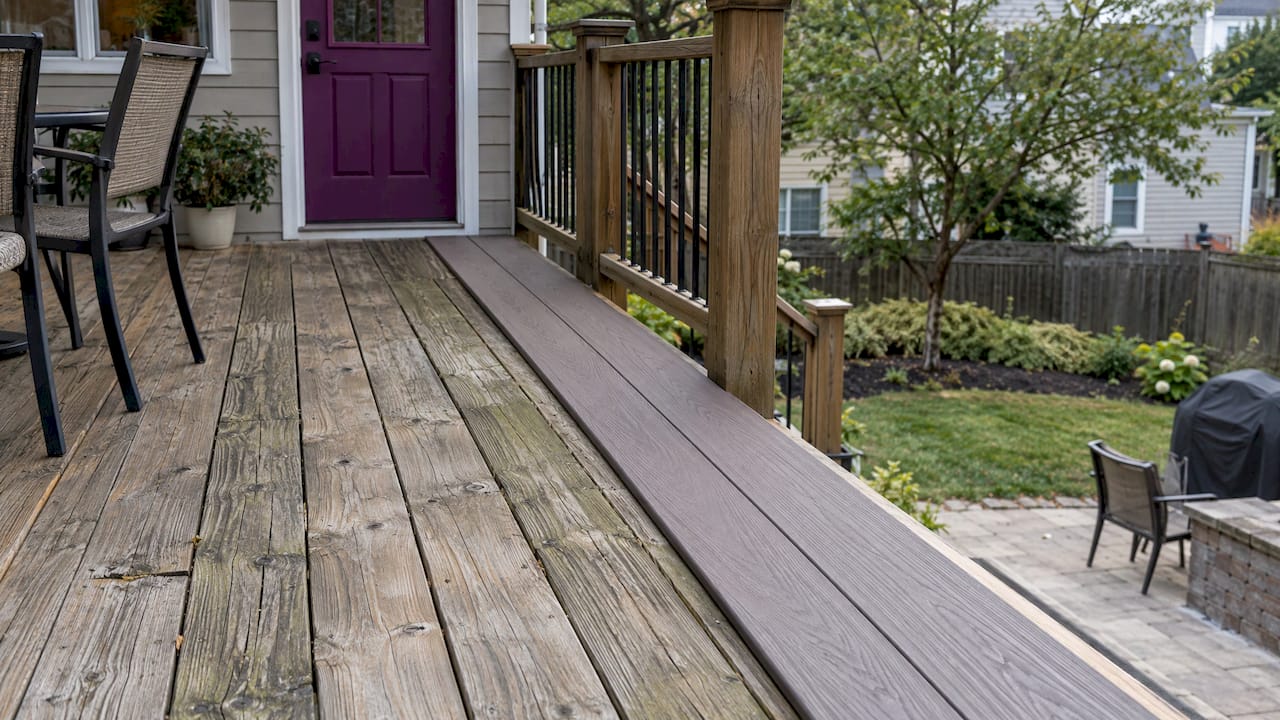
Composite costs more up front and asks far less of you afterward. Wood costs less on day one and asks for a stain-and-seal routine for as long as you own it. Which one is right depends on how long you will stay in the house, how much weekend time you want to give the deck, and how much direct sun the deck gets. Below, we walk through cost, lifespan, maintenance, heat, ipe and pressure-treated options, and resale, with the numbers that matter for homeowners in Maryland, DC and Northern Virginia.
TL;DR
- Cost: Composite boards run roughly 20–40% more than pressure-treated wood, but because labor and framing make up most of a build, switching can add as little as 15% to the total project.
- Upkeep: Composite needs no staining, sealing or painting. Wood needs regular sealing or staining to stay in good shape.
- Lifespan: Composite is commonly rated at 25 to 30 years or more. Pressure-treated wood generally has a shorter life, and ipe is the long-lived exception among woods.
- Heat: Dark composite gets hotter underfoot than wood. Choose a lighter color or add shade if the deck faces south or west.
- Rule of thumb: Staying ten years or more and want low upkeep? Composite. Selling soon, tight budget, or love real wood and will maintain it? Wood.
Table of Contents
- Composite vs wood at a glance
- What a deck really costs: materials, labor and the long view
- Maintenance: the stain-and-seal treadmill
- How long does a deck last?
- Heat, comfort and how each material feels
- Pressure-treated, cedar or ipe: which wood are we comparing?
- Resale value and who should pick what
- What this means in Maryland, DC and Northern Virginia
- Plan your deck with us
- FAQ
- Sources
Composite vs wood at a glance
Composite decking is made from a blend of wood fibers and recycled plastic, built to resist termites and decay and less likely than wood to warp, crack or splinter. Wood decking, whether pressure-treated pine, cedar or a hardwood like ipe, gives you the real grain and a lower starting price, in exchange for regular care.
| Factor | Pressure-treated wood | Cedar / hardwood (e.g., ipe) | Composite |
|---|---|---|---|
| Upfront material cost | Lowest | Mid to high | Mid to high |
| Staining and sealing | Regular | Regular, or optional oiling for ipe | None |
| Rot and insect resistance | Treated, but needs upkeep | Naturally resistant to varying degrees | High |
| Heat in direct sun | Moderate | Cooler than dark composite | Warmest, especially dark colors |
| Look | Real wood, changes over time | Real wood, richest grain | Uniform, many colors |
| Repairs | Easy to cut and replace | Sand or replace | Harder if boards are damaged |
What a deck really costs: materials, labor and the long view
Published per-square-foot numbers vary by region and product, so treat them as ranges. Consumer Reports prices composite at about $300 to $700 per 100 square feet, against roughly $200 to $1,100 or more per 100 square feet for wood, where the high end is exotic hardwood. Another useful figure: TimberTech reports composite boards at $1.75 to $8.00 per linear foot for materials alone in 2026.
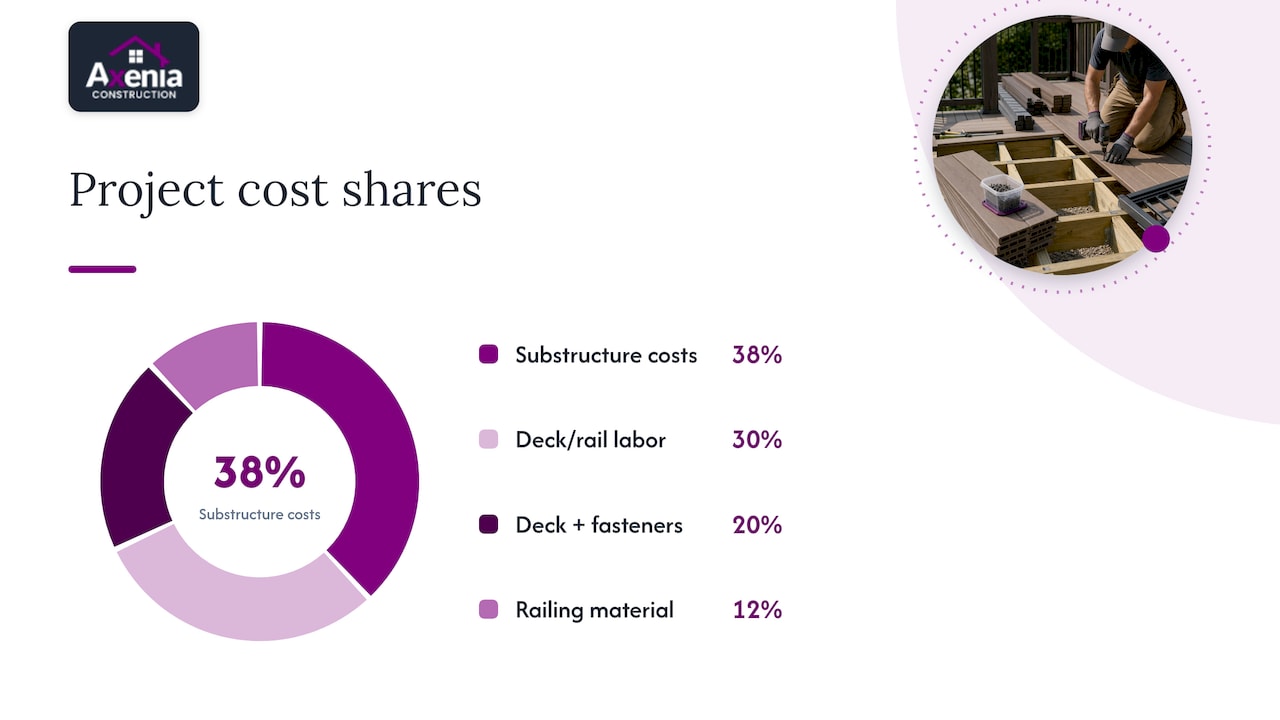
Those numbers look dramatic, but boards are not the biggest line on your invoice. By TimberTech’s breakdown, substructure materials and labor are the largest share at 38%, decking and railing labor is 30%, decking material and fasteners are 20%, and railing material is 12%. That is true whichever surface you choose. Consumer Reports’ editors add that you should factor in railings, stairs and the supporting structure, and that labor can easily exceed materials.
A worked example
Take a 320 square foot deck. Say the framing, footings, labor and railings come to a fixed amount no matter what you put on top. Because the boards are only about a fifth of the total, a surface that costs 20–40% more per board moves your total far less than the sticker comparison suggests. That is where the “as little as 15%” figure comes from.
Then add the cost of ownership. Wood needs sealer or stain, supplies, and your weekends or a hired crew, repeated every couple of years. Composite skips that. Over a long horizon, TimberTech’s analysis says composite saves money over 25 years by eliminating sanding, staining and sealing. That is a manufacturer’s view, so run your own numbers: your stain cost, your time, and how long you will own the home.
In our area there is another cost that has nothing to do with boards: footings must reach below the frost line and the deck usually needs a permit. Our guide to Maryland deck costs and footing depth explains how that affects a budget, and we cover the paperwork in what Maryland homeowners need to know about deck permits.
Maintenance: the stain-and-seal treadmill
This is the real dividing line. Composite doesn’t require painting, staining or sealing. A wash with soap and water and a clear of leaves from between the boards is the usual routine. Most current products also come with some or all sides encased in plastic to discourage mildew.
Wood tends to change color, crack and stain if it isn’t refinished, and boards may need to be replaced more often. In the humid Mid-Atlantic, with hot summers, wet springs and freeze-thaw winters, that cycle matters. A wood deck in a shady, damp backyard asks for more attention than the same deck in open sun.
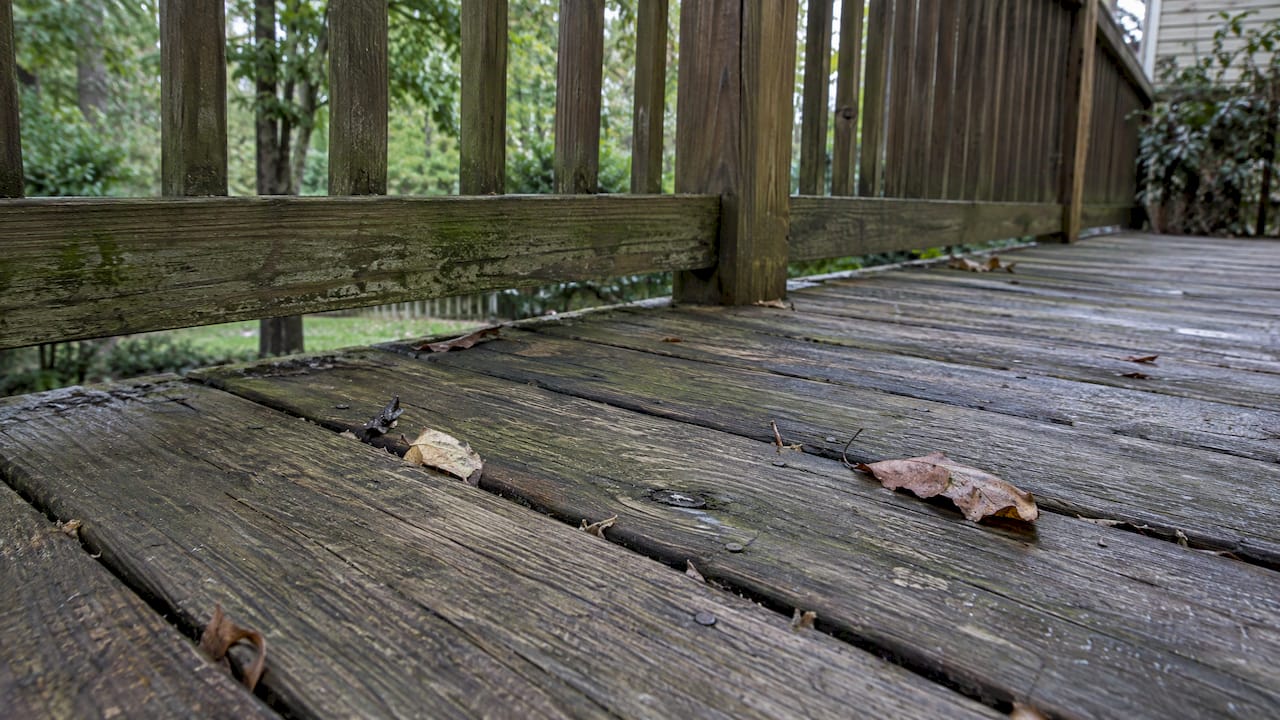
If you enjoy the ritual of refinishing and like watching wood age, that is a legitimate reason to choose it. If you picture your Saturdays differently, composite buys them back.
How long does a deck last?
Composite: One manufacturer puts the average composite lifespan at 25 to 30 years, with a good chance of more. Warranties point the same way: composite commonly carries 25 to 50 year warranties, while wood carries no surface warranty. Read the warranty terms on any product, since fade, stain and structural coverage differ.
Wood: Lifespan depends on species, exposure, framing and upkeep. Pressure-treated pine and cedar have a shorter lifespan than composite, and a well-kept deck will outlast a neglected one by years.
One point people overlook: the surface is not the only thing that ages. The framing underneath is usually wood either way, and its quality, flashing at the house and fastener choice often decide when a deck needs to be rebuilt. A 30-year board on a tired frame is not a 30-year deck.
Heat, comfort and how each material feels
Heat is the most common surprise with composite. Dense polymer holds more solar heat than wood’s cellular structure. Reported figures differ by test, but dark composite boards can run about 145–150°F or more in direct sun, against roughly 120–135°F for wood. That is hot for bare feet or a dog’s paws.
You cannot fix this after installation without replacing boards, so decide up front:
- Pick a lighter color. It manages heat better than a deep brown or gray.
- Plan shade: a pergola, an awning, a nearby tree, or an umbrella zone.
- If the deck faces south or west and the family is barefoot all summer, consider wood or a lighter board for the main surface.
Other comfort differences are smaller. Composite is also more difficult to repair if a board is damaged, and some homeowners feel it doesn’t fully replicate real wood. Quality varies: some composites offer far less resistance to slips, stains and mildew than others, so compare the specific line, not the category. Composite is also generally heavier and more expensive than pressure-treated pine. Joist spacing matters too. Composite is often installed on tighter spacing, and manufacturers’ instructions govern, because it expands and contracts with temperature and must be detailed to allow for that movement.
On stiffness, wood is the benchmark. Consumer Reports’ testing found wood resists bending and sagging, while a few composites come close but several flex or sag noticeably. The fix is proper framing and following the manufacturer’s span requirements.
Pressure-treated, cedar or ipe: which wood are we comparing?
“Wood” covers a wide price and quality range, and the comparison changes depending on which you mean.
- Pressure-treated pine is the budget baseline and the usual starting point for the “composite vs wood” cost gap. It accepts stain well but needs it.
- Cedar is lighter, naturally attractive and softer. It looks best when sealed and kept out of constant wet shade.
- Ipe is a dense tropical hardwood with a reputation for outlasting nearly everything. It carries a hardwood price and requires specialized installation (pre-drilling, hidden fastener systems) and, if you want to keep its color, periodic oiling. Left alone, it weathers to a silver tone. Published ipe cost comparisons vary widely by supplier, so get a written quote for your exact deck instead of trusting a blog average.
A fair summary: pressure-treated wins on upfront price, composite wins on effort, and ipe is the choice if you want real wood with the longest life and accept a premium. If you are weighing ipe against a high-end composite, ask for samples of both, and look at them outside in the afternoon light.
Resale value and who should pick what
In 2025 Cost vs. Value data, wood decks recouped about 95% of cost at resale and composite about 89%. If you are selling within a few years or have a tight budget, wood makes sense. If you are staying long term and would rather skip the stain-and-seal routine, composite is usually the better fit. Buyers also respond to a deck that looks clean on listing day, so condition matters as much as material. For other projects that move the needle, see our look at home renovations that increase property value.
A short decision guide:
- Staying 10+ years, low upkeep wanted: composite, in a lighter color if the deck is sunny.
- Selling in a few years or budget is tight: pressure-treated wood, built on solid framing.
- Love real wood and will restain it: cedar or pressure-treated, ideally in a mostly shaded spot.
- Pool, wet or humid location: composite resists algae and moisture; use stainless fasteners near saltwater.
- Want the longest-lived real wood: ipe, with a budget for specialized labor.
What this means in Maryland, DC and Northern Virginia
Our climate swings from humid summers to freezing winters, and boards expand and contract through that range. Wood absorbs moisture and may decay if not properly sealed and maintained, particularly in wet or humid climates. Composite resists moisture but needs correct gapping. Either way, the result depends on the installation: footing depth, flashing, joist spacing and fasteners.
Permits and local rules also differ by jurisdiction. If you are in Northern Virginia, Arlington deck permit rules are a good place to start. In Montgomery and Prince George’s counties, the Maryland permit guide linked above applies. HOAs sometimes restrict materials and colors, so check before you order.
Our perspective
After years of building and renovating outdoor spaces across Maryland, DC and Northern Virginia, we have found that the best material is the one that matches how you actually live. We are a women-owned general contractor, and we spend a lot of time asking clients what a normal Saturday looks like. Some want to be on the deck with a drink, not with a sanding block. Others love the character of real wood and are happy to refinish it.
What we care about most is that the choice is made early, together with the design. Surface material affects joist spacing, fastener systems, shade planning and budget, so it belongs in the first conversation, not the last. Our design-build approach keeps design, permitting and construction under one roof, so those trade-offs are settled before anything is ordered.
Our own view is simple: if you plan to stay and want a deck that stays looking the way it did on installation day, composite is a very strong choice, and we plan the framing, color and shade around it. If real wood is your heart’s choice, we build that too, with attention to the details that make it last.
Arienne
Plan your deck with us
We build and renovate decks and porches for homeowners across Maryland, DC and Northern Virginia, and we handle design, permitting and construction together. Whether you lean composite or wood, we can walk your yard, talk through sun exposure, budget and upkeep, and recommend a material and framing plan to match. Explore our decks and porches services, see our work as a deck builder in Rockville, MD, or learn how design-build keeps your project coordinated from first sketch to final walkthrough. Ready to talk? Contact Axenia Construction for a conversation about your deck.
FAQ
Is composite decking better than wood?
Neither is better for everyone. Composite is better for low maintenance, resistance to rot and insects, and long warranties. Wood is better for upfront price, real grain and easier cutting and repair. Match the choice to how long you will stay and how much upkeep you will do.
Does composite decking cost more than wood?
Yes, per board. Composite boards generally cost 20–40% more than pressure-treated wood, but since framing and labor make up most of the project, the total difference can be much smaller. Add in the staining and sealing wood needs over the years when you compare.
How long does composite decking last?
Manufacturers commonly cite 25 to 30 years or more, and many products carry warranties of 25 to 50 years. Actual life depends on the product line, installation, ventilation and the condition of the framing under it.
Does composite decking get hotter than wood?
Generally yes, especially in dark colors. Dark boards can reach 145–150°F or more in direct sun, while wood runs about 120–135°F. Lighter colors and shade help, and it is best decided before the deck is built.
What are the key differences between composite and pressure-treated decking?
Pressure-treated lumber is cheaper and easy to work with but needs regular sealing or staining and tends to crack and fade. Composite costs more up front, needs no sealing or staining and resists rot and insects, but runs hotter and is harder to repair.
Sources
- Comparing Composite vs Wood Decking, Lowe’s
- Ultimate Decking Buying Guide: Wood vs. Composite, Consumer Reports
- Composite Decking Material Costs in 2026, TimberTech
- Decking Cost Guide: How Much Does a Deck Cost?, TimberTech
- Composite Decking, Envision Outdoor Living
- Wood vs Composite Decking: Cost, ROI & Heat, Remodel Calculators