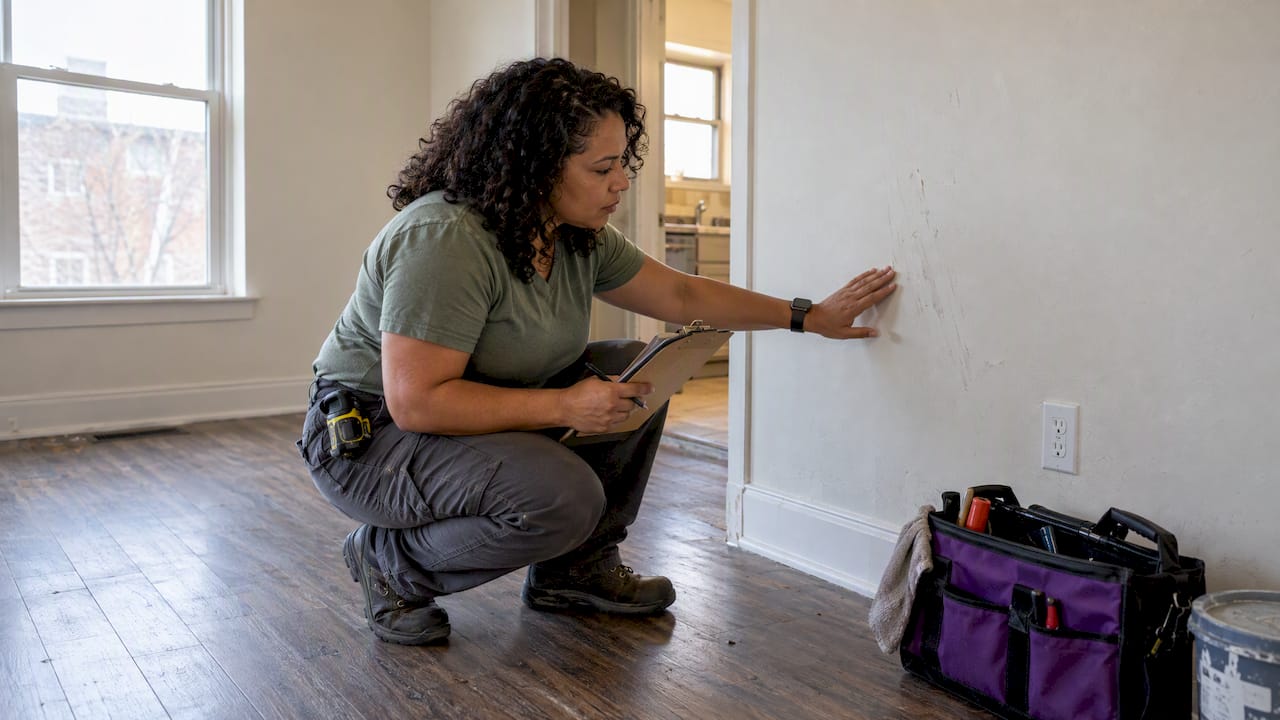
A standard apartment turn runs about $3,000 to $5,000 per unit all-in, a light turn $1,500 to $3,000, and a heavy turn with new flooring and appliances $8,000 to $12,000 or more, according to 2026 make-ready benchmarks. Those are national figures. We have not found a published Maryland-specific benchmark we trust, so this guide shows you how to build your own number for a unit in Rockville, Baltimore, Bethesda or Prince George’s County, and where Maryland rules change the math.
We are a licensed general contractor in Rockville, and we write this for owners, property managers and landlords who want a scope of work that holds up on the day the crew shows up.
TL;DR
- Budget $1,500 to $3,000 for a light turn, $3,000 to $5,000 for a standard turn and $8,000 to $12,000+ for a heavy turn, then adjust for your building’s age and finish level.
- The work itself is often only part of the bill. Lost rent, listing costs and concessions can double a light turn’s total cost.
- In Maryland, you cannot charge a tenant’s deposit for ordinary wear and tear, and the deposit must be accounted for within 45 days. Your scope has to separate tenant damage from routine upkeep.
- Painting, cleaning and minor repairs are turn expenses. Roofs, HVAC and major systems are capital items. Keep them in separate budgets.
- Write the scope before the tenant leaves, order materials early, and have one contractor coordinate the trades.
Table of Contents
- What counts as a unit turn
- Unit turn cost by scope level
- The costs that never appear on the contractor’s invoice
- How to write a unit turn scope of work
- Maryland rules that shape your turn budget
- Turn expense or capital expense?
- Ways to bring the number down without cutting corners
- Our perspective on unit turns
- When a turn becomes a renovation
- Work with a contractor who plans the turn with you
- FAQ
- Sources
What counts as a unit turn
A unit turn (also called make-ready) is everything between one tenant’s move-out and the next tenant’s move-in: inspection, cleaning, repairs, paint, flooring, fixtures, appliances, final walkthrough and re-listing.
The trap is that people quote two different numbers under the same name. A contractor’s quote covers labor and materials. The “average turnover cost” you read in industry reports covers far more. The national average of $3,872 per apartment cited by Propmodo includes make-ready expenses, vacancy loss, leasing commissions, advertising and concessions. When you compare a bid with a benchmark, make sure both measure the same thing.
Unit turn cost by scope level
Here is how we suggest thinking about the three tiers. The ranges come from the 2026 Lula benchmarks and are national, not Maryland-specific.
| Turn level | Typical scope | Range per unit |
|---|---|---|
| Light | Touch-up paint, deep clean, minor repairs | $1,500 to $3,000 |
| Standard | Full repaint, deep clean, plumbing and fixture fixes, some patching | $3,000 to $5,000 |
| Heavy | Flooring replacement, appliance work, possibly cabinets or bath updates | $8,000 to $12,000+ |
Two cautions. First, the Lula standard range includes lost rent during vacancy, so a contractor’s invoice for the same scope will usually land lower. Their direct labor and materials figure for a standard turn is about $2,000 to $3,000. Second, a heavy turn is not a bigger standard turn. It is closer to a small renovation, and it needs permits, scheduling and sometimes design decisions.
What pushes a Maryland turn above the range
We can’t hand you a verified Maryland multiplier, but these are the factors we see change a bid on the ground:
- Building age. Older rowhouses and garden-style complexes hide plaster repairs, outdated wiring and old plumbing that a fresh coat of paint will not solve.
- Finish level. A Class B garden unit and a Bethesda condo with stone counters do not share a budget.
- Occupant damage. Pet damage, smoke, water intrusion and removed fixtures are different from ordinary wear.
- Permit triggers. Swapping a water heater, moving a plumbing line or touching electrical may need a permit. Check with your county’s permitting office before you finalize the schedule.
- Vendor availability. Six unit turns and one painter is a scheduling problem, and every idle day costs rent.
The costs that never appear on the contractor’s invoice
Most owners budget repair labor and forget the rest. The Lula benchmark makes the point with a simple example: a 15-day vacancy on a unit renting for $2,400 a month is about $1,200 in lost rent alone. That is nearly the price of a light turn.
The NAA’s 2025 operating survey, as cited by US Tech Automations, puts vacancy at about $80 a day for a unit at $2,400 a month. Use your own rent and the same math:
- Divide monthly rent by 30 to get daily vacancy cost.
- Multiply by the days from move-out to move-in.
- Add listing fees, photos, leasing commissions and any move-in concession.
- Add the contractor’s price for labor and materials.
The sum is your real turn cost. Run it for a unit you turned last year and you will probably find the repair invoice was less than half of it.
Where the days go
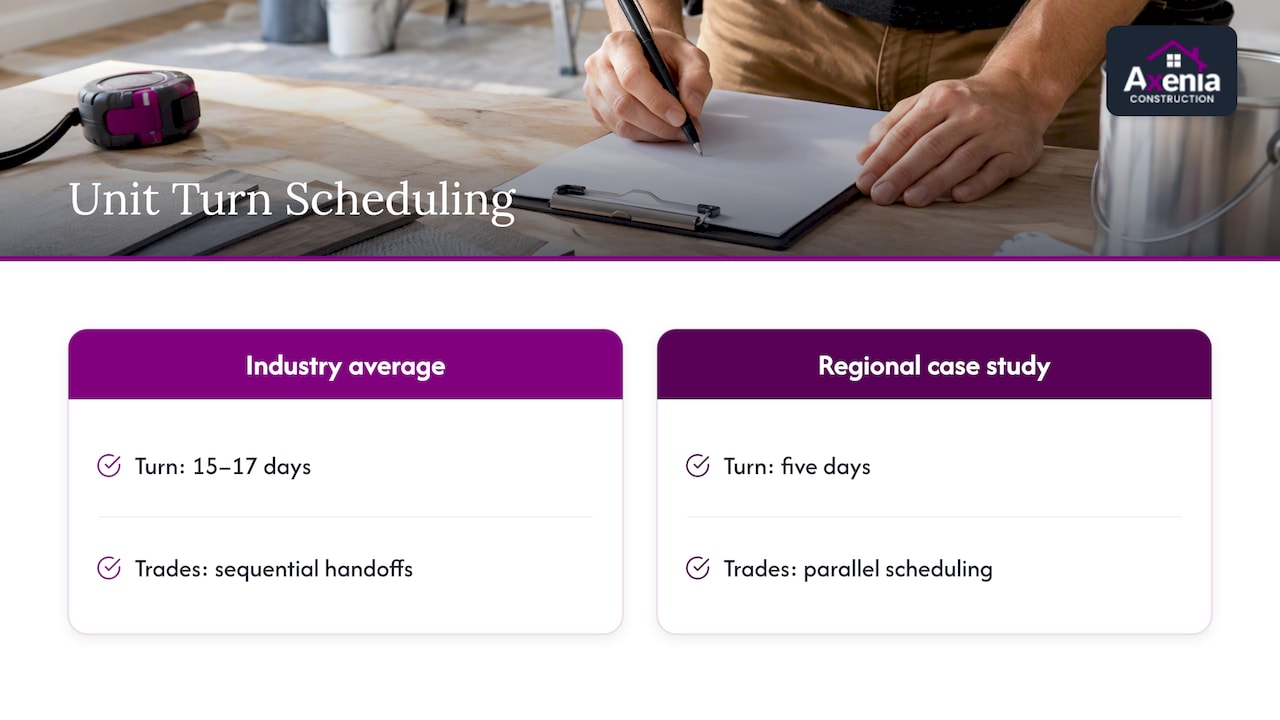
The industry average turn takes roughly 15 to 17 days, because trades work in sequence and each handoff leaves a gap. That case study describes a Maryland, Virginia and Washington-area portfolio that cut turns to five days by running tasks in parallel and scheduling vendors as soon as notice was given. You do not need software to borrow the idea. You need a scope of work drafted early and a contractor who can coordinate painting, flooring, plumbing and cleaning without you playing dispatcher.
How to write a unit turn scope of work
A scope of work is the document that turns a vague “freshen up the unit” into a price you can compare. Ours usually follows this order.
- Pre-move-out inspection. Walk the unit (with the tenant’s right to be present, covered below) and photograph every room.
- Line items by room. List walls, ceilings, flooring, doors, hardware, cabinets, counters, plumbing fixtures, lighting, appliances and windows.
- Action per item. Clean, patch, repaint, repair, replace. Be specific: “patch and paint 14 nail holes, bedroom 2” beats “paint.”
- Quantities and finishes. Square footage of flooring, paint color and sheen, brand and model for fixtures you want matched.
- Responsibility tag. Mark each item as ordinary wear (owner cost), tenant damage (deposit claim) or capital replacement (reserve).
- Sequence and dates. Cleaning last, paint before flooring where it makes sense, appliance delivery windows, inspection sign-off.
- Exclusions and change orders. Say what happens if the crew opens a wall and finds mold or rot.
If you price by line item, you can compare bids honestly and track actuals afterward. Contractors who track costs by cost code, a discipline covered in this guide to job costing by cost code, can tell you after a turn where the money really went, which makes your next budget sharper.
Sample line-item thinking
For a standard two-bedroom, you might structure the budget this way. Fill the numbers from your own quotes, not from ours.
- Deep clean, including appliances and cabinet interiors
- Wall patching and full repaint, ceilings and trim as needed
- Flooring: clean, repair or replace by room
- Plumbing: faucets, toilet parts, disposal, supply lines
- Electrical: outlets, switches, cover plates, fixtures, smoke and CO alarms
- Hardware, blinds, locks and rekeying
- Contingency of a few percent for what the walkthrough missed
Maryland rules that shape your turn budget
This is not legal advice. If a deposit dispute is brewing, talk to a Maryland landlord-tenant attorney.
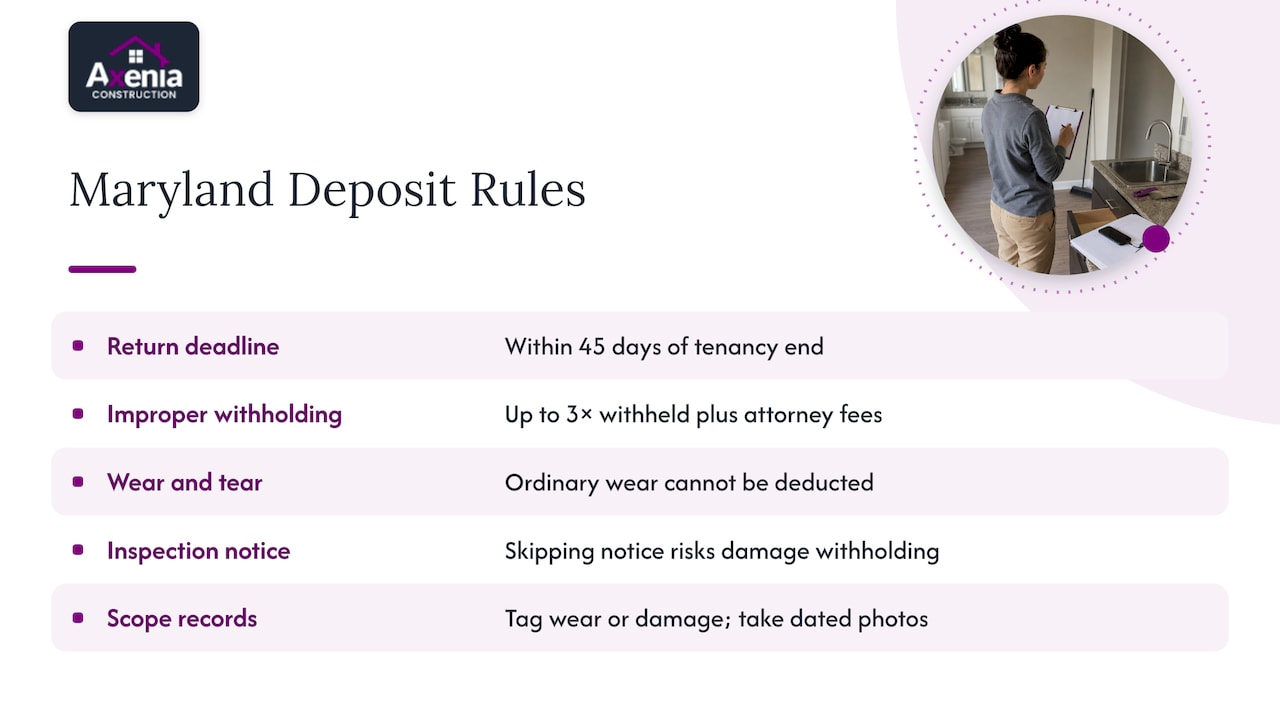
Deposit return. Under Real Property Article §8-203, the landlord must return the deposit, with interest where it applies, or send a written list of damages, within 45 days of the end of the tenancy. The state’s Tenant Bill of Rights notes that a landlord who withholds improperly can owe up to three times the amount withheld plus attorney fees.
Wear and tear. Landlords cannot deduct for ordinary wear and tear. In practice, repainting after a normal tenancy, light carpet wear and routine cleaning are your cost of doing business. The Attorney General’s landlord-tenant guide also covers the tenant’s right to request an inspection before move-out. A landlord who skips the required notice can lose the right to withhold for damages.
What this means for your scope. Tag every line item as wear or damage at the pre-move-out walk, with dated photos. Your contractor’s itemized estimate then doubles as documentation if a deposit is questioned.
Turn expense or capital expense?
Painting, cleaning and small repairs belong to the turn budget. Roofs, HVAC and major appliance replacement are capital items. The Maryland DHCD capital needs guidance defines a capital expense as a major improvement that significantly increases a property’s value or useful life. Mixing the two skews your per-unit data and can underfund reserves. If a turn reveals an aging furnace, price it separately and decide whether it is a reserve draw.
Ways to bring the number down without cutting corners
- Pre-market and pre-order. Start listing when notice arrives and order flooring, fixtures and paint before the keys come back.
- Standardize finishes. One paint color and one faucet model across units speeds every future turn.
- Fix small things during tenancy. Move-in maintenance and quick responses matter: residents who are satisfied with how repairs are handled are three times more likely to renew, according to that industry source, and every renewal is a turn you skip.
- Use one coordinating contractor. The case study above found that poor vendor coordination is a main source of wasted vacancy days.
- Replace with intent. A $900 refrigerator that fails in a year costs more than the right unit now. Decide at the scope stage.
The national average takes about 19 months to recover in rent, so every avoidable day or change order matters.
Our perspective on unit turns
We see two failure patterns. The first is the “quick turn” that is not quick: no scope, a painter booked after move-out, flooring on backorder, and a unit empty for a month. The second is the over-renovation, where an owner spends heavy-turn money on a light-turn unit and never recovers it in rent.
Our approach comes from project management, not painting. We walk the unit with you, write a line-item scope, sequence the trades and tell you early when something is not a turn problem but a renovation or a capital problem. If a bath or kitchen is at the end of its life, we say so and price it separately, because the cost of a full remodel in Maryland is a different conversation from patch and paint. We also know how permitting works across Maryland, DC and Northern Virginia, which keeps larger scopes from stalling at the county counter.
Plain advice: decide your turn standard before the next move-out, not during it. Light, standard or heavy, written down, with the finishes you will always use. That single page saves more than any negotiation.
— Arienne
When a turn becomes a renovation
Sometimes the right call is to stop turning and start renovating: a kitchen with failing cabinets, a bath with water damage, a basement that could become a rentable space. At that point you are weighing project cost against rent lift and vacancy length. Our guide to tenant turnover renovation costs goes deeper on that budgeting, and our contract review guide for DC, MD and VA shows what to check before you sign for larger work.
For commercial owners, the equivalent event is a tenant change in a retail or office suite. That is closer to a tenant buildout, with its own timeline and allowance questions.
Work with a contractor who plans the turn with you
We are a women-owned general contractor based in Rockville, serving Maryland, DC and Northern Virginia. We handle general contracting for rental owners and property managers, including kitchen and bath updates through our kitchen and bath remodel service. Send us the unit address, the move-out date and any photos you have, and we will help you write a scope and give you a clear, itemized price.
FAQ
How much does a unit turn cost in Maryland?
National benchmarks put a light turn at $1,500 to $3,000, a standard turn at $3,000 to $5,000 and a heavy turn at $8,000 to $12,000 or more. Maryland costs depend on building age, finish level and trade availability, so an itemized local quote is the only reliable number. Add lost rent and leasing costs to compare with industry averages.
How do I calculate the cost of turnover?
Add the contractor’s labor and materials, the days vacant multiplied by daily rent, listing and leasing fees, and any move-in concession. For a $2,400 unit vacant 15 days, lost rent alone is about $1,200. Keep the figures per unit so you can see which turns run over.
Can I charge the security deposit for repainting in Maryland?
Not for ordinary wear and tear. Maryland law lets a landlord withhold for damage beyond normal wear, and the list of charges and any balance are due within 45 days of the tenancy ending. Repainting after a typical tenancy is generally the owner’s cost. A landlord-tenant attorney can advise on a specific dispute.
What should a unit turn scope of work include?
A room-by-room list of items, the action for each, quantities and finishes, whether each is wear, damage or capital, the sequence of trades, dates and how change orders are handled. Photos from the pre-move-out walk make it stronger.
Sources
- How Much Does a Make-Ready Cost? 2026 Benchmarks, Lula
- Move-In Maintenance and Retention, Propmodo
- Turn Units in 5 Days, Not 15, US Tech Automations
- How a 340-Unit Firm Cut Turns to 5 Days, US Tech Automations
- Maryland Real Property §8-203
- Maryland Tenant Bill of Rights, DHCD
- Maryland Attorney General landlord-tenant guide
- Why Your Dispute Resolution Process Is a Retention Strategy
- Make Job Costing Reliable in 90 Days for Contractors