
A punch list is the documented record of remaining contract deficiencies that must be fixed and verified before a project is accepted and final payment is released. It’s created near the end of a build, tied directly to substantial completion, and it typically falls to the general contractor to manage and close out.
- Documents work that’s incomplete, damaged, or doesn’t meet spec
- Directly linked to retainage release and final payment
- Usually owned by the GC, with input from the owner and architect
- Documented with photos, assigned trades, and deadlines for each item
Key Takeaways
A punch list works because it converts vague closeout anxiety into a finite, assigned, and verifiable list tied directly to final payment.
| Point | Details |
|---|---|
| Definition matters | A punch list tracks in-scope, attempted work that fails to meet spec, not general checklist items or new scope. |
| Start early | Rolling punch lists that document defects as they’re spotted avoid the costly callback trips a single final walk creates. |
| Assign single ownership | Every item needs one named subcontractor responsible, or it stalls while trades assume someone else has it. |
| Batch by trade and area | Grouping corrective work reduces repeat site visits and improves subcontractor follow-through. |
| Verification unlocks payment | Owner or architect sign-off on a cleared punch list is typically what triggers retainage release. |
Table of Contents
- What Is a Construction Punch List, Exactly?
- Who Creates and Owns the Punch List?
- When Is a Punch List Created, and Why Does Timing Matter?
- What Items Typically Show Up on a Punch List?
- How Should You Manage and Track a Punch List?
- How Does Verification and Sign-Off Work?
- How Does Axenia Construction Run Punch Walks?
- What Templates and Software Options Handle Punch Lists Best?
- What the Industry Gets Wrong About Punch Lists
- Frequently Asked Questions
- Sources
What Is a Construction Punch List, Exactly?
A construction punch list is the itemized document listing incomplete, defective, or nonconforming work that has to be corrected before an owner formally accepts a project. Not every flaw belongs on it. An entry needs to meet three criteria at once, according to industry guidance from PunchOutPro:
- The work was part of the original contract scope.
- It was substantially attempted or installed, not simply skipped.
- It doesn’t meet the contract specification or an agreed quality standard.
That third criterion is where most confusion starts. A punch list is not the same as a recurring maintenance checklist. It’s a one-time deficiency tracker for this project, closed once every item clears. It’s also different from a change order, which adds or alters scope rather than fixing what was already promised. And it’s different from a warranty claim, which addresses problems that surface after occupancy, once the punch list itself has already been signed off.
Who Creates and Owns the Punch List?
Responsibility here isn’t ambiguous, though it does involve more than one party.
- The general contractor usually generates the master list, coordinates the walkthrough, and assigns each item to the right subcontractor.
- The owner and architect typically walk the site alongside the GC and add items they spot, especially anything affecting function or appearance.
- Design professionals often confirm that finished work matches drawings and specifications.
- Verification and final sign-off rest with the owner or architect, since their approval is usually what releases the GC’s obligation on that item.
Axenia Construction’s general contracting services build this shared responsibility into the closeout schedule from day one, so no party is caught guessing who owns what near the finish line.
When Is a Punch List Created, and Why Does Timing Matter?
The formal punch walk happens at substantial completion, the point where a project is usable for its intended purpose even though small items remain. Waiting for a single walkthrough at that moment is the most expensive mistake in closeout. Trades have already demobilized, and every callback means a new trip, a new schedule slot, and a new invoice.
A rolling punch list avoids that trap. Instead of saving everything for one big walk, the team documents defects continuously, area by area, as work finishes.
- Start tracking issues as soon as the first rooms or systems are substantially done.
- Log each item the day it’s spotted, with a photo, not weeks later from memory.
- Close simple fixes immediately while the trade is still on site.
Rolling punch lists cut closeout time significantly compared to a single end-of-project walkthrough, according to Constructable’s analysis of common closeout delays.
Pro Tip: Ask your contractor whether they run rolling punch lists on their projects. If the answer is “we’ll do a full walkthrough at the end,” that’s a warning sign for a longer, costlier closeout.
What Items Typically Show Up on a Punch List?
Punch items skew small individually but add up fast in aggregate. Common examples include paint touch-ups, misaligned doors or cabinets, missing or mismatched hardware, HVAC systems that need balancing, electrical fixtures that don’t work as installed, and scratched or damaged finishes.
A useful template captures the same fields for every entry so nothing gets lost in translation between trades:
- Punch number (unique ID)
- Location (room, unit, or drawing reference)
- Short description of the deficiency
- Responsible trade
- Priority level
- Photo documentation
- Start and due dates
- Current status
- Verifier name
Triage matters as much as documentation. Sorting items into A, B, and C priority, where “A” blocks occupancy or safety approval, keeps crews focused on what actually delays handover instead of chasing cosmetic fixes first.
How Should You Manage and Track a Punch List?
Ambiguous ownership kills punch list timelines faster than any single defect. Every item needs exactly one subcontractor assigned to it, with no shared or unclear responsibility, or it sits untouched while each trade assumes someone else is handling it.

Batching is the second lever. Grouping corrective work by trade and by area means the electrician makes one trip through the building instead of five, and it materially improves subcontractor compliance because each visit feels efficient rather than punitive.
Photo documentation with timestamps and locations pinned to drawings removes the guesswork from disputes. Requiring photo proof before an item moves to “verified” status eliminates the he-said-she-said arguments that stretch closeout by days.
Poor punch-list management can add 4 to 10 percent to total project cost in rework and extend closeout by weeks, according to Constructable’s closeout data. That’s the real cost of loose tracking, not just an inconvenience.
Spreadsheets work for small residential projects. On anything larger, a shift to a digital punch-list tool pays for itself. Real-time updates mean the owner isn’t waiting on a Friday-afternoon email to know status. Version control prevents three people from editing three different copies of the same list. Attachments keep photos tied directly to the item they document instead of buried in a separate folder.
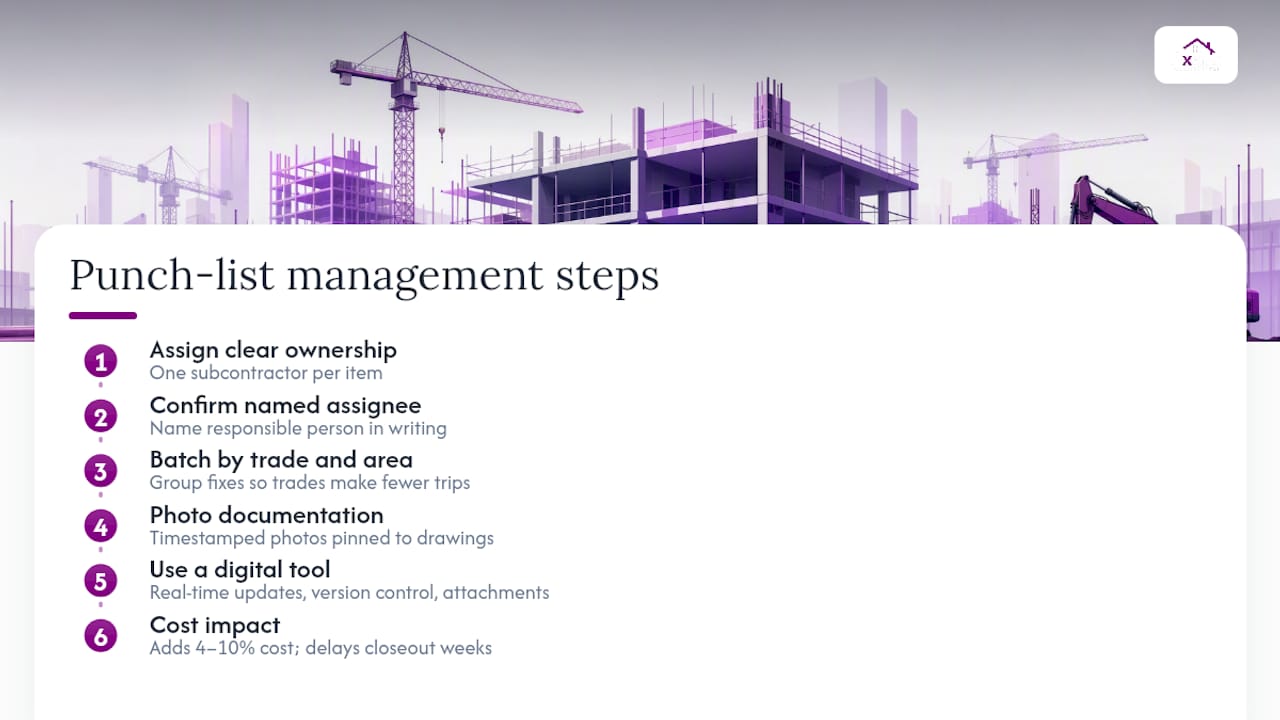
Pro Tip: Before assigning any punch item, confirm the responsible trade by name in writing. “The plumbing crew will handle it” is not the same as “Mike from ABC Plumbing owns item #14, due Friday.”
How Does Verification and Sign-Off Work?
Closing out the list follows a sequence, not a single event.
- The responsible party marks an item complete and submits photo proof.
- A verifier, often the GC’s superintendent or the architect, re-walks the item to confirm it meets spec.
- Once every item is verified, the owner or architect signs off on the punch list as a whole.
That sign-off is usually the trigger for releasing retainage, the portion of the contract sum owners commonly withhold until deficiencies are cleared. That’s exactly why contractors push hard for a zero-item list rather than accepting “close enough.” A lingering handful of items can hold up final payment for weeks.
When disputes remain, document the disagreement in writing, escalate per the contract’s dispute resolution clause, and use escrow provisions if the agreement includes them. Reviewing your construction bid process before signing helps set clear retainage terms up front, so closeout doesn’t turn into a standoff.
How Does Axenia Construction Run Punch Walks?
Our punch-walk routine follows the same discipline on every job, whether it’s a kitchen remodel or a commercial tenant buildout.
- We start documenting deficiencies as soon as a room or system is substantially finished, not at the end.
- Every item gets logged with a photo, a location, an assigned trade, and a due date, using the same fields every time.
- We batch corrective work by trade and by floor or unit, and we tie punch completion directly to the schedule milestone that unlocks the next payment draw.
A punch list that sits open for weeks isn’t a documentation problem. It’s a coordination problem, and it usually traces back to unclear ownership of individual items.
As a licensed, women-owned general contractor working across residential, commercial, and government projects, we’ve built punch-list discipline into our standard closeout process rather than treating it as an afterthought.
What Templates and Software Options Handle Punch Lists Best?
The right tool depends on project size, not preference. A simple renovation can run on a well-built spreadsheet with columns for punch number, location, description, trade, priority, photo link, dates, and verifier. Google Sheets or Excel handles this fine for a single-family remodel with a handful of trades.
Larger commercial and multifamily projects outgrow spreadsheets quickly. Once you’re coordinating a dozen subcontractors across multiple floors, a spreadsheet becomes a bottleneck: someone has to manually update it, someone else works from a stale copy, and photos live in a separate app entirely.
Digital punch-list platforms solve that by pinning each item directly to a location on the drawing set, attaching photos in the same record, and updating status in real time so the owner, architect, and GC all see the same information simultaneously. Items move through a clear workflow: open, in progress, ready for review, verified, with photo evidence required before anything reaches “ready for review.” That status gate is what actually eliminates disputes over whether work was really finished.
For homeowners managing a single renovation, a solid template is usually enough. For commercial buildouts or multi-trade projects, ask your contractor which digital system they use and whether you’ll have direct visibility into item status, not just a final PDF at handover.
What the Industry Gets Wrong About Punch Lists
Most advice on punch lists treats them as a paperwork problem: fill out the form, take the photo, move on. That misses the actual failure point. Punch lists fail because of ownership ambiguity, not documentation gaps. A missing photo is fixable in five minutes. An item nobody clearly owns can sit for three weeks while everyone assumes someone else is handling it.
The conventional advice to “do a thorough final walkthrough” is backward. By the time you’re standing in a finished space during a single closeout walk, you’ve already lost the cheapest window to fix problems, while trades are still mobilized on site. Rolling punch lists aren’t a nice-to-have process refinement. They’re the difference between catching a scratched countertop before the crew packs up and paying for a separate service call two weeks later.
If you take one thing from this: prioritize assigning single, named ownership to every item before you worry about templates or software. A perfect tracking system full of unassigned items still stalls closeout.
Frequently Asked Questions
What is a punch list in construction closeout?
A punch list is the itemized record of incomplete or nonconforming work identified near substantial completion. It guides final corrections before an owner accepts the project and releases final payment.
What is a commercial punch list, and does it differ from a residential one?
A commercial punch list covers the same core function, tracking deficiencies before acceptance, but usually involves more trades, more units or floors, and formal sign-off from an architect of record in addition to the owner.
What items typically appear on a punch list?
Common punch list examples include paint touch-ups, misaligned doors, missing hardware, HVAC balancing issues, electrical fixture problems, and scratched or damaged finishes.
How do you create a punch list?
Walk the space by area, log each deficiency with a photo, location, and assigned trade, and set a due date. Starting this process early, rather than waiting for a single final walkthrough, keeps the list manageable.
Who is responsible for closing out a punch list?
The general contractor typically coordinates the list and assigns items to subcontractors, while the owner or architect verifies completed work and provides final sign-off.
Ready to bring that same closeout discipline to your own project? Axenia Construction’s general contracting services manage punch-list tracking from substantial completion through final sign-off, so retainage release doesn’t turn into a waiting game.
Sources
- What Is a Construction Punch List? | Autodesk
- Punch Lists in Construction: Close Out Projects Without the Usual Delays (March 2026) – Constructable Blog
- Punch List Management: The Definitive Guide for Construction Teams (2026) | PunchOutPro