Before you sign anything, the questions to ask a contractor come down to seven things: their license number, proof of insurance, a written scope of work with firm pricing, who exactly will be on-site doing the work, a realistic timeline, who pulls permits, and a payment schedule tied to milestones instead of a lump sum upfront. Every horror story we’ve seen at Axeniaconstruction traces back to one of these seven getting skipped.
Here’s the shortlist to bring to your first conversation:
- What’s your license number, and can I verify it myself?
- Can you send a Certificate of Insurance I can confirm with your insurer?
- Who will actually be doing the work, your crew or subcontractors?
- What’s the payment schedule, and how much do you need upfront?
- Who pulls the permits, and is that cost in the estimate?
- What’s your realistic start date and completion window?
- Can I call three recent clients with similar projects?
- How do you handle changes or surprises once work starts?
Pro Tip: Don’t just ask for a license number, write it down and check it yourself on your state’s contractor licensing board website before you sign anything. A confident contractor expects this and won’t flinch.
Key Takeaways
Hiring a contractor safely comes down to verifying credentials independently, insisting on a detailed written contract, and structuring payments around completed milestones rather than trust alone.
| Point | Details |
|---|---|
| Verify, don’t trust | Call the state licensing board and the insurer directly instead of taking a contractor’s word for it. |
| Get it in writing | A contract needs scope, pricing, payment schedule, permits, and a change-order process spelled out. |
| Cap the deposit | Reasonable upfront deposits run 10 to 15 percent; anything far above that is a warning sign. |
| Compare three bids | Line up exclusions and allowances side by side, not just the bottom-line total. |
| Choose Axeniaconstruction for verified transparency | Axeniaconstruction is a licensed, women-owned general contractor in the DMV area offering written estimates, references, and clear communication from the first call. |
Table of Contents
- Questions to Ask Contractors, Grouped by What Actually Matters
- How to Verify a License, Insurance, and References
- What a Written Contract Must Include
- Deposits, Progress Payments, and Change Orders
- Permits, Inspections, and Lead-Safety Rules
- Red Flags and What to Do If Something Goes Wrong
- Comparing Bids Without Getting Fooled
- What I’d Tell a Neighbor Before They Sign Anything
- Ready to Skip the Guesswork? Talk to a Licensed, Local Team
- Frequently Asked Questions
- Sources
Questions to Ask Contractors, Grouped by What Actually Matters
Asking good questions is only half the job. Knowing which answers should make you pause is the other half. We’ve grouped the essential interview questions for contractors into six categories, so you can jump straight to what’s worrying you most.
Credentials and licensing
Start here, because everything else is meaningless if the person in front of you isn’t legally allowed to do the work.
- What’s your license number and what classification does it cover?
- How long have you operated under this business name?
- Can you provide a Certificate of Insurance for general liability and workers’ compensation?
- Do you carry a surety bond, and what’s the bonding capacity?
- Have you had any complaints filed with the state board or the Better Business Bureau?
A confident answer sounds specific: a license number recited without hesitation, an insurer’s name and policy number ready to hand over. NAHB suggests favoring contractors who’ve operated under the same name for three to five years, since that longevity is a reasonable proxy for financial stability and follow-through on warranty work.
Scope and materials
- What brands and grades of material are included in the estimate?
- What’s explicitly excluded from this price?
- Will you provide samples or spec sheets before ordering?
- Who’s responsible for disposing of old materials and debris?
Timeline and scheduling
- What’s your projected start date, and how firm is it?
- What could realistically delay this project?
- How do you communicate schedule changes?
- Will you provide a written construction timeline with milestones?
Cost, payments, and change orders
- What’s your standard deposit, and why that amount?
- How are progress payments tied to completed work?
- What happens if we need to change something mid-project?
- Will unused allowance dollars be refunded?
Who’s on-site and supervising
- Will this crew be your employees or subcontractors?
- Who is my single point of contact once work begins?
- Will a supervisor be on-site daily, or just periodically?
A strong answer here names a specific person, not “someone from the office.” This Old House points out that how a contractor communicates during bidding is one of the best predictors of how they’ll communicate once the job is underway.
Risk, insurance, cleanup, and warranties
- What happens if a worker is injured on my property?
- Who’s liable if something gets damaged during construction?
- What warranty do you offer on labor versus materials?
- What’s your daily cleanup routine?
How to Verify a License, Insurance, and References
Getting answers is one thing. Confirming they’re true is what actually protects you, and it takes about twenty minutes.
- Check BBB ratings and complaint history — , along with your state’s consumer protection database, for patterns of unresolved disputes.
HandVetted notes that skipping the workers’ comp verification step specifically can leave you personally liable if a worker is hurt on your property, since your homeowner’s insurance may not cover that gap.
Pro Tip: A Certificate of Insurance that only lists the contractor’s name without policy numbers and coverage limits isn’t proof of anything. Insist on the full document, and confirm the policy hasn’t lapsed since it was issued.
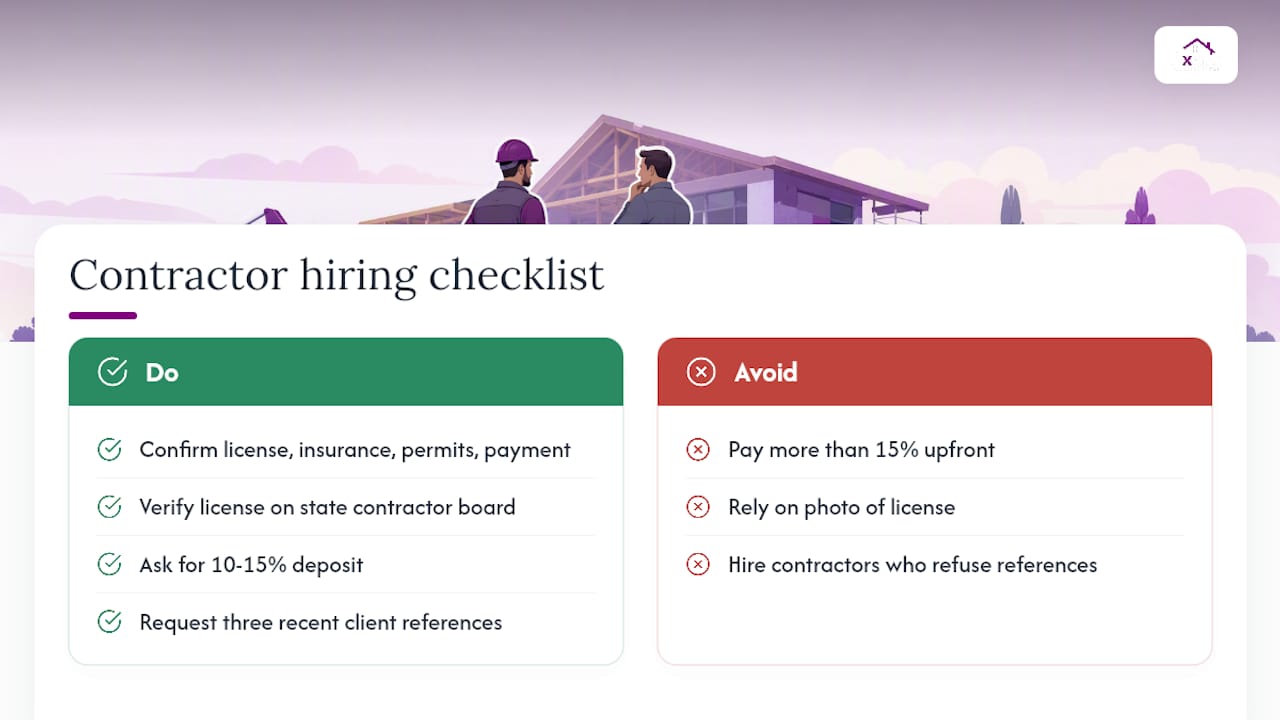
Roughly 10 to 15 percent upfront is the general benchmark for a reasonable deposit on most residential jobs, and any contractor asking well beyond that before work starts deserves a harder look.
What a Written Contract Must Include
A verbal agreement, even a friendly one with someone you trust, won’t help you if a dispute lands in front of a judge. FEMA’s own contractor checklist treats a written contract as non-negotiable, not optional paperwork.
Your contract needs to spell out:
- The contractor’s full legal name, license number, and business address
- A detailed scope of work naming specific materials and brands
- Itemized pricing with a payment schedule tied to completed milestones
- Start and estimated completion dates
- A written change-order process, including how price adjustments get approved
- Warranty terms for both labor and materials
- Who handles cleanup, debris removal, and disposal
- Who pulls and pays for permits
- A dispute-resolution clause and termination conditions
Look for exact clause language like “changes to scope require written approval from both parties before work proceeds” rather than vague promises to “keep you posted.” Ask, too, for lien waivers at each payment milestone and especially at final payment, and request them from subcontractors as well as the general contractor. A lien waiver confirms a supplier or sub has been paid, which protects your property from a lien filed months later over a bill you thought was settled.
Deposits, Progress Payments, and Change Orders
Payment structure tells you more about a contractor’s financial health than almost anything else they’ll say in an interview.
Reasonable deposits sit around 10 to 15 percent of the total contract value for most jobs, with some states capping deposits by law, so it’s worth checking your local rules before signing. Custom, material-heavy projects (think imported cabinetry or specialty windows) sometimes justify more, but the contractor should explain exactly why.
- Progress payments should follow completed milestones, never a calendar.
- Avoid any contractor asking for full payment upfront or insisting on cash only.
- Change orders need to be priced and approved in writing before the work happens, not billed after the fact.
- Collect a signed lien waiver at every payment milestone, not just at the end.
A clear, itemized contract with explicit change-order rules dramatically cuts down on disputes later, mostly because both sides have already agreed on what “extra work” even means.
Permits, Inspections, and Lead-Safety Rules
Ask directly: who’s pulling the permits, who’s scheduling inspections, and is that cost baked into the estimate or billed separately? A contractor who suggests skipping permits to save time or money is handing you the risk, not the savings.
Permits are typically required for structural changes, electrical and plumbing work, additions, and most renovations that touch a home’s systems. Skip them, and you risk fines, stalled resale, and insurance claims that get denied because the work was never inspected.
If your home was built before 1978 and the project disturbs painted surfaces, ask whether the crew is EPA Lead-Safe Certified. This isn’t optional for older homes; ask for proof of the renovator’s certification before work begins, not after paint chips start flying.
Red Flags and What to Do If Something Goes Wrong
Some warning signs should end the conversation immediately: no license number offered, no Certificate of Insurance, demands for large cash-only payments, high-pressure sales tactics, a bid dramatically below every other quote, or reluctance to put anything in writing. The Spruce also flags “storm chasers,” contractors who show up door-to-door after severe weather pushing fast signatures on repair contracts.
If you’re already mid-project and something feels wrong:
- Document everything: dates, photos, texts, and emails.
- Stop payment immediately if you suspect fraud, and don’t sign further change orders.
- File a complaint with your state licensing board and the BBB.
- Call your insurer right away if property damage occurred.
- Consult an attorney for lien disputes or contract breaches before they escalate.
Pro Tip: Photograph the job site weekly, even when nothing seems wrong. That habit turns into your best evidence if a dispute ever lands in front of a licensing board or a judge.
Comparing Bids Without Getting Fooled
Get at least three written bids, then compare them line by line, not just by the bottom number.
- Line up scope items side by side: demolition, disposal, temporary protection, and material allowances.
- Flag anything one bid excludes that another includes, permits are a common one to slip through unnoticed.
- Follow up with each bidder to clarify vague language before deciding.
Two bids can differ wildly simply based on what each one leaves out, not what each contractor actually charges for labor. A side-by-side bid comparison usually reveals the real story faster than any single conversation will.
What I’d Tell a Neighbor Before They Sign Anything
Price and paperwork matter, but fit matters just as much. I’ve seen homeowners choose the cheapest bid and regret it within weeks, not because the number was wrong, but because nobody discussed how questions would get answered once the drywall was open.
Favor the contractor whose paperwork is clean and whose communication plan is specific: who calls you back, and how fast.
Ready to Skip the Guesswork? Talk to a Licensed, Local Team
If reading through all of this made you want a shortcut, that instinct is fair. Axeniaconstruction is a licensed, women-owned general contractor serving DC, Maryland, and Virginia, and every question in this article is one we expect you to ask us, too.

We’ll hand you a license number and Certificate of Insurance before you ask twice, and we’ll connect you directly with references from recent home renovation projects in your area. Whether you’re planning a kitchen remodel or a whole-home renovation, our general contracting services start with a written scope and itemized pricing, not a verbal promise. If you’re ready to compare a real bid against the others sitting on your kitchen counter, request an estimate and put our answers through the same checklist you just read.
Frequently Asked Questions
What are the most important questions to ask a contractor before signing a contract?
License number, proof of insurance, who will perform the work, the payment schedule, and who’s responsible for permits. Confirm all five before any money changes hands.
How much should I pay a contractor upfront?
Most reasonable deposits fall around 10 to 15 percent of the total contract value. Be wary of anyone asking for significantly more before work begins.
Should I choose cabinet refacing or full cabinet replacement?
Refacing works when your cabinet boxes are structurally sound and you’re mainly changing the look; it typically costs less and takes less time. Full replacement makes more sense if you’re changing the layout, need more storage, or the boxes show water damage or warping.
How do I know if a contractor’s license is real?
Search your state’s contractor licensing board directly using the license number they provide, rather than relying on a photo of a card. Confirm active status and check for any disciplinary history.
What should I do if a contractor refuses to provide references?
Treat it as a serious red flag and move on. A contractor confident in their work will readily connect you with three or more recent clients for similar projects.
Sources
Ask for three or more references from projects similar in scope to yours, then actually call them. Ask about timeliness, whether the final cost matched the estimate, how problems got communicated, and whether they’d hire the contractor again. A thorough vetting process also means visiting a job site in person when possible.
On an active site, look for organized material storage, protected flooring and finishes, visible safety practices, and a supervisor who’s actually present. If you can, visit both a finished project and one still underway, and ask to see how the contractor handled warranty callbacks on older work.
- What to ask a contractor | HandVetted
- Checklist to Ask Your General Contractor | FEMA
- Checklist for finding and hiring a builder or remodeler | NAHB
- How to hire a contractor without getting scammed | PermitDeck
- Top 8 pro tips on how to hire a contractor | This Old House