
In the District, most commercial spaces, rentals with a business use, and multifamily or mixed-use buildings need a certificate of occupancy (C of O) from the Department of Buildings (DOB) before anyone uses them. Single-family homes in the common residential zones are exempt. If you are renovating a storefront, office or restaurant, plan the C of O into the schedule from day one, because the final inspection is what unlocks it.
This guide covers who needs a C of O, what DOB asks for, how the Certifi application works after a renovation, and how the rules differ across the river in Alexandria and Fairfax County.
TL;DR
- A C of O confirms that a building’s use matches DC zoning and the construction code. DC DOB issues it, and you apply online through its Certifi platform.
- Single-family residences in zones R-1A, R-1B, R-2 and R-3 are exempt, and DOB treats townhomes and condos as single-family homes.
- After a renovation, the usual trigger is a change of use, owner or tenant, or occupant load. Final inspections on your building permits come first.
- DOB says approval typically takes about seven business days once the application is complete.
- Alexandria and Fairfax County run their own processes, and a renovation in an existing space with a valid certificate may not need a new one in Fairfax.
Table of Contents
- What a certificate of occupancy actually is
- Who needs one in DC, and who does not
- What DOB asks for
- How to get a C of O after a renovation, step by step
- Temporary certificates when the space is nearly ready
- Timeline: where the days go
- Occupancy after renovation in Alexandria and Fairfax County
- Common mistakes that delay a C of O
- Why the contractor you hire matters here
- Our perspective
- Plan your renovation with the C of O in mind
- FAQ
- Sources
What a certificate of occupancy actually is
A certificate of occupancy is the document that says a building, structure or piece of land may be used for a stated purpose. DOB’s training materials explain that it confirms the use conforms to the DC Zoning Regulations, the DC Construction Code and the Green Building Act. Under the construction code, no one may use a building for anything other than a single-family dwelling until a valid C of O has been issued.
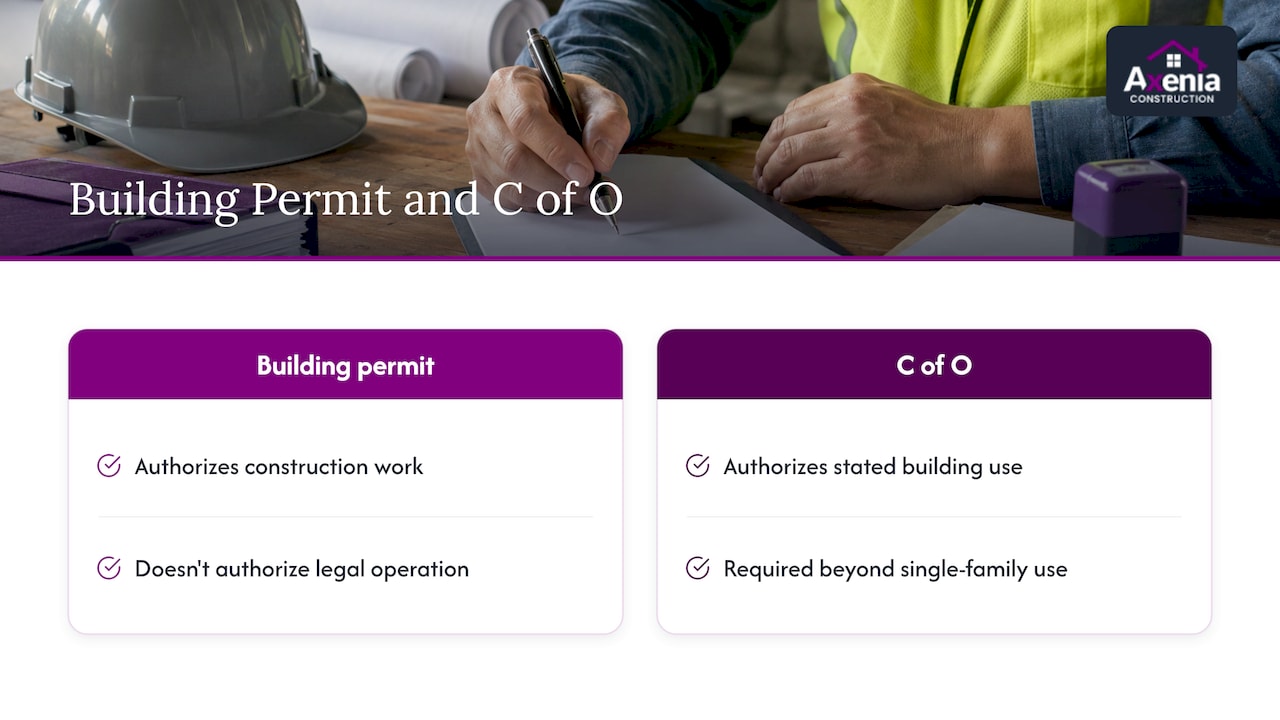
In plain terms: a building permit lets you do the work, and the C of O lets you open the doors. They are separate documents, and a finished renovation without the second one leaves a tenant or owner unable to legally operate.
The C of O also shows up in other places. A landlord may need it to lease a space, a lender may ask for it, and a business license application for a commercial address depends on it. DC’s consumer and regulatory agency states that a business operating from a commercial location needs a C of O from DOB’s Permits Division. A business run from a residence needs a Home Occupation Permit before the business license.
Who needs one in DC, and who does not
Homeowners
If you own a single-family house in R-1A, R-1B, R-2 or R-3 zoning, DOB says you do not need a C of O. That includes most rowhouses and condos, which DOB counts as single-family homes. Your kitchen, bath, addition or deck project still needs its building permits and final inspections. It just does not end with a C of O.
Two cases change that picture:
- Renting the home. DOB notes that people intending to use a property as a rental and who need a business license may obtain a renter’s license from the Department of Licensing and Consumer Protection instead.
- Running a business from home. A Home Occupation Permit is the document for that use, not a C of O.
Older or historic houses can bring extra review steps on top of the permit. If yours is one, our guide to renovating a historic home in Washington DC walks through them.
Business owners, landlords and commercial property owners
For everyone else, the rule is that you typically need a valid C of O to use a building, structure or land. DOB lists the situations that call for a new or updated one:
- A change of ownership
- A change of use
- A change in occupant load, meaning the number of people the space is approved to hold
- A revision to an existing certificate
- A temporary certificate
- A brand-new building
A new restaurant tenant taking over a former retail space is a classic example. Moving walls to fit more seating can trigger an occupant load change. Switching from office to a daycare, a gym or a clinic is a change of use. If that is your situation, read our breakdown of the change of use permit in DC alongside this guide, since the use change has to be approved before the C of O can reflect it.
Realtors
When a client is buying or leasing a commercial unit, ask early whether the existing C of O matches the intended use. A previous certificate can be pulled from DOB’s eRecords system, and the application asks for a copy when one exists. A mismatch between the C of O and the planned use is one of the most common reasons a commercial move-in date slips.
What DOB asks for
The documents depend on the application type, but DOB’s page lists a core set:
- Agent Authorization Form, if anyone other than the true owner or tenant applies. The owner or tenant signs it in front of a notary.
- Proof of your right to use the property: a signed lease, sublease, deed, management agreement or permission letter from the owner. DOB states that HUD documents are no longer accepted.
- A previous C of O, if one exists, so the new application can match the details of the space.
- Application-specific items. A temporary certificate needs an owner letter explaining why it is needed, a building plat and an evacuation plan. An occupant load change needs a previously approved C of O and an approved building permit.
DC’s code also lists what the application itself must include: the associated permit numbers and a copy of the final inspection approval, plus items such as flood elevation certificates or zoning order compliance statements where they apply. The same rule allows DOB to waive the inspection in a few cases, such as an ownership or tenancy change, a use change with no physical work, or an occupant load change that does not affect egress, plumbing or ventilation.
How to get a C of O after a renovation, step by step
Here is the routine for a commercial renovation or tenant improvement in DC. At each step we note where projects tend to stall.
Step 1: Confirm the use and the zoning
Before design starts, confirm that the zoning allows the use you plan. The C of O will not be issued for a use the zoning does not permit. If the use is changing, settle that first. Our team’s local permitting experience across DC, Maryland and Northern Virginia is built for this stage, where a wrong assumption costs weeks later.
Step 2: Get the building permits matching the work
The C of O follows the permits. DOB’s one-pager for occupant load changes requires building permits that match the new load, with final inspections completed. Permits left open, or work done under the wrong permit, are the classic roadblock.
Step 3: Pass the final inspections
Every trade permit (electrical, plumbing, mechanical) and the building permit need final approval. Treat this as a punch list that the project manager owns. When the general contractor sequences inspections and tracks open items, the C of O application can go in the day the last final is signed off. This is the part we take seriously: meticulous project management is how a build stays on its schedule.
Step 4: Create a Certifi account and apply
DOB takes C of O applications through Certifi. The workflow is:
- Search by property address and validate your identity.
- Select the application type (new, change of use, occupant load change, temporary and so on).
- Upload the required documents.
- Select a date for the required C of O inspection.
For assembly spaces such as restaurants, event rooms or houses of worship, the occupant load change also calls for a Capacity Placard Permit, which sets the posted maximum occupancy.
Step 5: Schedule the C of O inspection
DOB’s inspection page says a C of O inspection is required for final approval and offers two checklists: one for inspections with building permits and one without. Walk the checklist yourself before the inspector arrives. Exit signs, egress paths, posted placards and anything on the approved plans should match what is built.
Step 6: Review, draft, payment and issuance
DOB’s teams review the application, the issuance team sends you a draft C of O to approve, the application is invoiced, and the certificate is issued once you pay. DOB states that approval typically takes about seven business days, and you can follow the status in Certifi. Fees follow DOB’s permit fee schedule, so check the current schedule on the DOB site rather than relying on an old number.
Temporary certificates when the space is nearly ready
Sometimes part of a building is safe to use before every item is closed. DC allows a temporary C of O (TCO) for that situation. The application needs a letter from the owner explaining why it is needed and which floors, units or areas it covers, along with the plat and an evacuation plan showing which areas will be occupied and how the rest is isolated. A TCO can bridge a tight opening date, but it is a stopgap. Build the schedule around the full C of O.
Timeline: where the days go
The seven business days that DOB quotes is the review stage. The larger part of the timeline sits upstream: permit review, construction, and the final inspections. A realistic plan puts the C of O application directly after the last final inspection and includes a buffer for a re-inspection. For a fuller picture of how long fit-outs take end to end, see our tenant buildout timeline.
Occupancy after renovation in Alexandria and Fairfax County
If your property sits in Northern Virginia, the District’s process does not apply. Virginia localities run their own, under the Virginia Uniform Statewide Building Code.
Alexandria
The City of Alexandria’s Code Administration manages the CO process. Its procedures say the applicant should apply before scheduling final inspections, and separate sign-offs may be needed from:
- Planning and Zoning
- Transportation and Environmental Services (required)
- The Health Department, for uses such as food service
- The Fire Department, for commercial, industrial and shared areas of multifamily buildings
- Housing, where applicable
All building and trade permits must have final approval, fire systems must be operable with Knox Boxes in place, and accessibility must be met. The certificate is picked up through the Permit Center at (703) 746-4200. A change of occupancy also requires a new certificate before the new use begins.
Fairfax County
Fairfax County splits it into two paths. For commercial space, the Non-Residential Use Permit is applied for online in the county’s PLUS system. It requires an issued commercial building permit, completed final building and site inspections, zoning review and, where applicable, Fire Marshal and Health Department inspections. Applications go in at least five business days ahead, and the fee is $95. For a home, the Residential Use Permit is the last inspection before occupancy. All fees must be paid, all reviews approved and all final inspections passed first.
One useful point for renovators: Fairfax states that when you renovate an existing building or tenant space that already has a valid certificate, final inspection approvals may serve as the revised certificate and a new one is not required. A new certificate is needed for a new tenant space, a change of group classification, a change in floor area, or a change in owner or tenant name.
Common mistakes that delay a C of O
- Assuming the old certificate still fits. A new tenant, a new use or a new layout can make it out of date.
- Leaving a permit open. One unfinished trade permit holds up everything behind it.
- Missing ownership paperwork. No notarized agent form, or a lease that does not tie back to the owner, sends the application back.
- Booking the opening before the inspection. Treat the inspection date as the real opening milestone.
- Mixing up the three documents. A building permit, a C of O and a business license are different approvals from different offices.
Why the contractor you hire matters here
The C of O is where construction, permitting and zoning meet, so the person coordinating them matters. A general contractor who understands DC’s permit and inspection sequence can keep the final inspections, the paperwork and the opening date pointed at the same target. If you are weighing who to hire, our guide on finding a licensed general contractor in Washington DC explains what to look for. For tenants, the tenant fit out guide shows how a fit-out moves from design to handover.
Our perspective
Most delays we hear about on occupancy are not caused by DOB. They come from a project that was planned around construction and treated the certificate as an afterthought.
We build the C of O into the schedule from the first meeting: zoning and use first, permits matched to the work, final inspections sequenced, and the application ready when the last sign-off lands. As a women-owned, licensed general contractor in Rockville, we focus on transparent communication so you always know which approval is next and what it depends on.
That is also why design-build suits many occupancy-driven projects. When design and construction sit under one roof, the drawings, permits and inspections tell the same story.
Arienne
Plan your renovation with the C of O in mind
If you are renovating or fitting out a space in DC, Maryland or Northern Virginia, we manage the project from planning through final inspections, with local permitting expertise and clear communication at each stage. Learn more about our tenant buildout services or talk to us about your project through our general contracting page.

Homeowners planning a kitchen, bath or addition can start with our home renovations service.
FAQ
Do I need a certificate of occupancy for a home renovation in DC?
Usually not. DOB exempts single-family residences in zones R-1A, R-1B, R-2 and R-3, and treats townhomes and condos as single-family homes. You still need building permits and final inspections for the work itself.
How long does a certificate of occupancy take in DC?
DOB says approval typically takes about seven business days after the application is complete, and you can track it in Certifi. The overall timeline also depends on your permits and final inspections, which must be finished first.
Is a business license the same as a certificate of occupancy?
No. They are separate approvals. A business in a commercial location needs a C of O from DOB’s Permits Division, while one run from a residence needs a Home Occupation Permit before the business license is issued.
Can I occupy part of a building before the full certificate is issued?
Possibly. DC allows temporary certificates of occupancy. The application needs an owner letter explaining why, a building plat and an evacuation plan showing the areas to be occupied.
Does a renovation in Fairfax County always need a new certificate?
No. For an existing building or tenant space with a valid certificate, Fairfax says final inspection approvals may serve as the revised certificate. A new tenant space, a change of group or area, or a change of owner or tenant name does call for a new one.
Sources
- DC DOB: Certificate of Occupancy
- DC DOB: C of O application training (October 24, 2023)
- DLCP: Certificate of Occupancy and Home Occupation Permit details
- UpCodes: Application for and processing of certificates
- DC DOB: Occupant load change one-pager
- DC DOB: Certifi
- DC DOB: Request Inspection
- City of Alexandria: Certificate of Occupancy Procedures
- Fairfax County: Non-Residential Use Permit
- Fairfax County: Residential Use Permit
- Fairfax County Fire Marshal: Use and Occupancy Requirements