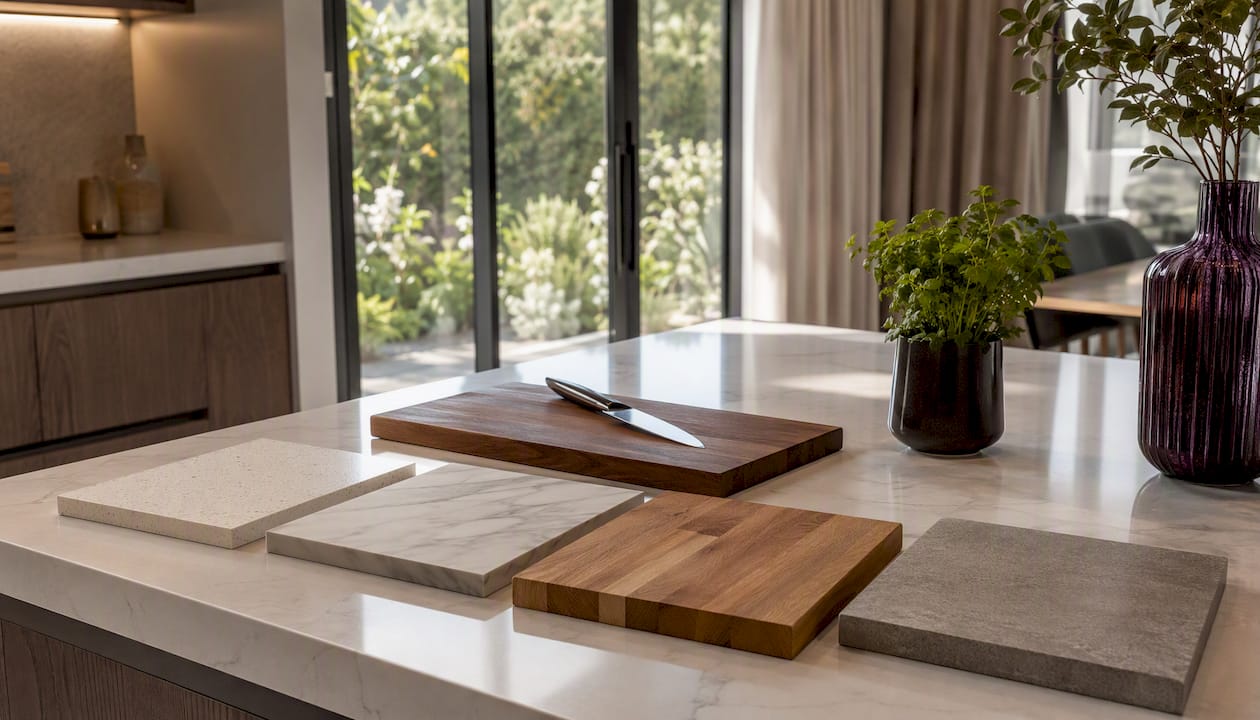
For most homeowners who want low maintenance, engineered quartz or porcelain deliver the best mix of durability and easy cleanup. If budget is the priority, laminate or ceramic tile stretch renovation dollars furthest. For a luxury look, quartzite or marble carry the design cachet natural stone lovers want, and butcher block remains the top pick for warmth underfoot and at the fingertips.
Every material trades something for something else. The countertops that need the least upkeep (quartz, porcelain, laminate) tend to look more uniform and less “natural,” while the ones with the richest, most individual character (marble, soapstone, live-edge wood) ask for more attention over the life of your kitchen. There’s no universally “best” material here, only the best fit for how you actually cook, clean, and live.
Here’s a quick-reference guide by priority:
- Low maintenance: Quartz or porcelain slabs
- Tightest budget: Laminate or ceramic tile
- Luxury appearance: Quartzite or marble
- Warm, tactile look: Butcher block or soapstone
- Heavy cooking use: Granite, quartzite, or stainless steel
Key Takeaways
The best countertop material depends on matching daily use, maintenance tolerance, and budget to the right surface rather than chasing the most popular option in the showroom.
| Point | Details |
|---|---|
| Busy family kitchens | Quartz or porcelain resist stains and scratches without sealing, ideal for daily wear. |
| Tight renovation budgets | Laminate or ceramic tile deliver the lowest cost per square foot without sacrificing basic function. |
| Luxury design goals | Quartzite or honed marble provide the natural-stone look designers favor for resale value. |
| Cook’s kitchens with heavy pan use | Granite, quartzite, or stainless steel handle direct heat exposure reliably. |
| Contractor coordination matters | Axenia Construction manages templating, fabricator scheduling, and installation oversight for a smoother remodel. |
Table of Contents
- What Are the Main Types of Kitchen Countertop Materials?
- Countertop Material Comparison Chart
- Is Quartz the Best Low-Maintenance Countertop Material?
- Why Are Porcelain and Ultracompact Slabs Gaining Popularity?
- How Does Granite Compare for Durability and Upkeep?
- Should You Choose Quartzite Over Granite or Marble?
- Is Marble Worth the Extra Maintenance?
- Does Solid Surfacing Still Make Sense for Modern Kitchens?
- Is Laminate a Smart Budget Countertop Choice?
- How Does Butcher Block Perform as a Countertop?
- What Should You Know About Soapstone Countertops?
- Are Concrete Countertops Practical for a Home Kitchen?
- When Do Stainless Steel and Metal Countertops Make Sense?
- What About Tile, Recycled Glass, and Terrazzo Countertops?
- How Do You Choose the Right Countertop Material?
- What Happens During Countertop Installation, and When Should You Hire a Contractor?
- How Eco-Friendly Are Different Countertop Materials?
- Do Countertop Materials Vary by Region and Availability?
- Which Countertop Materials Fit Different Kitchen Styles?
- Are There Health or Safety Concerns With Certain Countertop Materials?
- What Would Axenia Construction Recommend for Your Kitchen?
- How Axenia Construction Supports Your Countertop Installation
- Sources
What Are the Main Types of Kitchen Countertop Materials?
Kitchen countertop materials fall into three broad categories: engineered surfaces (quartz, solid surfacing, laminate), natural stone (granite, quartzite, marble, soapstone), and everything else, from wood and metal to concrete, tile, and recycled glass. Each category behaves differently under a hot pan, a wine spill, or a chef’s knife that missed the cutting board.
Consumer Reports tested more than a dozen countertop types for stains, heat damage, cuts, abrasion, and impact, and found that performance varies significantly by material category, though brands within the same material type performed similarly. That’s a useful reality check: paying more for a name-brand slab of the same material rarely buys you extra durability. What buys durability is choosing the right material category for your kitchen’s actual abuse level.
The industry term you’ll hear from fabricators and designers is “countertop substrate” or “surfacing material,” but “countertop material” works fine for shopping purposes. What matters more than terminology is matching the material’s real-world performance to your household. A family with three kids and a dog needs a different surface than a couple who bakes bread every Sunday and rarely touches raw meat on the counter.
Countertop Material Comparison Chart
Before you fall in love with a slab at the showroom, run it through this comparison. The columns reflect what actually fails first in real kitchens: heat marks, scratches from knives sliding off cutting boards, wine and oil stains, and the sealing routine each surface demands.
“Low” maintenance means routine soap-and-water cleaning with no periodic sealing. “Moderate” means an annual or biennial resealing task that takes an afternoon. “High” means sealing every six to twelve months, plus more careful handling of acidic foods and hot pans. Use this chart to eliminate options fast: if you know sealing is a dealbreaker, cross out marble and concrete before you even look at samples. If heat resistance near your range is nonnegotiable, porcelain and stainless steel jump to the top.
- Cross-reference cost against your total square footage before falling for a material.
- Match maintenance tolerance honestly. Nobody keeps up with quarterly sealing forever.
- Confirm undermount sink compatibility early. It affects fabrication and edge design.
Is Quartz the Best Low-Maintenance Countertop Material?
Engineered quartz is manufactured from roughly 90 to 95 percent crushed natural quartz bound with polymer resin, which is why slabs look remarkably consistent from one end to the other. That manufacturing process is also what makes quartz nonporous straight off the factory floor, with no sealing step required, ever.
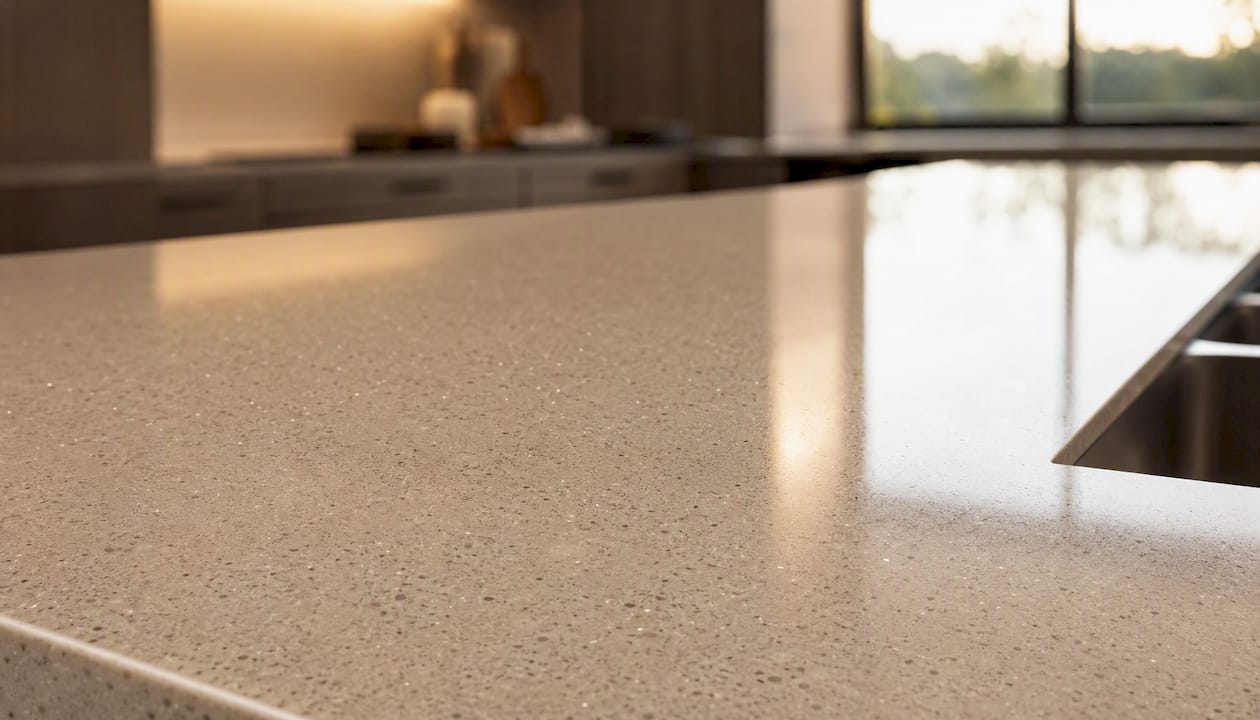
Consumer Reports lists quartz among the top performers for busy kitchens, largely because it resists the everyday chaos of wine spills, tomato sauce, and coffee rings without flinching. Engineered quartz also gives you near-total design control: because manufacturers blend the resin and stone chips, you can match an island to a backsplash pattern in a way that’s nearly impossible with natural stone.
Pros:
- Nonporous surface resists stains without sealing
- Extremely consistent color and pattern across the slab
- Scratch resistance holds up well against daily knife slips
- Wide range of colors, including convincing marble look-alikes
Cons:
- Heat resistance has real limits. Direct contact with a hot pan can discolor or crack the resin
- Edges can chip, and repairs are visible unless handled by an experienced fabricator
- Seams are more noticeable than with some natural stones
Installed quartz typically costs between moderate to higher price ranges per square foot, with major producers like Caesarstone and Silestone (Cosentino) representing the premium end of that range through proprietary colors and finish technology. Care is straightforward: mild soap and water, no bleach-based cleaners on colored surfaces, and always use a trivet.
Pro Tip: Ask your fabricator for an eased or beveled edge instead of a sharp square edge. It reduces chipping risk at the corners, where quartz takes the most abuse from dropped pans and shifting cutting boards.
Why Are Porcelain and Ultracompact Slabs Gaining Popularity?
Porcelain and ultracompact surfaces (the category that includes Dekton-style materials) are manufactured by compressing mineral particles under extreme heat and pressure, producing a surface that’s essentially glass-hard and completely nonporous. Homes & Gardens names porcelain the top pick for low maintenance and resistance to scratches, stains, and heat, calling it especially suited to high-use kitchens.
That performance comes from density. Porcelain slabs resist UV fading, which makes them a genuine option for outdoor kitchens where granite or quartz would eventually degrade. The trade-off shows up during fabrication rather than daily use.
Pros:
- Exceptional resistance to scratches, heat, and stains
- Available in large slabs, which supports dramatic vein-matching across an island
- Resists fading from sunlight, unlike resin-based quartz
Cons:
- Fabrication requires specialized tools and experienced installers
- Limited edge profile options compared to quartz or granite
- Higher risk of cracking during transport and installation if handled by an inexperienced crew
Expect to pay within a higher price range per square foot installed, with ultracompact brands often costing more due to slab thickness and specialized cutting equipment. Because full slabs can weigh several hundred pounds, cabinet support and delivery access matter more here than with most other materials.
Pro Tip: Porcelain’s rigidity makes it a strong choice for waterfall-edge islands, where the material wraps continuously from countertop to floor. Ask your fabricator about a mitered edge to hide the slab’s thinness and make it read as a thicker, more substantial surface.
How Does Granite Compare for Durability and Upkeep?
Granite is quarried, not manufactured, which means no two slabs are identical. Every piece carries its own mineral veining and crystal pattern, and that natural variation is exactly what draws homeowners toward it decades after it became a kitchen staple.
Granite performs well under heat, and setting a hot pan directly on it rarely causes damage. Scratch resistance is strong too, though the surface is porous enough that it needs periodic sealing to block stains from oil, wine, and acidic foods.
Pros:
- Outstanding heat resistance for direct pan contact
- High scratch resistance for daily food prep
- No two slabs look alike, which appeals to homeowners who want a one-of-a-kind kitchen
Cons:
- Requires resealing roughly every one to two years, depending on the finish
- Chips at the edges are possible and repair can be visible
- Color and veining vary slab to slab, which can complicate matching multiple pieces
Installed granite typically costs within a mid-range price per square foot, with exotic colors and larger veining patterns pushing toward the top of that range. A polished finish shows fingerprints more readily than a honed finish, but honed granite is more prone to staining since the surface is more porous.
To test whether your slab needs sealing, place a few drops of water on the surface. If it beads up, the seal is holding. If it darkens the stone within a few minutes, it’s time to reseal. Always view the actual slab you’re buying in person rather than relying on a sample chip. Natural variation means the piece in the showroom could look nothing like the sample.
Should You Choose Quartzite Over Granite or Marble?
Quartzite confuses a lot of homeowners because the name sounds like “quartz,” but it’s an entirely different material: a natural metamorphic stone formed when sandstone is subjected to intense heat and pressure underground. Genuine quartzite is one of the hardest natural stones available for countertops, often harder than granite.
That hardness translates directly into performance. Quartzite resists scratches better than granite in most cases and holds up well to heat. Designers quoted by RealSimple recommend natural stone for its beauty and resale value, and specifically point to honed quartzite as a way to get that natural-stone look with less visible maintenance than a polished finish would demand, since honed surfaces show fewer fingerprints and water spots.
Pros:
- Exceptional hardness and scratch resistance, often exceeding granite
- Strong heat tolerance for everyday cooking
- Unique, often dramatic veining that reads as high-end natural stone
Cons:
- Still requires periodic sealing, typically every one to two years
- Premium quartzite colors carry a steep price jump
- Naming confusion in showrooms means some “quartzite” is actually dolomite, a softer, less durable look-alike
Quartzite typically costs within a higher mid-range price per square foot, occasionally higher for rare colors like Taj Mahal or Fantasy Brown. If natural-stone performance matters more to you than granite’s lower price point, quartzite is often the better upgrade over granite or marble for kitchens that see heavy daily use. To confirm you’re getting true quartzite rather than dolomite or marble mislabeled by a showroom, ask your fabricator for a hardness test or request documentation of the stone’s geological origin.
Is Marble Worth the Extra Maintenance?
Marble’s visual appeal is hard to overstate. The soft veining and cool surface temperature have made it a favorite among serious bakers for generations, since marble stays cooler than granite or quartz, which helps when working pastry dough.
That same softness is marble’s biggest liability. It etches when lemon juice, vinegar, or wine touches the surface, leaving a dull mark that polishing can’t always fully remove. It stains more readily than granite or quartzite too, and while etching and light staining give marble a lived-in patina that some homeowners genuinely love, others find it frustrating within the first year.
Pros:
- Unmatched classic appearance with soft, distinctive veining
- Naturally cool surface, prized for pastry and baking work
- Ages into a patina that many designers consider part of its charm
Cons:
- Etches easily from acidic foods and drinks
- More prone to staining than granite or quartzite
- Handles heat reasonably but scratches more easily than harder stones
Marble typically costs within a higher price range per square foot installed. A honed finish hides etching better than a polished finish, since polished marble shows every mark starkly against its glossy surface. If you go with marble, seal it every six to twelve months and treat spills like small emergencies: blot immediately rather than wiping, which can spread the stain.
Does Solid Surfacing Still Make Sense for Modern Kitchens?
Solid surfacing, the category Corian pioneered decades ago, is made from acrylic or polyester resins blended with mineral fillers, poured into sheets with no natural stone involved at all. Its signature advantage is seamlessness: because the material can be thermoformed and joined invisibly, solid surfacing supports integrated sinks and backsplashes with zero visible seam.
That same chemistry makes solid surfacing uniquely repairable. Light scratches and burns can often be sanded out entirely, something that’s simply not possible with quartz or granite once damage sets in.
Pros:
- Seamless integration with sinks and backsplashes for a continuous, easy-to-clean look
- Scratches and minor burns can be buffed out rather than replaced
- Wide color range with a soft, matte finish option
Cons:
- Vulnerable to deep cuts from knives used directly on the surface
- Lower heat tolerance than stone or quartz; hot pans can scorch it
- Less “natural stone” prestige, which matters for some resale calculations
Solid surfacing is generally priced within a lower to mid-range per square foot installed, generally less than quartz and well below most natural stone. It makes the most sense in bathrooms, healthcare-adjacent kitchens, or any space where a truly seamless, sanitary surface matters more than heat resistance. If a scratch-prone, high-traffic prep station without heavy cooking is your priority, solid surfacing often beats engineered stone on total lifecycle cost.
Is Laminate a Smart Budget Countertop Choice?
Laminate has come a long way from the flat, plastic-looking counters of past decades. Modern high-definition printing lets manufacturers replicate marble veining and wood grain convincingly enough that it’s occasionally mistaken for the real thing from across a room.
Laminate remains the most affordable engineered option by a wide margin, and current formulations perform respectably well in stain and heat testing for everyday use, though the limits show up fast under real abuse.
Pros:
- Lowest price point of any common countertop material
- Modern designs mimic stone and wood convincingly
- Reasonable stain and heat performance for casual daily use
Cons:
- Easily cut or gouged by a knife used directly on the surface
- Not repairable; damage typically means replacing the section
- Seams and edges are more visible than higher-end materials
Laminate is generally priced at the lower end among common countertop materials per square foot installed, making it the go-to choice for rental properties, secondary prep areas, laundry rooms, and starter-home renovations where budget dictates every decision.
Pro Tip: Never cut directly on laminate, even for a quick job. A single slip with a knife leaves a permanent gouge. Keep a cutting board within reach at all times, and ask for a post-formed edge rather than a squared laminate edge; it resists chipping and moisture infiltration better over time.
How Does Butcher Block Perform as a Countertop?
Butcher block brings warmth no stone or quartz surface can replicate, and it’s one of the few countertop materials that genuinely improves with use in the eyes of many homeowners. Maple, walnut, and oak are the most common species, each with distinct grain character and hardness.
The maintenance decision that defines butcher block ownership is oil versus sealed finish. An oiled finish lets the wood breathe and is food-safe for direct cutting, but it needs reapplication every few weeks near sinks and stoves. A polyurethane-sealed finish requires far less upkeep but turns the wood into a surface you shouldn’t cut on directly, since sealing traps moisture rather than letting it evaporate.
Pros:
- Warm, tactile surface unmatched by any stone or engineered material
- Scratches and dents can typically be sanded out and refinished
- Gentle on knife edges compared to hard stone surfaces
Cons:
- Highly sensitive to standing water, especially near sinks
- Requires either frequent oiling or a sealed finish with cutting restrictions
- Susceptible to nicks, burns, and warping if not maintained
Butcher block costs typically fall within a mid-range price per square foot installed, depending on species and thickness. Keep it away from direct sink splash zones unless you commit to diligent oiling, and always use a dedicated sink surround or drainboard to protect the wood at the vulnerable edge.
Pro Tip: Reserve butcher block for an island or secondary prep zone rather than the primary sink run. You get the warmth and tactile appeal without the daily water exposure that shortens its lifespan.
What Should You Know About Soapstone Countertops?
Soapstone has a quieter reputation than granite or marble, but it’s built a loyal following among homeowners who want a classic, matte look with genuinely low-effort heat resistance. It’s a metamorphic stone rich in talc, which gives it a soft, slightly soapy feel underhand, and it has been used in laboratories and woodstoves for generations because it shrugs off heat so effectively.
Soapstone darkens over time as mineral oil is applied, moving from a pale gray-green toward a deep charcoal that many homeowners find more attractive than the original stone. Scratches happen more readily than with granite, but they’re often shallow enough to sand out yourself.
Pros:
- Outstanding heat resistance, tolerant of pots straight from the stove
- Highly resistant to staining thanks to its dense mineral structure
- Scratches and minor nicks can be sanded out at home
Cons:
- Softer than granite or quartzite, so nicks happen more easily
- Color darkens noticeably with regular mineral oil application, which not everyone wants
- Limited color palette compared to granite or quartz
Soapstone generally falls within a higher mid-range price per square foot installed. Apply mineral oil every few weeks during the first year to develop the patina, tapering to occasional touch-ups once the color settles. It suits farmhouse and traditional kitchens especially well, and with reasonable care it can last as long as granite.
Are Concrete Countertops Practical for a Home Kitchen?
Concrete countertops appeal to homeowners who want something no other material offers: total customization of shape, color, and texture, down to embedding tile, glass, or metal accents directly into the surface. They come in two forms, cast-in-place, poured directly onto the cabinets, and pre-cast, formed off-site and installed like a slab.
The practical challenges are real and worth taking seriously before committing. Concrete is heavy enough that cabinets often need additional bracing, and hairline cracks can develop as the material cures and settles, especially with cast-in-place installations.
Pros:
- Fully customizable shape, color, texture, and embedded design elements
- Strong heat resistance for direct cookware contact
- Genuinely one-of-a-kind, since each pour is unique
Cons:
- Significant weight often requires reinforced cabinetry
- Prone to hairline cracking, especially in cast-in-place applications
- Requires consistent sealer maintenance to prevent staining
Concrete countertops generally are priced within a higher mid-range to upper-end price per square foot installed, with intricate custom work pushing toward the top of that range. Sealers come in two types: topical sealers sit on the surface and need reapplication every year or two, while penetrating sealers soak into the concrete and generally last longer with less frequent maintenance. Ask your fabricator which sealer type they use and how often it needs renewing before signing a contract.
When Do Stainless Steel and Metal Countertops Make Sense?
Stainless steel dominates commercial kitchens for good reason. It’s nonporous, resists bacteria, and shrugs off heat that would damage nearly every other material on this list, which is why restaurant lines are lined with it from end to end.
For a residential kitchen, stainless steel and other metals like copper and zinc bring that same performance with a distinct aesthetic trade-off. Copper and zinc develop a living patina over time, darkening and shifting tone in a way some homeowners love and others find unpredictable. Stainless steel doesn’t patina, but it shows fingerprints and light scratches constantly, which is either a nonissue or a daily irritation depending on your tolerance for visible wear.
Pros:
- Outstanding heat resistance and hygiene, ideal for heavy cooking
- Completely nonporous, with no sealing ever required
- Distinctive, professional-grade appearance that suits cook-focused kitchens
Cons:
- Shows fingerprints and light scratches readily, especially with a polished finish
- Custom fabrication costs run high for large or complex layouts
- Can dent under significant impact, unlike stone
Metal countertops tend to be priced in a higher range per square foot installed, with custom copper and zinc work often landing at the top of that range. A brushed finish hides fingerprints and light scratching far better than a polished finish. For fingerprints, a quick wipe with a microfiber cloth and stainless cleaner handles most daily marks, and light scratches can often be buffed with a fine abrasive pad in the direction of the grain. Stainless steel earns its place in a home kitchen when you cook seriously and often, particularly if you’re already drawn to a commercial-style range and hood.
What About Tile, Recycled Glass, and Terrazzo Countertops?
Tile countertops split into two very different experiences: traditional field tile with grout lines, and large-format porcelain slabs that minimize grout almost entirely. Field tile offers the most design flexibility of any material on this list, since you can mix colors, patterns, and even salvaged pieces, but grout lines demand real maintenance and can stain or crack over time.
Recycled glass and terrazzo countertops take a different eco-conscious approach, embedding crushed glass or stone chips (often from post-consumer or post-industrial sources) into a resin or cement binder. Better Homes & Gardens lists recycled glass among the design-forward options homeowners increasingly consider alongside more traditional stone and quartz choices.
Pros:
- Tile offers nearly unlimited design and pattern flexibility
- Recycled glass and terrazzo repurpose post-consumer material, appealing to eco-conscious remodelers
- Both resist heat well and offer strong stain resistance when properly sealed
Cons:
- Grout lines in field tile require regular cleaning and occasional resealing
- Tile surfaces can crack under heavy impact
- Recycled glass and terrazzo installation requires experienced fabricators, which limits availability in some regions
Field tile varies considerably based on material and pattern complexity, generally costing less than some other options; large-format porcelain tile and recycled glass or terrazzo are typically moderately priced per square foot. Reseal grout annually in high-use kitchens, and consider an epoxy grout from the start since it resists staining far better than standard cementitious grout. Tile suits eclectic, bohemian, and farmhouse kitchens especially well, where visible pattern and texture are part of the design goal rather than something to minimize.
How Do You Choose the Right Countertop Material?
Narrowing a dozen-plus options down to one decision comes down to answering a short list of questions honestly, in this order:
- How hard is this kitchen used? A household that cooks daily and hosts often needs different durability than a lightly used secondary kitchen.
- What’s the real maintenance tolerance? Be honest about whether resealing marble twice a year will actually happen.
- What’s the total budget, including fabrication and installation, not just the slab price?
- Does the sink style require specific edge or seam compatibility? Undermount sinks need a nonporous edge material like quartz, granite, or solid surfacing.
- Does the material match the kitchen’s design direction? Farmhouse leans toward butcher block and soapstone; modern leans toward quartz and porcelain.
Budget planning should account for more than the per-square-foot slab price. Fabrication, edge profiles, sink cutouts, and removal of the old countertop typically add 20 to 40 percent on top of the base material cost. Premium colors within any material category, whether it’s a rare quartzite or an exotic quartz pattern, can push the total 30 percent or more above standard options. BobVila’s cost guidance is a useful sanity check when a fabricator’s quote seems unusually high or low for the material in question.
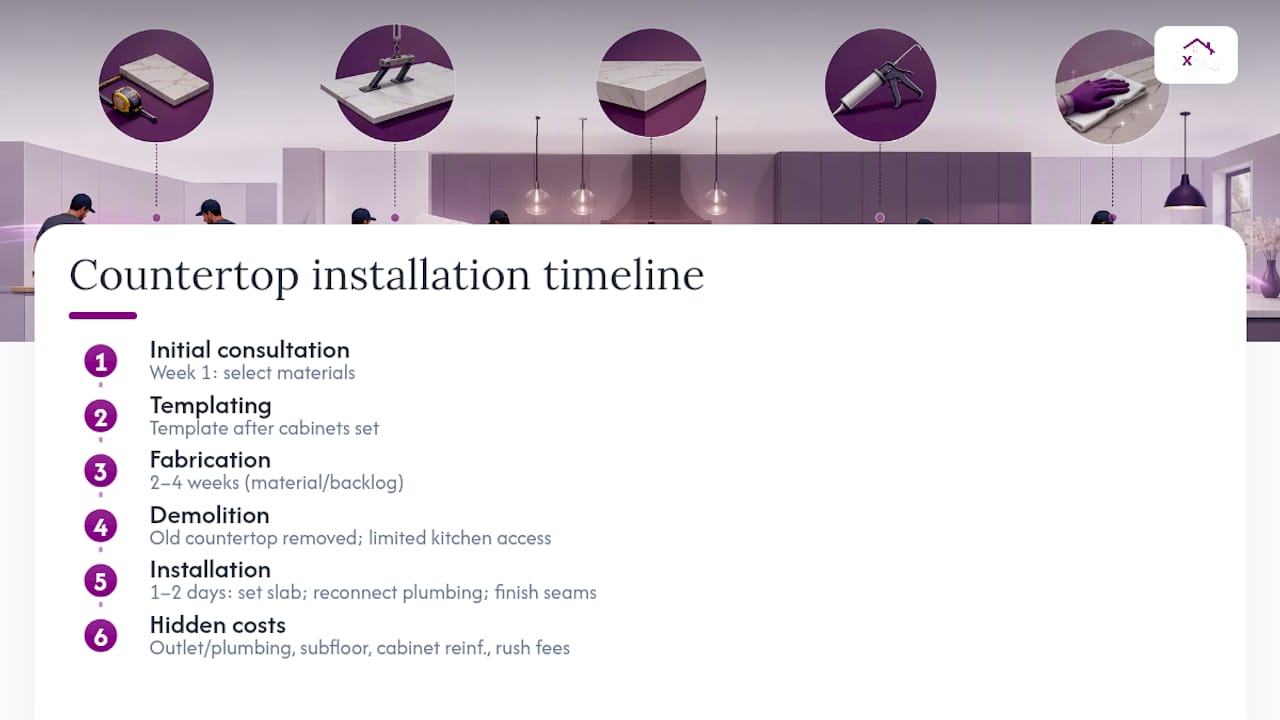
A typical countertop replacement timeline runs four to six weeks from signed contract to final installation:
- Week 1: Template the existing space (measured digitally or with a physical template)
- Weeks 2 to 4: Fabrication at the slab yard, which varies by material and current order volume
- Week 5: Old countertop demolition and new slab installation, sink cutouts included
- Week 6: Sealing, final inspection, and any punch-list touch-ups
Before signing with a fabricator or contractor, ask these questions directly:
- Where will seams fall, and can I see a seam diagram before fabrication begins?
- Is my chosen sink style (undermount, drop-in) compatible with this material’s edge?
- What warranty covers cracking, staining, or seam separation?
- What’s the current lead time from template to install, given material availability?
| Contractor Question | Why It Matters |
|---|---|
| Seam placement | Poor seam placement is highly visible and can trap debris |
| Sink compatibility | Undermount sinks need specific edge finishing that not all materials support |
| Warranty terms | Coverage varies widely by material and fabricator |
| Lead time | Slab availability and fabrication backlogs shift by season and region |
HouzzWire advises homeowners to physically inspect full slabs and gather multiple quotes rather than trusting a small sample chip, since natural stone in particular can vary dramatically from the sample to the actual slab you receive.
Watch for these red flags before signing anything:
- A quote significantly below every other bid for the same material and square footage
- Reluctance to show you the actual slab before fabrication
- No written warranty or unclear language about what it covers
- Vague answers about seam placement or lead time
What Happens During Countertop Installation, and When Should You Hire a Contractor?
Countertop installation involves more moving parts than most homeowners expect, which is exactly why a general contractor’s coordination role matters. A full countertop replacement typically includes demolition of the old surface, substrate preparation and reinforcement if needed, precise sink and faucet cutouts, plumbing disconnection and reconnection, digital or physical templating, fabrication lead time, delivery and installation, seam finishing, and a final walkthrough inspection.
Hidden costs catch a surprising number of homeowners off guard. Moving an electrical outlet or plumbing line to accommodate a new layout adds cost that rarely shows up in the initial slab quote. Damaged subfloor discovered during demolition, additional cabinet reinforcement for heavier materials like concrete or quartzite, and rush fabrication fees when a slab needs to be expedited can all add unbudgeted line items late in the project.
A realistic installation timeline with milestones looks like this: initial consultation and material selection in week one, digital templating once cabinets are set, a fabrication window of two to four weeks depending on the material and current shop backlog, then a one to two day installation window that includes old countertop removal, new slab setting, and sink/faucet reconnection. Homeowners should plan for limited kitchen access during demolition and installation days specifically, not the full fabrication period.
Pro Tip: Before hiring anyone, verify their contractor license and insurance directly with your state licensing board rather than taking their word for it. A properly licensed and insured general contractor coordinates the fabricator, plumber, and electrician as one team, which matters far more than most homeowners realize until a scheduling conflict threatens the whole timeline.
How Eco-Friendly Are Different Countertop Materials?
Sustainability varies more across countertop categories than most homeowners assume. Recycled glass countertops and terrazzo lead the pack because they’re built from post-consumer or post-industrial waste, glass bottles, mirror scraps, and stone offcuts, bound into a durable surface rather than sent to a landfill.
Natural stone materials like granite, quartzite, and marble carry a different kind of environmental profile. They’re not manufactured with synthetic resins, but quarrying and long-distance shipping of dense stone slabs carry a real transportation footprint, and the extraction process itself disturbs land. Engineered quartz sits in between: it uses natural stone content but relies on polymer resins that come from petroleum-based sources, which affects both its production footprint and its end-of-life recyclability, since resin-bound composites are harder to break down and repurpose than pure stone.
Butcher block and other wood surfaces are genuinely renewable when sourced from responsibly managed forests, and they biodegrade at the end of their life in a way no engineered surface can match. Concrete’s environmental impact depends heavily on the cement mix used, since cement production is energy-intensive, though some fabricators now offer lower-carbon mix alternatives. If eco-friendliness ranks high on your priority list, recycled glass, terrazzo, and responsibly sourced wood are the strongest choices, with natural stone a reasonable middle ground over resin-heavy engineered surfaces.
Do Countertop Materials Vary by Region and Availability?
Not every material shows up with the same ease at every fabricator, and regional supply chains genuinely shape both price and selection. Granite and marble quarried overseas, in Brazil, Italy, or India, ship through major ports and distribution yards, which means coastal metro areas often have deeper slab selection and faster turnaround than more rural regions.
Local quarrying also matters. Soapstone and certain granite varieties have historically been sourced domestically in parts of the country, which can shrink both cost and lead time compared with imported stone. Popular engineered brands like quartz and porcelain slabs typically move through regional distribution centers, so availability depends more on how close you are to a major fabrication hub than on the raw material’s origin. If you’re in the Mid-Atlantic region, ask your contractor which slab yards they source from regularly. Established relationships with local suppliers often mean shorter lead times and better access to the full range of colors, rather than only what’s sitting in a showroom sample book.
Which Countertop Materials Fit Different Kitchen Styles?
Material choice shapes a kitchen’s personality as much as cabinet color or hardware finish does. Modern kitchens generally lean on quartz and porcelain for their clean, consistent surfaces and minimal visual noise, especially in monochromatic or two-tone color schemes. Traditional kitchens tend to favor granite and marble, where natural veining and warmer tones complement raised-panel cabinetry and classic hardware.
Farmhouse-style kitchens gravitate toward butcher block, soapstone, and honed natural stone, materials with texture and a lived-in character that fits the aesthetic’s relaxed, functional roots. Eclectic or bohemian kitchens often embrace tile, recycled glass, and terrazzo precisely because those materials support bold pattern and color choices that quartz and granite can’t replicate. Industrial-style kitchens, meanwhile, are where stainless steel and concrete genuinely shine, echoing the exposed, utilitarian look that defines the style. None of these pairings are rules carved in stone. A quartzite island can anchor a farmhouse kitchen just as well as a soapstone one, but understanding the typical pairing helps you avoid a material that fights your cabinetry and lighting choices instead of complementing them.
Are There Health or Safety Concerns With Certain Countertop Materials?
Sealing chemicals used on natural stone are one area worth understanding before you commit to a high-maintenance material. Most modern penetrating sealers are formulated to be food-safe once fully cured, but they do off-gas during application, so proper ventilation matters during the sealing process itself, particularly in the first 24 to 48 hours.
Food safety differences between materials are smaller than marketing sometimes suggests. Nonporous surfaces like quartz, porcelain, and solid surfacing resist bacterial growth in surface pores simply because they don’t have meaningful pores to begin with. Porous natural stone, granite, marble, and unsealed soapstone, can theoretically harbor bacteria in microscopic surface irregularities if not properly sealed and cleaned, though normal kitchen hygiene practices largely offset this risk. Wood surfaces have a long, well-documented history of safe food-prep use as long as they’re cleaned and oiled appropriately; some research has even suggested wood’s natural antimicrobial properties compare favorably to plastic cutting surfaces. The practical takeaway: any material can be used safely with reasonable cleaning habits, but nonporous options simplify that hygiene equation for households that don’t want to think about it.
What Would Axenia Construction Recommend for Your Kitchen?
Having coordinated countertop installations across residential and commercial projects throughout the region, our take is straightforward: durability should win for any kitchen that sees daily family use, and appearance should only take the lead once the durability bar is already cleared. A gorgeous marble island means little if it’s etched and dull within eighteen months because nobody had the bandwidth to blot every wine spill immediately.
For families who cook constantly and want zero-maintenance peace of mind, we steer clients toward quartz or porcelain nearly every time. For design-forward remodels where the client has already accepted the maintenance trade-off, quartzite and honed marble deliver a look that engineered materials still can’t fully replicate. Our project portfolio includes kitchen remodels across a range of styles and budgets, and the pattern holds consistently: the homeowners happiest five years later chose their material based on how they actually live, not how a showroom sample looked under gallery lighting.
How Axenia Construction Supports Your Countertop Installation
Choosing the right material is half the job. Getting it templated, fabricated, and installed without a scheduling mess is the other half, and that’s where a general contractor earns their fee. Axenia Construction manages the full sequence: templating your space accurately, coordinating directly with fabricators so seam placement and lead times are locked in early, overseeing installation day so sink cutouts and plumbing reconnections go smoothly, and following up on warranty questions after the crew leaves.
As a women-owned general contractor serving residential and commercial clients, we bring the same project management discipline to a kitchen countertop swap that we bring to a full renovation. If you’re weighing materials against a real budget and timeline, our kitchen remodel budget planning guide is a solid next stop, and our general contracting services page outlines exactly what our team handles from first template to final walkthrough. Ready to talk specifics? Reach out through our home renovation services page and get a real quote for your kitchen, not a guess.
Sources
- Kitchen Countertop Guide
- The Most Durable and Low-Maintenance Kitchen Countertop Materials | Homes and Gardens
- The Best Countertop Materials for Every Type of Kitchen
- How to Choose the Right Kitchen Countertop for You
- How to Choose the Right Countertop for Your Kitchen Remodel
Before you commit to any material, visit a fabricator’s showroom in person and inspect full slabs under natural light rather than relying on a sample chip. Stone, in particular, can look dramatically different once you see the whole piece.
Recommended
- Kitchen Remodeling in Bowie, MD: Transform Your Home with Modern Luxury Design – Axenia Construction
- Kitchen Remodeling in Bethesda, MD: Upgrade Your Home with Modern Design – Axenia Construction
- Kitchen Remodeling in Alexandria, VA: Upgrade Your Home with Modern Design & Functionality – Axenia Construction
- Luxury Kitchen Remodeling in Potomac, Maryland: Modern Design Trends That Increase Home Value – Axenia Construction