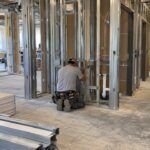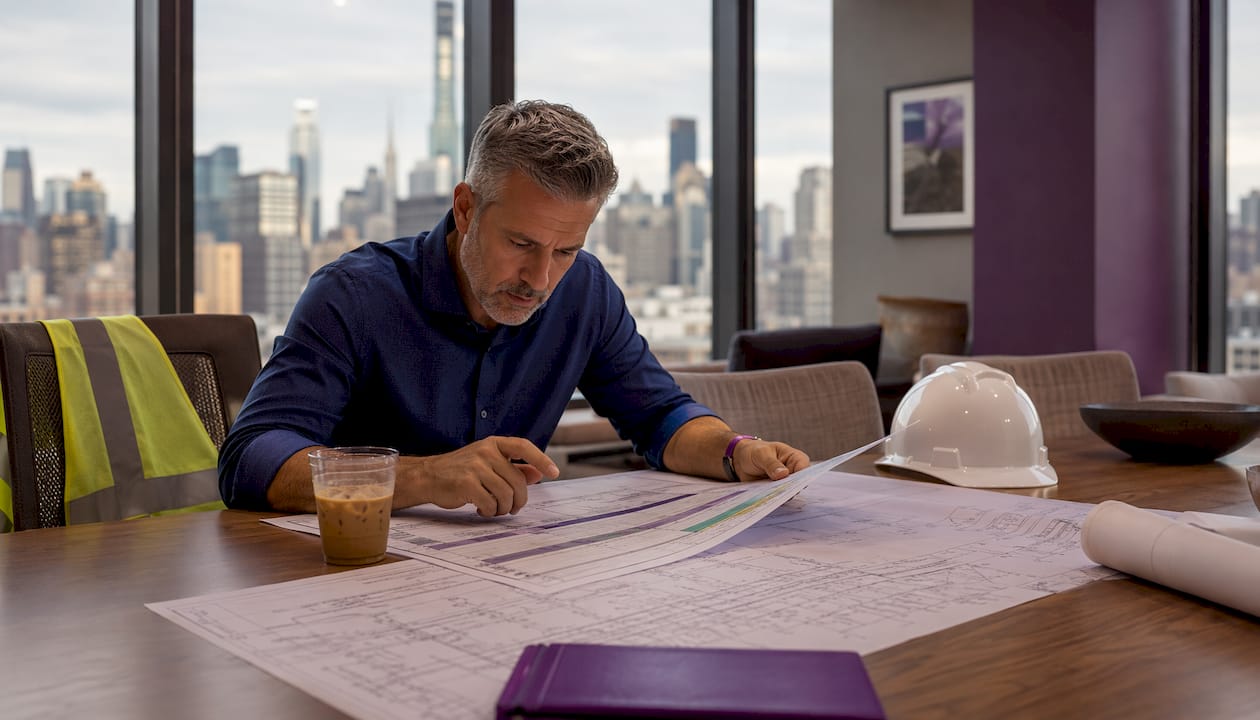
Phased construction for commercial projects means dividing a build into sequential, planned stages so that portions of a facility can open, generate revenue, or remain operational while later work continues. Project phasing creates a roadmap of measurable milestones that helps owners and general contractors control complexity without shutting down the entire site. The core benefits are three: revenue continuity through early occupancy, capital risk mitigation by validating market demand before committing to later phases, and operational continuity for tenants and owners. At Axeniaconstruction, we work with commercial developers and construction managers across the DC, Maryland, and Virginia regions to plan and deliver exactly this kind of staged approach.
- Revenue continuity: Completed sections open and generate income before the full project finishes.
- Capital risk mitigation: Early-phase lease-up data validates rent assumptions before later phases commit capital.
- Operational continuity: Tenants or building users stay in place while adjacent work proceeds safely.
Table of Contents
- When does phased construction make sense for your project?
- How phasing strategies differ across commercial project types
- Pre-construction planning essentials for phased commercial projects
- Which contract forms reduce risk in phased commercial projects?
- Managing the site when operations and construction overlap
- Cost, schedule, and risk tradeoffs you need to plan for
- Common pitfalls and how to prevent them
- What a phased office/retail project actually looks like
- Key Takeaways
- What we’ve learned from phased commercial projects
- Axeniaconstruction’s phased commercial construction services
- Useful sources and further reading
When does phased construction make sense for your project?
Phasing works best when maintaining revenue-generating operations during construction is a priority. Common commercial scenarios include large mixed-use developments, active retail centers needing renovation, tenant-in-place office refits, market-driven multi-building campuses, and funding-limited expansions where capital must be staged over time.
Watch for these decision signals:
- Financing constraints that require early occupancy to service debt
- Tenants or operations that cannot relocate during construction
- Market uncertainty that makes full upfront commitment risky
- Long site complexity requiring sequential infrastructure work
- Staged tenant requirements tied to lease execution milestones
The honest tradeoff: phasing accelerates market entry and limits initial exposure, but it typically increases overall project cost because of repeated mobilizations and duplicated temporary works. If your project has highly integrated systems where a single continuous build yields better life-cycle cost, phasing may not be the right call.
How phasing strategies differ across commercial project types
Not every phased project looks the same. The strategy you choose should match your project’s primary objective, whether that’s speed to market, revenue generation, or cost control.
| Phasing Strategy | How It Works | Best Suited For | Primary Objective |
|---|---|---|---|
| Occupancy phasing | Sectional completion lets tenants fit out and open completed areas first | Mixed-use, multi-tenant retail, office | Early revenue generation |
| Area/footprint phasing | Build one wing, parcel, or building at a time | Multi-building campuses, large retail centers | Operational continuity |
| Vertical phasing | Complete lower floors before upper floors | High-rise office, hotel, residential-over-retail | Structural sequencing |
| Horizontal phasing | Build across the site footprint in sequential zones | Industrial parks, campus expansions | Site logistics control |
| Functional phasing | Infrastructure and core systems first, fit-out later | Healthcare, lab, data center | System reliability |
| Hybrid/center-out | Core amenities built first to anchor later phases | Mixed-use town centers | Demand creation |
Occupancy phasing is the most common choice for commercial developers because it ties directly to lease revenue. Functional phasing suits projects where MEP infrastructure must serve the whole facility before any tenant can occupy. Hybrid models, like the center-out sequencing used in large mixed-use centers, build the anchor tenant or shared amenity first to draw foot traffic that supports later retail phases.
Pre-construction planning essentials for phased commercial projects
Strong planning before a shovel hits the ground is what separates a smooth phased project from a costly one. The pre-construction phase for a phased commercial project requires more detailed coordination than a single-phase build.
Pre-construction checklist:
- Scope-by-phase drawings with clear phase boundaries and interface details
- Phased permitting plan with sequenced submissions and inspection schedules
- Temporary services and utilities plan for each active phase
- Traffic, parking, and pedestrian management for occupied areas
- Life-safety and egress provisions for all occupied zones during construction
- Tenant relocation or operational continuity plans
- Roles confirmed: owner, CM/GC, design team, tenant representatives, MEP lead, and permitting authority
Designing adaptable infrastructure — modular utility corridors, oversized stubbed services, and reserve capacity — positions each phase to tie into later work without expensive retrofits. This is one of the highest-value decisions made in early design, and it costs far less than reworking a closed-in structure later.
Pro Tip: Specify phased utility stub sizes and future connection points in your contract documents from day one. This single step eliminates the most common source of change orders when later phases begin.

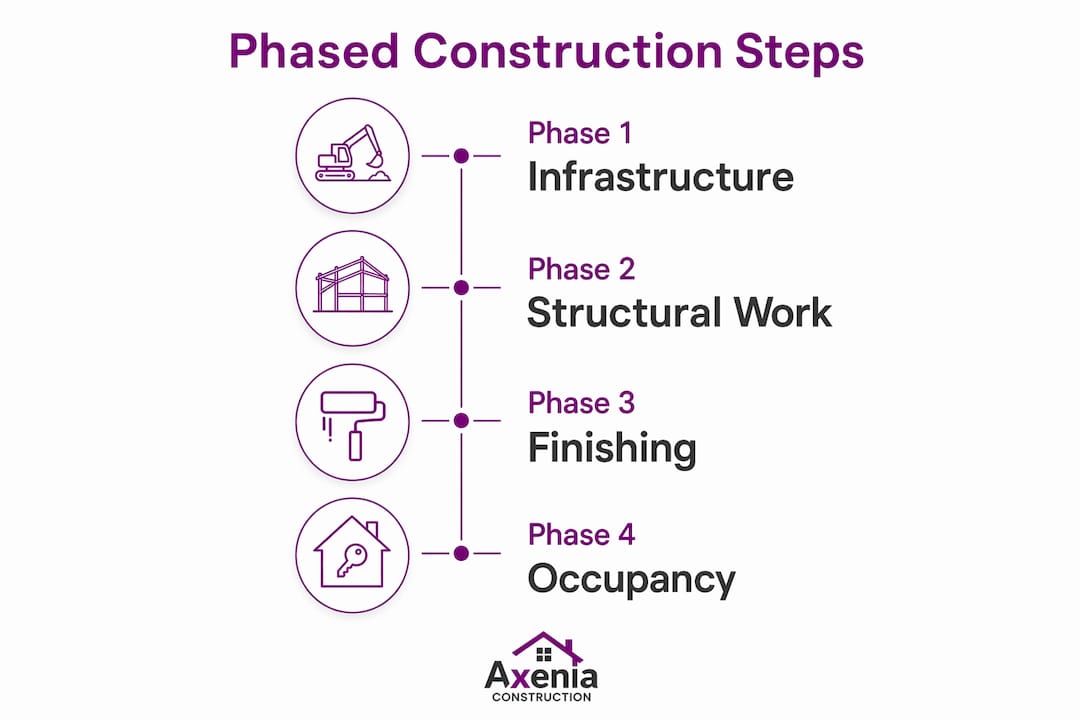
A realistic phasing timeline template for a three-phase commercial project looks like this: Phase 1 site work and foundations (months 1–6), Phase 1 core and shell with sectional completion certificate (months 7–14), Phase 2 structural and MEP rough-in (months 10–18, overlapping), Phase 2 fit-out and commissioning (months 16–22), Phase 3 construction and final certificate of occupancy (months 20–28).
Which contract forms reduce risk in phased commercial projects?
Contract structure matters as much as construction sequencing. The right form protects both owner and contractor when scope, schedule, and funding evolve across phases.
Phased Guaranteed Maximum Price (GMP) amendments are the most common approach: the owner and CM/GC agree on a GMP for each phase as design is sufficiently complete, rather than locking a single GMP for the whole project upfront. This preserves pricing accuracy and gives the owner flexibility to pause or modify later phases based on market conditions.
Construction Manager at Risk (CMAR) with staged buyouts works well for large, complex projects. The CM is engaged early for preconstruction services, then buys out trade packages phase by phase as design advances. This model supports phased commercial delivery and early contractor involvement without requiring full design completion before construction begins.
Separate bid packages per phase give owners maximum pricing competition but require more procurement management and can create coordination gaps between contractors. A single contract with sectional completion clauses is simpler to administer and keeps accountability with one team.
Key contract clauses to include: sectional completion certificates tied to each phase, phased liquidated damages or milestone incentives, allowance language for future-phase scope increases, and clear change-order paths for interface conditions. Bonds and insurance should be reviewed phase by phase; sureties and insurers may require phase-specific documentation, particularly when sectional completion certificates transfer risk incrementally.
Managing the site when operations and construction overlap
Clearly defined, secured, and communicated work zones are the single most important operational control on a phased commercial site. When this breaks down, safety risk and operational disruption follow quickly.
Site management practices:
- Physical barriers (hoarding, chain-link, or temporary walls) between active construction and occupied areas
- Controlled access points with badging or escort protocols for contractors entering occupied zones
- Dust and noise mitigation: negative air pressure in construction zones, scheduled noisy work during off-hours
- Dedicated staging and laydown areas that do not encroach on tenant parking or egress
- Secure, ADA-compliant pedestrian routes maintained throughout all phases
Communication plan elements:
- Advance tenant notifications (minimum 48 hours) for any work affecting utilities, access, or noise
- Posted signage at all phase boundaries and temporary egress routes
- Emergency contact list distributed to all operations staff and tenants
- Daily briefings between the CM/GC superintendent and building operations manager
MEP handovers on phased projects require careful system isolation. When one portion of a building is live and another is under construction, HVAC zones, electrical panels, and plumbing systems must be isolated and clearly labeled. Temporary services — portable HVAC, generator power, temporary restrooms — should be specified in the phasing plan, not improvised in the field.
Cost, schedule, and risk tradeoffs you need to plan for
Phasing shifts cost drivers in ways that surprise owners who are new to the approach. Repeated mobilizations, duplicated temporary works, and longer overall timelines increase total project cost compared to a single continuous build. The offset is lower initial capital outlay and earlier revenue capture from occupied phases.
Phase stacking — overlapping later-phase work before earlier phases fully complete — can shorten the overall calendar significantly. The risk is that imprecise MEP coordination creates rework when the structure closes in. A dedicated MEP sequencing plan, tied to phase milestones, is not optional when stacking is used.
Developers increasingly use phased commercial development to validate demand with initial building phases before committing capital to later expansions — a discipline that protects against overbuilding in uncertain markets.
Risk register items to track across all phases: phased permitting conflicts, utility tie-in coordination windows, tenant-driven late scope changes, and contingent funding gaps tied to lease-up performance.
Common pitfalls and how to prevent them
- Unclear work zones causing operational disruption — Require detailed zone drawings and signage plans from the GC before each phase begins; hold daily coordination meetings between the superintendent and building operations.
- Conflicting permitting expectations between phases — Develop a phased permitting strategy early; phased permitting compresses timelines but risks conflicts when later design changes contradict earlier inspected work. Document phase assumptions in every permit submittal.
- Insufficient MEP coordination during phase stacking — Require a dedicated MEP sequencing plan and schedule MEP coordination reviews as phase milestones, not as an afterthought.
- Pricing erosion from repeated mobilization — Consolidate procurement for long-lead items (switchgear, elevators, roofing systems) across all phases and use staged purchase commitments to lock pricing early.
- Scope creep at phase interfaces — Define interface conditions in contract documents with allowance language; require the GC to flag interface conflicts during each phase’s preconstruction review.
Bidder checklist owners should require during procurement: phased site logistics plan, MEP sequencing narrative, phased permitting schedule, temporary services plan, and a phase-interface risk register.
What a phased office/retail project actually looks like
A mid-size office/retail complex with three phases illustrates how this works in practice.
| Phase | Scope | Duration | Key Milestone |
|---|---|---|---|
| Phase 1 | Sitework, foundations, district utilities, parking structure | Months 1–6 | Site permit issued; utility infrastructure complete |
| Phase 2 | Core and shell, retail ground floor, MEP rough-in for all phases | Months 6–16 | Sectional completion certificate; retail tenant fit-out begins |
| Phase 3 | Upper-floor office fit-out, commissioning, final CO | Months 16–22 | Certificate of occupancy; full building operational |
The critical design decision in Phase 1 is building district-scale infrastructure — electrical, data, HVAC distribution, and plumbing mains — sized to serve all three phases. The Mission Rock development in San Francisco used exactly this approach: district systems built in Phase 1 allowed later phases to tie in without disrupting occupied buildings. Stubbed connections, oversized conduit sleeves, and reserved mechanical room space are the physical proof that adaptable infrastructure was planned, not retrofitted.
Key Takeaways
Phased commercial construction works when it is planned deliberately — with adaptable infrastructure, clear contracts, and disciplined site management from day one.
| Point | Details |
|---|---|
| Phase when operations must continue | Phasing is the right choice when tenants, revenue, or operations cannot stop during construction. |
| Design infrastructure for all phases upfront | Oversized stubs, modular utility corridors, and reserved capacity prevent costly retrofits in later phases. |
| Match contract form to phase complexity | Phased GMP amendments or CMAR with staged buyouts protect pricing and flexibility across phases. |
| Treat work zones as safety documents | Detailed zone drawings, signage, and daily coordination meetings prevent disruption and liability on occupied sites. |
| Axeniaconstruction for phased commercial delivery | Axeniaconstruction provides phased preconstruction planning, CM/GC delivery, and staged commissioning across the DC, MD, and VA region. |
What we’ve learned from phased commercial projects
The most consistent mistake we see on phased commercial projects is treating the phasing plan as a scheduling document rather than a design document. By the time the schedule is written, the decisions that make or break a phased project — utility stub locations, permit sequencing, MEP zone boundaries — have already been made, or missed.
At Axeniaconstruction, our standard practice is to involve the CM in preconstruction before schematic design is complete. That timing lets us influence the decisions that matter: where to locate phase boundaries, how to size temporary services, and which long-lead items to procure across all phases at once. Our construction process is built around this kind of early collaboration.
We also recommend against phasing when a project’s systems are deeply integrated — a hospital central plant, for example, where a single continuous build yields better life-cycle cost and fewer commissioning risks than staged handovers. Phasing is a tool, not a default.
Axeniaconstruction’s phased commercial construction services
Phased commercial projects demand a contractor who plans the whole project before building any of it. Axeniaconstruction brings licensed GC expertise, local DC/MD/VA permitting knowledge, and a genuine commitment to keeping your operations running while we build.
Our phased commercial services include preconstruction phasing analysis, phased permitting coordination, CM/GC delivery with staged GMP amendments, MEP sequencing plans, and staged commissioning support. When you come to a first meeting, bring your site plan, any existing lease commitments, and your financing timeline — those three inputs shape every phasing decision that follows.
To start a phased-construction consultation, visit our commercial construction services page or review our full general contracting capabilities. We are ready to help you scope, sequence, and deliver your project in phases that work for your tenants, your capital stack, and your schedule.
Useful sources and further reading
The following practitioner and industry sources informed this guide:
- Procore — Project phasing milestones and schedule control; referenced in the BLUF definition and cost/schedule sections.
- RETTEW — Adaptable infrastructure and commercial permitting; referenced in the pre-construction checklist and utility stub guidance.
- Propmodo — Mission Rock phased mixed-use development; referenced in the illustrative example.
- Samuels Group — Phase stacking, mobilization costs, and operational continuity; referenced in cost/schedule and when-to-use sections.
- Western Building Consultants — Work-zone planning and communication plans; referenced in site operations and pitfalls sections.
- Facility Authority — Phased permitting risks and scheduling; referenced in pitfalls and pre-construction sections.
- Kettlestone — Demand validation through phased commercial development; referenced in cost/schedule and when-to-use sections.
- Boom & Bucket — Foundational definition of phased construction; referenced in the BLUF opening.