
The construction bid process is the formal method by which contractors submit detailed proposals for building projects, enabling you to select qualified professionals based on cost, timeline, and capability. Whether you are planning a home renovation in Rockville, MD, or managing a commercial build, understanding this process protects your budget and your project. The four primary phases are bid solicitation, bid submission, bid selection, and contract formation. Each phase has specific requirements, and skipping steps or misreading bids can lead to costly surprises. This guide walks you through every stage so you can approach your next project with confidence.
What is the construction bid process and how does it work?
The construction bid process is a structured sequence that connects project owners with qualified contractors through formal, competitive proposals. The industry term for this sequence is “competitive tendering,” though “bidding” is the everyday term most owners use. Both refer to the same four-phase framework.
The four consecutive phases are bid solicitation, bid submission, bid selection, and contract formation. Each phase builds on the last, and precision at every step reduces financial risk for you as the owner.
Phase 1: Bid solicitation. You, as the project owner, issue a formal document inviting contractors to submit proposals. This document takes one of three forms: an Invitation for Bid (IFB), a Request for Proposal (RFP), or a Request for Qualifications (RFQ). An IFB focuses on price. An RFP asks for a full project approach. An RFQ screens contractors by qualifications before pricing is discussed.
Phase 2: Bid submission. Contractors review your documents and prepare a complete bid package. A complete bid package must include the scope of work, itemized labor, material and equipment costs, project timelines, company qualifications, and proof of insurance or bonding. Missing any of these elements can disqualify a bid immediately.

Phase 3: Bid selection. You review all submitted bids and compare them. This step often involves bid leveling, which is explained in detail later. You evaluate price, qualifications, timeline, and risk before making an award decision.
Phase 4: Contract formation. Once you select a contractor, both parties negotiate final terms, sign a legal agreement, and finalize the scope before work begins. This phase is where vague language causes the most problems, so read every clause carefully.
Pro Tip: Ask every contractor to submit a written list of clarifying questions before the bid deadline. Their questions reveal how thoroughly they read your documents and how well they understand your project.
What are the common types of construction bidding?
Project owners use three primary tendering methods, and the right choice depends on your project type, timeline, and how much control you want over contractor selection.
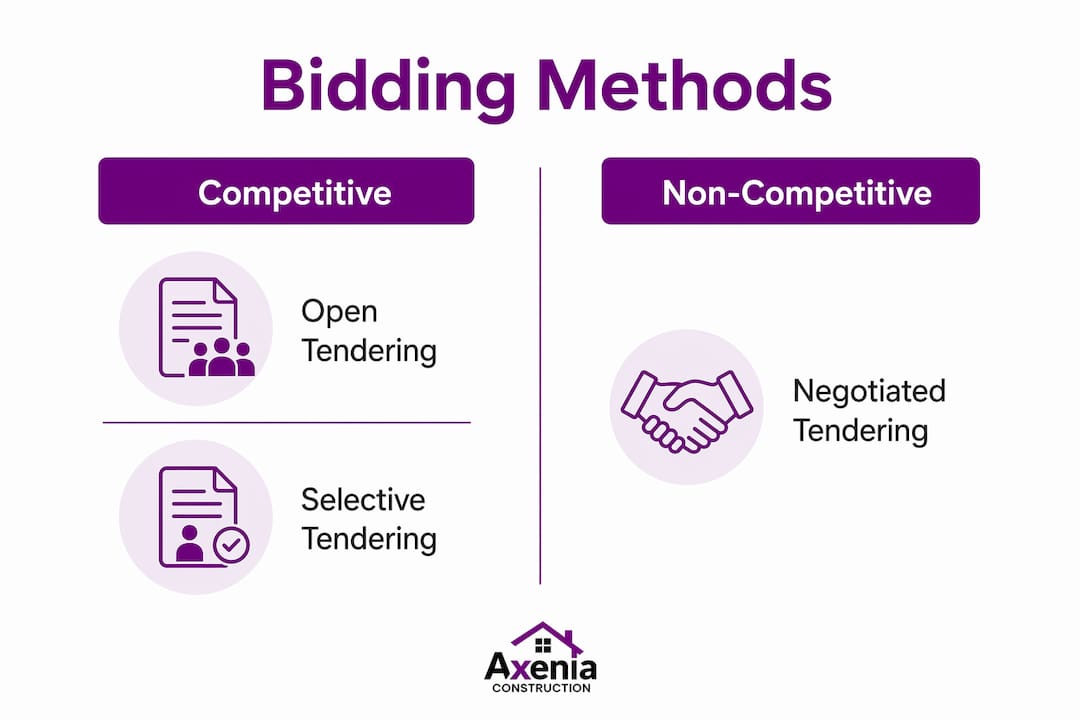
Open tendering is the most common method for government and publicly funded projects. Any licensed contractor can submit a bid after you advertise the project publicly. This method produces the most competition and typically the widest price range. The tradeoff is that you may receive bids from contractors with little relevant experience.
Selective tendering limits the field to contractors you invite directly. You prequalify candidates based on experience, financial capacity, and past performance before issuing bid documents. Private owners and commercial property managers favor this method because it filters out unqualified bidders upfront.
Negotiated tendering skips competitive bidding entirely. You select one contractor and negotiate price and terms directly. This approach works well when speed matters, when a contractor has unique expertise, or when you have an established relationship built on past projects.
| Tendering type | Competition level | Transparency | Best for |
|---|---|---|---|
| Open tendering | High | Highest | Public and government projects |
| Selective tendering | Moderate | Moderate | Private commercial projects |
| Negotiated tendering | None | Lower | Fast-track or specialized work |
Each method carries different risk profiles. Open tendering gives you the most price options but requires more vetting after bids arrive. Selective tendering front-loads the vetting work but saves time during bid review. Negotiated tendering is fastest but gives you no price benchmark from competing bids.
How are construction bids prepared and what do they include?
A professional bid package is not a rough estimate. Three terms are often confused, and the distinction matters financially.
- An estimate is an internal calculation a contractor uses to figure out their own costs. You never see this document.
- A proposal is a detailed project offering that outlines approach, scope, and pricing. It is more common in design-build or negotiated projects.
- A bid is a formal, competitive offer submitted in response to your solicitation documents. It is legally binding once accepted.
Misunderstanding these three terms causes contractors to submit unprofitable bids or lose contracts. As an owner, it also causes you to compare documents that are not equivalent.
A complete bid package covers these core elements:
- Scope of work with clear inclusions and exclusions
- Itemized costs broken down by labor, materials, equipment, and overhead
- Project schedule with milestones and completion date
- Company qualifications, licenses, and references
- Proof of general liability insurance and workers’ compensation coverage
- A bid bond, typically valued at 5–10% of the total bid amount
A bid bond is a legal guarantee that the contractor will execute the contract if awarded. If the contractor withdraws after winning, you can claim against the bond to cover your costs of re-bidding. This protection is standard on commercial projects and increasingly common on larger residential renovations.
General contractors also collect bids from subcontractors for specialized trades like electrical, plumbing, and HVAC. Those subcontractor bids roll up into the general contractor’s total price. Errors in subcontractor bids are one of the most common sources of post-award cost disputes.
Pro Tip: Request a written scope clarification from every bidder before award. Ask each contractor to confirm exactly what is and is not included in their price. This one step prevents the majority of change order disputes.
What factors influence bid selection beyond the lowest price?
The lowest bid is rarely the best bid. Selecting the lowest bidder often leads to contractors increasing contract costs through change orders after award, making the initially cheap bid the most expensive outcome.
Bid leveling is the process that makes fair comparison possible. Bid leveling adjusts each bid to a comparable scope, accounting for exclusions, assumptions, and allowances that differ between contractors. Without this step, you are comparing bids that do not cover the same work.
Beyond price, strong bid evaluation covers these factors:
- Contractor reputation: Check references from projects of similar size and type.
- Safety record: Request the contractor’s Experience Modification Rate (EMR). A rate above 1.0 signals higher-than-average workplace incidents.
- Relevant experience: A contractor who has completed five similar projects carries less execution risk than one attempting your project type for the first time.
- Financial capacity: Ask for a financial reference or bonding capacity letter. A contractor who cannot finance materials and labor through the project cycle creates cash flow risk for your schedule.
- Subcontractor relationships: Established subcontractor networks reduce the risk of trade delays.
Evaluation criteria extend beyond price to include contractor competence, safety records, and financial stability. Owners who ignore these factors and award on price alone frequently face project delays, quality defects, and budget overruns that dwarf the initial savings.
Bid bonds add another layer of protection during this phase. The financial penalty mechanism they create ensures contractors honor awarded contracts. If a contractor defaults after award, the surety company covers your re-bidding costs up to the bond amount.
What are common project delivery methods and contract types?
The delivery method you choose shapes how bidding works, who is responsible for what, and how risk is distributed across the project.
Design-Bid-Build, Construction Manager at Risk, and Job Order Contracting each impact bidding timelines, contractor responsibilities, and project execution differently.
- Design-Bid-Build (D-B-B): The most traditional method. You hire a designer first, complete full drawings, then solicit competitive bids. Contractors bid on a fully defined scope, which produces the most accurate price comparisons.
- Construction Manager at Risk (CMAR): You bring a construction manager on early, before design is complete. The CM provides cost input during design and then takes on the financial risk of delivering within a guaranteed maximum price.
- Job Order Contracting (JOC): A pre-priced contract vehicle common in facility management. Work is ordered against a pre-established unit price book, eliminating the need for individual bids on each task.
Contract type also affects how you evaluate bids. The design-build approach combines design and construction under one contract, which changes the bidding structure entirely.
| Contract type | How price is set | Best for |
|---|---|---|
| Lump sum | Fixed total price | Well-defined scopes |
| Cost-plus | Actual costs plus a fee | Projects with evolving scope |
| Unit price | Price per measurable unit | Repetitive or phased work |
Applying the correct delivery method improves project success and bid competitiveness. Choosing the wrong method for your project type adds cost and confusion. A residential renovation with a clear scope fits a lump sum contract well. A commercial tenant improvement with an evolving program often suits cost-plus better.
For a deeper look at commercial contract types, the differences between lump sum and cost-plus agreements have significant implications for your budget risk.
Key Takeaways
The construction bid process is a four-phase framework covering solicitation, submission, selection, and contract formation, and owners who understand each phase make better award decisions and avoid costly surprises.
| Point | Details |
|---|---|
| Four phases define the process | Solicitation, submission, selection, and contract formation each require specific actions from owners and contractors. |
| Bid type shapes competition | Open tendering maximizes competition; selective and negotiated tendering prioritize speed and contractor quality. |
| Lowest bid carries risk | Underbidding leads to change orders; use bid leveling to compare bids on equal terms before awarding. |
| Bid bonds protect owners | A bid bond worth 5–10% of the bid amount covers re-bidding costs if a contractor defaults after award. |
| Delivery method affects bidding | Design-Bid-Build, CMAR, and JOC each change how bids are structured, who bears risk, and how prices are set. |
What I have learned from watching owners navigate the bid process
After working through dozens of construction projects with homeowners and commercial property owners, one pattern stands out clearly. Owners who treat the bid process as a formality almost always pay more in the end. Owners who treat it as a decision-making tool get better projects at fairer prices.
The single most underused step is asking clarifying questions before bids are submitted. Submitting RFIs during pre-bid phases reduces costly surprises and change orders after award. Most owners do not know they can request this, and most contractors will not volunteer it unless asked.
Bid leveling is the other step that separates experienced owners from first-timers. When three bids come in at $180,000, $210,000, and $240,000, the instinct is to pick the lowest. But if the $180,000 bid excludes electrical rough-in and the $210,000 bid includes it, the real comparison is $210,000 versus $210,000. The “cheap” bid was never cheap.
My honest advice: do not sign a contract until you have read every exclusion listed in the bid. Exclusions are where scope gaps hide. A contractor who lists ten exclusions is being transparent. A contractor who lists none either has a perfect scope or has buried assumptions in their price that will surface as change orders.
The bid process exists to protect you. Use it fully.
— Arienne
How Axeniaconstruction helps owners through every phase
Navigating bids, contracts, and contractor selection is a lot to manage on your own. Axeniaconstruction works with homeowners and commercial property owners in the Rockville, MD area to bring clarity and confidence to every stage of the construction process.

From helping you understand what belongs in a complete bid package to reviewing contractor qualifications before you sign, our team brings transparency to a process that can otherwise feel opaque. Whether you are planning a home renovation or a commercial build, we are here to guide you through the details that matter. Our general contracting services cover residential, commercial, and government projects, with a commitment to honest communication at every step. Reach out to Axeniaconstruction and get a partner who explains the process, not just the price.
FAQ
What is the construction bid process in simple terms?
The construction bid process is a formal sequence where contractors submit detailed price and scope proposals for a project, and the owner selects the best fit based on cost, qualifications, and timeline. It typically follows four phases: solicitation, submission, selection, and contract formation.
What should a construction bid include?
A complete bid must include the scope of work, itemized labor and material costs, a project schedule, company qualifications, proof of insurance, and a bid bond. Missing any of these elements can disqualify a bid before it is reviewed.
Is the lowest construction bid always the best choice?
No. Selecting the lowest bid often results in higher total costs because contractors may underbid and then recover costs through change orders. Bid leveling and a full review of contractor qualifications produce better outcomes than price alone.
What is a bid bond and why does it matter?
A bid bond is a legal guarantee, typically 5–10% of the bid amount, that a contractor will execute the contract if awarded. If the contractor withdraws after winning, the owner can claim against the bond to cover re-bidding costs.
What is the difference between an estimate, a proposal, and a bid?
An estimate is an internal cost calculation the contractor keeps. A proposal is a detailed project offering used in negotiated or design-build projects. A bid is a formal, competitive offer submitted in response to an owner’s solicitation documents.