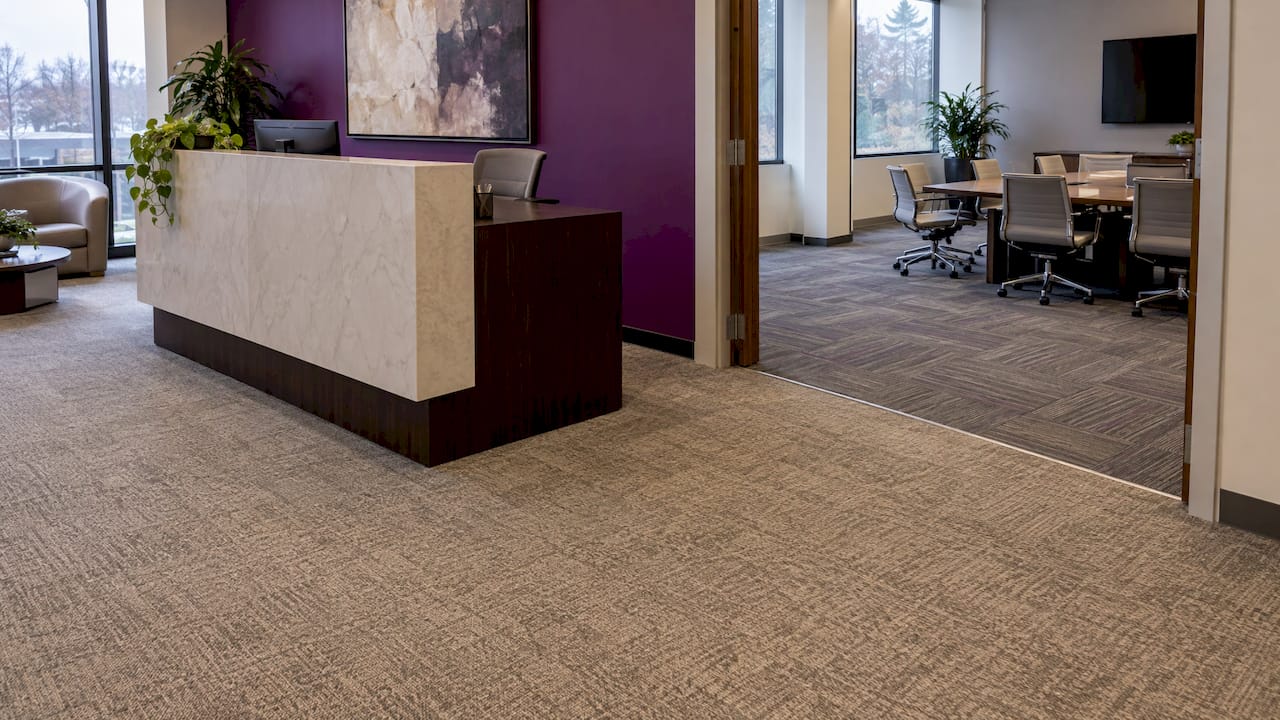
Choose broadloom when you want one continuous, soft surface in a room that is cleared and stays quiet, such as a bedroom, boardroom or hotel corridor. Choose carpet tile when wear is uneven, furniture is hard to move, moisture is a risk or you will need to repair the floor without disturbing the whole space. Cost is closer than most guides suggest, because the real price difference comes from waste, padding, downtime and what happens in year five. We are a Rockville, Maryland general contractor, and this is how we walk owners through the decision before flooring goes into a renovation or buildout.
TL;DR
- Broadloom is wall-to-wall carpet sold on wide rolls and laid over padding. It looks seamless and feels soft, but a damaged area often means a patch or a full replacement.
- Carpet tile comes in pre-sized squares with its own backing, so you can lift and swap single tiles. It suits offices, basements, corridors and any space with concentrated wear.
- Broadloom often has the lower material price. Tile tends to win on waste, installation speed, downtime and repairs, so compare the whole installed job, not the price per square foot on the label.
- Subfloor condition and moisture decide more than style. A floor that is uneven or damp changes which product works.
- Settle the carpet decision early in the project plan, because it affects schedule, subfloor work and furniture moves.
Table of Contents
- What the two products actually are
- Side-by-side comparison
- Cost: what really separates the two
- Durability, repairs and lifespan
- Maintenance that protects either choice
- Where each one wins
- What this means for homeowners
- What this means for commercial owners and property managers
- Subfloor and installation: where projects go wrong
- Our perspective
- Plan your flooring inside the right project
- FAQ
- Sources
What the two products actually are
Both are carpet. The difference is the format and how each is installed.
Broadloom is carpet made on a wide loom and sold on rolls. The Carpet and Rug Institute (CRI), the industry’s trade association, lists commercial broadloom widths of 12, 13.5 or 15 feet. Installers stretch it over a separate pad, cut it to the room and join the pieces at seams. When the seams are placed well, the floor reads as a single surface and patterns can run unbroken across the room.
Carpet tile, also called modular carpet, comes as squares or planks with a built-in backing. Common sizes are 18 by 36 inch planks and 24 by 24 inch squares, according to a hospitality carpet manufacturer’s technical guide. It sits directly on the subfloor with no separate pad. CRI notes that tile can be installed with standard, releasable or mill-applied peel-and-stick adhesives, and that it can go down under jacked-up furniture.
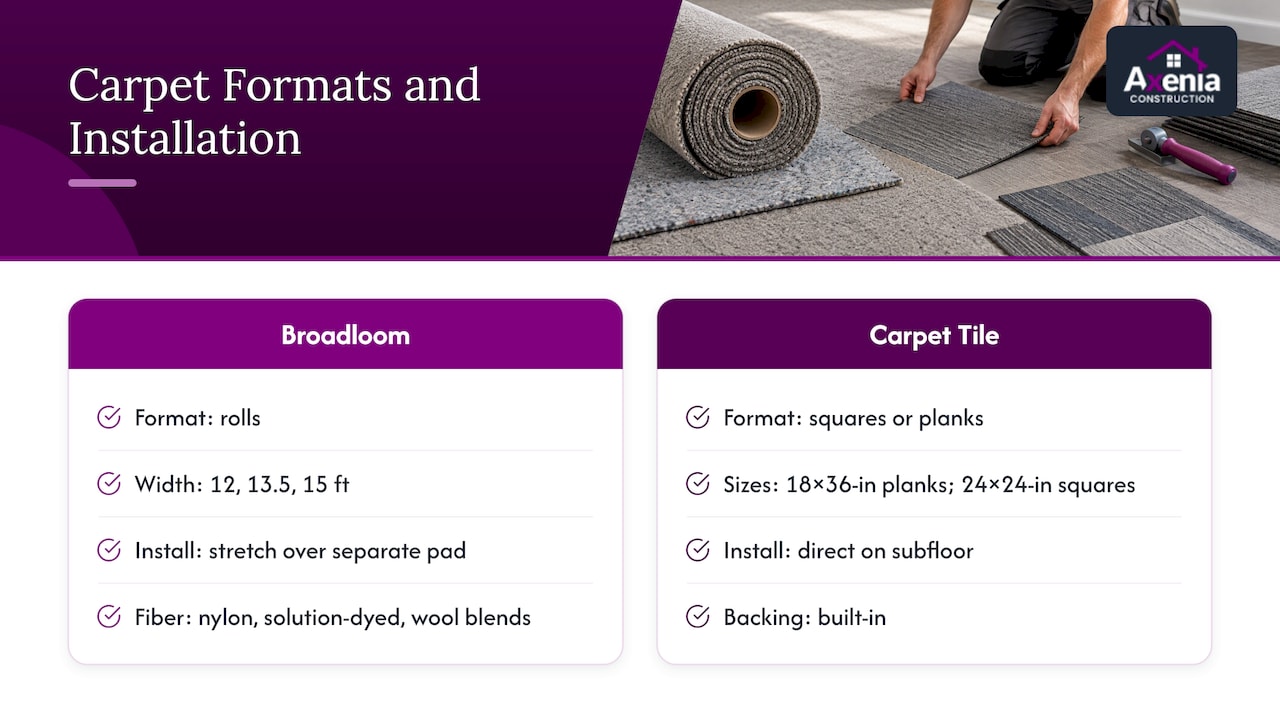
The fiber matters as much as the format. Nylon, solution-dyed fibers and wool-blend constructions are available in both, so do not assume that tile means a commercial look or broadloom means a soft home look. Ask which fiber, pile height and backing a specific product uses, then compare like with like.
Side-by-side comparison
| Factor | Broadloom | Carpet tile |
|---|---|---|
| Look | Seamless, continuous, supports custom patterns and mosaics | Visible grid lines, though layouts like ashlar or quarter-turn can make that a design feature |
| Feel underfoot | Softest, especially over a quality pad | Firmer; cushion-backed tile narrows the gap |
| Installation | Stretched or glued down, seams to be cut and joined, rooms usually cleared | Laid tile by tile, little cutting, can be done in zones |
| Waste | Higher, because rolls are cut around room shapes | Lower, because small modules fit odd shapes |
| Repairs | Cut-in patch or section replacement | Swap one tile |
| Moisture | Traps moisture against the slab if it gets wet | Tiles can be lifted and dried, backings can act as a moisture barrier |
| Hides subfloor flaws | Yes, the pad helps with minor imperfections | No, the subfloor must be flat and clean |
| Best fit | Bedrooms, boardrooms, hotels, large continuous areas | Open offices, corridors, basements, tenant spaces |
Cost: what really separates the two
Homeowners and owners of commercial property ask the same first question: which is cheaper? The honest answer is that broadloom frequently has the lower material price and tile frequently has the lower total cost of ownership in busy spaces. Published installed prices vary widely with fiber grade, traffic rating, region and project size, so treat any per-square-foot figure in a blog as a rough range and ask for a written bid on your own floor plan.
Here is what moves the total on both sides:
- Material price. Broadloom tends to be less per square foot. CRI notes that the reduced business disruption of overnight tile installation often makes up for tile’s extra product cost.
- Pad. Broadloom needs a separate pad, which is another material and another labor step. Tile has its backing built in.
- Waste. Rolls are cut to fit, and the offcuts are often unusable. The US EPA notes that tile’s smaller size reduces trimming waste in spaces with unusual dimensions, even though a tile’s thicker backing uses more material up front.
- Subfloor preparation. Removing old flooring, patching and leveling, and moisture treatment on a slab are separate line items on either product. Broadloom’s pad forgives small flaws; tile does not.
- Labor and schedule. Seam work and stretch-in installation take time on broadloom. Tile goes down faster and can be phased around occupied areas.
- Lifecycle. The EPA points out that tile can save material in the long run because worn or soiled tiles are replaced individually rather than the whole floor.
A simple worked example shows why waste matters. Say a corridor-and-office suite is 13 feet wide in one section. A 12-foot roll cannot cover that width in one piece, so the installer needs a second strip and a seam, and the leftover from that strip may go to the dumpster. A 13.5-foot roll might fit, but then the layout is locked to that roll width. With 24-inch tiles, you order the area plus a small overage and the cut tiles at the edges can often be reused elsewhere. The same logic applies in a home with bump-outs, closets and stairs: odd shapes punish rolls more than modules.
For a budget you can trust, ask for pricing on the same fiber and traffic rating in both formats, with pad, removal, subfloor work, furniture moves and after-hours labor listed separately. That makes the comparison honest.
Durability, repairs and lifespan
Carpet lasts as long as its construction, traffic and care allow, and a poor installation can shorten life and trouble a warranty. Within that, the formats age differently.
In a broadloom floor, a stain, burn or worn path forces a choice: live with it, patch it, or replace a larger area. A patch is hard to hide because the new piece is cut into a floor that has aged around it. In a tile floor, you lift the damaged tile and drop in a replacement. That difference is the reason many property managers prefer tile in corridors, entrances and reception areas where wear concentrates in predictable lanes.
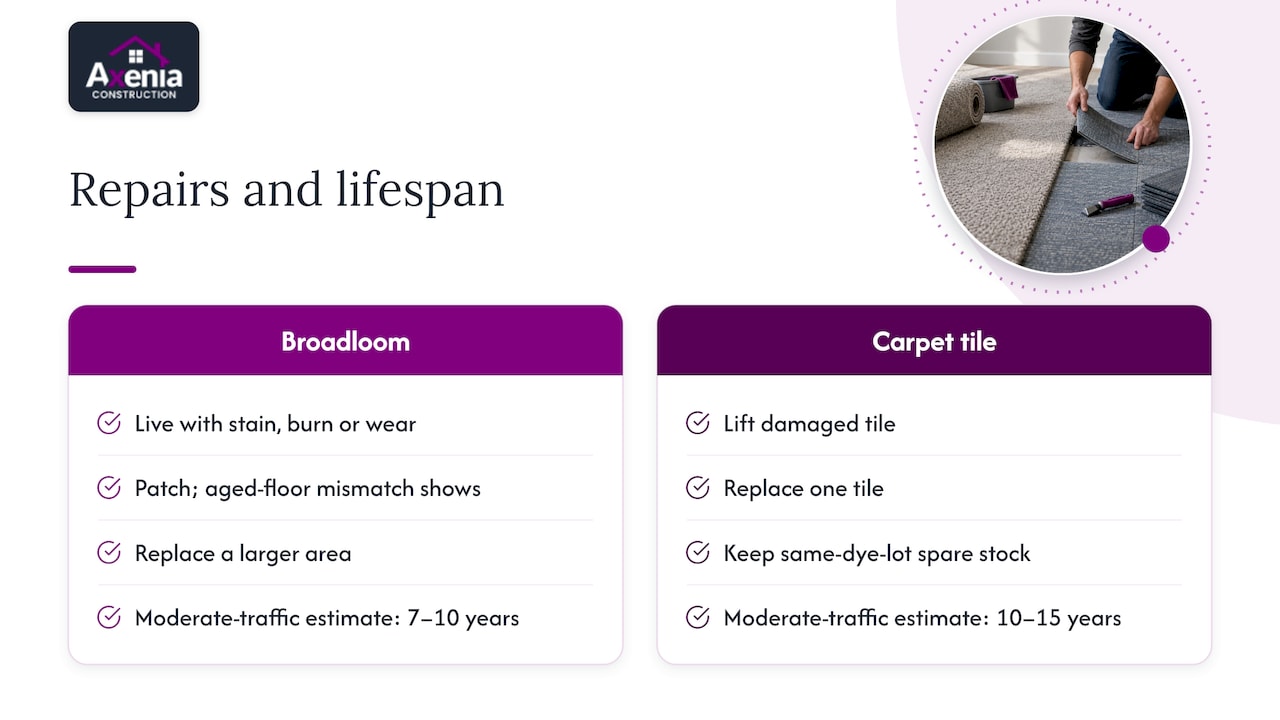
CRI states that where traffic paths or soiling occur, rotating or replacing individual tiles is an easy and cost-effective solution. A practical habit that follows from this: order extra cartons from the same dye lot at installation and store them on site. Tile that is replaced years later can look a shade different if the style has been discontinued, so spare stock (often called attic stock) protects the repair.
Some flooring suppliers publish lifespan estimates, commonly 7 to 10 years for commercial broadloom and 10 to 15 for commercial tile in moderate traffic. Treat those as rules of thumb rather than guarantees. Fiber, pile construction, backing and maintenance matter more than format, and the EPA adds a useful reminder: a highly durable carpet may not be the right choice for a temporary space where tenants or renovations will change things soon. Match durability to how long you actually expect to keep the floor.
Maintenance that protects either choice
Both formats need the same basics: regular vacuuming, entrance matting to catch grit before it reaches the pile, prompt spot cleaning and periodic deep cleaning. Grit is what wears carpet fibers down, so a good walk-off mat at each entry does more for lifespan than most product upgrades. Scheduling professional deep cleaning on a regular cycle removes embedded soil that vacuuming cannot reach, and it keeps both broadloom and tile looking consistent. Tile has a small edge here too: stained tiles can be rotated to a low-traffic area or replaced, while broadloom has to be cleaned in place.
Where each one wins
Choose broadloom when
- You want a seamless, high-end look in a boardroom, executive suite, hotel corridor or primary bedroom. Broadloom supports matched pattern repeats and custom designs, which is why it is favored in hospitality and high-end corporate projects.
- Softness matters most, as in bedrooms and living areas, where a thicker pad makes a real difference underfoot.
- The room is large, rectangular and can be fully cleared. Long runs of broadloom reduce how often seams appear, and seam placement and pattern flow can be controlled in corridors and big open areas.
- The subfloor has minor imperfections you do not want to grind or level, since the pad helps hide them.
Choose carpet tile when
- Wear is uneven: entrances, copy rooms, reception paths, stair landings.
- Furniture is heavy or fixed. Open-plan offices with systems furniture can be recarpeted in zones, and CRI describes how an office can be recarpeted in one overnight shift.
- The layout changes often. CRI explains that frequently changing open-plan configurations have driven advances in tile technology. If you are still deciding on layout, our guide to open versus private office layouts will help you plan the floor around it.
- The space is a tenant suite where you may need to refresh only part of the floor at turnover.
- You are covering a slab where moisture is a concern, such as a basement. Tile backings can act as a moisture barrier between pile and subfloor, and individual tiles can be lifted to dry if water gets in.
- You want a mixed-pattern or planked design. Tile can be laid in monolithic, quarter-turn or ashlar patterns for visual variety.
If a building needs both, use both. A common approach is tile in work areas and corridors and broadloom in conference rooms or executive offices where the continuous look is the point.
What this means for homeowners
In a Maryland, DC or Northern Virginia home, broadloom remains the usual choice for bedrooms, family rooms and stairs because it is soft and looks like one piece. Tile is worth a look in a finished basement, a home office, a playroom or any area where a pet, a spill or a leak is a realistic risk. In a basement especially, think about moisture first: concrete slabs can hold and release moisture, and a floor that can be lifted and dried is more forgiving than one that is glued and padded wall to wall.
A few homeowner questions come up again and again:
- Will tile feel like an office? Not necessarily. Residential tile and planks come in soft textures and warm colors, and cushion-backed options narrow the comfort gap. Still, broadloom over a good pad is the softest option.
- Will I see the seams? In broadloom, a well-placed seam is nearly invisible. In tile, you will see a grid, so choose a pattern or color variation that makes the grid look intentional.
- Is it good for resale? Flooring that is clean, consistent and suited to the room helps a listing. Realtors often tell sellers that neutral, fresh flooring matters more than the format. For ideas on what pays back, see our guide to the best home renovations to increase property value.
If the carpet is part of a bigger remodel, put the decision in the plan early. Our home renovation project planning guide shows where flooring sits in the sequence, and a note on sound: if you are upstairs from living space, check the underlayment and pad choice against our piece on soundproofing between floors, because the pad under broadloom changes how much impact noise travels down.
What this means for commercial owners and property managers
For offices, clinics, retail suites and government space, the question shifts from “which looks better” to “what does it cost to keep this floor in service?” Three scenarios come up most:
- A multi-tenant building with regular turnover. Tile lets you refresh high-wear spots between tenants without replacing a whole suite. Our look at tenant turnover renovation costs explains how those line items add up.
- An occupied office. Tile phases by zone, which means fewer days when staff are displaced. Broadloom generally needs areas cleared, which means more furniture moves and more downtime.
- A new tenant fit-out. Flooring is one of the last finishes, but the decision affects subfloor work, schedule and ceiling and furniture coordination earlier. Our tenant buildout timeline and office build out checklist show where it fits.
If you are renovating to a green building standard, flooring choices count too. The EPA’s guidance on greener carpet is a good starting point, and our article on LEED certification for renovations covers how renovation decisions feed into a rating.
Subfloor and installation: where projects go wrong
Most carpet failures begin below the carpet. Before either product goes down, three things have to be right:
- Flatness. Tile shows every ridge and dip, and broadloom over an uneven slab can wear faster at the high spots. Patching or leveling belongs in the scope, not as a surprise add-on.
- Moisture. Concrete slabs should be tested before carpet is installed, and readings that are too high call for mitigation. Adhesive and backing performance both depend on it.
- Old flooring and adhesive. Removal, residue and disposal are real costs. Ask for them as separate lines so you can compare bids on equal terms.
Then coordinate the work around other trades. Painting, ceiling work and electrical should be done before carpet, and furniture moves and after-hours labor should be scheduled and priced. When a general contractor manages those pieces, the flooring crew arrives to a floor that is ready, rather than discovering problems on the day.
Our perspective
Most carpet decisions go wrong because the choice is made from a sample, not from the building. Owners fall for a texture or a price per square foot, and then the schedule, the subfloor and the furniture plan arrive and change the answer.
We think about flooring the way we think about the rest of a project: as one part of a sequence that has to be planned, permitted where needed and coordinated. In Maryland, DC and Northern Virginia, that includes knowing local permitting expectations and who has to be on site in what order. Our approach is built on meticulous project management and transparent communication, so you know what the floor will involve before work begins.
For commercial owners, we lean toward asking about the second and fifth year, not just the first day. If the space has predictable wear, changing layouts or tenant turnover, a modular approach is easier to live with. For a primary suite or a boardroom, a seamless broadloom installation can be the right way to make the room feel finished. Either way, the decision should be made early, with the subfloor and the schedule in view.
As a women-owned, locally owned firm, we want clients to feel informed and supported through every step, from the first walk-through to the final punch list.
Arienne
Plan your flooring inside the right project
Carpet is rarely a stand-alone job. It is part of a renovation, a tenant buildout or a refresh that touches walls, ceilings, electrical and furniture. Axenia Construction is a licensed general contractor in Rockville, MD, serving residential, commercial and government clients in Maryland, DC and Northern Virginia, with design-build services that keep design decisions and construction in one conversation.
If you are planning an office or suite, see our tenant buildout services. If it is a home, our home renovations page explains how we manage a project from planning to completion.

Bring your floor plan and your questions, and we will help you sort out the format, the subfloor work and the sequence before you commit.
FAQ
Is carpet tile better than broadloom?
Neither is better in every room. Tile is easier to repair and install in zones, and it handles uneven wear and moisture-prone areas well. Broadloom offers the softest, most seamless look and often a lower material price. Match the format to the room’s traffic, moisture and appearance needs.
Is carpet tile more expensive than broadloom?
Per square foot of material, tile is often higher, though not always. Broadloom adds a pad, more waste and more labor, while tile saves on those and on downtime. CRI notes that overnight tile installation can offset the added product cost in offices. Compare complete installed bids rather than material prices.
Can carpet tile go in a basement?
Often yes. Tile can be lifted and dried if water gets in, and its backing can act as a moisture barrier. The slab should still be tested for moisture before installation and any problems corrected first.
Do carpet tile seams show?
Yes, a tile floor has a visible grid. Many designers use that as a feature, with quarter-turn, ashlar or mixed-color layouts. If you want an unbroken surface, choose broadloom with carefully placed seams.
Sources
- Finding the Right Carpet, The Carpet and Rug Institute
- Identifying Greener Carpet, US EPA
- Broadloom vs. Carpet Tile?, Siena USA
- Broadloom vs Carpet Tile in Hospitality Environments, Dalton Hospitality Carpet
- Deep cleaning services