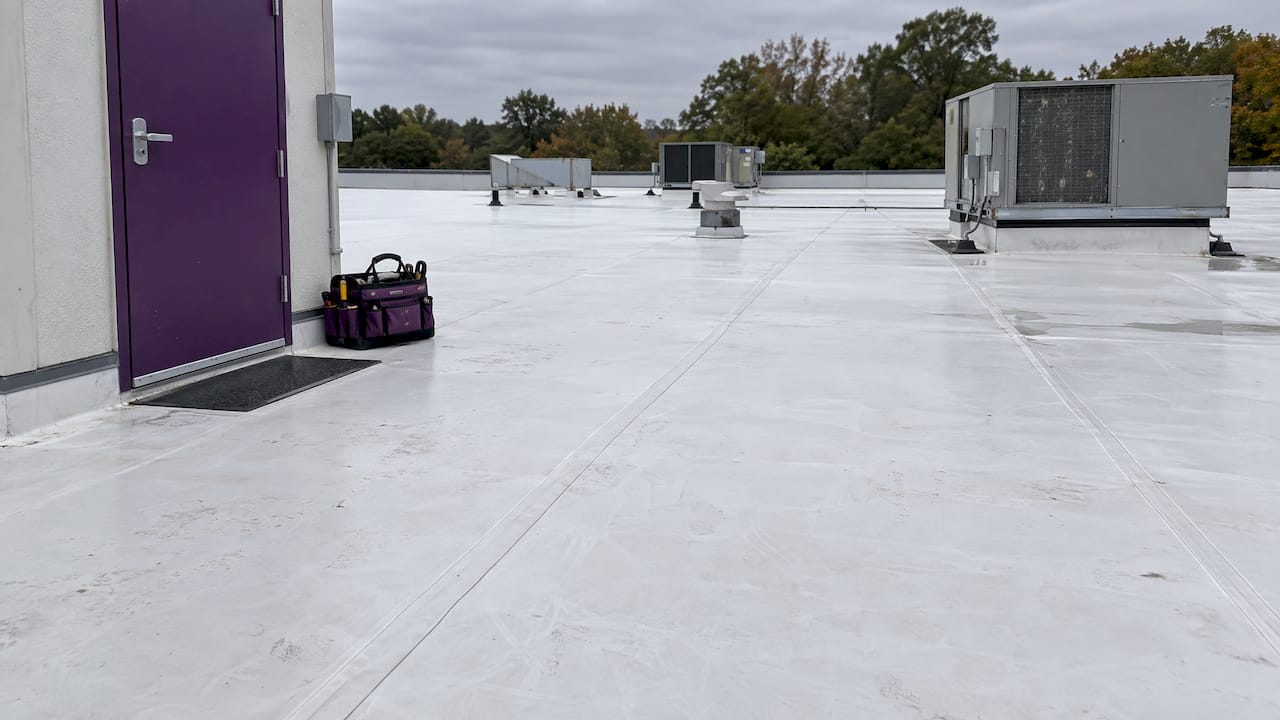
TPO is usually the better fit for offices, warehouses, retail space and most homes with a low-slope roof: it costs less to install and reflects heat well. PVC is the stronger fit where the roof faces grease, chemicals or higher fire demands, such as restaurants and industrial buildings, and where flexible detail work matters. Both are single-ply thermoplastic membranes with heat-welded seams. The right choice depends on what your roof is exposed to, how many penetrations it has, and what warranty you can get on the exact product.
This guide is for business owners, commercial property owners, homeowners with flat or low-slope roofs in Maryland, DC and Virginia, and realtors who need to understand what is on a building. It explains the differences in plain terms, shows where each membrane goes wrong, and gives you a way to decide.
TL;DR
- Choose TPO for most offices, retail, warehouses and low-slope residential roofs where cost and heat reflectivity matter most.
- Choose PVC when the roof sits below kitchen exhaust, vents chemicals, or has many pipes, curbs and curved details.
- Both are heat-welded single-ply membranes. Installation quality and the specific product matter as much as the material name.
- Compare thickness, formulation and warranty terms product by product, not just “TPO” against “PVC”.
- Plan the roof as part of the whole building project so permits, drainage and rooftop equipment are coordinated.
Table of Contents
- What TPO and PVC membranes are
- TPO vs PVC at a glance
- Cost: what actually drives the price
- Durability and weather
- Chemicals, grease and fire
- Installation: where each one goes wrong
- Which is right for your property
- How to tell whether a roof is TPO or PVC
- Permits and planning in Maryland, DC and Virginia
- Why a coordinated contractor makes the difference
- Work with a team that manages the whole project
- FAQ
- Sources
What TPO and PVC membranes are
A single-ply roof is one sheet of membrane laid over the roof deck and insulation, rather than built up from several layers of asphalt and felt. The National Roofing Contractors Association’s Professional Roofing magazine describes thermoplastic roofing as a synthetic material that softens when heated and hardens when cooled. That property is what lets installers fuse two sheets into one continuous surface.
TPO stands for thermoplastic polyolefin. PVC is polyvinyl chloride, the same family of plastic often called vinyl. Sika’s comparison describes TPO as built from ethylene propylene rubber and polypropylene, and PVC as built from ethylene and chlorine. GAF’s 2025 U.S. guide adds that both are made in three layers and both can have their seams heat-welded. The key chemical difference: PVC uses a liquid plasticizer to stay flexible, while TPO does not.
That one difference explains most of what follows. Plasticizer gives PVC its flexibility and its resistance to grease. It is also what can make PVC more expensive.
TPO vs PVC at a glance
| Factor | TPO | PVC |
|---|---|---|
| Typical installed cost | Generally lower | Generally higher |
| Flexibility | Stiffer | More flexible |
| Heat reflectivity | Strong, white is common | Strong, white is common |
| Chemical and grease resistance | Resistant to many chemicals, not acids, grease or oils | Higher |
| Fire resistance | Lower | Higher |
| Puncture resistance | Higher | Lower |
| Detail work around pipes and curbs | Harder | Easier |
| Track record on roofs | Newer, formulations keep changing | Longer history |
The chemical, fire and puncture rankings come from Elevate’s U.S. comparison, which also states that real performance depends on the specific product and manufacturer. Treat the table as a starting point for the conversation, not a verdict on every roll of membrane.
Cost: what actually drives the price
On price, the ranking pages agree: TPO is typically cheaper than PVC, and PVC is generally viewed as the higher-grade material. SFS’s comparison says TPO is typically cheaper while offering many of the same characteristics. We do not quote a per-square-foot number here, because installed prices move with material costs, roof size, access and region, and a figure from a different market or year would mislead you. What you can rely on is what moves the total.
Material. Elevate lists thickness, membrane formulation, installation speed and total installation cost as the factors that differ between the two. GAF says TPO comes in 45-, 60- and 80-mil sheets (a mil is one thousandth of an inch). A thicker sheet costs more and is usually paired with a longer warranty. Compare mils to mils, not a thin TPO quote against a thick PVC one.
Attachment method. Both membranes can be mechanically attached with fasteners, adhered with cold adhesive, or laid loose under ballast, according to Elevate. SFS adds installation in hot asphalt and induction welding. Each method changes labor, insulation and fastener costs.
Roof complexity. Every pipe, vent, curb, drain and piece of rooftop equipment is a detail that must be flashed (sealed with cut and welded membrane). A roof with few penetrations favors the cheaper, stiffer TPO. A roof crowded with equipment can make PVC’s easier handling worth the premium.
Tear-off and deck repair. Removing the old roof, drying wet insulation and fixing the deck often cost more than the membrane itself. These are the surprises that separate a low bid from a realistic one.
Warranty. One forum thread from a strip-mall owner found a TPO quote with a 20-year manufacturer and workmanship warranty against a PVC quote that cost more. A longer warranty on the cheaper material is possible, so read what each warranty covers, who backs it, and what voids it.
How to compare two quotes fairly
- Ask for the membrane thickness in mils on both.
- Ask for the manufacturer and the exact product line.
- Confirm the attachment method and the insulation thickness.
- Confirm the scope: tear-off, deck repair, flashings, drains, edge metal.
- Compare the warranty term, what it covers, and whether it includes labor.
Durability and weather
Both membranes are made for sun, rain and temperature swings, and both are widely used on low-slope commercial roofs. The real difference shows in specific stresses.
UV and heat. GAF characterizes TPO as reflective and suitable for cool-roof applications, noting white is common but other colors can also reflect strongly. A reflective roof sends sunlight away from the building, which reduces heat load on the space below. That matters in the hot, humid summers of the Mid-Atlantic, where air conditioning runs for months.
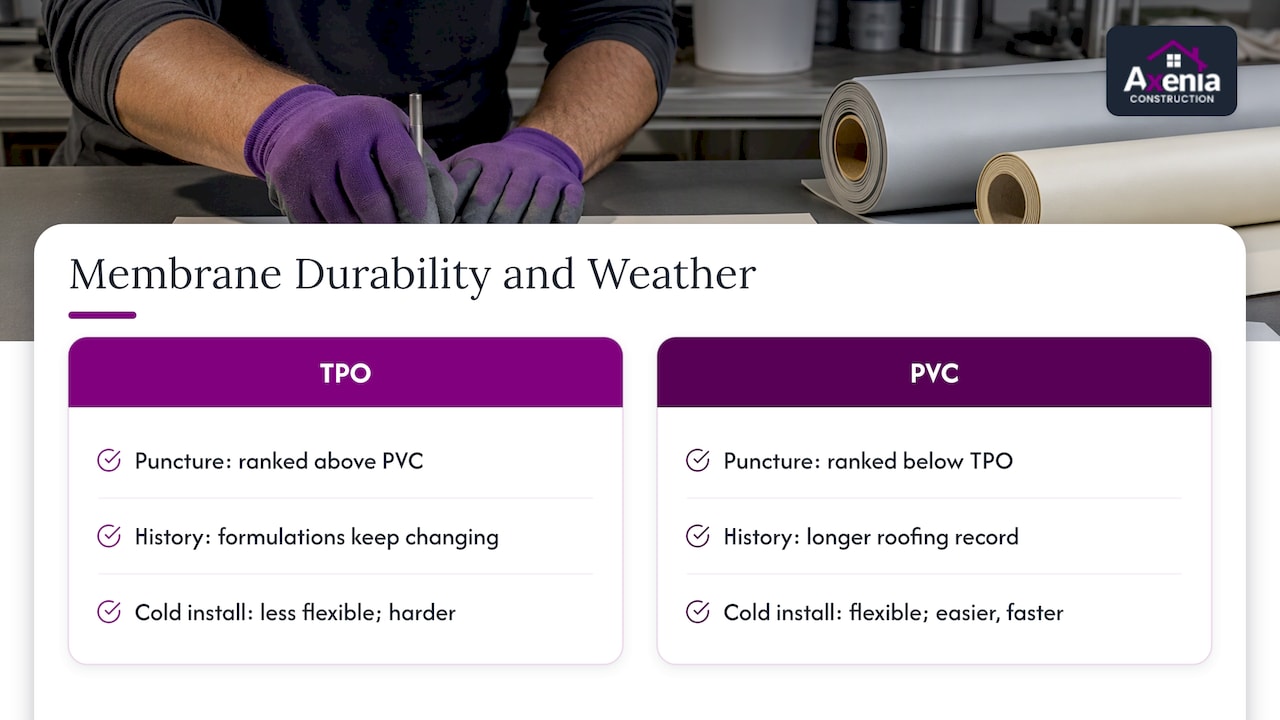
Puncture and foot traffic. Elevate ranks TPO above PVC for puncture resistance. If technicians regularly walk the roof to service rooftop units, that counts in TPO’s favor, though walkway pads protect either one.
Age and track record. Sika notes that TPO formulations have continued to be modified, while PVC has a longer roofing history. In practice, that is a reason to look closely at the specific TPO product and its warranty rather than the category name.
Flexibility in cold weather. A stiffer sheet is harder to work in winter. SFS says TPO is slightly more challenging to install because of its reduced flexibility, while PVC’s flexibility can make installation easier and faster. Our region has cold snaps, so scheduling and crew skill matter.
Chemicals, grease and fire
This is the clearest dividing line.
GAF states that its TPO formulation is flexible without plasticizers and resistant to fungus and many chemicals, but not to acids, grease or oils. Elevate ranks PVC above TPO for chemical and fire resistance. For a restaurant with a kitchen exhaust, a food processing building, a lab or an industrial site, PVC is the safer match to the exposure, because grease and chemical vapors settle on the roof near vents.
For a typical office building, medical suite, retail shop, church or warehouse with no unusual exhaust, TPO’s resistance is enough, and the lower cost makes it the practical choice.
Installation: where each one goes wrong
Both membranes are joined by hot-air welding, which fuses the sheets into a continuous seam. The IIBEC paper by Walter Brown and Helene Hardy Pierce stresses that clean, dry membrane surfaces are critical to a sound seam. That is the practical risk on any job: dust, moisture or a rushed weld at an overcast, damp morning will leave a seam that looks fine and fails later.
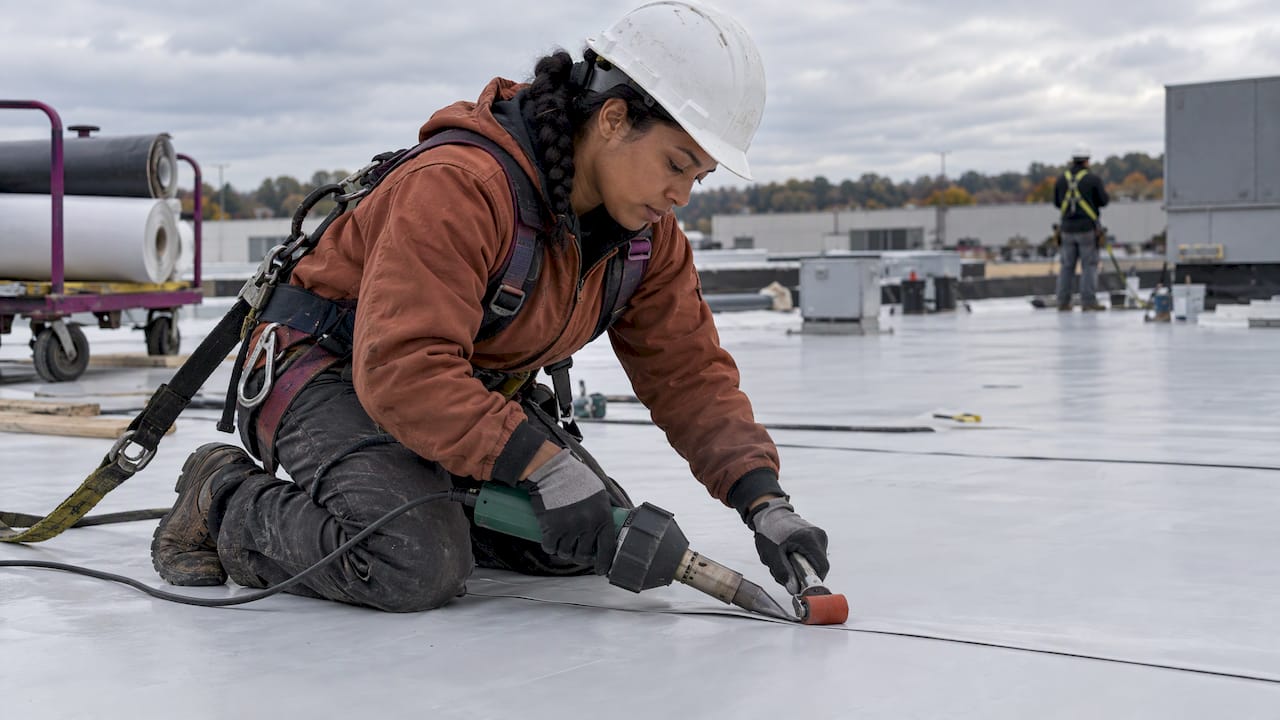
The other common failure is detail work. Sika points out that TPO’s stiffness makes flashing around penetrations and other details harder, and that can leave areas that are not fully watertight. Roofs fail at pipes, corners, curbs and edges far more often than in the open field of the membrane.
What this means when you review a proposal:
- Ask how many penetrations and curbs the roof has, and how each will be flashed.
- Ask whether seams will be probed and inspected before the crew leaves.
- Ask who supervises the job and how weather delays are handled.
- Ask how the roof will be protected from other trades working on the building.
Which is right for your property
Commercial property owners and tenants
For offices, retail strips, warehouses and medical buildings, TPO is a solid default. Choose PVC when the building houses a restaurant or any tenant that vents grease or chemicals, or when the owner wants a higher fire rating. If you are a landlord, consider what future tenants might do: a shell that becomes a restaurant later is a PVC candidate now.
If you are a tenant finishing a space, ask who owns roof work, because rooftop equipment for a new tenant often means new penetrations. Our guides on the tenant buildout timeline and what a commercial build out is show how roof-level work fits the schedule.
Homeowners with flat or low-slope roofs
Many Maryland, DC and Northern Virginia homes have a flat section over a rear addition, a porch, a garage or a rowhouse. Single-ply membrane suits these areas. TPO is typically the economical choice, and PVC is worth a look when the roof is small and crowded with details like skylights, chimneys and vents, or when a roof deck will be built above it. If you are planning an addition or whole-home renovation, treat the roof as part of that project rather than a separate purchase.
Realtors and buyers
A roof’s membrane type and age shape a buyer’s budget. Note the membrane, its approximate age and any transferable warranty in the property file. Ask for roofing records during due diligence, because warranty terms often depend on who installed the roof and whether it was maintained.
How to tell whether a roof is TPO or PVC
Both are usually white or light gray and heat-welded, so they look alike from a ladder. Start with paperwork: the original contract, warranty letter, permit file or manufacturer label will name the product. If that is missing, a trained contractor can identify the membrane on site, often from markings along the sheet edge and by checking the seams and flashing. Do not rely on color or feel alone, and have a qualified person walk the roof rather than climbing onto it yourself, since flat roofs have unprotected edges.
Permits and planning in Maryland, DC and Virginia
Re-roofing is regulated work in most jurisdictions here, and rules differ by county and city. Many projects need a permit, and some roofs must meet energy code requirements for insulation and reflectivity. DC’s rules for runoff can also come into play when roof drainage changes; see our guide to the DC stormwater permit. Check with your local building department before work starts, and make sure the contractor pulls the permit in the property’s name and schedules inspections.
Why a coordinated contractor makes the difference
The membrane is only one decision. The roof also has to work with the structure beneath it, the drainage, the rooftop equipment, the tenant’s plans and the permit calendar. When those pieces are handled by separate parties, gaps appear: a mechanical contractor cuts a curb after the roof is finished, or a drain is relocated without a plan for flashing.
A single general contractor who runs the whole scope avoids that. It also gives you one party responsible for the schedule, the inspections and the documentation you will need later for a warranty claim or a sale. Our guide to types of commercial construction contracts explains how the contract structure affects who carries the risk.
Our perspective
A roof decision looks like a material question, but owners rarely regret the material. They regret the surprises: a flashing that was never planned, a permit that stalled the schedule, a quote that left out deck repair. That is why we treat roofing the way we treat every project, as part of the whole building.
We are a licensed, women-owned general contractor in Rockville, Maryland, and we work with homeowners, commercial owners and government clients across Maryland, DC and Northern Virginia. Our approach rests on meticulous project management, transparent communication and local permitting expertise. For you, that means one team coordinating the scope, the paperwork and the other trades, and plain answers about what each choice means for your building.
Our advice on TPO and PVC is simple. Match the membrane to the exposure, compare products by thickness and warranty, and insist that the details around penetrations get as much attention as the field of the roof. We would rather you make that decision with a clear plan than with a price per square foot alone.
Arienne
Work with a team that manages the whole project
If your roof is part of a larger renovation, an addition or a commercial build out, our General Contracting team coordinates the scope, permits and trades. Commercial owners can also look at our Tenant Buildout and Design Build services, and homeowners at our Home Renovations service.

Tell us about your building, the roof you have now and what you plan to do with the space. We will help you work out the scope and the right next step. Start at axeniaconstruction.com.
FAQ
Is PVC roofing better than TPO?
PVC performs better against grease, chemicals and fire, and it is easier to detail around penetrations. TPO costs less and resists punctures well. Neither wins everywhere, so match the membrane to the building’s exposure and compare the specific products.
What are the disadvantages of TPO roofing?
TPO is stiffer than PVC, which makes flashing around pipes and curbs harder and puts more weight on installer skill. It is not resistant to acids, grease or oils, and its formulations have kept changing, so the manufacturer and warranty matter. On roofs without those exposures, it remains a widely used choice.
What are the disadvantages of PVC roofing?
PVC generally costs more than TPO and ranks lower for puncture resistance. Its flexibility comes from a plasticizer, and PVC is typically the higher-priced material. Where grease, chemicals or fire rating matter, those costs buy a better fit.
Can TPO and PVC be installed the same way?
Mostly yes. Both can be mechanically attached, adhered or laid loose under ballast, and both have seams joined with hot air. The difference is handling: PVC’s flexibility can speed up installation, while TPO’s stiffness makes details more demanding.
How long do these roofs last?
Service life depends on the product, thickness, installation quality, climate and maintenance. Warranty terms give a useful baseline, so compare the term, what it covers and who backs it for each specific membrane you are considering.
Sources
- Thermoplastics 101, Professional Roofing (NRCA)
- Critical Components of Welding Thermoplastic Membranes, IIBEC
- Single-Ply Roof Membrane Types and Comparison, GAF
- What is the Difference Between PVC & TPO Roofing?, Elevate
- PVC vs TPO, Sika Roofing
- Installing TPO & PVC Roofing: Membrane, Cost + Process, SFS