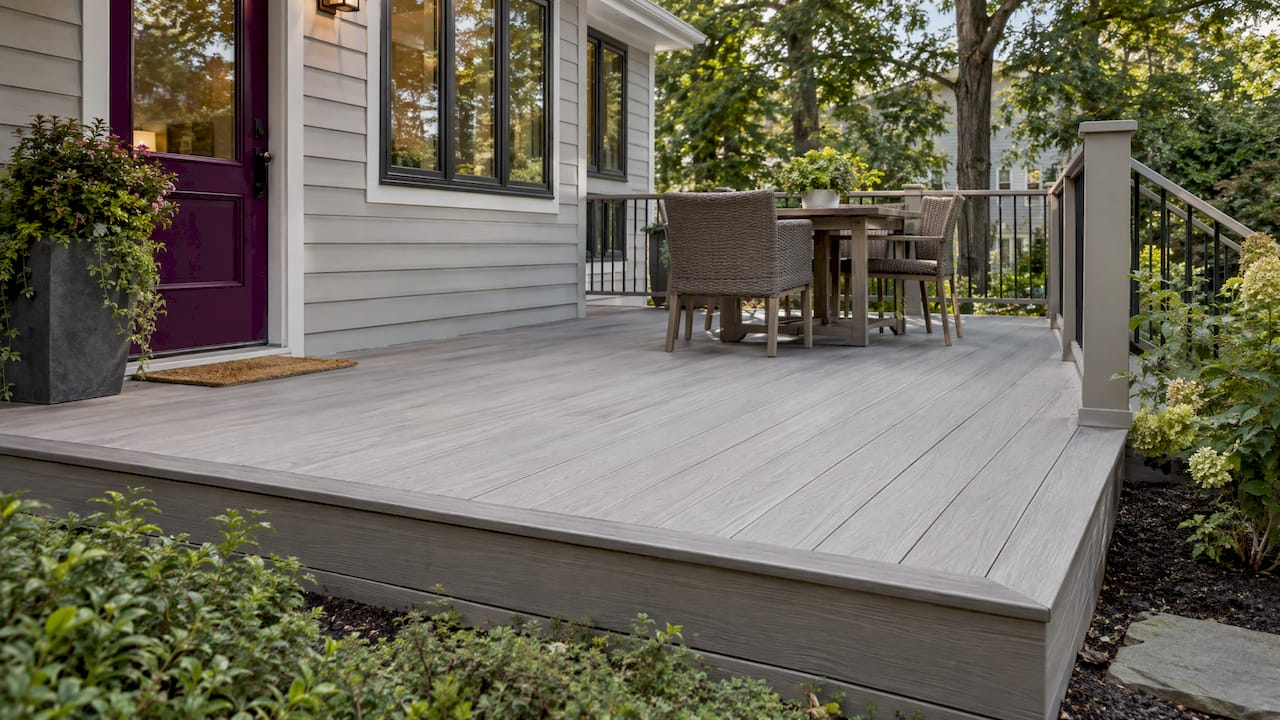
PVC decking is plastic all the way through, so it resists moisture and stays low-maintenance, but it costs more up front. Composite decking blends plastic with wood fibers, usually costs less, and gives you a wide choice of looks. For most Maryland, DC and Northern Virginia homeowners, the right pick comes down to budget, how much sun the deck gets, and whether the railing and framing under it are built to local code. We build decks in all three jurisdictions, and this guide gives you the comparison we use when a homeowner asks us the same question.
TL;DR
- PVC has no wood fiber, resists moisture, mold and insects, and installs at roughly $70 to $110 per square foot, per a 2026 national cost guide.
- Composite mixes plastic and wood fibers, installs at roughly $50 to $85 per square foot in the same guide, and suits most budgets.
- Ipe, a dense tropical hardwood, can last decades but needs oiling, special tools and careful sourcing.
- Material is only part of the bill: footings, framing, railing and permits often decide the final price.
- In DC, plastic decking needs to meet specific labeling or evaluation rules, so confirm them before you order.
Table of Contents
- What each material is made of
- PVC vs. composite: the side-by-side
- Appearance: how each one looks
- Heat, moisture and slipperiness
- Lifespan and upkeep
- Cost: what PVC and composite really run
- Ipe vs. composite: when the hardwood makes sense
- What the code says in DC, Maryland and Virginia
- Don’t forget the railing
- Which should you choose?
- Planning your deck with Axenia Construction
- Our perspective
- FAQ
- Sources
What each material is made of
The names get used loosely, so start with the basics.
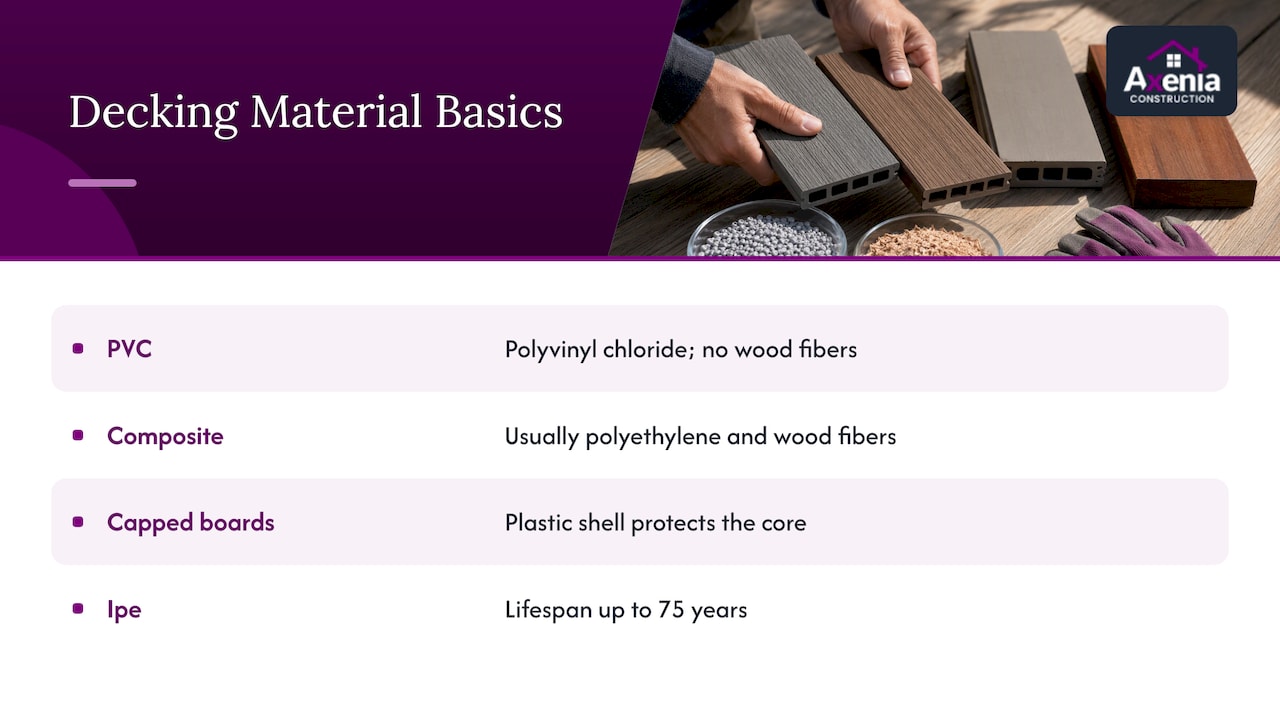
PVC decking is made entirely of polyvinyl chloride, a plastic. There are no wood fibers in the board. Decks.com’s buying guide describes it as resistant to moisture, mold, rot and insects, with the trade-off that it can look more synthetic than wood.
Composite decking is commonly made from polyethylene plastic and wood fibers. The same guide notes that some products use rice hulls or other fillers, and that some manufacturers use up to 95% recycled content. Most boards sold today are “capped,” meaning a plastic shell wraps the core to protect it from stains and moisture.
Ipe (pronounced “ee-pay”) is a very dense hardwood from Central and South American forests. It is naturally resistant to insects and rot, and the same guide puts its life at up to 75 years. It is also hard to carry, cut and drill, and it typically needs special tools.
Keep that in mind when you compare quotes: “composite” on one estimate and “PVC” on another are different products with different price points, not two names for the same board.
PVC vs. composite: the side-by-side
| Factor | PVC (cellular) | Capped composite | Ipe hardwood |
|---|---|---|---|
| Core material | 100% plastic | Plastic plus wood fibers | Dense tropical hardwood |
| Moisture and mold | Strongest resistance, no wood to absorb water | Strong when the cap is intact | Naturally rot-resistant |
| Installed cost (2026 national guide) | $70 to $110 per sq ft | $50 to $85 per sq ft | $65 to $110 per sq ft |
| Upkeep | Soap and water | Soap and water | Annual oiling to keep the color |
| Weight | Lightest | Moderate | Very heavy |
| Typical warranty on the material | 50 years | 25+ years | Varies by supplier |
The installed cost and warranty figures come from Is My Quote Fair’s May 2026 guide, which also lists material-only prices of $11 to $18 per square foot for PVC, $4 to $14 for composite tiers and $10 to $22 for ipe. These are national ranges. Your quote will reflect local labor, deck height, access and design.
Appearance: how each one looks
Composite generally gives the more wood-like look, because wood fibers are part of the board. It comes in many colors and grain patterns, and for many homeowners that is the deciding factor.
PVC has a reputation for looking like plastic. That reputation comes mostly from older products, and current boards offer far more convincing grain and color. Still, hold a sample against your siding and railing in daylight before you commit. A sample on your own porch tells you more than a showroom display.
Ipe has a rich, deep-brown look that no manufactured board copies exactly. Left unoiled, it weathers to silvery gray. If you want the original color, plan on annual refinishing, which Decks.com recommends especially in sunny or harsh climates.
Heat, moisture and slipperiness
Heat is the question we hear most from homeowners with a south- or west-facing deck. Dark boards of any kind can get hot in direct summer sun. PVC tends to stay a little cooler than dark composite, but the color you choose matters more than the material. Lighter shades stay more comfortable underfoot, and a pergola or shade sail changes the picture further.
Moisture matters in our region, with humid summers and freeze-thaw winters. PVC has no wood fiber, so there is no path for water to enter the board. Capped composite performs well as long as the cap stays intact, and good installation keeps it that way: proper spacing, ventilation under the deck and correct fasteners.
This Old House’s decking guide notes that cellular PVC can become slippery when wet. If your deck sits under trees or on the shady side of the house, ask for a textured board and clean it regularly. Good drainage helps too. Decks need to be designed so rain and melting snow flow away from the house, a point the DC Department of Buildings deck guide makes directly.
Lifespan and upkeep
Both plastics are low-maintenance. You wash them with soap and water, with no sanding, staining or sealing. That is the main reason people pay more than they would for pressure-treated lumber.
On lifespan, Decks.com says high-quality capped composite can last 25 to 50 years with minimal care. PVC products in the cost guide above carry 50-year material warranties, against 25 or more for composite. A warranty covers the material, not the labor to replace it, and it generally depends on correct installation. That is a good reason to choose an installer who builds to the manufacturer’s instructions and to code.
The frame under the boards matters just as much. A 50-year board on a frame that fails at year 20 is not a 50-year deck. Footing depth, flashing at the house and fastener choice decide how long the whole structure lasts. Our guide to deck footing depth in Maryland shows what the counties require.
Cost: what PVC and composite really run
According to the 2026 guide cited above, installed prices run $50 to $85 per square foot for composite and $70 to $110 for PVC. Here is what that means for a typical 16 by 20 foot deck of 320 square feet:
- Composite at $50 to $85: about $16,000 to $27,200
- PVC at $70 to $110: about $22,400 to $35,200
- Ipe at $65 to $110: about $20,800 to $35,200
That is simple multiplication of the published ranges, not a quote. Your price changes with:
- Deck height. The same guide notes that decks more than 4 feet above grade need code-compliant guardrails, larger footings and often an engineered design.
- Railing. It estimates railing at 15 to 25% of total deck cost.
- Stairs, lighting and built-ins. Each adds labor and materials.
- Site conditions. Slope, access for materials and existing structures to remove all affect labor.
- Permit and inspection. Required in most cases (more below).
The cheaper option is not always the better value, and neither is the pricier one. Over many years, a board that needs no refinishing saves labor and product costs, which is where PVC and composite earn back their higher price compared with wood. We compare that math in our composite vs. wood deck guide, and our piece on deck replacement costs in Maryland covers what drives local prices.
Ipe vs. composite: when the hardwood makes sense
Ipe appeals to homeowners who want a natural hardwood with a very long life. Decks.com puts its lifespan at up to 75 years and notes that it resists insects and rot by itself. That is a long time, but the upkeep and handling come with it. Boards are heavy, installers need carbide tools and pre-drilling, and keeping the original color means oiling every year.
There is also an environmental question. Decks.com points out that slow-growing ipe is harvested from old-growth tropical forests and that illegal logging is a concern, so ask where any hardwood comes from and for documentation of its sourcing.
Composite gives you a lower-maintenance deck with no oiling and a more predictable price, and PVC goes further on moisture resistance. If you love the look of real hardwood and will keep up with the finish, ipe is a fair choice. If you want to wash the deck and enjoy it, one of the two plastics usually fits better.
What the code says in DC, Maryland and Virginia
The decking material you pick has to work with local rules, and those differ across our three jurisdictions.
Washington, DC. The DC Department of Buildings’ deck guide says plastic composite decking must carry a label showing compliance with ASTM D7032, a standard for wood-plastic composite boards. PVC decking and guards need a valid evaluation report from an accredited listing agency. Ipe and other non-North American lumber may be used as decking only, not as guards. That last point matters if you were picturing matching ipe railings.
Maryland. Rules are set at the county level. Caroline County, for example, lists a 24-inch frost line, a 100 mph design wind speed and heavy termite susceptibility in its building code FAQ. It also exempts only small, low, freestanding decks from permits: no more than 200 square feet, no more than 30 inches above grade, unattached to the house and not serving the exit door. Counties near Rockville, Bowie and Fort Washington have their own requirements, so check yours. Our guide to the Maryland deck permit process walks through it.
Northern Virginia. Jurisdictions like Arlington have their own permit rules, which we cover in our Arlington deck permit guide.
Check your property in a few steps:
- Confirm your county or city permit requirements before choosing a product.
- Ask for the decking and railing product’s code listing or evaluation report.
- Confirm the frost depth and footing requirements for your address.
- Check any HOA approvals for materials and color.
Don’t forget the railing
Railing is a bigger part of the budget than most people expect, and it must meet code even when the decking does. Along with the code point above on guards, the material you choose for rails changes both look and cost. Many owners with a view pair the deck with glass railing systems to keep sight lines open. Plan the railing with the decking, because post spacing, attachment and the frame must be designed together.
Which should you choose?
Choose PVC if moisture is your main worry, the deck is close to the ground or shaded, or you want the lowest-maintenance surface and have the budget.
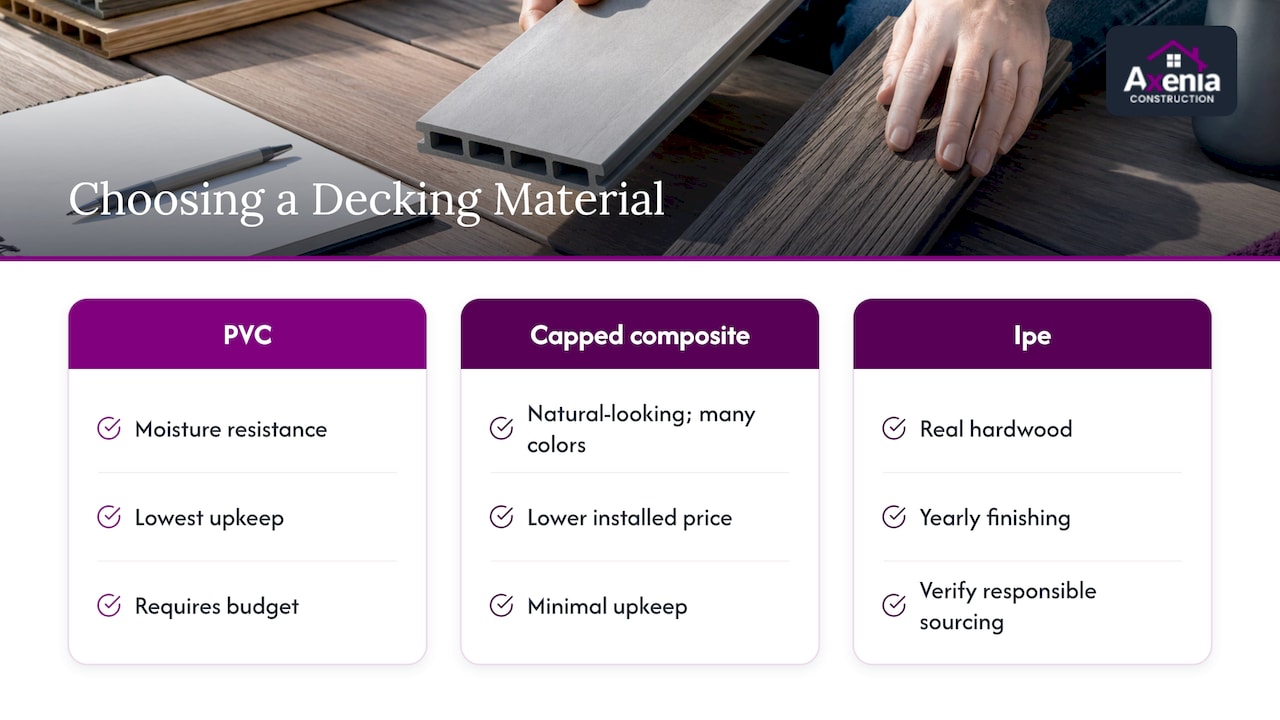
Choose capped composite if you want a natural-looking deck, a wide range of colors and a lower installed price while keeping upkeep minimal.
Choose ipe if you want real hardwood, accept the yearly finishing and heavy handling, and can verify responsible sourcing.
Whichever you pick, quality of installation will decide how it performs. Premium boards on a poorly built frame disappoint.
Planning your deck with Axenia Construction
We are a licensed, women-owned general contractor in Rockville, MD, and decks and porches are part of our work, alongside remodeling and design-build services. We bring local permitting experience in Maryland, DC and Northern Virginia, so the board you choose fits what your jurisdiction expects. Our team handles project management and communicates clearly at each stage.
If you are weighing PVC against composite for your own home, our decks and porches service is the place to start. You can also see our local work for deck building in Rockville.
We can talk through your site, your budget and the right material, and plan the deck as a whole, from footings to railing. For a deck that is part of a larger renovation, our design-build service keeps design and construction under one team. Contact us through axeniaconstruction.com to begin.
Our perspective
Most deck regrets we hear about are not about the board. They are about what is underneath it: a footing that was too shallow, flashing that was skipped, a railing that did not pass inspection.
That is why we start every deck conversation with the site and the code, and only then talk material. A deck should look right on day one and still be solid long after. When the structure, permit and material are planned together, PVC and composite both do their jobs well.
We build as a licensed, women-owned team that believes in transparent communication. You should know what is being built, why, and what each choice does to cost and upkeep. Our aim is for you to feel confident from the first conversation to the final walkthrough.
Arienne
FAQ
Is PVC decking better than composite?
Neither wins on every point. PVC resists moisture best, needs no sealing and carries a longer warranty in the 2026 guide cited above. Composite costs less up front and often looks more like wood. Choose based on your budget, sun exposure and the look you want.
Which costs more, PVC or composite decking?
PVC. A 2026 national guide puts installed PVC at $70 to $110 per square foot and composite at $50 to $85. Local labor, deck height, railing and permits move the final number, so get a written estimate for your site.
Does PVC decking get hotter than composite?
Not usually. PVC tends to stay cooler underfoot than dark composite, but color matters most. Any dark board in full sun can be hot for bare feet, so choose lighter tones and add shade for south- or west-facing decks.
How does ipe compare with composite?
Ipe is a dense hardwood that can last up to 75 years, according to Decks.com, but it needs yearly oiling to keep its color and is hard to install. Composite needs no refinishing and costs less to maintain. In DC, ipe is allowed as decking but not for guards.
Do I need a permit for a new deck?
In most cases, yes. Small, low, freestanding decks may be exempt in some places, such as Caroline County, Maryland, under the limits described above. Rules vary by county and city, so confirm yours before you build.
Sources
- Decking Material Options: Buying Guide, Decks.com
- Decking Materials: Composite, Wood, or Plastic?, This Old House
- Deck installation cost in 2026, Is My Quote Fair
- Deck Guide, DC Department of Buildings
- Building Codes FAQ, Caroline County, Maryland