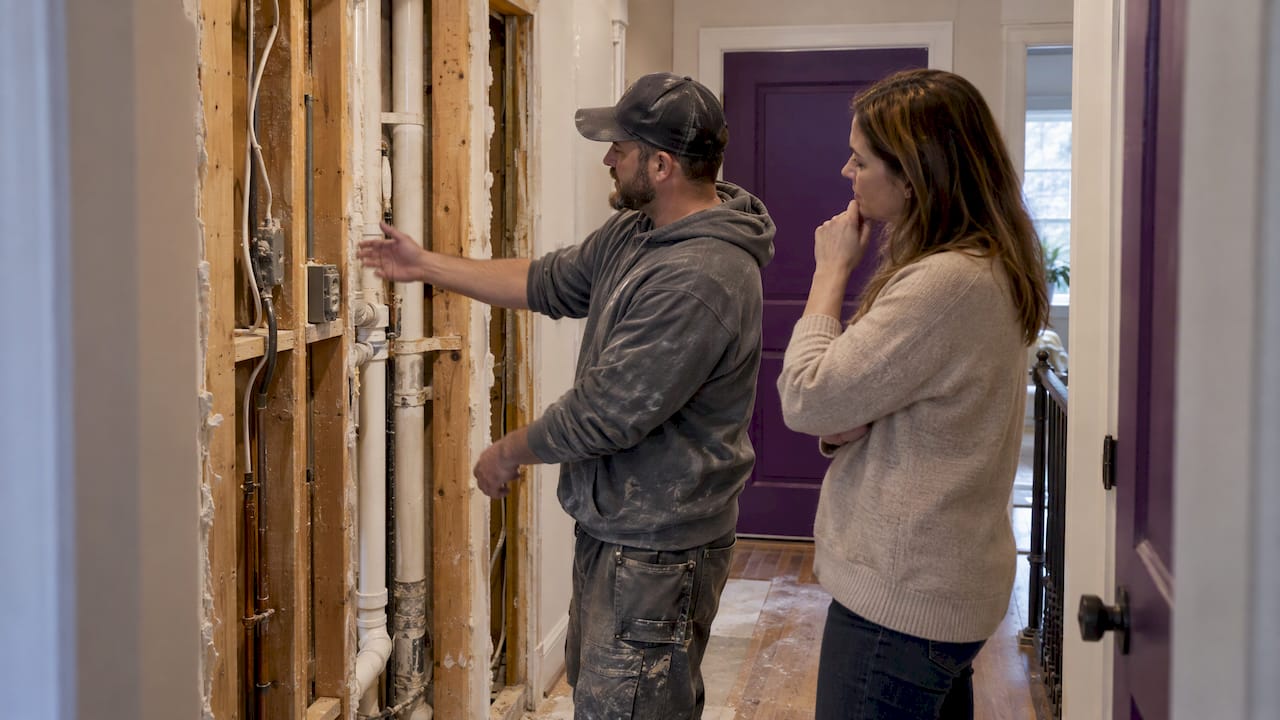
A handyman fixes small, single-trade problems. A general contractor runs a project: it plans the scope, pulls permits, hires and schedules the trades, and answers for the finished result. If your job touches plumbing, electrical, structure or more than one trade, or if it needs a permit, you want a licensed general contractor. We are Axenia Construction, a licensed, women-owned general contractor in Rockville, MD, and this guide shows how to tell the two apart before you sign anything.
TL;DR
- A handyman handles minor repairs and installations that one person can finish. A general contractor manages multi-trade projects from permit to final inspection.
- In Maryland, any work that counts as home improvement requires a license from the Maryland Home Improvement Commission (MHIC). A handyman doing that work needs one too.
- Permits are the dividing line. If the job needs one, you need a licensed contractor who will obtain it, because the homeowner can be cited when a permit is missing.
- A general contractor costs more per project because the fee covers coordination, permits, insurance and accountability. For kitchens, baths, additions and tenant buildouts, that coordination is the product.
- Check the license, the insurance and the written scope before work begins, whoever you hire.
Table of Contents
- What each one actually does
- Side-by-side comparison
- Which jobs belong to which
- Licensing: what Maryland, DC and Virginia require
- Permits and inspections: who carries the risk
- Insurance and accountability
- What each one costs, and why
- Special cases for different readers
- A short checklist before you hire anyone
- Perspective
- Working with Axenia on your project
- FAQ
- Sources
What each one actually does
The two titles get used loosely, so start with the working definitions.
A handyman takes on small repairs, maintenance and basic installations. Typical jobs are installing shelves, touching up paint, cleaning and repairing gutters, or laying flooring, tasks one person can complete without significant danger or special licensing. A handyman is usually a single-trade, single-person operation.
A general contractor (GC) takes a project from start to finish. According to one insurance-industry guide, a GC oversees complex, multi-trade projects, including permit acquisition and subcontractor coordination. In practice that means the GC hires the plumber, electrician, framer and tile setter, sequences them so one does not wreck another’s work, and is the single party you call when something goes wrong.
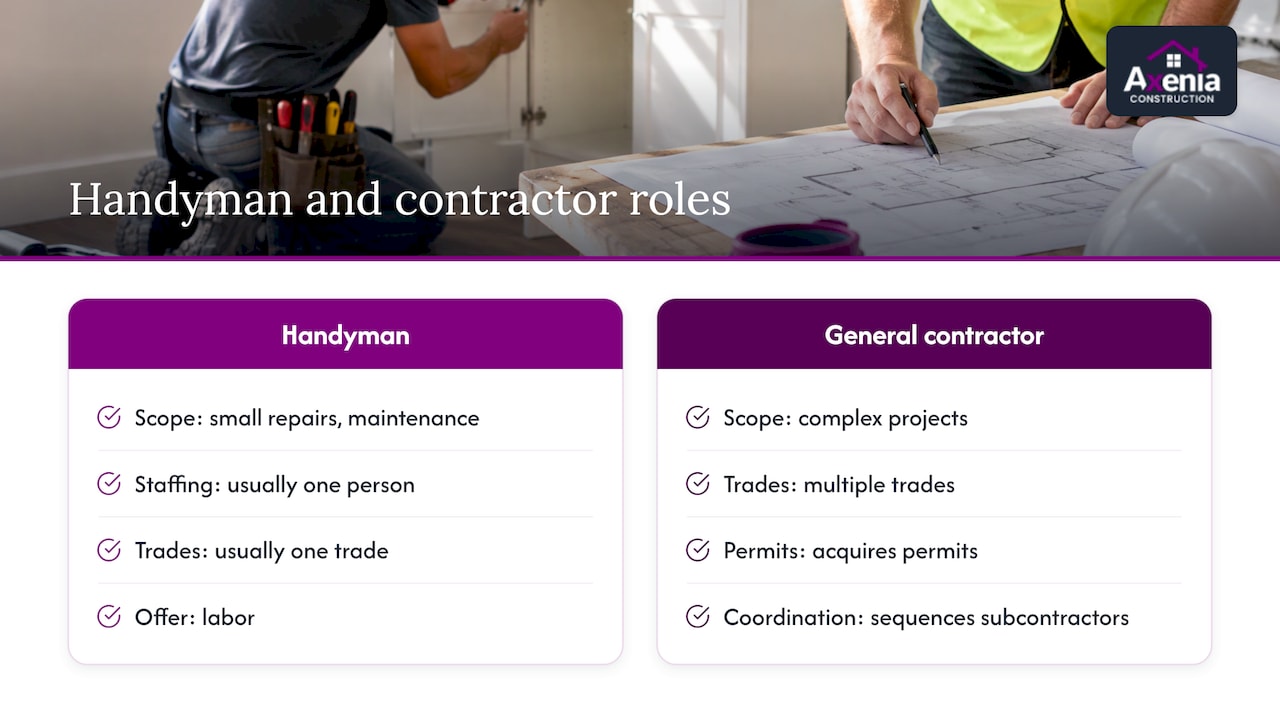
That last point is the real difference. A handyman sells you labor. A general contractor sells you a managed outcome.
Side-by-side comparison
| Handyman | General contractor | |
|---|---|---|
| Typical work | Small repairs, installs, touch-ups | Remodels, additions, buildouts, new construction |
| Trades involved | Usually one | Several, coordinated by the GC |
| Permits | Rarely suited to permitted work | Obtains required permits and schedules inspections |
| Team | Often one person | Crews plus licensed subcontractors |
| Pricing | Hourly or per task | Fixed price, or a percentage of project cost |
| Accountability | The individual | A business with a contract, a schedule and insurance |
| Best for | A dripping faucet, a loose handrail, a door that sticks | A kitchen, a bathroom, a deck, an office fit-out |
Which jobs belong to which
The cleanest test is not the size of the invoice. It is four questions about the job.
- Does it need a permit? Structural changes, new or moved plumbing and electrical lines, gas work, decks, additions and most basement finishing do. Our guides to deck permits in Maryland, basement permit rules and kitchen remodel permits show how counties differ.
- Does it involve more than one trade? A bathroom remodel combines demolition, plumbing, electrical, waterproofing, tile, ventilation and paint. Someone has to sequence them.
- Could a mistake damage the structure or create a safety hazard? Wiring, gas lines, load-bearing walls and roof penetrations all qualify.
- Will you need design decisions and a schedule? Layouts, material selections and lead times need a person managing them.
If you answered yes to any of these, the project is general contractor work. If every answer is no, you are in handyman territory: a loose cabinet hinge, a ceiling fan swap on existing wiring, patching drywall, hanging a mirror.
For homeowners, the common mistake is the project that starts small and grows. A “quick” bathroom update turns into moving a drain once the vanity comes out. At that point you need permits, a licensed plumber and an inspection, and a person who can absorb the change. A general contractor builds that possibility into the plan from the start.
Licensing: what Maryland, DC and Virginia require
Licensing differs by jurisdiction, and it is the first thing to verify.
Maryland
Maryland does not issue a separate “handyman license.” Under the state’s rules, handymen doing work that falls within the legal definition of home improvement must hold an MHIC home improvement license. The same page notes that operating without one is a misdemeanor and can bar an unlicensed contractor from suing to collect payment. One licensing summary adds that the MHIC license is needed to contract directly with a homeowner on an existing residence, with no dollar threshold.
So in Maryland, the question “handyman or contractor?” is partly a question of whether the person in front of you holds the license for the job. You can look anyone up using our walkthrough on how to verify a contractor license in Maryland. Montgomery County’s Office of Consumer Protection also advises homeowners to verify licensing and business details, check MHIC records for insurance information, and ask for recent references.
Washington, DC
DC is in the middle of a change. D.C. Law 25-244, effective December 17, 2024, creates a board and licensing criteria for residential and commercial general contractors. It defines general contracting as undertaking or offering to construct, alter, repair, add to, improve, move, wreck or demolish buildings or structures, and its application is subject to a start date no earlier than January 1, 2026. Because rollout details can shift, confirm the current status with the District’s licensing agency before you hire.
Virginia
Virginia licenses contractors through its Department of Professional and Occupational Regulation (DPOR). One summary reports that a contractor license is required once a single project is valued over $1,000, with Class A, B and C limits that depend on project value and annual volume. Check the DPOR license lookup for the exact class a contractor holds against the size of your job.
Permits and inspections: who carries the risk
Permits protect you. They put a municipal inspector’s eyes on the structural, electrical, plumbing and gas work that will sit behind your walls for decades. Skipped permits show up later, at resale, in an insurance claim, or when the county catches the work.
In Maryland, licensed home improvement contractors are expected to obtain the required municipal permits, but the county notes that the homeowner remains ultimately responsible and may receive a citation if the contractor does not obtain a required permit. That is why a contractor who says “we don’t need a permit for that” about a bathroom gut or a deck should be a red flag for you.
The permit process is where a general contractor earns part of its fee. We bring local permitting expertise across Maryland, DC and Northern Virginia, so applications, plan details and inspection scheduling are part of the project plan rather than a task left to you.
Insurance and accountability
Insurance is the quiet difference between the two. When a trade worker is injured on your property or a leak damages the floor below, the question is who pays.
Maryland sets a minimum insurance requirement for licensed contractors, and we explain the exact wording in our guide to Maryland contractor insurance requirements. Whoever you hire, ask for the certificate of insurance and confirm the policy is active and names the right business.
Accountability also means paper. A general contractor works from a written contract with a defined scope, a payment schedule and a timeline. Our list of questions to ask a contractor before you hire covers what that paperwork should contain. With a single-person operator working from a text message, the scope often lives only in conversation.
What each one costs, and why
Handymen are cheaper per hour and per task. Contractors are cheaper per result on complex work, because you are not paying for rework or for your own time managing trades.
HomeAdvisor’s 2026 data puts handyperson rates at $50 to $150 per hour, with an average project of $405 and a range of $65 to $1,500. The same publisher reports that general contractor fees typically run 10% to 20% of total project cost, and that fees overall range from $250 to $58,000. Bob Vila’s 2022 guide cites a national average of $4,000 to hire a general contractor, with bathroom remodel contractor fees of $1,000 to $2,000. These are national figures, so local pricing in the DC region will differ. If you want a method for building your own numbers, a guide on estimating rehab costs walks through the logic of itemizing a renovation budget.
A worked example
Say a bathroom update is budgeted at $20,000. A 15% management fee would be $3,000, using the 10% to 20% range above. That fee pays for the person who schedules the demolition, plumber, electrician, tile setter and inspector, resolves surprises behind the wall, and keeps the permit file current. Compare that with hiring each trade yourself: you would be that coordinator, with no one contractually responsible when the tile crew arrives before the plumber has finished rough-in.
For current Maryland pricing on that exact project, see our breakdown of bathroom remodel costs in Maryland and our kitchen remodel budget planning guide.
Special cases for different readers
Homeowners in Maryland, DC and Virginia
Start with the scope. A list of what you want changed, in rooms and trades, tells you quickly which side of the line you are on. For whole-room remodels, additions, decks and porches, the project is contractor work. Our overview of what homeowners should know about remodeling companies in Maryland helps you compare firms.
Commercial property owners and tenants
Commercial work raises the stakes: building codes, accessibility requirements, fire and life-safety systems, landlord approvals and lease deadlines. A tenant buildout is not a handyman job under any reading, and a delay costs you rent on space you cannot use. If you are planning one, read our tenant buildout timeline and office build out checklist.

Realtors
When a listing needs work before sale, the dividing line matters to your clients. Permitted work done by a licensed contractor leaves a paper trail that buyers and their inspectors can verify. Unpermitted work can slow or reopen a deal. Pointing sellers toward licensed, insured contractors for anything beyond cosmetic touch-ups protects the closing.
A short checklist before you hire anyone
- Confirm the license with the state lookup for Maryland, Virginia or, in DC, the District’s current requirements.
- Ask for a certificate of insurance and check that it is current.
- Get a written scope and price that lists materials, trades, payment milestones and a target schedule.
- Ask who pulls the permits. The answer should be the contractor, by name, with the inspection steps in the schedule.
- Ask for recent references for jobs like yours.
- Decide who runs the project. If the answer is you, the job is probably bigger than a handyman’s scope.
Perspective
We meet many homeowners who began with a handyman and came to us when the project outgrew the plan. It is rarely about bad workmanship. It is about scope: a kitchen refresh that suddenly involves a gas line, a wall, a permit and four trades needs a manager, not another pair of hands.
That is how we work at Axenia. Our approach rests on meticulous project management, transparent communication and integrated design-build services, and on knowing how permitting works in Maryland, DC and Northern Virginia. As a women-owned firm, we also put real weight on building genuine relationships with the people whose homes and businesses we work on.
The fee for a general contractor buys you one accountable partner for the whole project. We think that is the right trade for anything that touches your walls, your systems or your lease.
Arienne
Working with Axenia on your project
We are a licensed general contractor in Rockville, MD, serving homeowners, commercial property owners and government clients. Our residential work includes home renovations and kitchen and bath remodels, and we offer design-build when you want design and construction under one roof. For offices and retail space, we build out tenant spaces.

If you are not sure which side of the line your project falls on, describe it to us through our general contracting page and we will tell you what it involves.
FAQ
Is a handyman the same as a contractor?
No. A handyman performs small repairs and installations, usually alone and in a single trade. A general contractor manages larger projects, hires and coordinates subcontractors, and handles permits. In Maryland, anyone doing work that qualifies as home improvement needs an MHIC license, whatever title they use.
Is a general contractor a handyman?
Not in the way people usually mean it. A general contractor’s job is management: scope, scheduling, permits, subcontractors and inspections. Some contractors do small repairs, but the role is defined by running whole projects under a written contract.
What is a fair price to pay a handyman per hour?
HomeAdvisor’s 2026 data reports $50 to $150 per hour, depending on location and experience. Rates in the Washington, DC area can sit toward the higher end. Ask for a flat quote when the task is clearly defined.
Who is responsible for permits on a home project?
In Maryland, a licensed contractor must obtain the required municipal permits. The homeowner still carries ultimate responsibility and can be cited if a required permit is missing, so ask who is pulling the permit and get it in the contract.
When should I hire a general contractor instead of a handyman?
Hire a general contractor when the job needs a permit, involves more than one trade, touches plumbing, electrical, gas or structure, or needs design decisions and a schedule. Remodels, additions, decks and tenant buildouts all fall in that group.
Sources
- General Contractor vs. Handyman: What is the Difference?
- Handyman vs. general contractor
- Does A Handyman Need A License in Maryland?
- Maryland Contractor License: 2026 MHIC Guide
- How to Hire a Home Improvement Contractor, Montgomery County Office of Consumer Protection
- D.C. Law 25-244, General Contractor Licensing Amendment Act
- Virginia contractor license requirements
- What Are Average Handyperson Hourly Rates?
- How Much Does a General Contractor Cost?
- How Can I Find the Best Contractors Near Me?
- Estimate Rehab Costs guide