The federal tax credits for energy-efficient home upgrades do not apply to work installed in 2026. The Energy Efficient Home Improvement Credit (Section 25C) and the Residential Clean Energy Credit (Section 25D) ended for property placed in service or expenditures made after December 31, 2025. What remains is a claim on your 2025 return for work finished by that date, plus a patchwork of state, utility and local programs in Maryland, DC and Virginia. Below, we walk through each, so you can plan your next project with accurate numbers.
TL;DR
- Federal credits 25C and 25D do not cover upgrades installed after December 31, 2025, so 2026 installations cannot qualify.
- Work finished on or before that date can still be claimed when you file your 2025 return, using Form 5695.
- In our region, savings now come from utility programs and state or district initiatives, and their funding and rules change, so verify each one before you sign a contract.
- Sequence matters: a good remodel plan captures efficiency gains (insulation, windows, mechanical systems) even without a tax credit.
Table of Contents
- Did the federal energy-efficient home credits expire?
- What the credits covered before they ended
- Claiming a 2025 upgrade on your return
- What is still available in Maryland, DC and Virginia
- How to check that a rebate is real before you start work
- Why efficiency upgrades still pay off without a credit
- Our perspective
- Plan an efficient remodel with Axenia
- For realtors and sellers: documenting upgrades
- FAQ
- Sources
Did the federal energy-efficient home credits expire?
Yes. The One, Big, Beautiful Bill (Public Law 119-21), signed July 4, 2025, ended both credits. According to the IRS, the credits are unavailable for property placed in service or expenditures made after December 31, 2025. The two credits use different timing tests:
- 25C (Energy Efficient Home Improvement Credit): tied to when the property is placed in service.
- 25D (Residential Clean Energy Credit): tied to when the expenditure is made, which for an installation generally means when the original installation is completed.
You may still see pages online that say the credit runs to 2032. That was the schedule before the 2025 law change. The IRS’s own credit page now describes the credit as covering improvements installed from January 1, 2023 through December 31, 2025.
If a contractor, a website or a salesperson tells you in 2026 that a new heat pump or window project earns a 30% federal credit, that is out of date. Ask them to point to the IRS guidance, and keep reading below for what you can actually plan around.
What the credits covered before they ended
It helps to know what qualified, because the same upgrades still lower energy bills, and because you may be documenting a 2025 project right now. The IRS describes the 25C credit as generally equal to 30% of eligible expenses, subject to annual limits. Covered items included exterior doors, windows and skylights, insulation and air sealing, home energy audits, central air conditioners, certain gas, propane or oil water heaters, furnaces and boilers, qualifying electrical panel and circuit upgrades, heat pumps, heat pump water heaters, and biomass stoves or boilers.
| Category | Annual limit (2023 to 2025) |
|---|---|
| Exterior doors | $250 per door, $500 total |
| Windows and skylights | $600 total |
| Insulation, air sealing and other envelope and equipment items | Shared $1,200 annual cap |
| Heat pumps, heat pump water heaters, biomass stoves and boilers | Separate $2,000 annual limit |
Those limits come from the IRS credit page and the IRS home energy tax credits page, which also notes that for 2023 through 2025 there was no lifetime limit. Earlier, for 2022, the credit was 30% with a $500 lifetime maximum.
Claiming a 2025 upgrade on your return
If your project was finished and in service by December 31, 2025, you can still claim it. A few practical points from the IRS:
- File Form 5695. The IRS says taxpayers must file Form 5695, Residential Energy Credits to claim eligible credits. Keep receipts and manufacturer certifications for your records. They are not filed with the return.
- Know the carryover rule. The 25C credit has no carryover, while unused 25D credits can be carried forward to future tax years.
- Check the property conditions. The 2025 Form 5695 instructions require building-envelope components to be installed on or in an owned main home in the United States, be originally used by you, meet the applicable standards, and be expected to remain in use at least five years.
- Separate labor from materials. Per the same instructions, labor for installing insulation, air sealing, windows, skylights and exterior doors was not eligible, while labor could be included for heat pumps, heat pump water heaters and biomass equipment.
- Report the product ID. For specified property placed in service in 2025, you report each item’s qualified manufacturer identification number (QMID). You may rely on the manufacturer’s written certification and should keep it.
Tax situations vary. If you are unsure whether a particular item or an installation date qualifies, a CPA or enrolled agent can confirm it against your return.
What is still available in Maryland, DC and Virginia
With the federal credits gone, the savings picture depends on where your home sits and which utility serves it. Programs change often, so treat what follows as a map of where to look, not a promise of a specific payout.
Maryland
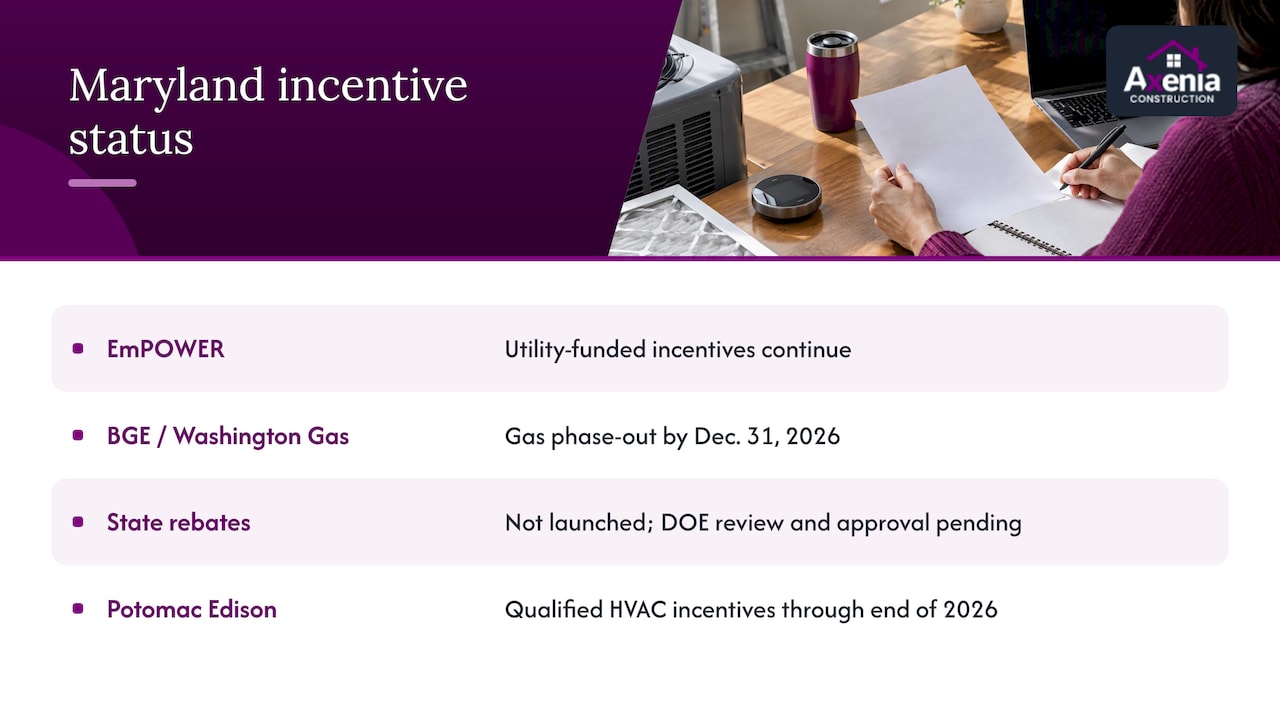
Maryland’s EmPOWER programs continue to offer utility-funded efficiency incentives. Legislative changes mandate a phase-out of gas customer programs for BGE and Washington Gas by December 31, 2026, so if your upgrade involves gas equipment, ask your utility what is still funded before you commit.
The federal Home Energy Rebate programs, created under the Inflation Reduction Act, are separate from the tax credits. The Maryland Energy Administration reports on its rebate program page that these have not yet launched in the state and that timing depends on Department of Energy review and approval. Check that page for the current status rather than relying on anyone’s summary.
Potomac Edison residential customers in Maryland have had access to HVAC equipment incentives on qualified products purchased and installed through participating contractors, running through the end of 2026. The program points customers to energysaveMD-home.com for details, so confirm current terms there.
Washington, DC
In the District, federal rebate funding is being used to expand existing low-income initiatives, namely the Affordable Housing Retrofit Accelerator and the Affordable Home Electrification Program, rather than offered as general consumer rebates, according to DOEE. The DC Sustainable Energy Utility (DCSEU) manages them. The same DOEE page explains that federally funded programs aimed at low-income households and eligible multifamily properties differ from locally funded rebates open to households at any income. Start with DCSEU to see which bucket your household falls into.
Virginia
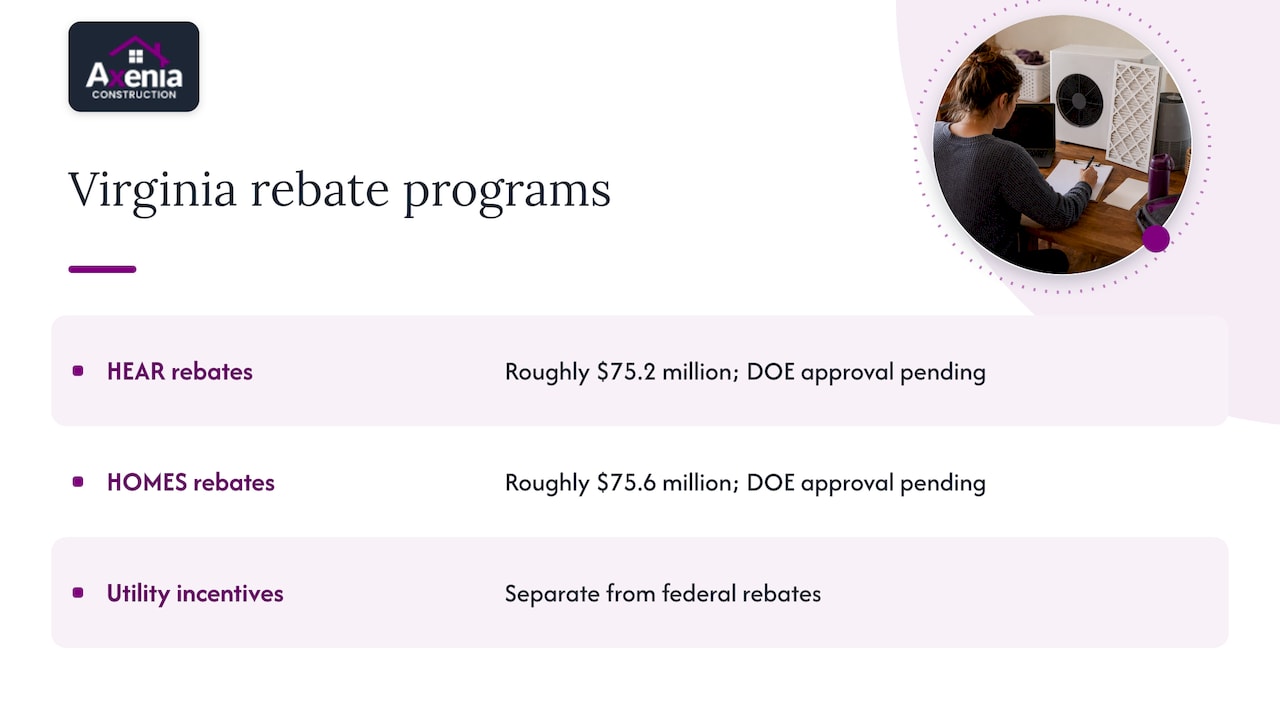
Virginia Energy has described proposed Home Energy Rebate programs with roughly $75.2 million for HEAR rebates and $75.6 million for HOMES rebates, subject to final U.S. DOE approval. Because launch depends on approval, check the state’s FAQ page for the current status. Separately, your electric and gas utility may run its own equipment incentives that do not depend on the federal rebates, so ask your provider directly.
How to check that a rebate is real before you start work
Incentive programs can close when funding runs out, and a contractor’s brochure may lag behind the program rules. Before signing:
- Confirm program status with the administrator. The Department of Energy notes that Home Energy Rebates are available in select states and tells homeowners to contact their State or Territory Energy Office for status and eligibility.
- Ask whether you must use a participating contractor. Some utility programs, like the Potomac Edison HVAC incentives, require that equipment be installed through participating contractors. Getting this wrong can cost you the incentive.
- Find out if pre-approval is needed. Some programs require an application or an audit before work begins. Ask, and get the answer in writing.
- Get the product specifications in your contract. Model numbers and efficiency ratings should appear in the scope of work, since programs list qualified equipment.
- Keep every document. Invoices, permits, certifications and photos are what you will need if a program or a buyer asks later.
Why efficiency upgrades still pay off without a credit
A tax credit was never the main reason to upgrade. Better insulation, tighter air sealing, modern windows and right-sized mechanical equipment change how a house feels and what it costs to run. In our region, with humid summers and cold winters, that matters in every season.
The order of work also matters. Air sealing and insulation before you size new heating and cooling equipment can mean a smaller, cheaper system. Replacing windows during a remodel is simpler when walls are already open. We cover this in our guide to sequencing energy-efficient remodel upgrades, and the specifics of insulation upgrades during a remodel show what to do and when. If windows are on your list, our page on energy-efficient window replacement in Potomac explains how the work typically fits into a project.
For a wider plan, see our home remodeling tips for Maryland in 2026 and our look at the best home renovations to increase property value.
Our perspective
The end of the federal credits changed the math, not the logic. When a homeowner sits down with us, we start with the house: where it leaks, where it is over- or under-conditioned, and what the family wants to change anyway. Efficiency is most affordable when it rides along with work you were already planning, because the walls are open, the permits are pulled and one team is accountable for the whole sequence.
That is why we favor an integrated approach. Design-build puts the designer and the builder in the same conversation, so the insulation, window and mechanical decisions are made together rather than patched in later. Our local permitting experience across Maryland, DC and Northern Virginia helps keep that process predictable, and we believe in transparent communication at every step, so you know what is in scope and why.
If a utility or state program applies to your project, we want you to use it. We will help you plan the work so the documentation is in order. The program rules themselves are set by the administrators, so we always point you to them for the final word.
Arienne
Plan an efficient remodel with Axenia
Axenia Construction is a licensed, women-owned general contractor based in Rockville, MD, serving homeowners and commercial clients in Maryland, DC and Northern Virginia. If you are planning a renovation where energy performance matters, our home renovations team can help you scope the work, and our design-build process keeps design and construction decisions under one roof.
Kitchen and bath projects are a natural moment to upgrade ventilation, windows and insulation, and our kitchen and bath remodels service covers them. For a broader scope, our general contracting service manages the full project. Contact us to talk through your plans.
For realtors and sellers: documenting upgrades
Efficiency work is easier to talk about at sale when it is documented. If a seller upgraded windows, insulation or a heat pump in 2025, the paperwork supports both their tax filing and the listing story. Keep the manufacturer’s certification, the invoice, the permit and the date the system went into service. The IRS instructions say you may rely on the manufacturer’s written certification and keep it for your records, which makes a single project folder worth the effort.
For 2026 upgrades, do not describe the home as having received a federal credit. Describe the work itself: what was installed, when and by whom.
FAQ
Can I claim a tax credit for a heat pump installed in 2026?
No. The IRS states that the 25C and 25D credits do not apply to property placed in service or expenditures made after December 31, 2025. A heat pump installed in 2026 cannot qualify for them. Check Maryland, DC or Virginia programs and your utility for other incentives.
Can I still claim a credit for work I finished in 2025?
Yes, if the property was placed in service (25C) or the expenditure made (25D) by December 31, 2025. You file Form 5695 with your 2025 return and keep receipts and manufacturer certifications. A tax professional can confirm your specific situation.
Are there rebates for energy upgrades in Maryland, DC and Virginia in 2026?
Some exist, but they vary by state, utility and income. Maryland has EmPOWER utility programs, DC directs federal rebate funds mainly to low-income and multifamily initiatives through DCSEU, and Virginia’s federal rebate programs are proposed pending DOE approval. Always confirm current status with the administrator.
How do I know a rebate is still funded?
Contact the program administrator directly. The Department of Energy advises homeowners to reach out to their State Energy Office for status and eligibility. Do that before you sign a contract, and ask about contractor requirements and pre-approval.
Does it still make sense to upgrade insulation and windows?
Yes, particularly when they are part of a remodel. Open walls make insulation and air sealing simpler, and a coordinated plan helps you size mechanical equipment correctly. A contractor can walk your home and recommend a sequence suited to your budget.
Sources
- IRS: FAQs on the changes to sections 25C, 25D and related credits under Public Law 119-21
- IRS: Energy Efficient Home Improvement Credit
- IRS: Home energy tax credits
- IRS: How to claim an energy efficient home improvement tax credit
- IRS: 2025 Instructions for Form 5695
- Maryland Energy Administration: Home Energy Rebate Programs
- Maryland Office of People’s Counsel: EmPOWER Programs
- Potomac Edison Maryland Residential HVAC Program measure list
- DC DOEE: Federal Home Energy Rebates
- Virginia Energy: Home Energy Rebates FAQ
- U.S. Department of Energy: Home Energy Rebates Program