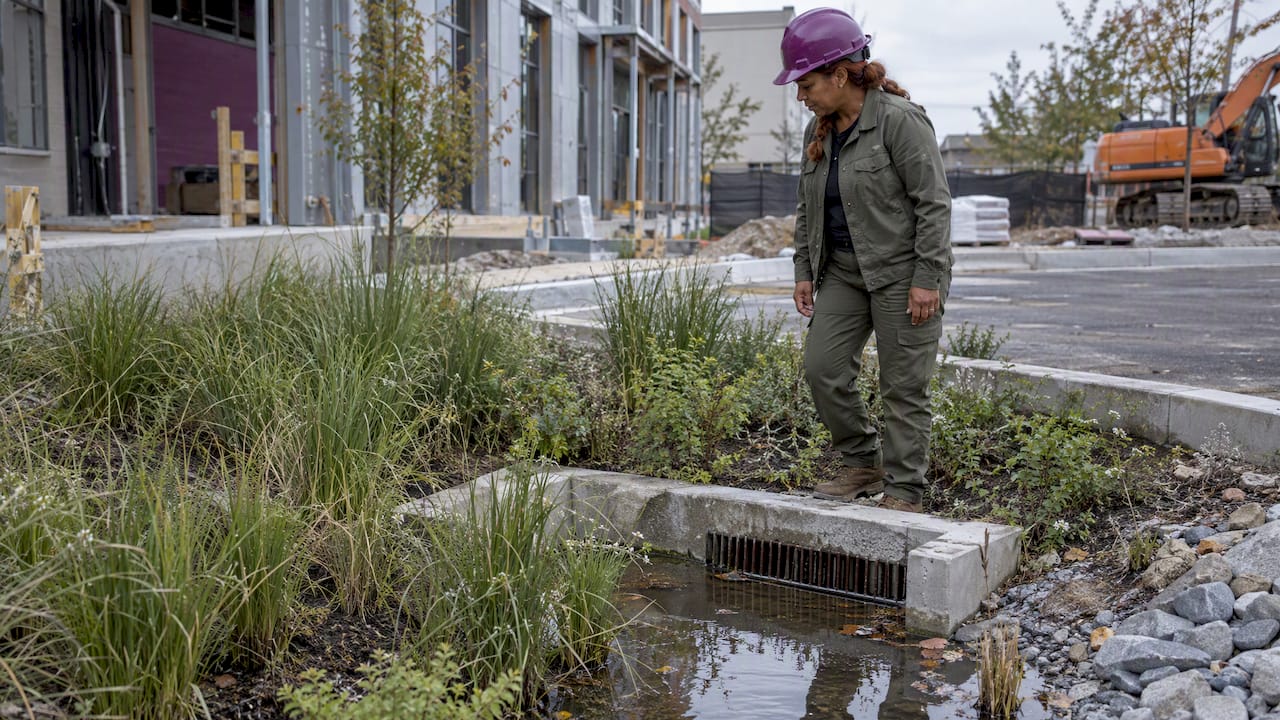
There is no single “DC stormwater permit” that a property owner applies for. The phrase covers two different things. The first is the District’s own municipal storm sewer permit (MS4), which DC holds with the EPA. The second is the stormwater management plan (SWMP) approval that the District’s Department of Energy and Environment (DOEE) requires for qualifying construction, renovation and redevelopment projects. If you are building or renovating in the District, the second one is the one that affects your schedule and budget.
TL;DR
- The MS4 permit belongs to the District. Your project is governed by the stormwater rule that the MS4 permit requires DOEE to enforce.
- Projects that disturb at least 5,000 square feet of soil, or have a building footprint of that size, generally need DOEE-approved stormwater controls.
- A District-licensed professional engineer certifies the plan. DOEE’s stated technical review window is generally 10 to 30 working days after a complete submission.
- The related permit cannot issue until DOEE approves the plan or grants an exemption or waiver, so start stormwater planning at design, not at permit submission.
- Working without required approval can bring a stop-work order, corrective action and penalties.
Table of Contents
- The MS4 permit and your project approval are not the same thing
- Which projects need stormwater approval
- Controls your plan may need
- Off-site compliance with Stormwater Retention Credits
- How approval works, step by step
- Keeping the paperwork clean
- What happens without approval
- Where stormwater meets other DC approvals
- Our perspective
- Plan stormwater with a builder who handles the approvals
- FAQ
- Sources
The MS4 permit and your project approval are not the same thing
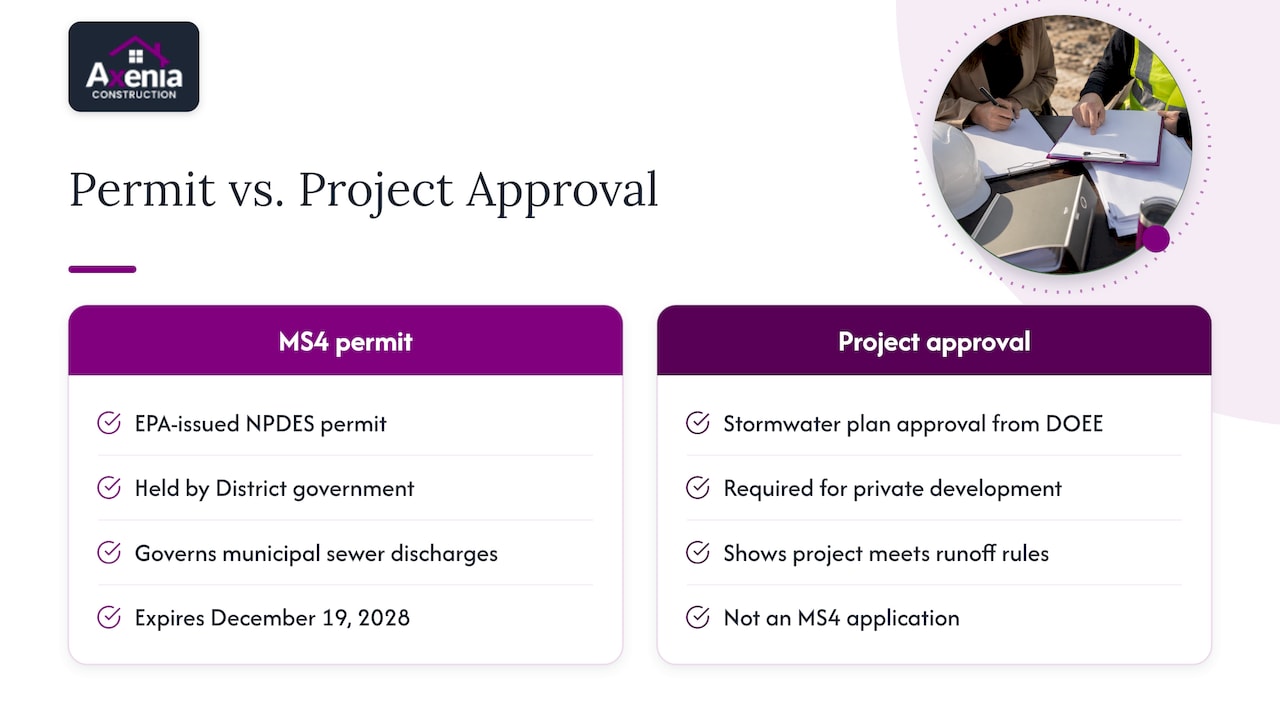
DOEE explains that the District’s MS4 permit is an EPA-issued NPDES permit that governs stormwater discharges from the municipal separate storm sewer system. The current permit took effect in December 2023 and expires on December 19, 2028. It replaced the 2018 permit, which had continued administratively after its June 2023 expiration, according to EPA’s fact sheet.
The MS4 permit is held by the District government. EPA identifies permit DC0000221 as covering areas served by, or contributing discharges to, the District-owned or operated MS4. It requires District-wide pollution-reduction work, including BMP implementation, public outreach and monitoring of District waters.
For a homeowner, developer or tenant, the practical consequence is this. To satisfy its permit, the District requires private development to control runoff. That requirement reaches you as a stormwater management plan approval from DOEE. You are not applying for the MS4 permit. You are proving that your project meets the rules the MS4 permit depends on.
DOEE sends users to Title 21, Chapter 5 of the DC Municipal Regulations for compliance requirements and to the Stormwater Management Guidebook for design and plan review, as described on its stormwater rule and guidebook page.
Which projects need stormwater approval
The trigger is size. D.C. Code applies stormwater control standards to new construction and substantial improvement projects that disturb at least 5,000 square feet of soil or have a building footprint of at least 5,000 square feet.
The regulation states that no person may undertake a major regulated project unless DOEE has issued an approved stormwater management plan, subject to an applicable exemption.
What counts as a substantial improvement
Renovations are where owners most often get surprised. DOEE’s clarification describes a major substantial improvement as a renovation or addition that meets two thresholds at once:
- Construction cost of at least 50% of the structure’s assessed value before the project.
- A combined structural footprint and land disturbance of at least 5,000 square feet.
So a large interior gut renovation of a small rowhouse may fall below the footprint threshold, while a major addition with yard regrading on a larger lot may not. We always run these two numbers during pre-construction, before design is locked.
How much runoff you must retain
EPA’s MS4 fact sheet says the permit requires controls for public and private development or redevelopment disturbing at least 5,000 square feet to retain 1.2 inches from a 24-hour storm on site, after a 72-hour antecedent dry period, using evapotranspiration, infiltration and/or harvesting and reuse.
For substantial-improvement projects that disturb less than 5,000 square feet but have a combined improved-building and land-disturbing footprint of at least 5,000 square feet, the same fact sheet says the retention requirement is 0.8 inches.
| Project type | Retention standard (24-hour storm, 72-hour dry period) |
|---|---|
| Development or redevelopment disturbing 5,000+ sq ft | 1.2 inches |
| Substantial improvement under 5,000 sq ft disturbed, with combined footprint of 5,000+ sq ft | 0.8 inches |
Controls your plan may need
DOEE guidance says regulated sites must use BMPs and post-development land cover sufficient to achieve the applicable retention volume. The Minimum Control Requirements chapter lists accepted BMP categories for removing 80% of total suspended solids. They include:
- Permeable pavement
- Bioretention
- Filtering systems
- Ponds and wetlands
- Dry and wet swales
- Qualifying proprietary practices
D.C. Code also sets a preference order for approved controls: vegetated retention and beneficial-use controls first, then compatible infiltration, other low-impact-development practices, collection and reuse for on-site irrigation, and other on-site methods. The same section requires applicable projects to address water-quality treatment, restrict fertilizers, pesticides and herbicides through an approved integrated pest-management plan, prevent stormwater migration into contaminated soils or groundwater, and treat construction or post-construction groundwater as required.
In plain terms: on a tight urban lot, plan the green roof, bioretention planter, permeable paving or cistern at schematic design. Retrofitting them after the architectural layout is fixed is expensive.
The retention standard can be met through any combination of on-site and off-site retention controls, which leads to the next topic.
Off-site compliance with Stormwater Retention Credits
When the site cannot physically hold the required volume, DOEE says large projects may meet part, or sometimes all, of their requirements off site using Stormwater Retention Credits. EPA explains that projects over 5,000 square feet in the MS4 and combined sewer areas may satisfy retention obligations partly or entirely by purchasing credits from private sellers.
For a constrained commercial site, such as a tenant building with no room for a planter bed or a lot that is almost entirely building, credits can keep a project viable while funding retention elsewhere. Credit prices move with the market, so confirm current pricing with DOEE and credit sellers when you budget.
How approval works, step by step
The owner, a qualifying lessee or an agent applies to DOEE for approval of a major-project SWMP. Here is the sequence as we manage it for clients, based on the regulation and the Guidebook:
- Screen the project. Calculate land disturbance, building footprint and, for renovations, the 50% cost test.
- Design controls with the engineer. The SWMP is certified by a District-licensed professional engineer, according to DOEE’s regulation.
- Assemble the submission. The Guidebook says plans should include computations, drawings, environmental and water-resource information, BMP effectiveness information, and construction and maintenance schedules.
- Submit and pay the review fee. Fees are set in Chapter 5 of Title 21 and adjusted annually for inflation, so check DOEE’s current fee table before budgeting.
- Technical review. Staff determine approval or disapproval within 10 to 30 working days of submission, per the Guidebook. Complex projects can take longer.
- Execute easements. Applicable easements for facilities and for inspection and maintenance access must be in place.
- Permit issuance. A stormwater discharge permit cannot be issued unless DOEE grants an exemption or waiver or approves a compliant plan.
- Build and certify. The applicant or contractor must certify construction in accordance with the approved plan.
The sequence matters because stormwater approval sits upstream of the building permit. A slow review is a slow start. Our guide to the pre-construction phase in DC, MD and VA shows where this step fits among the other approvals.
Keeping the paperwork clean
Stormwater submissions fail on small inconsistencies: a drawing that disagrees with the computations, a maintenance schedule that was never assigned to anyone, or a scope change that adds disturbed area after approval. Reviewing the full document set before submission catches most of these. A five-step bid document review is a good model for how to check specifications and drawings for conflicts before they become late change orders.
Waste and wash water belong in the same conversation. Site cleanup, equipment washing and pressure washing can send contaminated water toward storm drains, which is exactly what the District’s program exists to prevent. Review the compliance rules for pressure washing wastewater recovery before crews start washing down hardscape or dumpster areas on your site.
What happens without approval
The regulation says a person may not commence a regulated activity without required approval. Violations may lead to a stop-work order, corrective action, and criminal or civil penalties, and each instance or day of a violation is a separate violation.
A stop-work order costs more than the plan would have. Crews and subcontractors sit idle, and lender and tenant dates slip. Anyone selecting a builder should ask directly how stormwater review is handled. Our article on finding a licensed general contractor in Washington, DC lists the other questions worth asking.
Where stormwater meets other DC approvals
Stormwater is one of several approvals running in parallel on a District job:
- Tenant fit-outs. Interior-only work often falls below the thresholds, but landlord requirements and other approvals still apply. See our tenant fit-out guide for DC.
- After-hours work. Tight urban sites often need extended hours, which require their own permit. We cover that in after-hours construction permits in DC.
- Maryland projects. Rules differ across the border. Our guides to Maryland basement permit requirements and deck permits in Maryland explain the county-level picture. Do not assume the DC thresholds apply there.
Our perspective
Owners tend to ask about stormwater only after the drawings are finished, and that is the most expensive moment to ask. We treat it as a design input. When we screen a site in the first meeting, we look at disturbed area, footprint, the 50% cost test and where water can realistically go, and we build the answer into the budget and schedule.
That is the reason we favor integrated design-build for projects with real site work. When the designer, engineer and builder sit at one table, a bioretention bed or permeable paving decision is made once, priced once and scheduled once. Local permitting expertise across DC, Maryland and Northern Virginia is a core part of how we work, and we explain each approval to clients in plain language so there are no surprises.
Our advice: ask every contractor you interview who coordinates the stormwater plan, who certifies construction and who owns maintenance afterward. You should get clear names and clear answers.
Arienne
Plan stormwater with a builder who handles the approvals
Axenia Construction is a licensed, women-owned general contractor based in Rockville, MD, serving DC, Maryland and Northern Virginia. Our design-build team brings permitting questions into the project from day one, and our general contracting services cover residential, commercial and government work. If you have a site in the District and want to know whether stormwater approval applies, talk to us before design is finalized.

FAQ
Do I need a stormwater permit for a small renovation in DC?
Generally, the requirements target projects that disturb at least 5,000 square feet, or substantial improvements that meet both the 50% cost test and the combined 5,000 square foot footprint test. A small interior renovation usually falls below both. Confirm with DOEE before relying on that.
How long does DOEE take to review a stormwater plan?
The Guidebook says technical review staff determine approval or disapproval within 10 to 30 working days of submission, with longer periods possible for complex projects. Incomplete submissions restart the clock, so a thorough package matters.
Who prepares and signs the plan?
The owner, qualifying lessee or agent applies. The SWMP is certified by a District-licensed professional engineer. Your contractor or the applicant then certifies that construction followed the approved plan.
Can I meet the requirement without building anything on my site?
Often partly, sometimes entirely. DOEE says large projects may use off-site BMPs and Stormwater Retention Credits to satisfy some or all of their retention obligation. Whether that works depends on the site and DOEE’s approval.
Sources
- Separate Storm Sewer System MS4 Permit, DOEE
- EPA fact sheet on the DC MS4 permit, November 2023
- D.C. Municipal Separate Storm Sewer System (MS4), US EPA
- Stormwater Management Rule and Guidebook, DOEE
- D.C. Code § 2-1226.36, Stormwater control standards
- 21 DCMR Chapter 5, November 14, 2025
- DOEE clarifications for the 2013 stormwater rule
- Chapter 2 Minimum Control Requirements, DOEE Guidebook
- Chapter 5 SWM Plans, DOEE Guidebook
- Off-site Stormwater Management in Washington, DC, US EPA
- Stormwater review fee table, DOEE
- Bid document review in 5 steps
- Pressure washing wastewater recovery rules