Most design-build projects are priced in one of three ways: a lump sum (fixed) price, cost of the work plus a fee, or cost-plus with a guaranteed maximum price (GMP). The right model depends on how well your scope is defined when you sign and on how much cost risk you want to carry. This guide explains each model, who holds the risk, what the contract should say, and how to choose.
We are a licensed, women-owned general contractor in Rockville, MD, and we price design-build work for owners in Maryland, DC and Northern Virginia. What follows is how we explain it to clients before they sign.
TL;DR
- Lump sum fixes the price once design is far enough along. The design-builder carries most overrun risk, so the owner pays for that certainty in the price.
- Cost-plus with a fee reimburses actual costs plus a pre-negotiated fee. It suits scopes that are still evolving, but the owner carries more cost risk.
- GMP puts a ceiling on cost-plus. It is the common middle path, with open-book accounting and shared savings if the contract provides for them.
- Compare models on scope clarity, contingency ownership, what the fee covers and how savings are handled, not only on the headline number.
- Public work in Maryland and Virginia follows specific rules, so check them before assuming a private-sector structure will carry over.
Table of Contents
- Why design-build pricing works differently
- The three main design-build pricing models
- What a real GMP looks like on paper
- How to choose the right model
- Rules that affect pricing in Maryland, DC and Virginia
- Where owners get surprised
- Our perspective
- Planning a design-build project with us
- A quick checklist before you sign
- FAQ
- Sources
Why design-build pricing works differently
In design-bid-build, the architect finishes the drawings and contractors bid on them. You get price competition, but you learn the real cost late. In design-build, one team is responsible for both design and construction, so the builder sits at the table while the design is still taking shape. The AIA’s primer on project delivery terms describes design/build alongside design/bid/build and construction manager at risk as the three most commonly referenced delivery methods, and notes that how the owner selects the main service providers shapes the whole project.
That early involvement is the reason pricing is staged. You rarely get a single final number on day one. Instead, the price firms up as drawings develop: a budget estimate during concept design, a more detailed estimate as the design advances, and a binding price once the scope is clear enough to commit to. The pricing model is the contract’s answer to one question: what happens to cost when reality differs from the estimate?
If you want the delivery method itself explained first, our owner’s guide to the design-build process walks through the phases.
The three main design-build pricing models
| Model | How you pay | Who carries overrun risk | Best when |
|---|---|---|---|
| Lump sum (fixed price) | One agreed price for a defined scope | Mostly the design-builder | Scope and drawings are well defined |
| Cost of the work plus a fee | Actual costs plus a negotiated fee | Mostly the owner | Scope will evolve, or speed matters most |
| Cost-plus with a GMP | Actual costs plus a fee, capped at a maximum | Shared: builder above the cap, owner below it | You want transparency and a ceiling |
Lump sum (fixed price)
A lump sum contract sets one price for a described scope of work. If the builder’s costs rise, the price does not, unless you change the scope. That predictability is why many owners and lenders like it.
The trade-offs are real, though:
- The builder prices in risk. When design is incomplete, a prudent builder adds contingency to the number, and you pay for it whether or not the problems show up.
- Changes get expensive. Every scope change becomes a negotiated change order, and a vague scope is where disputes begin.
- You see less of the build-up. A lump sum shows the total, not how each dollar was spent.
Lump sum works best once drawings and specifications are mature, the site conditions are well understood and you are unlikely to change your mind. For homeowners weighing this against cost-plus on a remodel, our 7-point contract checklist for cost-plus or fixed price is a practical companion.
Cost of the work plus a fee
Under cost-plus, you reimburse the documented cost of the work and add a fee for the design-builder. This is the model that gets misunderstood, so it is worth being precise.
The “plus” is not a percentage of whatever the project ends up costing. In the sample design-build agreement published by the Georgia State Financing and Investment Commission, the fee is a pre-negotiated design-builder’s fee that functions as the contractor’s gross profit. The same document treats items such as home office overhead and subcontractor bonding as costs that generally belong inside that fee, not as reimbursable project costs. Confusing the two is a classic source of disputes when the books are reviewed. Georgia’s form is a public-sector sample, not a Maryland or DC template, but the logic is useful for any owner reading a proposal.
Cost-plus also does not mean you lose control. Modern versions run on open-book accounting, meaning you can see the actual costs incurred and manage the budget alongside the builder instead of simply receiving invoices. The advantage is flexibility: you can start work before every detail is drawn and adjust as you learn. The downside is that without a cap, the final cost is uncertain.
Cost-plus with a guaranteed maximum price
A GMP contract is a cost-plus agreement with a ceiling. The design-builder is reimbursed for the cost of the work plus a fee, but the total cannot exceed the guaranteed maximum without an approved change. A DBIA explainer on federal design-build describes it as a hybrid of cost-plus and fixed price, which captures why owners like it.
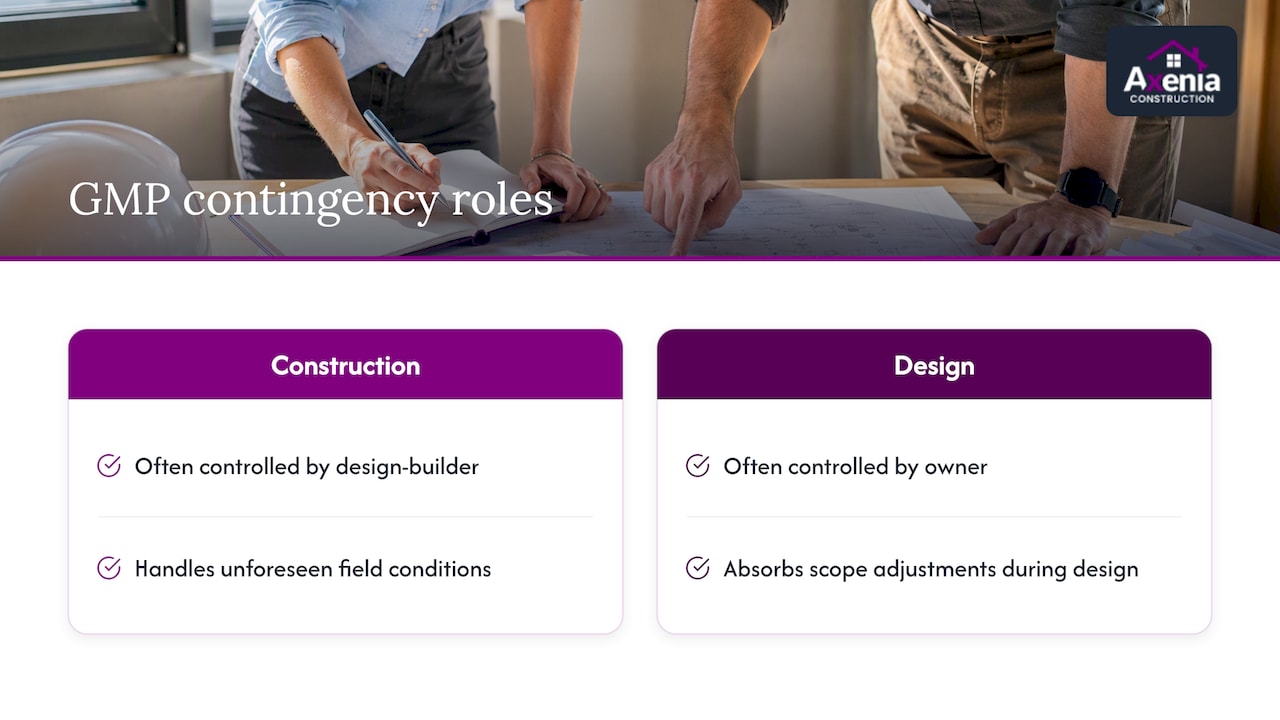
A GMP is also an active financial control, not just a budget. The Georgia sample agreement describes two kinds of contingency: a construction contingency, often controlled by the design-builder to handle unforeseen field conditions, and a design contingency, often controlled by the owner to absorb scope adjustments while the design is finalized. Both go away if the project later converts to a lump sum price. Knowing who controls each pot of money is one of the most useful questions you can ask before signing.
If the final cost lands under the GMP, the contract decides what happens to the difference. Some agreements return all of it to the owner, others split it. Maryland’s regulations for public construction management at risk work, for example, allow savings to be shared between the school system and the manager per the contract terms. Private owners can negotiate the same kind of arrangement.
What a real GMP looks like on paper
Public agencies publish their forms, which makes them a good way to see the structure. A District of Columbia Department of General Services design-build agreement for recreation center upgrades is labeled cost plus fixed fee with a guaranteed maximum price. It breaks compensation into a design fee, a design-build fee, a preconstruction fee and a capped amount for general conditions, and it places part of the fee at risk. You do not need a public project to borrow the lesson: a clear contract itemizes each layer instead of burying them in one number.
When you review a GMP proposal, look for these line items:
- Cost of the work: the direct costs of labor, materials and subcontractors, with the rules for what is reimbursable.
- General conditions: site supervision, temporary facilities, insurance and similar running costs, either capped or itemized.
- Design-builder’s fee: a fixed amount or a clearly defined formula, and what overhead it already covers.
- Contingencies: the size of each, who controls it and what happens to unspent balances.
- Savings clause: who keeps the difference if the work finishes under the GMP.
- Allowances: items not yet selected, such as finishes or fixtures, with a stated amount and a process for reconciling actual cost.
How to choose the right model
There is no universally best model. Match the structure to the facts of your project.
Start with scope clarity
If you can describe the finished building in detail and the drawings are close to complete, a lump sum is realistic. If you know the outcome you want, such as a new tenant space or a kitchen and addition, but not every detail, a GMP or cost-plus lets design and pricing evolve together. Owners who force a fixed price on an unclear scope usually end up paying through contingencies, change orders or both.
Decide how much risk you want to hold
Ask yourself honestly: could the project absorb a 10 percent increase? If not, you want a cap. If you have a tight lender-approved budget, a GMP or lump sum fits better than open-ended cost-plus. Our guide to construction contingency budgets explains how to size a reserve, whichever model you use.
Consider schedule pressure
Cost-plus and GMP allow early work packages, such as demolition, long-lead equipment orders and permitting, to start before the design is finished. A lump sum usually waits until the design is complete enough to price. For tenants facing a lease start date, that difference can matter as much as the price. Our tenant buildout timeline shows where those weeks go.
Check who you are, and where you are
A private homeowner, a commercial landlord and a government agency face different rules. Public owners are bound by procurement law; private owners have more freedom to negotiate. That brings us to the rules in our region.
Rules that affect pricing in Maryland, DC and Virginia
This section covers public contracts. Private projects are governed mainly by what you and your contractor agree in writing, plus licensing and permitting rules. Public rules are still a helpful benchmark for what a well-built contract contains.
- Maryland: for public school construction management at risk projects, the regulations require that the GMP be set once construction documents are developed enough to estimate costs, and that it include the cost of the work, the construction management fee and general conditions. Negotiations in a competitive process may begin only after public notice and at least 28 days for proposals.
- Virginia: the Code of Virginia allows public contracts on a fixed price or cost reimbursement basis, but prohibits awards based on cost plus a percentage of cost for public safety, health and welfare work, with narrow exceptions for things like certain insurance and financial consulting arrangements. That is one more reason a fixed fee, not a percentage, is the cleaner way to structure the “plus.”
- Federal and government work: the Federal Acquisition Regulation’s Part 16 on contract types lays out the range of fixed-price and cost-reimbursement forms agencies may use. If you are a government contractor or pursuing public work, read it before you price.
For a broader view of how these structures sit alongside other agreements, see our guide to types of commercial construction contracts. If your project is in Maryland, it also helps to confirm contractor coverage early; we explain Maryland contractor insurance requirements separately.
Where owners get surprised
Most pricing disputes are not about the model. They are about what the model left unsaid. These are the places we see surprises, and the questions that prevent them.
Allowances that are too optimistic
A low allowance for tile, lighting or equipment makes a proposal look cheaper. Ask what the allowance assumes, and compare it with what you actually plan to select.
Exclusions hiding in the fine print
Permit fees, utility connections, testing, hazardous material abatement and final cleaning are often excluded or carried separately. Final cleaning is a good example: a post-construction clean is its own line, and a construction cleaning bid preparation guide shows how those bids are put together. Make sure someone has priced it, and that you know whether it sits inside the contract or outside it.
Permitting assumptions
Permit timing and review comments change both schedule and cost. Counties and the District each have their own process. Builders with local experience price those risks more accurately, and our notes on permit expediting in Maryland show what that looks like in practice.
Unclear change-order rules
Under any model, you want a written process: how a change is priced, who approves it and how fast. Markups on changes should be stated in the contract, not negotiated mid-project.
Fee confusion
Ask exactly what the fee covers. If overhead, bonding and profit are inside it, you should not also see them as reimbursable line items.
Our perspective
We do not believe in a single pricing model for every client, and we are wary of any contractor who does. A homeowner finishing a basement with a settled layout and a commercial tenant racing a lease deadline are asking different questions, and the contract should reflect that.
What we do insist on is transparency. Our approach to design-build rests on meticulous project management and plain communication: you should be able to see how your price is built, understand what is in and out, and know who decides when something changes. For owners, that usually means we start by pinning down the scope with you, explain the realistic pricing options and put the assumptions in writing before any number becomes binding.
We also tell clients when an option does not fit. If your drawings are still loose, we will say a fixed price will probably cost you more in padded contingencies than a capped, open-book approach. If your scope is settled and your budget is firm, we will say a fixed price may be the simplest path. Because we work across Maryland, DC and Northern Virginia, we also build local permitting realities into the numbers instead of discovering them afterward.
The point of a pricing model is trust that survives surprises. Choose the structure that lets both sides stay honest when the unexpected arrives.
— Arienne
Planning a design-build project with us
If you are weighing these models for a renovation, addition, tenant buildout or commercial project, our team can walk you through the options for your specific scope. Learn how our design-build service works, or see how we approach a tenant buildout for commercial space. We do not publish fixed prices, because the right number depends on your scope, site and chosen contract structure. To talk it through, reach out through our website.
You can also read about the benefits of working with a design-build contractor, or, if you are in the District, our comparison of design-build and a traditional general contractor in Washington, DC.
A quick checklist before you sign
- Is the scope described in enough detail that two builders would read it the same way?
- Does the contract name the pricing model and say what triggers a change in price?
- Are the fee, general conditions and contingencies shown separately?
- Do you have audit or open-book rights if the price is cost-based?
- Does the agreement say who keeps savings if costs come in under the maximum?
- Are allowances, exclusions and permit responsibilities listed?
- Is the change-order process written down, with markups stated?
If you can answer yes to each, you are comparing proposals on facts rather than on hope.
FAQ
Which design-build pricing model is cheapest?
None is cheapest by definition. A lump sum can look higher because the builder prices in risk, while cost-plus can start lower but leaves the final figure open. A GMP gives you a ceiling and transparency, and the real cost depends on how clear your scope is and how well the project is managed.
Is cost-plus the same as a blank check?
No. A well-written cost-plus contract uses a negotiated fee and open-book accounting, so you can see the costs incurred. Adding a guaranteed maximum price puts a ceiling on the total, and the contract should say what is reimbursable and what the fee already covers.
What does GMP stand for, and does it mean the price cannot rise?
GMP means guaranteed maximum price. The builder commits that the total cost will not exceed that amount for the defined scope. It can still change if you approve a scope change, so the change-order process matters as much as the number.
Can I switch from GMP to a lump sum later?
Often yes, once the design is complete enough to fix the price. When that happens, contingencies tied to the GMP are typically eliminated and folded into the fixed number, so check how each one is treated before you agree.
Do public projects price design-build differently?
They can. Public owners follow procurement rules, such as Virginia’s limits on cost-plus-percentage awards and Maryland’s regulations on GMP-based public work. Private owners have more freedom, but the public rules show what a careful contract looks like.
Sources
- AIA: A primer on project delivery terms
- Georgia State Financing and Investment Commission: design-build construction contract
- DBIA: Deeper Dive on federal design-build and GMP
- Maryland COMAR 14.39.04.06: Construction Management at Risk
- Code of Virginia § 2.2-4331: Contract pricing arrangements
- eCFR: 48 CFR Part 16, Types of Contracts
- DC DGS: design-build agreement form of contract