
Whether the Buy American Act or the newer Build America, Buy America framework governs your job depends on one question: who is funding it? Direct federal procurement contracts fall under FAR 52.225-9, while projects paid for with federal grants or loans fall under BABA. Once you know which one applies, locate the exact clause in your contract, notify your contracting officer, and start building your domestic-sourcing paper trail immediately.
TL;DR:
- Contractors must correctly identify whether their project falls under the Buy American Act or Build America, Buy America based on funding sources before procurement.
- Proper documentation of supplier attestations, cost worksheets, and factory origin is essential and must be maintained throughout the project to ensure compliance.
- Longer lead times and stricter manufacturing process evidence may be required for domestically produced iron, steel, and complex manufactured products.
- Waivers for domestic-content requirements are rare and require detailed justification, including market surveys and price comparisons, which can delay procurement.
- Enforcement involves multiple agencies and layers, making early and continuous compliance documentation critical to avoid costly rip-and-replace or legal penalties.
Table of Contents
- What Buy American Act Construction Compliance Requires On Day One
- Key Definitions And Domestic-Content Thresholds Contractors Must Know
- When FAR 52.225-9 Applies: Contractor Obligations And Procedure
- Practical BABA Compliance For Grant-Funded Projects
- Building Your Compliance Documentation And Supplier Qualification File
- Waivers, Exceptions, And What To Expect
- Enforcement Risks And How To Limit Your Exposure
- Why The Buy American Act Exists In The First Place
- Other Domestic Preference Laws Contractors Should Know
- Recent Policy Shifts Contractors Need To Track
- Common Compliance Challenges And How To Manage Them
- Who Enforces Buy American Rules On Construction Contracts
- Compliance Outcomes: What Separates Success From Failure
- An Editorial Take On Where Contractors Actually Get This Wrong
- How Axenia Construction Approaches Buy American Compliance
- Let Axenia Construction Handle Your Compliance Documentation
- Sources
- FAQ
What Buy American Act Construction Compliance Requires On Day One
You don’t need to read the entire Federal Acquisition Regulation to figure out your obligations. You need to answer three questions, in order, before you order a single pallet of material.
Start with the money. Run through this sequence at your first project meeting, ideally before you sign anything:
- Is the project funded by a federal grant, loan, or other federal financial assistance? If yes, Build America, Buy America governs your material sourcing, not the traditional Buy American Act.
- Is the federal government the direct contracting party under a FAR-based procurement? If yes, you’re working under the Buy American Act and FAR 52.225-9 applies to your construction materials.
- If neither applies cleanly, check whether other domestic-preference statutes are in play, such as the American Iron and Steel provisions or the Berry Amendment for certain defense-related textiles and components. When in doubt, escalate to contract administration rather than guessing.
Industry groups like the National Precast Concrete Association report that many contractors trip over exactly this fork. They read clause language instead of checking the award instrument, and end up applying the wrong domestic-content test to the wrong material category.
Once you know your governing statute, capture the paper trail immediately:
- Pull the exact contract or grant language citing Buy American, BABA, or both.
- Identify the specific award instrument (direct contract vs. subgrant vs. cooperative agreement).
- Note any referenced clauses by number, not just by name, since agencies sometimes layer multiple domestic-preference requirements onto a single award.
- Flag your contracting officer or grant administrator early if the funding source is unclear on the face of the documents.
Getting this sequence wrong doesn’t just risk a paperwork headache. It can mean sourcing decisions made under the wrong percentage threshold, which is expensive to unwind mid-project.
Key Definitions And Domestic-Content Thresholds Contractors Must Know
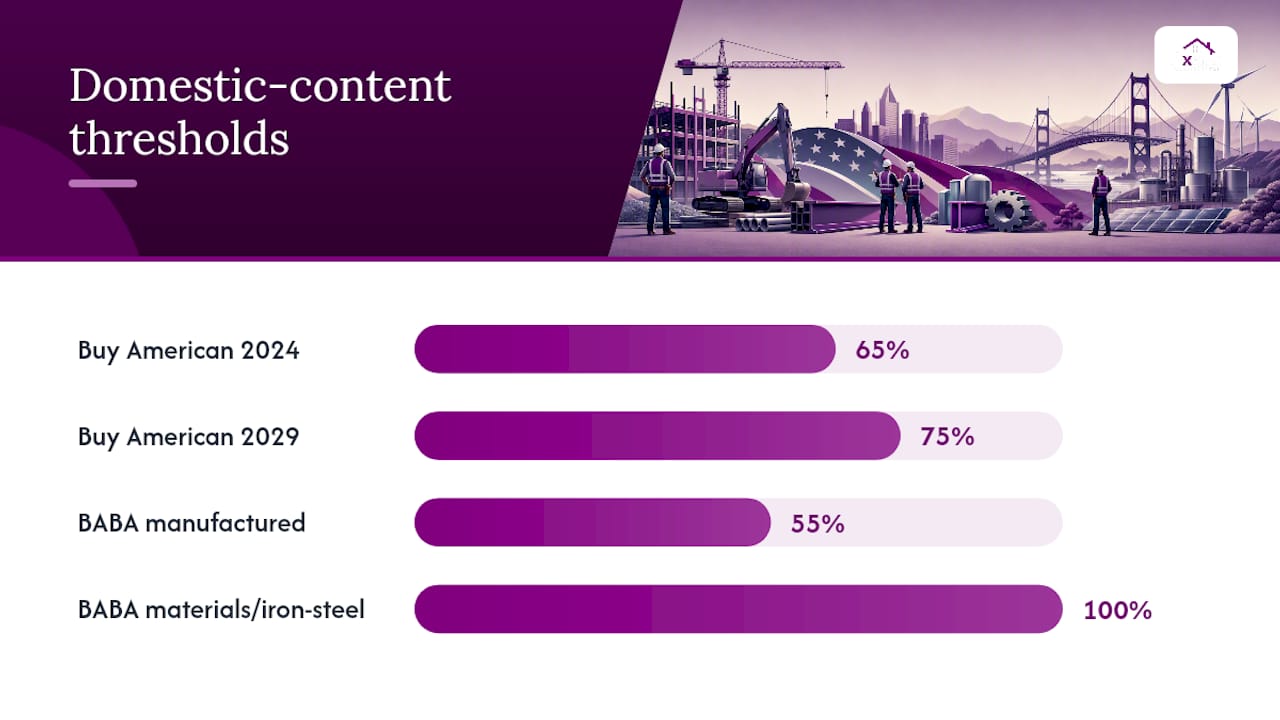
The two statutes use different vocabulary and different math, and mixing them up is where most compliance failures start.
Construction material under both frameworks generally means an article, material, or supply brought to the site that gets incorporated permanently into the structure. Manufactured products are items that have undergone a change in form, function, or characteristics through a manufacturing process. Iron and steel gets its own category because both statutes track it separately from general construction materials, often with stricter production-location rules. Under BABA specifically, section 70917© materials, things like cement, aggregates, and similar bulk materials, are excluded from the construction-material category unless they become part of a manufactured product before arriving on-site, according to guidance published by the Colorado Office of the State Controller.
The threshold math is climbing. Under the Buy American Act, the domestic-content requirement moved from 60% to 65% starting in 2024, with a jump to 75% in 2029, according to FAR Part 25. BABA requires manufactured products to meet a domestic component cost threshold of over half the total cost, most construction materials to be produced entirely in the U.S., and iron/steel items to have all manufacturing processes conducted domestically, as outlined in Commerce Department guidance.
That gap between “55% domestic components” and “100% domestic manufacturing processes.” is where a lot of estimating teams get burned. A manufactured product can source some subcomponents overseas and still qualify under BABA, as long as the domestic content cost calculation clears 55%. Iron and steel gets no such flexibility. Every process, from initial melting to the final coating, has to happen in the United States.
Real classification examples make this clearer:
- A framed window assembly is typically treated as a manufactured product, so the 55% domestic-component cost test applies under BABA.
- Plate glass on its own, before fabrication into a window unit, is usually evaluated as a construction material, which under BABA generally needs to be produced domestically outright.
- PVC pipe used as structural conveyance is a construction material subject to domestic-production rules, while the instrumentation or control components attached to a piping system are often manufactured products evaluated separately under the component-cost test.
This is why a single line item on a submittal log, “water main piping,” can actually hide two or three different compliance tests depending on how the fittings, gaskets, and control valves are categorized. Break down your bill of materials by category before you build your supplier list, not after.
When FAR 52.225-9 Applies: Contractor Obligations And Procedure
If you’re on a direct federal construction contract, FAR 52.225-9 is the clause doing the heavy lifting. It requires you to use domestic construction materials unless you qualify for one of a handful of exceptions, and it spells out exactly how to request one.
The clause’s domestic preference language is straightforward in principle: unless an exception applies, materials incorporated into the work must meet the domestic-content threshold in effect at the time of your contract. The exceptions are where the real work happens, and the most commonly used one is unreasonable cost.
Pro Tip: Don’t wait until a supplier quote comes back high to start your unreasonable-cost analysis. Build the price-comparison framework into your bid stage, so you’re not scrambling for documentation after award while the schedule clock is running.
The unreasonable-cost exception generally applies when the domestic material’s cost significantly exceeds the foreign alternative’s cost, typically by a notable percentage, with contracting officers evaluating cases individually for critical items, per the clause text at Acquisition.gov. A parallel reproduction of the same clause language appears at 48 CFR § 52.225-9, useful if you need to cite exact regulatory wording in a formal request.
A contractor request for an exception needs to include specific, checkable content, not a general assertion that foreign material is cheaper:
| Required element | What it must show |
|---|---|
| Price comparison table | Domestic vs. foreign unit cost, freight, and installed cost side by side |
| Supplier details | Name, location, and manufacturing site for both domestic and foreign sources |
| Delivery timing | Lead times for each option and impact on project schedule |
| Quantities | Exact quantities needed, tied to the specific contract line item |
Once an exception is granted, the process doesn’t end there. The contracting officer typically issues a contract modification documenting the approved substitution, and if the foreign material carries a cost differential, negotiation over adequate consideration, meaning what the government gets in return for approving the more expensive path, or a credit if the foreign option is actually cheaper, happens before the modification is finalized. Keep every version of your price comparison; contracting officers frequently ask for updated numbers if there’s a gap of more than a few weeks between request and approval.
Practical BABA Compliance For Grant-Funded Projects
Build America, Buy America casts a wider net than most contractors expect, and it changes how you plan procurement long before the first material order goes out.
BABA applies whenever federal financial assistance is obligated for an infrastructure project, using what’s often called the purpose, time, and place test: does the funding serve an infrastructure purpose, was it obligated after the law’s effective date, and is it tied to a specific project location. If your funding traces back to a federal grant or loan supporting infrastructure, BABA governs your materials regardless of who technically signs your subcontract.
The toughest part of BABA compliance is the “all manufacturing processes” rule for iron, steel, and most construction materials. OMB’s final guidance tightened this interpretation compared to earlier interim rules, raising the evidentiary bar for factory-location proof. It’s no longer enough to show a supplier’s headquarters address. You need documentation tracing each manufacturing step, melting, forming, coating, finishing, back to a U.S. facility.
That documentation burden reshapes your supplier qualification process:
- Require factory or process-location evidence as part of vendor onboarding, not as an afterthought during submittal review.
- Ask suppliers for cost-of-components worksheets upfront if their products are manufactured goods rather than raw construction materials.
- Build a prequalified domestic-vendor list before bidding begins, since scrambling for compliant suppliers mid-project adds weeks to procurement.
- Update your contract specifications to reference BABA category definitions explicitly, rather than relying on generic “domestic preference” boilerplate left over from BAA-only contract templates.
Procurement timelines feel this immediately. Domestic manufacturers for certain specialty items, particular coated steel products or specific electrical components, sometimes carry longer lead times than their overseas counterparts, and a compliance-driven sourcing switch discovered late in design can push a schedule by months, not days.
A subcontractor selection process built around domestic-content attestations from the outset, something worth formalizing in your qualification paperwork, saves real time compared to chasing documentation after a supplier is already under contract.
Building Your Compliance Documentation And Supplier Qualification File
Good documentation isn’t paperwork for its own sake. It’s the difference between a clean audit and a rip-and-replace order six months into construction.
Here’s the sequence that holds up under scrutiny:
- Collect supplier attestations stating country of origin and, for manufactured products, the domestic component cost percentage.
- Request cost-of-components worksheets from any supplier providing manufactured products, broken down by component and sourced cost.
- Gather bills of lading and mill or test reports for iron and steel items, since these documents often provide the clearest chain of custody back to a domestic mill.
- Build a market survey covering at least two to three domestic sources and the available foreign alternative, formatted as a straightforward price-comparison table if you anticipate an unreasonable-cost claim.
- Write flow-down language into every subcontract requiring the supplier to cooperate with documentation requests and provide evidence on demand, not just at the point of sale.
- Set an RFI or change-order protocol for on-site discoveries, like a shipment arriving with unexpected country-of-origin markings, so field staff know exactly who to notify and how fast.
Pro Tip: Treat your market survey like a living document, not a one-time exhibit. Update it whenever a supplier’s pricing shifts more than a few percentage points, because contracting officers increasingly ask for current numbers rather than accepting a survey from the original bid package.
Record retention matters as much as collection. Keep every attestation, worksheet, and price comparison for the full contract record-retention period, and organize files by contract line item rather than by supplier, so an auditor or contracting officer can trace a single material back to its full documentation chain in minutes, not days. A disciplined closeout documentation process makes this dramatically easier at the back end of a project, when memories fade and staff turn over.
Waivers, Exceptions, And What To Expect
Three grounds justify a waiver under both frameworks: public interest, nonavailability, and unreasonable cost. Public-interest waivers are rare and typically reserved for cases with broader policy implications. Nonavailability waivers apply when a domestic source simply doesn’t exist in sufficient quantity or quality.
Agencies expect a specific evidentiary package: a documented market survey, itemized price comparisons, supplier correspondence showing you actually tried to source domestically, and a clear statement of the quantities and timeline involved. Vague assertions get rejected quickly.
Timing matters more than most contractors plan for. Waiver review can take weeks, and a denial late in the schedule often means rip-and-replace of already-installed material, or an expensive scramble to find a compliant alternative on short notice. Build contingency time into your schedule for any material where you’re pursuing a waiver, and notify your contracting officer the moment you suspect one will be needed, not after the material is already on order.
Published waiver decisions are searchable through the Made in America Office and individual agency BABA waiver pages, which is worth checking before you file, since a similar material may already have a precedent on record.
Enforcement Risks And How To Limit Your Exposure
The consequences for getting this wrong range from administrative to genuinely severe, and contractors sometimes underestimate how far enforcement can reach.
At the contract level, a contracting officer can modify the contract, withhold payment, or in serious cases terminate for default. That’s the mild end. Certifying domestic content inaccurately, whether through carelessness or intent, can trigger False Claims Act exposure, which carries treble damages and significant per-claim penalties. On federally assisted projects under BABA, misrepresentation can also mean funding clawbacks that hit the grant recipient, not just the contractor, which is why prime contractors on BABA projects tend to scrutinize subcontractor certifications closely.
Roughly a 20% cost gap is the commonly cited trigger point for an unreasonable-cost exception under FAR 52.225-9, according to the clause’s own evaluation criteria. Certifications built on anything less defensible invite exactly the kind of scrutiny that leads to False Claims Act referrals.
Operationally, the biggest risk is rip-and-replace: discovering noncompliant material after installation, which means demolition, disposal, re-procurement, and re-installation, often at your own cost.
Practical risk reduction comes down to a few habits:
- Keep contemporaneous documentation, not reconstructed records built after a problem surfaces.
- Notify the contracting officer early whenever sourcing uncertainty arises, rather than hoping it resolves itself.
- Review indemnity and insurance clauses in your construction contracts to understand who bears the cost if a compliance failure is later found upstream in your supply chain.
Why The Buy American Act Exists In The First Place
Congress passed the original Buy American Act in 1933, in the depths of the Great Depression, with a straightforward legislative intent: direct federal purchasing power toward domestic manufacturers to protect American jobs and industrial capacity. The logic was simple. The federal government spends enormous sums on goods and construction, and lawmakers wanted that spending to circulate through the domestic economy rather than leak overseas.
For decades, the law operated with a relatively modest domestic-content bar and applied narrowly to direct federal procurement. What’s changed is the pressure to close loopholes. Contractors found ways to route materials through minimal domestic assembly steps to technically qualify, and the Government Accountability Office has documented enforcement gaps over the years that prompted successive rounds of regulatory tightening.
They reflect a deliberate policy choice to push more of the actual manufacturing supply chain back onto U.S. soil, not just the final assembly step. Understanding that intent matters practically, because it explains why waiver requests built on “we assembled it here” arguments get more scrutiny now than they did a decade ago. Agencies are increasingly looking for evidence tracing the full manufacturing chain, consistent with what Congress and later OMB guidance intended the law to accomplish.
Other Domestic Preference Laws Contractors Should Know
Buy American Act and Build America, Buy America dominate the conversation, but they’re not the only domestic-preference statutes a construction contractor might encounter on a federal or federally assisted job.
The Trade Agreements Act (TAA) applies primarily to federal supply contracts above certain dollar thresholds and takes a different approach entirely. Rather than requiring domestic content, TAA permits products from countries with qualifying trade agreements with the United States, alongside domestic products. It’s a “designated country” test rather than a percentage-of-domestic-content test, and it typically governs different procurement categories than construction materials, though contractors on mixed-scope contracts sometimes see both TAA and BAA clauses in the same solicitation.
The American Iron and Steel (AIS) provisions apply specifically to certain EPA-funded water infrastructure projects and require that iron and steel products used in the project be produced in the United States, with a scope and waiver process that runs parallel to, but separate from, BABA.
The Berry Amendment is narrower still, applying mainly to Department of Defense procurement of textiles, food, and certain specialty items, and it’s worth knowing about mainly so you don’t confuse it with construction-material rules when a project touches defense infrastructure.
The practical takeaway: read every domestic-preference clause in your contract individually. Contracts increasingly stack multiple statutes, and assuming “Buy American” language covers everything can mean missing a TAA or AIS requirement buried in a different section of the same solicitation.
Recent Policy Shifts Contractors Need To Track
BABA implementation has moved fast since its statutory enactment, and the guidance has tightened at nearly every step rather than loosened.
OMB’s final guidance clarified definitions that earlier interim guidance left ambiguous, most notably the “all manufacturing processes” standard for iron, steel, and construction materials. That single clarification raised the documentation bar across the industry, pushing contractors to collect factory-level process evidence rather than relying on a supplier’s general domestic-manufacturing claim.
Individual agencies have also issued their own BABA implementation guidance and waiver frameworks tailored to their specific grant programs, meaning a contractor working across multiple federally assisted programs, say, a Department of Transportation grant and an EPA water infrastructure grant, may find the waiver process and documentation expectations differ slightly between them even though both trace back to the same underlying statute.
Contractors who built their compliance programs around the earlier, looser interim guidance are the ones most likely to find themselves out of step now. The practical response is to treat your BABA and BAA compliance documentation as something to revisit at least annually, not something you set up once at contract award and file away.
Common Compliance Challenges And How To Manage Them
The single most common failure point isn’t fraud. It’s confusion between statutes, exactly the funding-source mix-up covered earlier, compounded by supply-chain visibility gaps that most contractors simply don’t have built into their normal procurement process.
Most general contractors are used to qualifying suppliers on price, capacity, and schedule reliability. Domestic-content verification adds a fourth qualification axis that requires different documentation, and subcontractors several tiers down the supply chain often don’t have that documentation readily available, or don’t understand why a prime contractor is suddenly asking for a cost-of-components worksheet on a routine material order.
The best practice that consistently works is pushing compliance requirements upstream, into subcontract and purchase order language, before the first order is placed rather than retrofitting requirements after a shipment arrives. Pair that with a designated compliance point of contact on larger projects, someone who owns the documentation file and fields supplier questions, rather than leaving it scattered across procurement, project management, and field staff.
Scheduling is the other recurring friction point. Domestic sourcing sometimes means longer lead times, and project schedules built around the fastest available material, regardless of origin, run into trouble when a compliant alternative takes six extra weeks to arrive. Building domestic-content verification into your 30/60/90 design review checkpoints, rather than discovering the issue during procurement, is what separates projects that stay on schedule from ones that don’t.
Who Enforces Buy American Rules On Construction Contracts
Enforcement authority isn’t concentrated in one office. It’s distributed across the agencies actually funding and administering the work.
The contracting officer on a direct federal procurement contract is the primary enforcement point for FAR 52.225-9, reviewing waiver requests, approving or rejecting price-comparison submissions, and issuing contract modifications when exceptions are granted.
On BABA-covered projects, the federal awarding agency, whether that’s the Department of Transportation, EPA, or another agency distributing infrastructure funding, sets category-specific waiver processes and reviews grant recipient compliance, often through the recipient’s own procurement and monitoring staff rather than direct federal oversight of every purchase order.
The Made in America Office, housed within the Office of Management and Budget, plays a coordinating role, publishing guidance, tracking agency-issued waivers, and pushing for consistency across agencies implementing BABA differently. It doesn’t typically enforce individual contracts directly, but its guidance shapes how every other enforcing body interprets the rules.
Grant recipients themselves, often state or local government agencies passing federal infrastructure dollars through to contractors, carry their own monitoring responsibility and are frequently the ones actually reviewing contractor documentation day to day, since they’re accountable to the federal awarding agency for the funds they’ve received. That layered structure means a contractor’s most frequent point of contact for compliance questions is often a state or local grant administrator, not a federal official, even though the underlying rule is BABA.
Compliance Outcomes: What Separates Success From Failure
The clearest pattern separating smooth Buy American compliance from painful compliance failures isn’t the complexity of the material list. It’s when the domestic-content analysis happens relative to procurement.
Projects that succeed tend to run domestic-content classification during design development, categorizing major material lines by BAA or BABA category before specifications go out to bid. That timing gives estimators and subcontractors a chance to build compliant sourcing into their pricing from the start, rather than discovering a mismatch after a purchase order is already cut.
Projects that struggle tend to share a common thread: domestic-content verification treated as a closeout-phase paperwork exercise rather than a procurement-phase sourcing decision.
The lesson generalizes cleanly: domestic-content compliance is fundamentally a procurement-timing problem, not a paperwork problem. Contractors who treat it that way, building classification and supplier vetting into the schedule from the earliest design milestones, consistently avoid the expensive surprises that show up when it’s treated as an afterthought.
An Editorial Take On Where Contractors Actually Get This Wrong
Most compliance guides treat the Buy American Act and BABA as a legal puzzle to solve once, at contract signing, and then file away. That framing is backwards, and it’s the root of most compliance failures on construction projects.
The rules don’t stay still. Treating domestic-content compliance as a one-time checklist item at award, rather than a live procurement variable you revisit at every major schedule milestone, is exactly how contractors end up staring at a rip-and-replace order they never saw coming.
The second underestimated point is how much of this is a documentation discipline problem, not a legal one. Contractors rarely lose a compliance fight because they misunderstood the statute. They lose because the paper trail wasn’t built in real time, supplier attestations were verbal, cost-of-components worksheets never got collected, and by the time a contracting officer asked for proof, nobody could reconstruct it convincingly. The contractors who handle this well aren’t necessarily the ones with the deepest legal knowledge. They’re the ones who built documentation habits into ordinary procurement workflow, the same way they’d track submittals or change orders, rather than treating it as a specialty compliance function bolted onto the side.
That’s a workflow and project-management challenge as much as a regulatory one, and it rewards contractors who already run disciplined procurement and subcontractor qualification processes for other reasons.
— Arienne
How Axenia Construction Approaches Buy American Compliance
Axenia Construction is a women-owned, licensed general contractor serving Maryland, DC, and Northern Virginia, and government contracting is a core part of how the firm supports public-sector clients. Compliance with domestic-sourcing rules starts the same way it should on any federal or federally assisted job: verifying the funding source and governing clause before procurement decisions get made, then building supplier qualification and documentation requirements into the project from day one rather than retrofitting them later.
Let Axenia Construction Handle Your Compliance Documentation
Chasing down supplier attestations, cost-of-components worksheets, and price-comparison tables while also running a construction schedule is exactly the kind of split focus that leads to compliance gaps. Axenia Construction is a local alternative to managing this alone: as a women-owned general contractor already working government and federally assisted projects across Maryland, DC, and Northern Virginia, the documentation and procurement discipline this article describes is built into how projects get run, not bolted on after a compliance question surfaces.
If you’re planning a federal or federally assisted construction project and want a contractor who treats domestic-sourcing verification as part of standard procurement rather than an afterthought, reach out through Axenia Construction’s government contracting services page to start a compliance-focused project conversation.
Sources
- Acquisition
- Build America Buy America (U.S. Department of Commerce)
- OMB final guidance — Build America, Buy America (White House / Made in America Office)
- Buy American vs. Build America, Buy America (National Precast Concrete Association)
- The Buy American Act (GAO)
FAQ
Does the Buy American Act still exist?
Yes. The Buy American Act remains active law governing direct federal procurement, and its domestic-content threshold is currently on a rising schedule toward 75% by 2029, per FAR Part 25.
What qualifies for the Buy American Act?
Construction materials, iron and steel, and manufactured products incorporated into a direct federal construction contract qualify as domestic when they meet the applicable content threshold, with iron and steel typically held to a stricter domestic-manufacturing standard than general construction materials.
What is the Build America, Buy America Act?
BABA is a separate statute governing federal financial assistance for infrastructure projects, requiring iron and steel to be manufactured entirely in the U.S., manufactured products to clear a 55% domestic-component cost test, and most construction materials to be produced domestically, according to Commerce Department guidance.
Can a contractor get a waiver from Buy American or BABA rules?
Yes, on grounds of public interest, nonavailability, or unreasonable cost, though agencies require detailed market-survey and price-comparison documentation before approving one, and denials can arrive late enough in a schedule to force rip-and-replace decisions.