
If you’re searching for probuildandren.com alternatives, here’s the short answer: Buildertrend leads for residential GCs, Fieldwire wins on jobsite mobile use, JobTread offers the clearest pricing for small teams, and Oracle Primavera handles enterprise-scale commercial portfolios. Professional Building & Renovations, LLC is a Bowie, MD remodeling firm — not a software platform — so contractors searching for comparable providers are really looking for either a similar full-service contractor or a project-management tool that matches their workflow.
TL;DR — Top picks at a glance:
- Buildertrend — Best for residential GCs managing multiple active projects with client-facing portals
- Fieldwire — Best for field crews and subcontractors who need reliable offline mobile access
- JobTread — Best for small-to-mid GCs who want transparent pricing and fast onboarding
- CoConstruct — Best for custom home builders and remodelers already using Buildertrend’s ecosystem
- Projul — Best for estimating-first workflows with built-in proposal tools
- Oracle Primavera — Best for large commercial GCs and enterprise portfolio management
The Associated General Contractors of America consistently highlights that verified user reviews on platforms like G2 and Capterra are among the most reliable signals when evaluating construction software. We’ll pull from both throughout this article.
Table of Contents
- Why contractors look for alternatives to probuildandren.com
- The best probuildandren.com alternatives compared side by side
- How to choose the right alternative and plan your migration
- What does construction software actually cost you?
- Core features every contractor should prioritize
- When hiring a general contractor beats buying software
- Key Takeaways
- What most contractors get wrong when choosing software
- Axeniaconstruction: when a managed GC is the better call
- Useful sources
Why contractors look for alternatives to probuildandren.com
Most contractors who land on this search aren’t unhappy with a software subscription. They’re looking for a service provider comparable to Professional Building & Renovations — or they’ve outgrown a tool and need something that actually fits how their crews work. Either way, the underlying frustration is the same: the current option doesn’t match the job.
The most common reasons construction teams switch platforms or seek new providers include:
- Pricing surprises. Many platforms advertise a base rate but charge separately for estimating modules, API access, or premium support. A 5-person team can easily pay two to three times the listed price once add-ons stack up.
- Missing RFI and submittal workflows. Residential tools often skip formal RFI tracking, which becomes a liability on commercial or government projects.
- Poor offline mobile performance. Foremen working in basements, rural sites, or steel-framed buildings need apps that function without a signal. Many platforms fail this test.
- Weak accounting integrations. If your platform doesn’t sync cleanly with QuickBooks, Sage, or Xero, your bookkeeper is doing double entry every week.
- No real onboarding support. A platform that drops you into a help center after signup costs more in lost productivity than the subscription saves.
- Scaling limits. A tool built for a 3-person residential crew breaks down when you’re running 15 concurrent commercial projects.
Local reputation and verified user feedback significantly influence buyer choice for construction services — and that same demand for transparency is now driving contractors to prioritize software with published pricing and clear migration support.
Contractors who recognize two or more of these pain points in their current setup are the right audience for the comparison below.
The best probuildandren.com alternatives compared side by side
Comparison table
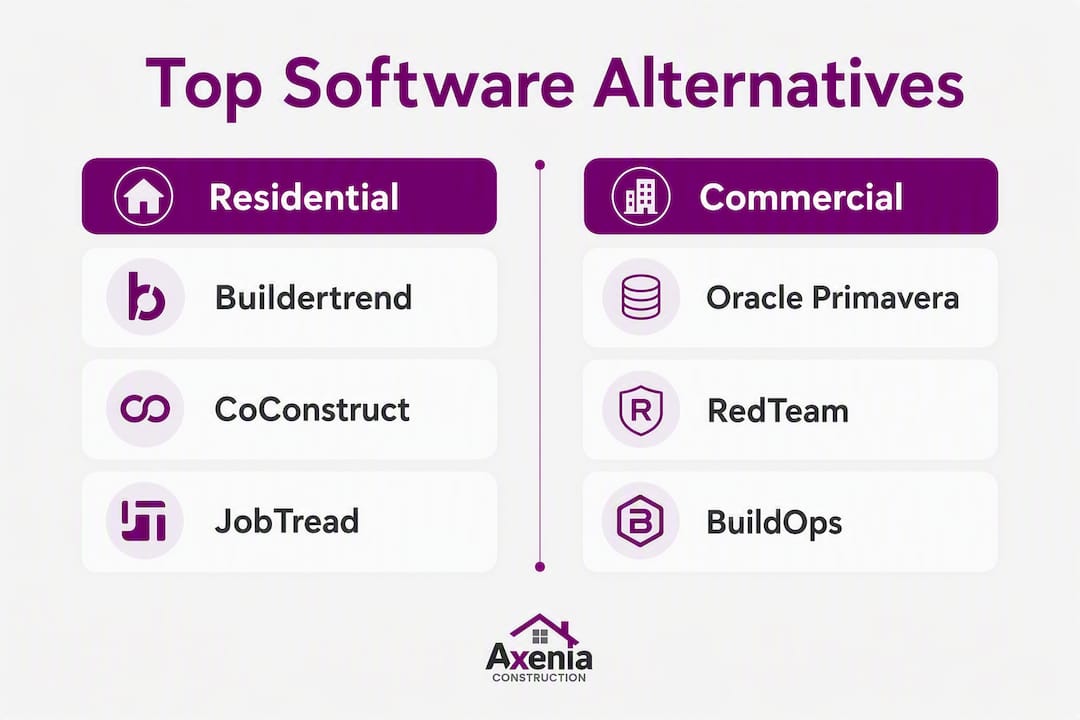
| Tool | Best For | Key Features | Pricing Model | Ease of Use | Integrations | Scalability |
|---|---|---|---|---|---|---|
| Buildertrend | Residential GCs, multi-project | Scheduling, budgets, change orders, client portal, RFIs | Tiered subscription | Moderate onboarding | QuickBooks, Xero, Gusto | High |
| CoConstruct | Custom home builders, remodelers | Budgeting, selections, client communication | Per-project or subscription | Moderate | QuickBooks | Medium |
| Fieldwire | Field crews, subcontractors | Task management, plans, punch lists, offline mobile | Per-user subscription | Low learning curve | Procore, Autodesk | Medium–High |
| Projul | Estimating-first small GCs | Proposals, scheduling, job costing | Tiered subscription | Fast onboarding | QuickBooks | Medium |
| JobTread | Small-to-mid GCs | Budgeting, change orders, scheduling, client portal | Flat monthly tiers | Very fast onboarding | QuickBooks, Stripe | Medium |
| Houzz Pro | Residential designers, remodelers | Lead management, mood boards, estimates, 3D floor plans | Tiered subscription | Easy | Limited | Low–Medium |
| Oracle Primavera | Enterprise commercial GCs | CPM scheduling, risk analysis, portfolio management | Enterprise licensing | High complexity | SAP, Oracle ERP | Very High |
| RedTeam | Mid-market commercial GCs | Preconstruction, RFIs, submittals, daily reports | Per-user subscription | Moderate | QuickBooks, Sage | High |
| BuildOps | Commercial specialty subcontractors | Dispatch, work orders, service agreements, mobile | Enterprise subscription | Moderate | QuickBooks, Sage | High |
Mini-reviews: what each platform actually does well
Buildertrend
Buildertrend is a widely adopted platform among residential general contractors in the U.S., and for good reason. It covers the full project lifecycle — from pre-sale proposals through final punch list — with a client-facing portal that keeps homeowners informed without requiring phone calls. The scheduling module ties directly to budget line items, so a delayed framing crew automatically flags a cost variance.
Best for: Residential GCs running three or more active projects simultaneously.
Limitation: The learning curve is real. Most teams require several weeks before crews use it consistently, and the mobile app has historically drawn complaints about speed on older Android devices.
- Pros: Strong client communication tools, deep QuickBooks integration, large user community
- Cons: Higher price point at scale, some features locked behind upper tiers, onboarding takes time
CoConstruct
CoConstruct was built specifically for custom home builders and high-end remodelers, and that focus shows in its selections and allowances module. Clients can log in, review finish options, and approve selections directly in the platform, which cuts down on the email chains that derail timelines. Capterra reviews for similar platforms consistently flag client communication as a top decision factor for residential teams.

Best for: Custom builders and remodelers who want clients deeply involved in the process.
Limitation: CoConstruct merged into the Buildertrend ecosystem, so its long-term standalone roadmap is less certain. Teams evaluating it should ask vendors directly about feature parity and migration paths.
- Pros: Best-in-class selections workflow, strong budget-to-actual tracking, client-friendly interface
- Cons: Ecosystem consolidation creates uncertainty, limited commercial project support, fewer third-party integrations than competitors
Fieldwire
Fieldwire earns its reputation on the jobsite, not in the back office. Its plan management and task assignment tools are fast, intuitive, and — critically — work offline. A foreman can mark up drawings, assign punch list items, and log daily reports without a cell signal, then sync everything when connectivity returns. G2 reviews for field-focused tools consistently highlight offline reliability as the single most important mobile feature for trade contractors.

Best for: Subcontractors, specialty trades, and field superintendents on commercial sites.
Limitation: Fieldwire is a field execution tool, not a full project-management suite. You’ll still need a separate platform for budgeting, change orders, and owner billing.
- Pros: Excellent offline mobile performance, fast plan uploads, strong punch list workflow
- Cons: No native budgeting or cost control, limited preconstruction features, requires pairing with a financial platform
Projul
Projul positions itself as an estimating-first platform, which makes it a natural fit for contractors who win work on proposal quality. The built-in proposal builder generates professional client-facing documents from the same line items used for internal job costing, eliminating the double-entry problem most small GCs live with. G2 product data for Projul shows consistent praise for its onboarding speed.
Best for: Small GCs and specialty contractors whose sales process depends on fast, polished estimates.
Limitation: Projul’s scheduling module is functional but not as deep as Buildertrend’s. Teams running complex multi-phase projects may find it limiting.
- Pros: Fast proposal-to-contract workflow, clean UI, quick onboarding
- Cons: Scheduling depth lags behind larger platforms, fewer integrations, limited enterprise scalability
JobTread
JobTread stands out for one reason most contractors appreciate immediately: transparent, published pricing with no hidden tiers. The platform covers budgeting, change orders, scheduling, and client communication in a single interface that most teams can learn in a week. For a 5–10 person residential or light commercial GC, it delivers most of what Buildertrend offers at a lower total cost.
Best for: Small-to-mid GCs who want a full-featured platform without enterprise pricing.
Limitation: JobTread’s reporting depth and portfolio-level dashboards are limited compared to mid-market platforms. Growing firms may outgrow it within a few years.
- Pros: Transparent pricing, fast onboarding, strong budgeting and change-order tools
- Cons: Limited advanced reporting, smaller integration library, less suited for 20+ person teams
Houzz Pro
Houzz Pro is a different kind of tool. It combines lead generation, client communication, mood boards, 3D floor plans, and basic project management in one subscription — making it genuinely useful for design-build remodelers and interior-focused contractors who need to win clients as much as manage projects. The lead generation component alone can justify the cost for firms that rely on Houzz’s consumer marketplace.
Best for: Residential remodelers and design-build contractors who want marketing and project tools in one platform.
Limitation: Houzz Pro is not a construction management platform. Change orders, RFIs, and subcontractor coordination are thin. It works best as a client-acquisition and communication layer, not as a jobsite operations hub.
- Pros: Built-in lead generation, strong visual tools, easy client communication
- Cons: Weak construction-specific features, limited integrations, not suited for commercial work
Oracle Primavera
Oracle Primavera P6 is the industry standard for enterprise-scale project scheduling and portfolio management. Large commercial GCs, infrastructure firms, and government contractors use it to manage multi-year programs with hundreds of interdependent activities. Its critical path method (CPM) scheduling and risk analysis tools have no real peer at the enterprise level.
Best for: Large commercial GCs, ENR-ranked contractors, and government project managers handling complex multi-phase programs.
Limitation: Primavera is expensive, complex, and requires dedicated training. A small or mid-size GC will spend more on implementation and licensing than the platform saves in efficiency.
- Pros: Unmatched scheduling depth, strong risk analysis, integrates with Oracle and SAP ERP systems
- Cons: High cost, steep learning curve, overkill for projects under $10M
RedTeam
RedTeam targets mid-market commercial GCs who need preconstruction, RFI, and submittal workflows without the enterprise price tag of Primavera or similar platforms. Its daily reporting and document control tools are well-regarded among commercial project managers, and it integrates with QuickBooks and Sage for accounting sync.
Best for: Mid-market commercial GCs managing projects in the $2M–$50M range.
Limitation: RedTeam’s mobile app has received mixed reviews, and its UI feels dated compared to newer entrants. Teams that prioritize mobile-first workflows may find it frustrating.
- Pros: Strong RFI and submittal tracking, solid document control, good accounting integrations
- Cons: Mobile experience lags behind competitors, UI needs modernization, limited residential applicability
BuildOps
BuildOps is purpose-built for commercial specialty subcontractors — mechanical, electrical, plumbing, and HVAC firms — who need dispatch, work order management, and service agreement tracking alongside project execution. Most general project-management platforms treat subcontractor operations as an afterthought. BuildOps does not.
Best for: Commercial specialty subcontractors (MEP, HVAC, fire protection) managing both project and service work.
Limitation: BuildOps is not a GC platform. General contractors managing multi-trade projects will find it too narrow. Pricing is enterprise-tier and requires a vendor conversation.
- Pros: Best-in-class dispatch and service management, strong mobile app, built for specialty trade workflows
- Cons: Not suitable for GCs, enterprise pricing, limited preconstruction tools
Pro Tip: Before committing to any platform, run a two-week pilot using a real active project — not a demo dataset. Score each tool on five axes: schedule reliability, real-time cost visibility, change-order speed, offline mobile performance, and accounting sync. Those five dimensions reveal fit faster than any sales demo.
How to choose the right alternative and plan your migration
Decision checklist: what to score before you sign
- Define your must-have features first. List the five workflows your team runs every day (scheduling, change orders, RFIs, mobile reporting, billing). Any platform missing two or more of these is a non-starter regardless of price.
- Set a cost ceiling. Include subscription fees, implementation costs, and the internal labor hours your team will spend on training. A $200/month platform that requires 80 hours of onboarding costs more than a $400/month platform with white-glove setup.
- Map your integrations. Confirm the platform connects natively to your accounting software (QuickBooks, Sage, or Xero), your estimating tool, and any payroll system you use. API-only integrations add maintenance overhead.
- Assess your team’s change tolerance. A crew that resists new tools needs a platform with a low learning curve and strong in-app guidance. Forcing a complex platform on a resistant team is a reliable way to end up back on spreadsheets.
- Verify mobile offline behavior. Ask vendors to demonstrate offline mode on a device without a signal. Not a demo environment — a real device with airplane mode on.
- Check support tiers. Confirm whether live phone support is included or costs extra. For a 10-person team mid-project, a 48-hour email SLA is not acceptable.
Questions to ask during vendor demos
- What file formats do you accept for data import (CSV, Excel, XML, native export from [current tool])?
- Is API access included in our tier, or is it a paid add-on?
- What is your support SLA for critical issues during business hours?
- How does the mobile app behave when a device loses connectivity mid-task?
- Is there a limit on active projects or storage at our subscription level?
- What does a typical onboarding timeline look like for a team our size?
Migration timeline by team size
- Weeks 1–2: Audit your current data. Export project files, contact lists, budget templates, and document libraries. Clean duplicates before importing — garbage in, garbage out.
- Weeks 3–4: Configure the new platform. Set up user roles, permission levels, and project templates. Run a parallel pilot on one active project while keeping the old system live.
- Weeks 5–6: Train your crew. Prioritize the five daily workflows identified in your checklist. Record short screen-capture walkthroughs for field staff who miss live training.
- Week 7–8 (small teams, under 10 users): Full cutover. Archive the old system but keep read-only access for 90 days.
- Weeks 7–12 (larger teams, 10–30 users): Staggered rollout by project type or division. Full cutover after all active projects have been migrated.
Pro Tip: Freeze your billing cycle on the old platform the day you start the pilot, not the day you complete the cutover. Most vendors allow a 30-day overlap — use it. The cost of running two systems for a month is far less than losing project data mid-migration.
Migration is often the real barrier to switching software. Teams that budget time for a pilot project, data cleanup, and hands-on crew training reduce long-term churn and avoid the costly “we switched back” scenario.
What does construction software actually cost you?
Common pricing models and where they fit
Construction project-management platforms use four main pricing structures:
- Per-user monthly license (Fieldwire, RedTeam, BuildOps): Cost scales with headcount. Works well for specialty subs with stable team sizes; gets expensive fast for GCs with large field crews.
- Tiered subscription (Buildertrend, Projul, Houzz Pro): Fixed monthly fee unlocks a feature set. Lower tiers often exclude estimating, API access, or advanced reporting. Read the tier matrix carefully.
- Per-project pricing (CoConstruct legacy model): You pay per active project rather than per user. Economical for firms running fewer than five concurrent projects; costly for high-volume residential builders.
- Enterprise seat-based licensing (Oracle Primavera, BuildOps): Annual contracts negotiated directly with the vendor. Pricing is not publicly listed; budget for a multi-month procurement process.
Illustrative cost comparison: 5-person residential team vs. 30-person commercial GC
Note: The figures below are illustrative examples based on published pricing ranges and typical market structures. Verify current pricing directly with each vendor.
| Cost Component | 5-Person Residential Team | 30-Person Commercial GC |
|---|---|---|
| Platform subscription (annual) | Varies by vendor and package; small teams can expect several thousand dollars per year | Larger teams should budget for significantly higher costs, often in the tens of thousands per year |
| Data migration (one-time) | Can range from a few hundred to several thousand dollars depending on data complexity | Expect higher migration costs if consolidating many users or legacy systems |
| Internal training labor (hours × rate) | Typically 40–80 hours of staff time for small teams; larger firms with more users should anticipate 2–3x that | For a 30-person GC, training labor may total hundreds of hours |
| Lost productivity during cutover | Most teams experience reduced productivity for 1–3 weeks | Larger organizations often see broader productivity dips, especially during phased rollout |
| Estimated Year-1 Total Cost | For a 5-person team, Year-1 total is usually 2–3x the headline subscription price | For a 30-person GC, Year-1 costs may approach or exceed six figures, depending on complexity |
The gap between headline subscription price and real Year-1 cost surprises most teams. A $299/month platform costs $3,588 in subscription fees — but the training, migration, and productivity dip often triple that figure in Year 1.
Hidden costs to watch for
- Premium integrations. Some platforms charge separately for QuickBooks sync, Sage connector, or Procore bridge. Confirm what’s included before signing.
- API access. If your team uses custom reporting or connects to a CRM, API access is often a paid add-on at mid-tier pricing.
- Custom reports. Standard dashboards rarely match how your PM team tracks job cost. Custom report builders are frequently locked behind enterprise tiers.
- Support upgrades. Basic plans often include email-only support. Phone and dedicated CSM support can add $200–$500/month per the vendor’s published add-on pricing.
Pro Tip: Ask every vendor for a “total cost of ownership” worksheet before signing. Any vendor who can’t produce one in 48 hours is signaling that their pricing is designed to obscure, not inform.
Core features every contractor should prioritize
Not every feature in a platform’s marketing deck matters equally on a real jobsite. Here’s how to separate must-haves from nice-to-haves.
Must-have features
- Scheduling with dependency logic. Tasks that automatically shift when a predecessor slips. Without this, your schedule is a static document, not a live plan.
- Budgeting and cost-to-complete tracking. Real-time visibility into committed costs, actual spend, and projected final cost. This is the single feature that prevents budget overruns from becoming surprises.
- Change order management. A formal workflow that captures scope changes, gets owner approval, and updates the budget automatically. Verbal change orders are how contractors lose money.
- RFIs and submittals. Required for any commercial or government project. Platforms without these force you to manage RFIs in email, which creates document control gaps.
- Mobile app with offline support. Field crews work where Wi-Fi doesn’t. If the app fails without a signal, it won’t get used.
- Document control. Version-controlled drawing sets, spec sheets, and contracts. One outdated drawing set on a jobsite can cost more than a year’s software subscription.
Nice-to-have features
- Estimating and takeoff tools. Valuable if your estimating process is currently spreadsheet-based, but not a dealbreaker if you use a dedicated estimating tool like Bluebeam Revu or PlanSwift.
- Payroll and accounting integrations. Useful, but most teams can tolerate a weekly manual sync if the core platform is strong.
- BIM/CAD integration. Relevant for commercial GCs working with design teams using Autodesk Revit or AutoCAD. Less critical for residential remodelers.
- Client-facing portal. A strong differentiator for client satisfaction, but not operationally critical for subcontractors or trade-only firms.
Support and device compatibility
Confirm that the platform supports both iOS and Android before committing. Web-based access matters for PMs working from laptops in the office. Ask whether the vendor offers live onboarding calls, a dedicated implementation specialist, or only self-serve help documentation. For teams of 10 or more, live onboarding support typically cuts time-to-productivity by several weeks.
When hiring a general contractor beats buying software
Software solves a coordination problem. A general contractor solves a delivery problem. Those are not the same thing, and conflating them is one of the most common and costly mistakes owners and small contractors make.
Scenarios where a GC removes more overhead than software adds
- Single large project. If you’re managing one kitchen remodel, one commercial tenant buildout, or one government renovation, the overhead of selecting, implementing, and learning a PM platform exceeds the value it delivers. A licensed GC absorbs that overhead as part of their service.
- Complex multi-trade remodels. Projects involving structural work, MEP coordination, permitting, and finish selections require a level of trade sequencing that software assists but does not replace. An experienced GC brings the subcontractor relationships and field judgment that no dashboard can replicate.
- Owners without construction experience. Homeowners and commercial tenants who want a finished result, not a project-management education, are better served by full-service delivery than by a software subscription they’ll use once.
- Government and commercial contracts. Projects with formal procurement requirements, certified payroll, and compliance documentation benefit from a GC who already has those systems in place. Understanding commercial construction contract types — lump sum, cost-plus, GMP — is itself a specialized skill that most owners don’t have time to develop.
Decision framework: software vs. GC
| Scenario | Software Makes Sense | Hire a GC Instead |
|---|---|---|
| Portfolio of 5+ recurring projects | ✓ | |
| Single complex remodel or buildout | ✓ | |
| In-house PM team with construction experience | ✓ | |
| Owner with no construction background | ✓ | |
| Multi-trade coordination required | ✓ | |
| Ongoing service/maintenance work | ✓ | |
| Government or compliance-heavy project | ✓ |
For owners weighing a residential renovation, the math is usually straightforward: a GC’s project management fee is offset by the mistakes, delays, and subcontractor coordination costs that a first-time owner would otherwise absorb. Value-driving upgrades — kitchens, baths, additions — tend to deliver stronger returns when executed by an experienced team rather than self-managed through software.
The real cost of self-managing a complex remodel isn’t the software subscription. It’s the three weeks of schedule slippage, the change order you didn’t document, and the subcontractor who walked off because no one was coordinating sequencing.
Pro Tip: If your project involves more than three trades, a permit, and a budget over $75,000, get a GC quote before you buy a software subscription. The comparison will clarify your decision faster than any feature matrix.
Key Takeaways
The best alternative to probuildandren.com depends on whether you need a software platform or a full-service general contractor — and most contractors benefit from being honest about which problem they’re actually trying to solve.
| Point | Details |
|---|---|
| Match tool to team size | Buildertrend and JobTread fit small-to-mid GCs; Oracle Primavera suits enterprise commercial teams. |
| Score five daily workflows | Evaluate scheduling, cost visibility, change orders, offline mobile, and accounting sync before signing. |
| Budget for Year-1 total cost | Training, migration, and productivity loss often triple the headline subscription price in Year 1. |
| Pilot before full cutover | Run a two-week pilot on a real project and freeze the old system’s billing during the overlap period. |
| Axeniaconstruction as an alternative | For single complex projects or owners without construction experience, Axeniaconstruction’s general contracting services remove the software overhead entirely. |
What most contractors get wrong when choosing software
The conventional wisdom in construction tech says: pick the platform with the most features, get everyone trained, and the efficiency gains follow. That framing is wrong in a specific and expensive way.
Most platforms are evaluated on what they can do in a demo. Demos are optimized environments — clean data, fast connections, a sales engineer who knows every shortcut. The real test is what happens on week three, when a foreman is trying to log a daily report from a basement with no signal, or when your bookkeeper discovers that the QuickBooks sync doesn’t handle retention correctly.
The teams that switch platforms successfully share one habit: they define their five non-negotiable daily workflows before they ever open a demo. Not the features they wish they had. The ones they use every single day. Then they test those five workflows under realistic conditions — real data, real devices, real connectivity constraints.
The other thing most contractors underestimate is training time. Not the initial onboarding session, but the ongoing reinforcement that gets field crews to actually use the system consistently. A platform adopted by the PM but ignored by the field is worse than a spreadsheet, because it creates a false sense of control. Budget three to four weeks of active reinforcement, not one training day.
Software is a real investment when it fits. When it doesn’t, it’s an expensive distraction from the work that actually builds the business.
Axeniaconstruction: when a managed GC is the better call
Not every contractor or owner needs to buy and operate project-management software. For homeowners planning a kitchen remodel, commercial tenants fitting out a new space, or government clients managing a single renovation contract, the smarter path is often a licensed general contractor who brings the project management, trade coordination, and compliance expertise as part of the engagement.
Axeniaconstruction is a licensed, women-owned general contractor based in Rockville, MD, serving residential, commercial, and government clients across the DC/MD/VA region. Our services cover design-build delivery, residential renovation, commercial construction, tenant buildouts, and government contracting — the full scope of what a software platform helps you coordinate, handled by an experienced team instead.
For owners and contractors who’ve looked at the software options and decided the implementation overhead isn’t worth it for their current project, we’re the practical alternative. You get transparent communication, a single point of accountability, and a team that has managed the exact project types you’re evaluating — from Alexandria, VA home renovations to commercial buildouts requiring certified payroll and formal procurement.
Contact Axeniaconstruction to discuss your project and get a consultation. No software subscription required.
Useful sources
- Professional Building & Renovations, LLC — GuildQuality profile
- Top 8 Builders in Bowie — Seolium local survey
- Top 15 Contractors in Bowie — Seolium local survey
- Axeniaconstruction Services page
- What Is Residential Renovation? A Homeowner’s Guide — Axeniaconstruction
- Best Home Renovations to Increase Property Value in 2026 — Axeniaconstruction
- Types of Commercial Construction Contracts: 2026 Guide — Axeniaconstruction
- Home Renovation in Alexandria, VA — Axeniaconstruction
- JobTread — Capterra reviews
- Projul — G2 product page
- Fieldwire field tools — G2 user reviews